All How to Conduct a Code Quality Audit to Future-Proof Your Software
Updated:July 27, 202615 min read


If you want your software system to remain reliable and scalable over time, a code quality audit should be a priority.
Why does code quality matter so much? Because poor code silently drains resources and can ultimately jeopardize an entire project.
Consider the numbers:
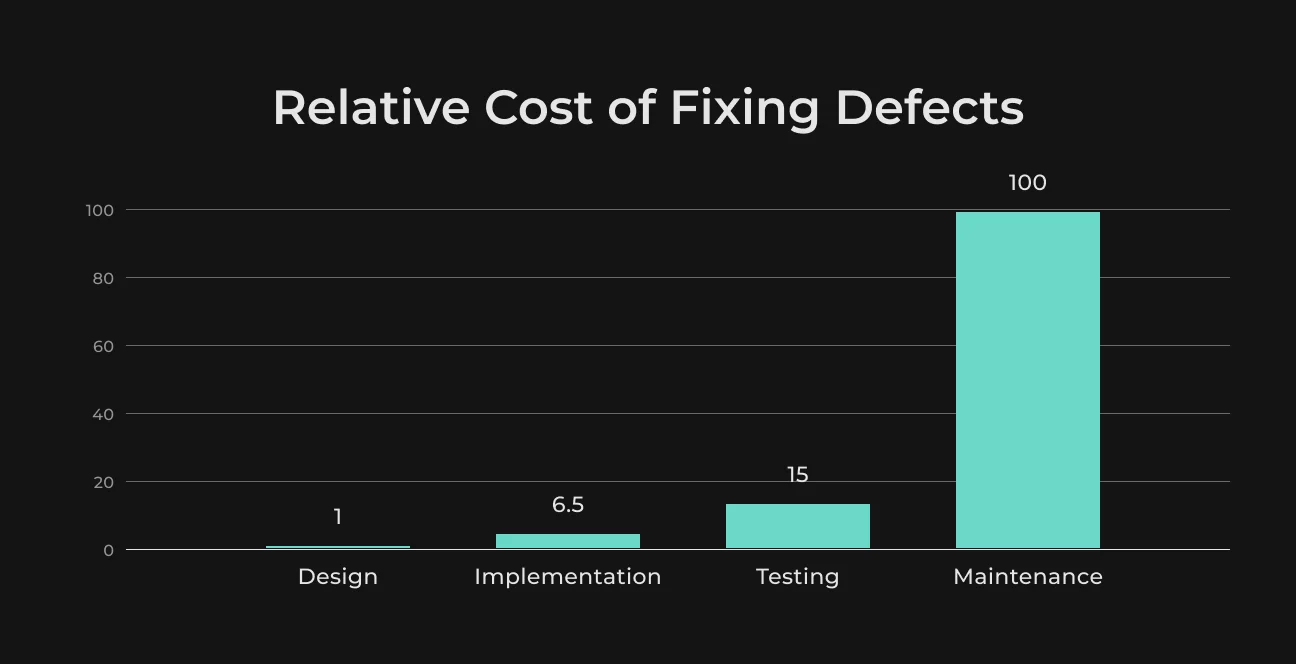
- Fixing errors during testing costs 15 times more than resolving them during implementation;
- During maintenance, fixes can become up to 100 times more expensive;
- Around 40% of organizations spend over $1 million annually due to poor software quality;
- In the US, 45% of companies lose more than $5 million per year because of bad code.
Your business does not have to be part of that statistic.
SapientPro’s technical experts explain how to ensure the quality of your code effectively.
What Is a Code Quality Audit?
A code quality audit is a structured evaluation of your software to ensure it meets defined standards for security, maintainability, performance, and compliance.
The review typically covers the entire development lifecycle with initial design concepts, testing, and deployment. The final goal is to identify risks, inefficiencies, or deviations from best practices.
A code audit typically:
- Verifies compliance with regulations and internal standards;
- Identifies defects and architectural weaknesses;
- Improves development processes;
- Detects risks early to prevent costly failures.
Here are two ways you can run a code audit:
- Manual code review.
It means the developers themselves analyze the code for quality and functionality. These are frequently team reviews, especially for complex parts that automated tools might overlook;
- Automatic code review.
This involves the use of both tools and scripts that help finding errors or adherence to coding standards. It's frequently implemented as part of CI/CD pipelines.
They provide almost instant feedback after a piece of code is submitted. For 63% of companies, the AI tools allow them to release code much faster.
Why Code Quality Check is Important
The average global cost of a data breach is $4.4 million. Companies using AI-driven security measures save $1.9 million more than those that do not.
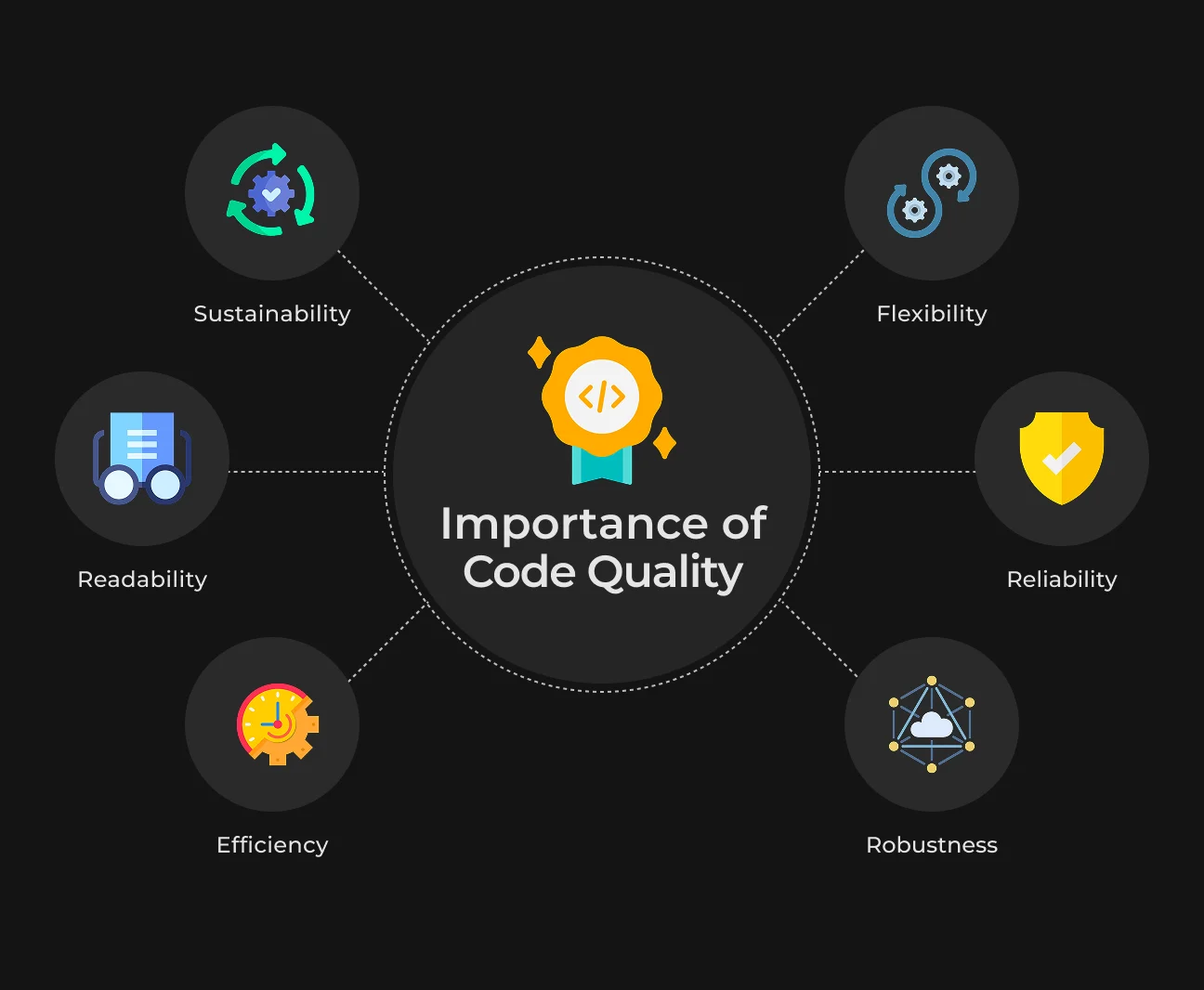
High-quality code:
- Reduces technical debt;
- Lowers maintenance costs;
- Improves scalability;
- Simplifies onboarding and collaboration;
- Prevents expensive full-system rewrites;
Technical debt, which is the additional work caused by quick or outdated solutions, accumulates quickly when quality is neglected. Ignoring the importance of well-written, high-quality code can result in costly and time-consuming rewrites of an entire codebase.
Code Audit vs. Code Review
A code audit is a full review of all the code in a software project, typically carried out by experts. Whereas a code review concentrates on changes made recently, the audit targets your project as a whole. It covers UI/UX design, security, performance, and maintenance.
A code review is the practice where developers look at one another’s code to ensure a certain level of quality and the absence of issues. The goal with code reviews is to find bugs and make the code easier for other developers.
Continual code reviews also encourage cross-team learning, and allow junior developers to learn from their seniors.
This checklist compares the differences between code review and source code audit:
Aspect | Code Audit | Code Review |
| Purpose | Comprehensive review of the entire codebase. | Assess code changes for quality, accuracy, and standards compliance before integration. |
| Scope | Focuses on overall structure, architecture, and potential risks. | Targets specific code segments or updates |
| Frequency | Periodically, like quarterly or after major releases. | Continuously during development, typically before merging code. |
| Duration | Takes several days to weeks, depending on codebase size and complexity. | Lasts a few hours to a couple of days per review, based on code changes. |
What’s Included in a Code Audit
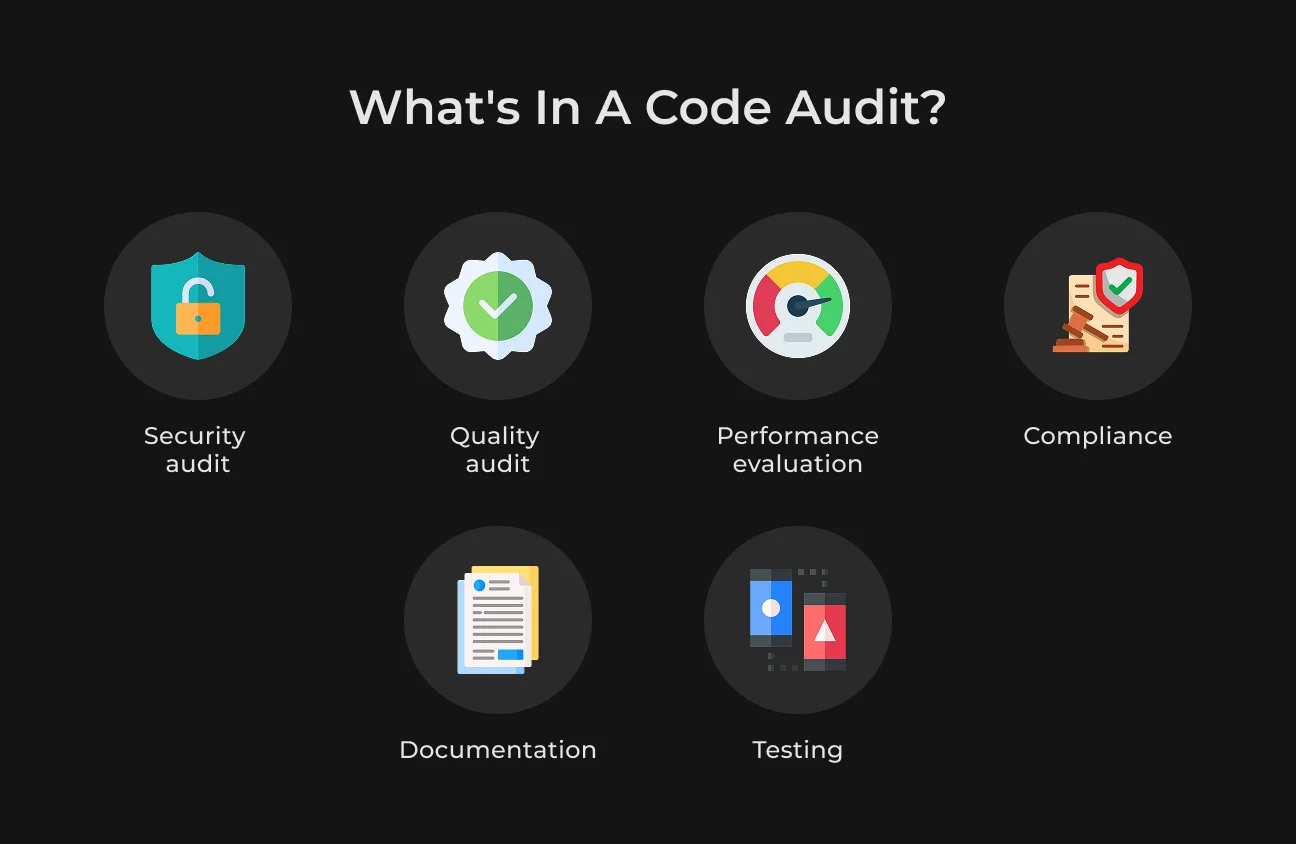
Code audits target different aspects based on the goal of an audit. But they still address some common elements. Understanding these elements helps everyone see the level of detail and thoroughness needed in an audit.
Code Security Audit
Security analysis focuses on finding vulnerabilities that could expose data, disrupt operations, or damage reputation. This includes detecting:
- Injection vulnerabilities (SQL, command, LDAP);
- Cross-site scripting (XSS);
- Cross-site request forgery (CSRF);
- Broken authentication or session handling;
- Insecure deserialization;
- Buffer overflows and memory safety issues;
- Misconfigured access controls.
Apart from the OWASP Top 10 Security Risks, auditors review:
Beyond common OWASP Top 10 risks, auditors review:
- Role-based access control (RBAC) implementation;
- Secrets management (hardcoded API keys, exposed credentials);
- Encryption standards (data at rest and in transit);
- Secure API design and rate limiting;
- Logging practices that may leak sensitive information.
This stage answers a critical question:
“What is the financial and reputational exposure if this system is attacked?”
Security findings are typically prioritized by exploitability and business impact, not just technical severity. However, this is only one elements of your code audit.
Quality Audit
A quality audit evaluates how well the codebase supports long-term development and team collaboration. It reviews:
- Naming conventions and consistency;
- Adherence to language and framework standards;
- Code duplication;
- Comment clarity and relevance;
- Architectural layering and separation of concerns.
Special attention is paid to complexity metrics such as cyclomatic complexity and maintainability index. High complexity increases defect probability and slows onboarding for new developers.
As indicated by SapientPro’s Head of Project Management Illya Vorobets, poor code quality directly impacts:
- Development speed;
- Cost of feature expansion;
- Time required for bug resolution;
- Team productivity.
A quality audit does not only highlight problems — it defines refactoring priorities and identifies quick wins that improve readability and structure without major rewrites.
Performance Evaluation
Performance analysis examines how efficiently the system uses resources under expected and peak loads. This includes:
- CPU and memory consumption;
- Database query efficiency;
- N+1 query problems;
- Caching strategies;
- Thread handling and concurrency issues;
- API response times;
- Load balancing and horizontal scalability.
Auditors often simulate real-world traffic patterns to assess how the application behaves under stress. This phase also determines:
- Whether the system can support growth;
- Infrastructure cost optimization opportunities;
- Risks of downtime during traffic spikes;
- Readiness for market expansion.
Identifying bottlenecks early prevents costly architectural rework later.
Compliance and Standards
Regulatory compliance affects legal exposure and partnership opportunities. The audit verifies alignment with requirements such as:
- GDPR and CCPA for data protection;
- Industry-specific regulations (HIPAA, PCI DSS, SOC 2, etc.);
- Accessibility standards (WCAG);
- Data retention and audit logging requirements.
Auditors also examine:
- Third-party libraries for known vulnerabilities (via CVE databases);
- License compatibility (MIT, GPL, Apache, proprietary conflicts);
- Deprecated dependencies.
This step reduces legal and operational risk for companies preparing for audits, funding rounds, or enterprise contracts.
Documentation and Maintainability
Maintainability determines how easily the system can evolve.
This part of the audit evaluates:
- Inline comments and code clarity;
- API documentation accuracy;
- Architectural diagrams;
- Deployment and onboarding guides;
- Configuration management practices.
It also reviews architectural patterns (MVC, microservices, event-driven systems) and whether they are consistently applied.
Poor documentation increases reliance on individual team members and creates knowledge silos. A maintainable system reduces turnover risk and simplifies scaling development teams.
This section answers:
“How dependent are we on specific individuals to keep this system running?”
Testing Coverage
Testing assessment measures reliability and release confidence.
Auditors review:
- Unit test coverage and quality;
- Integration and end-to-end tests;
- Edge-case and boundary testing;
- Test data management;
- Mocking strategies;
- CI/CD pipeline integration;
- Flaky or unstable tests.
High coverage alone is not sufficient – test effectiveness matters more than raw percentages.
A 90% coverage rate with shallow assertions may provide less value than 70% coverage with well-designed tests. This stage determines:
- Release confidence levels;
- Deployment automation maturity;
- Risk of regression;
- Ability to scale feature development without destabilizing production.
When Do You Need a Software Code Audit?
How to know when you need a code audit? Maybe you notice that your developers constantly miss their deadlines or that your website is becoming slow and dropping rankings in search engines. Then a code audit may likely be due.
The basic idea is that when your project isn’t working the way you want it to, that’s when you start investigating why this is so.
1. During Product Development
In product development, details (especially tiny ones) can be neglected many times, so even seasoned developers overlook them occasionally. So, double-checking is key.
An independent code audit service can review the quality of your developers' code. Solving any issues early saves costs, since the cost of fixing major errors later on can be much higher.
2. M&A Evaluations
It’s wiser to find any code issues before you are locked into a purchase. That way, you can decide whether to go through with the deal or, if possible, adapt the software as you desire.
For full validation, it is necessary to have the code audited by another company. It provides a neutral perspective without any conflict of interest in the transaction.
The fact that a third-party code audit service is used will also minimize surprises down the road of post-acquisition.
3. Security Breach Aftermath
Business leaders are most concerned with hack-and-leak operations (42%), third-party data breaches (38%), and cloud weaknesses (36%). Company chief executives in the public sector often only turn to cybersecurity and privacy after large breaches.
Code audit will help find the vulnerability so that you can prevent such attacks from happening and regain the confidence of your customers.
4. New Compliance Standards Adoption
In 2025, European regulators fined companies more than 1.2 billion euros ($1.4 billion), based on the GDPR. And while there were more data breaches reported, that was a relatively small increase from the previous year.
With more laws similar to GDPR and CCPA popping up all the time, you will need to audit or update your code in order to stay compliant and avoid lawsuits.
5. Releasing Minimum Viable Products
Whether you’re moving an MVP or preparing for a product pitch, manually auditing your code is important to keep quality high. It allows you to catch issues early in the game, launch a market-ready product, and determine if your product and tech stack are ready for scaling. For founders who reached this point on a prototype built at speed, an audit often marks the moment to rebuild the validated parts through MVP development services that put the product on foundations meant for real traffic.
6. Legacy Systems Use
Legacy systems are commonly based on obsolete software, hardware, and programming languages. Although they can be effective, it can be a chore to upgrade these systems because of compatibility issues. Actually, 70% of the software that Fortune 500 companies rely on was created two decades ago.
A code audit can determine where legacy systems are employed, and suggest means to modernize your system to comply with the best practices.
7. Dealing with Technical Debt
In product development, the priority is often to get things done, and not necessarily perfectly.
This, though, can create technical debt, which is similar to the unfinished work that has been delayed by taking shortcuts. The result is a lower quality of code and solutions all around.
A code audit is important for technical debt management as it uncovers latent issues, like bugs or security vulnerabilities, which may decrease productivity and escalate maintenance efforts.
8. Before Product Launches or Upgrades
Annually, more than 30,000 new products are launched; while about 80% of them fail to meet their launch projections.
You will always need a code audit before you go in for a release of a new product or even an update. Your software is going to be commercial, so you want the peace of mind that it’s well-built and absolutely free from any critical bugs.
Releasing an app that’s buggy or insecure can do something even worse – destroy your company’s reputation and your users’ experience.
9 Steps to Conduct a Code Quality Audit
There are a number of steps involved in conducting a thorough code quality audit. Here are the stages that you would typically go through to perform it successfully.
Step 1 | Know your goals | Outline what you're checking for in the audit. Is it security, speed, or just not crashing in the middle of a conversation? Understanding what you want out of a code audit will keep you focused. |
Step 2 | Form your team | Create a team with software architects, security specialists, and developers who really know your tech in detail. More diverse brains mean better insights. |
Step 3 | Decide on your tools | Choose robots (tools), like SonarQube, to help automate and boost your auditing process. |
Step 4 | Start with a glance | Do a quick check to find high-risk zones. Look into past issues, bug logs, and user complaints to focus on areas that matter most. |
Step 5 | Go checking | Extract critical parts of your code. Focus on tricky bits that might trip you up or parts that automated tools missed. |
Step 6 | Read documentation | Make sure the documentation matches what your code actually does. Good docs mean smoother navigation later. |
Step 7 | Check the testing zone | See how well your software is tested. Find and fix places where the tests are short or missing altogether. |
Step 8 | List problems | Write down issues you’re having, rank them by potential disruptive character, and make a plan on how to improve code quality now and later. |
Step 9 | Keep testing | Continually reviewing and altering your process is necessary to improve. Learn from your audit and make it a routine, so quality just gets better. |
With these nine aspects in mind, you can better understand what's good and wrong about your software. And take crucial steps to improve its quality and performance.
3 Best Practices in Coding Audits for 2026
The practices we detail below help developers make their code audits more efficient and maintain product stability in the long term. Check them out.
Combination of Automated and Manual Code Reviews
Machines are good at code reviews because they’re fast and reliable, but less so at understanding context. On that front, human reviewers excel. Developers do not just stare at code. They realize why it exists and what it's supposed to achieve.
For an effective code audit, you may use both methods in combination. Robotic review can take over tasks that don’t necessitate human judgment. So, developers can spend time on more significant work. As one, they are an unstoppable reviewing force.
Invite External Code Auditors
People are not always great at finding their own mistakes. It’s really useful to have experienced reviewers give you feedback. It's where an external team takes a look at your code for quality, red flags, etc.
Team members may be too hesitant to talk about what is wrong for fear of conflict. And a neutral observer can more easily share useful criticism.
Also, outside reviewers bring fresh perspectives that may breathe new life into the project with a bit of change. An audit produces findings, and the harder part is deciding what the findings mean for the roadmap. Companies that lack a permanent technical lead often bring in CTO as a service to convert audit output into a sequenced remediation plan.
Follow Documentation and Coding Guidelines
When you make a project following standards, your code will be consistent and secure. In an audit, you may find components like hardcoded passwords, improper data handling, weak access controls, or dependencies that an automated tool might simply leave behind.
Talking about these holes and the best way to avoid them helps build confidence in the code and its risk mitigation.
What Tools Are Used in Code Quality Analysis
Code quality tools basically fall under three categories:
- Static analysis (SAST).
Examines code without running it to detect vulnerabilities, flaws, or insecure coding practices;
- Dynamic analysis.
Monitors apps while they run for input glitches or runtime errors;
- Hybrid techniques.
Use both static and dynamic methodologies, which are also typical in today’s DevSecOps.
Let's explore five top tools that help developers work magic and write clean, effective code.
SonarQube
SonarQube is a functional platform that can help increase the quality and maintainability of software projects. It comes with a full-fledged toolkit that automatically checks your code to give you immediate feedback.
SonarQube scans the code for any bugs, security vulnerabilities, or quality weaknesses.
Snyk Code
Snyk develops at speed and scales in an AI-first world. Their AI security platform rapidly locates and remediates security problems in code, dependencies, containers, and cloud configuration.
With such AI insights, companies can effortlessly integrate security and AI trust into their development processes.
Codacy
Codacy works on boosting the security and quality of your CI/CD pipelines. So you can make sure that you developed compliant code from development to production.
And because it integrates with your IDEs and AI tools, Codacy gives you immediate analysis on security and quality issues.
It also automatically checks your code repositories to ensure they meet your organization's standards.
Veracode
Veracode’s application risk management platform lets you identify risks during software development, automates flaw fixes, and simplifies governance and compliance. This helps you reduce threats and deliver secure software faster.
The platform features the world's largest database of code vulnerabilities and flaws.
DeepSource
DeepSource is a DevSecOps platform that integrates SAST tools with the CI/CD pipeline to detect issues early. It often runs automated code reviews for quality, security (real-time SAST), and more.
It has smooth integrations with GitHub, GitLab, and Azure DevOps, so you can use static analysis almost everywhere. You can also inspect every commit and pull request for mistakes, bad practices, etc.
9 Code Quality Metrics to Follow
Code quality metrics are objective measures that determine how effective and suitable a code is, based on the clear, quantifiable indicators of software quality. The following are the top nine metrics to measure code quality and make business profits.
| #1 | Code complexity | Measures the complexity of software by simply estimating the number of control flows through cyclomatic. Every function, every module, and every class should have low complexity to prevent overlapping code. |
| #2 | Code coverage | Automated test code coverage percentage (shows how much of your codebase is tested). More coverage gives us more confidence that the code is reliable. But coverage should be balanced with test quality and relevance to prevent false security. |
| #3 | Code churn | Shows the frequency of code changes in a timeframe. Lots of code churn may also indicate instability or significant refactoring, which might affect the productivity of other members on your team. |
| #4 | Technical debt | Quantifies the penalty for doing extra rework from taking cuts in the code. It helps prune refactoring and steer the balance between feature development and long-term maintainability. |
| #5 | Maintainability index | A combined index considering code complexity and clarity of comments that shows how easy the code is to maintain. A high MI simply represents a code base that is easier to change, fix, and improve. |
| #6 | Duplication | It measures the laxity of your codebase towards code duplication. High duplication results in redundancies, causing inconsistency. Cutting down on it keeps the code organized and easier to manage. |
| #7 | Code review statistics | Assesses the value of peer code reviews through analysis of review coverage, feedback loops, and defect capture. |
| #8 | Defect density | Divides the number of defects by the size of the codebase (usually expressed per thousand lines of code). Checking this value is a way to rank quality assurance and debug work. |
| #9 | Performance efficiency | It rates how well the software performs against resource consumption. It’s a way to detect bottlenecks and other inefficiencies. The use of statistical methods, performance measurement, and optimization makes the software scalable and responsive for users. |
How Much Does Source Code Auditing Cost
Each project has a different code audit price depending on many specifics: scope, urgency, complexity, or the experience of those who provide code audit services.
We gathered an average of the costs charged by US-based IT companies for different audit services.
Phase | Cost |
| 1. Mutual pre-audit planning, where we set the scope and purpose | $500 - $2,000 |
| 2. Automated code scanning with the help of specific tools | $1,000 - $5,000 |
| 3. Manual code analysis of the most important sections | $2,000 - $10,000 |
| 4. Documentation and suggesting corrective actions | $1,000 - $3,000 |
| 5. Consultations on how to make the changes | $2,000 - $8,000 |
If you want to receive the most realistic estimate and a full assessment of your software project, contact SapientPro. You'll get a detailed estimate with all the details. Also, our tailored solutions help improve code quality and reach your business goals by providing the visibility and support you need.
How Can SapientPro Help Improve Your Code
Partner with SapientPro for software audits designed to meet your needs. Our code review services thoroughly analyze architecture, security, and performance.
SapientPro's engineers manage tasks through crucial stages like planning, code reviews, releases, security checks, and handoffs. You'll get clear insights into risks, inefficiencies, and minor tweaks that can improve delivery consistency.
We evaluate everything from naming conventions to structure, testing, duplication, warnings, and risky patterns. Then, we give your team practical examples, fixes, and repository notes they can use right away.
Here are examples of our previous case studies:
Contact us today for professional advice and a clear plan to keep production running smoothly.
Ensure Your Code's Safety & Efficiency