All How Enterprise AI Transforms Your Business Operations in 2026
January 17, 202610 min read


Companies using AI have seen their revenues surge since 2022. The launch of ChatGPT and similar occasions showed just how powerful AI can be for enterprises. It encouraged businesses to jump on and reap great benefits, especially in areas ready for AI transformation.
AI isn't just making companies' profits higher. It's also increasing workers' paychecks.
Salaries in AI-heavy industries are rising twice as fast as those in industries without much AI.
Enterprise AI is advanced artificial intelligence in big companies to improve and simplify their operations. Including technologies like machine learning, predictive analytics, or natural language processing also helps transfer organizations to the digital age.
Check out our new guide to learn about:
- What enterprise artificial intelligence is all about;
- Cases and benefits of enterprise AI solutions;
- Checklist for implementing enterprise AI tailored to your unique needs.
Key Takeaways
- Enterprise AI is using advanced artificial intelligence in large organizations to improve and simplify their operations;
- Enterprise AI covers complex areas like automating tasks, improving customer support, and managing risks;
- Salaries in AI-heavy industries are rising twice as fast as those without AI;
- Responsible AI usage can boost ROI and efficiency for nearly 60% of executives.
What is Enterprise AI?
Enterprise AI is the integration of advanced technology into the core of a large organization. It goes far beyond simple data entry or basic analysis; it’s about using technology to automate complex workflows, sharpen customer support, and manage high-level risks.
To do this, companies lean on a specific toolkit:
- Machine learning: for identifying patterns and making predictions.
- Natural language processing: for understanding and generating human speech.
- Computer vision: for allowing software to "see" and interpret visual data.
These tools don't just handle the boring and repetitive tasks. They give leadership the insights needed to transform strategies and track performance in real-time.
Adopting this technology isn't a "plug-and-play" process. It requires a significant investment of both capital and talent, and the transition can be a bumpy ride. However, for businesses willing to commit the resources and hire the right artificial intelligence experts, the competitive advantage is worth the effort.
Top 5 Examples of Enterprise AI Solutions
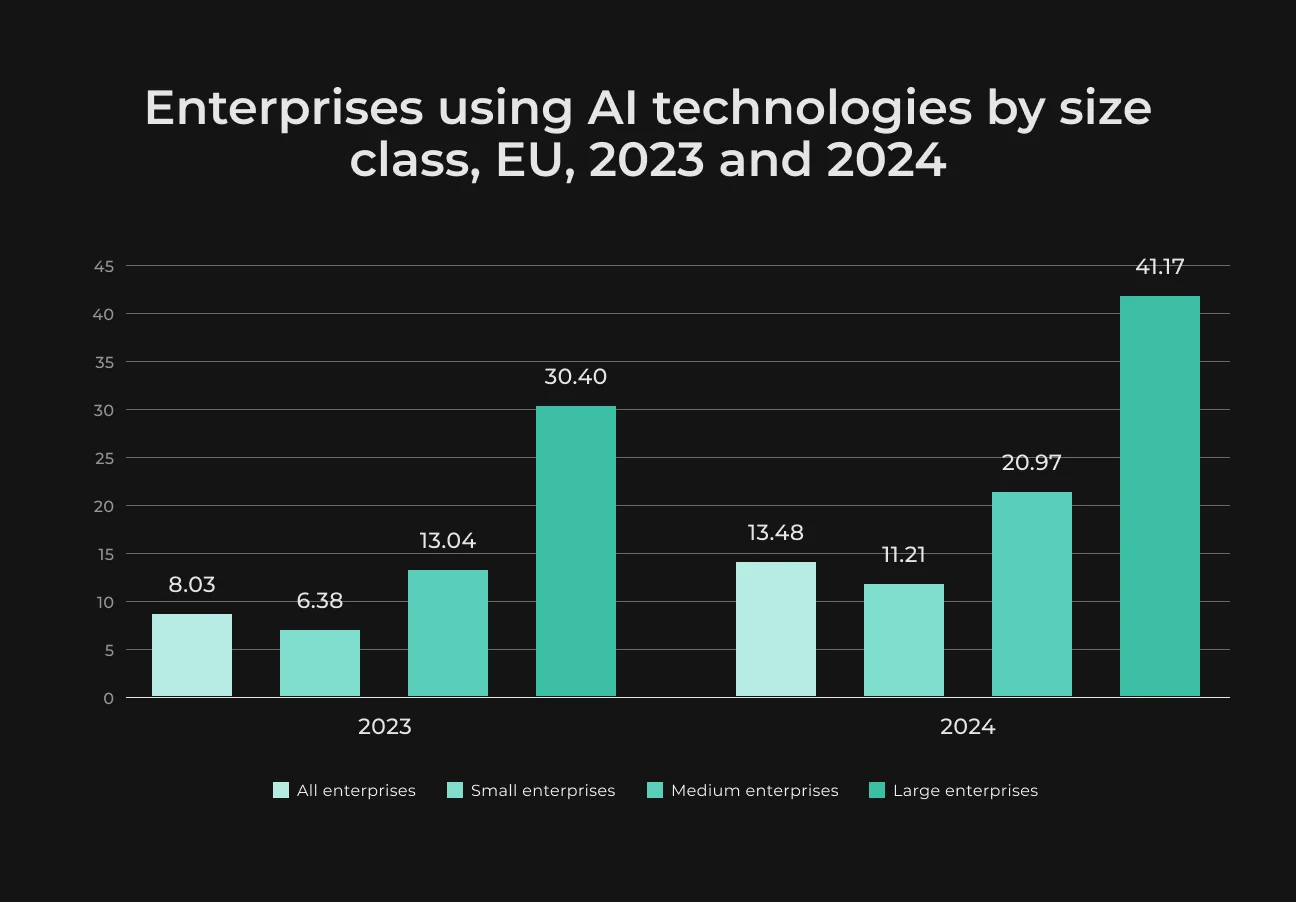
Most organizations are still at the start of implementing AI, with around two-thirds yet to fully dive in. Despite this, a lot of industries are already gaining AI rewards, and 62% of respondents are at least trying out AI agents. Check out some examples below.
1. AI-Powered Chatbots for Customer Service
So far, 72% of customer service leaders believe AI might actually outperform human agents. Conversational AI can run customer support via chat, voice, and email for enterprises.
These advanced bots use natural language processing to understand questions, manage conversations (simple and complex), and deliver correct answers.
Conventional chatbots mostly stick to scripts, while new agents use large language models to answer tough questions, FAQs, and even run transactions. Enterprises can benefit from AI-powered customer support much more because of these three key advantages:
- Availability 24/7;
- Fast responses;
- Scaling up support without hiring more staff.
Customer service agents who use AI tools like chatbots and knowledge assistants can be 13.8% more productive and take more inquiries per hour.
2. Generative AI in Sales and Marketing
Around 75% of AI's potential value lies in four key areas. These are customer support, marketing, sales, and R&D. In sales, in particular, AI can take on tedious work like data entry or more cognitive tasks like creating sales scripts or suggesting products.
It could even have chats with customers. This AI assistance helps in everything from finding new leads and keeping customers engaged to closing deals faster than any human ever could.
Moreover, the market for AI in marketing could reach around $217 billion by 2034. AI, trained on massive data, now generates excellent content in various forms. Marketing teams rely on these tools for writing blogs, sales emails, product descriptions, landing pages, and social media posts.
AI also helps businesses personalize marketing by using real-time customer data for personalized recommendations, dynamic emails, and content.
3. Autonomous AI Agents
If we take simple chatbots, they can answer just one question at a time. But autonomous AI agents have their own plans and goals. They can handle your calendar, shoot emails, chase people for replies, adjust plans, and keep a diary of it all, without your instructions.
For tech-savvy executives and operations experts, using AI agents is like having a secret weapon. Instead of your team passing tasks around, the AI can manage entire processes on its own, like onboarding. In this case, it also:
- Sets up accounts;
- Schedules training;
- Sends welcome emails, and more, ensuring nothing gets missed.
These multitasking agents can actually work anywhere, like in finance, e-commerce, customer service, etc. They can manage loan applications, track inventory (either order more or redirect shipments), or they can quickly solve issues if customers get upset with the services.
4. AI in Fraud Detection
AI-driven fraud detection finds sneaky patterns by constantly learning from new data, unlike systems that use fixed rules. It gets more intelligent over time, adapting to new fraud tricks.
AI systems sort through large datasets of data like what you buy, how you behave online, and your favorite gadgets.
They can notice those tricky patterns and connections that humans might miss. This helps catch fraud faster and more accurately than the old methods.
5. AI-Driven Predictive Analytics and Maintenance
The International Society of Automation says that downtime can consume 5% to 20% of manufacturing capacity. The hidden costs of downtime? Lost production, piles of waste, neglectful fixes, and last-minute calls asking for help to keep things moving.
Artificial intelligence helps get rid of that guesswork. It gathers and analyzes machine data to predict breakdowns and gives us a better look at how machines are doing. The predictive analytics market is set to grow by 22% to 28% in the next five years.
There are many more examples of how AI-based predictive analytics work.
In healthcare, predictive models help providers fast and accurately predict patient issues, hospital readmissions, or treatment results. In retail, these models provide personalized recommendations and fair pricing based on individual habits.
All these rely on real-time data tech, which transforms predictions into smart actions that simplify life.
Benefits of Using Enterprise AI Tools
Enterprise AI is a real rescuer for large companies. It's capable of tackling issues that rarely happen in smaller businesses. These could be managing tons of data, global operations, or staying ahead of competitors. Older methods just no longer work.
When used the right way, AI can support and carry out your business goals.
Let's dive into some major benefits of using AI in large businesses.
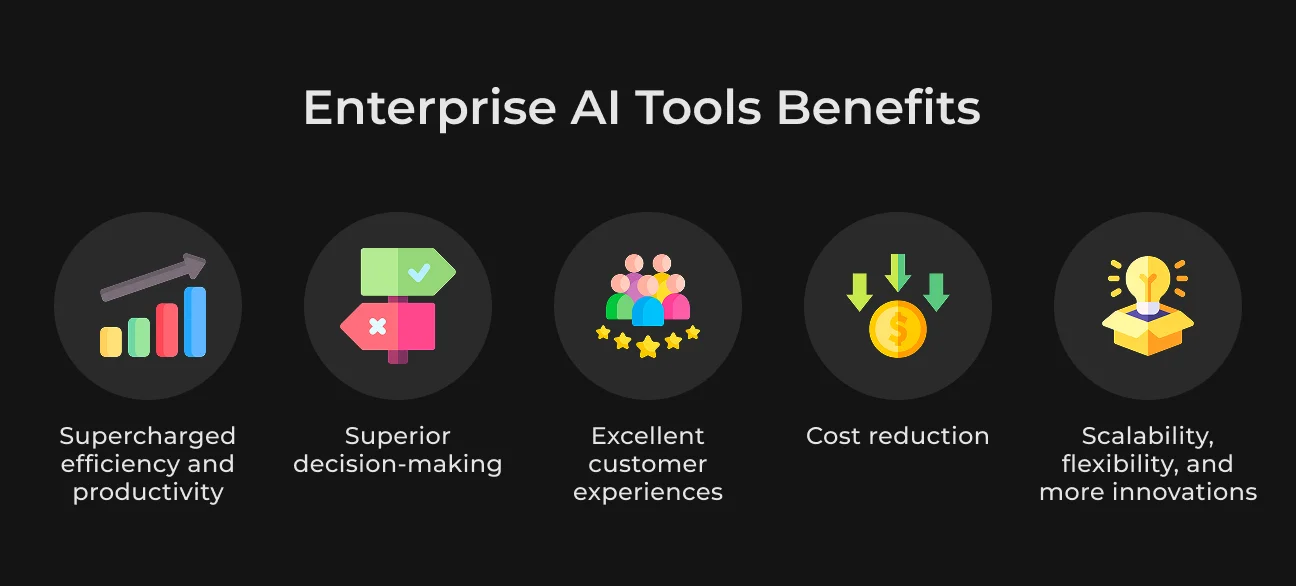
Supercharged Efficiency and Productivity
When the right talents know how to use enterprise artificial intelligence correctly, businesses can be 40% more productive. AI takes care of stuffy activities, like data entry or easy questions, freeing up employees to manage bigger and more vital challenges.
This results in more innovation and happier workers.
Superior Decision-Making
Among businesses that adopt AI agents, 55% make decisions faster, 57% save money, and 54% have a better customer experience. Companies can adjust their strategy and stay on top when they see trends earlier than their competitors.
Excellent Customer Experiences
Research shows that 80% of customers now value the experience a company provides as much as its products and services. Imagine how much better customer service could be with AI at the enterprise level.
Chatbots are already our new office companions. About 91% of businesses with more than 50 employees have them in use somewhere in their customer dealings. And these bots boost customer satisfaction by an average of 27%.
Cost Reduction
Most top executives are concerned about costs, with over 90% believing AI will help reduce expenses in the next 18 months. For example, a company used AI to create marketing materials like text and images, cutting agency costs by 20% to 30%.
The AI tool also helps marketers create content 40% faster, so everything gets done on time and for less money.
Scalability, Flexibility, and More Innovations
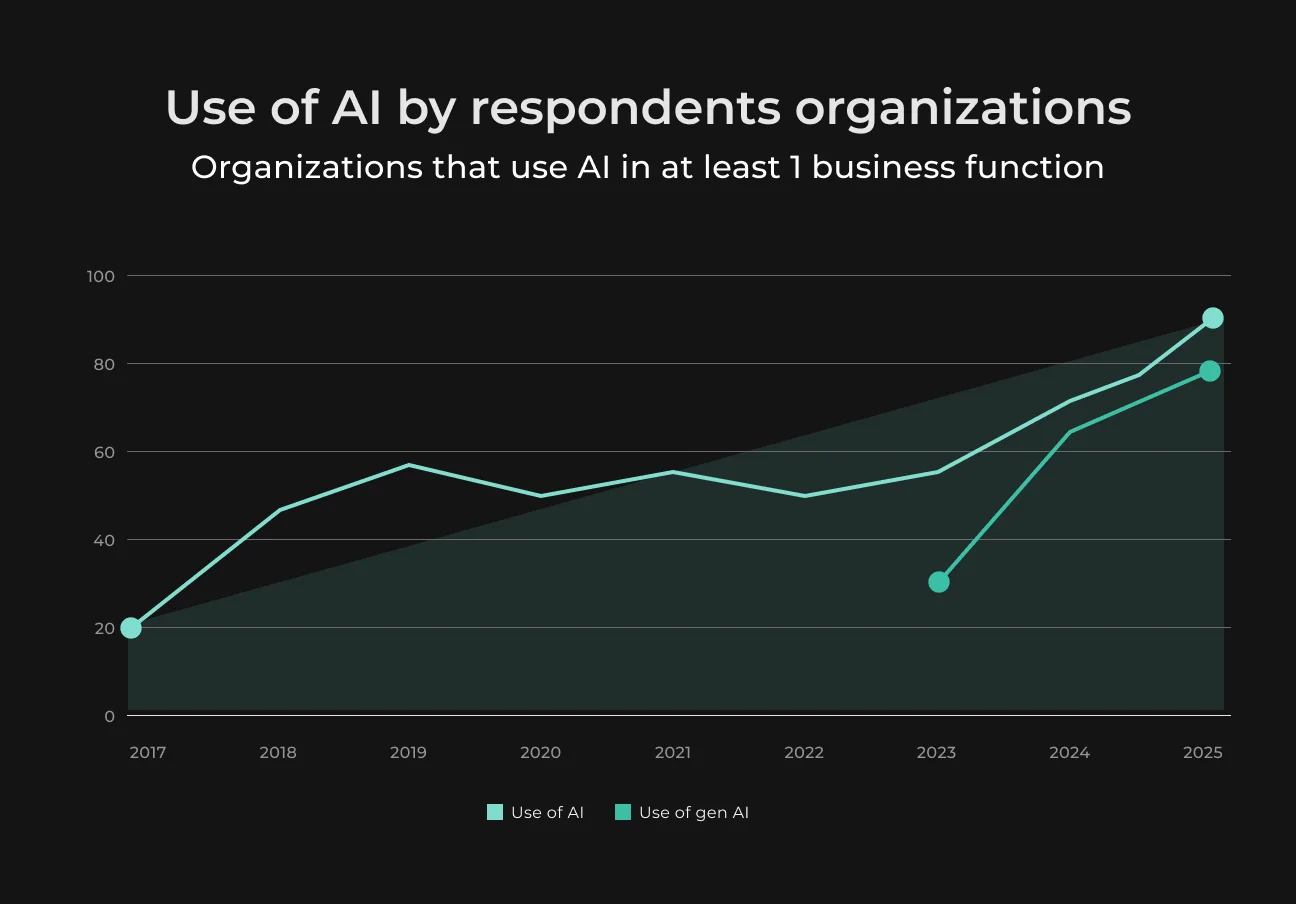
In fact, 80% of businesses surveyed say their companies use AI to drive more efficiency. The real winners, though, are those also aiming to grow and innovate — 64% of businesses think AI is already boosting their innovation skills. AI helps businesses grow while keeping costs in check.
Challenges of Using AI Enterprise Software
AI can be great for businesses and has much potential. But it still has its flaws.
Understanding these risks will help you become an AI expert.
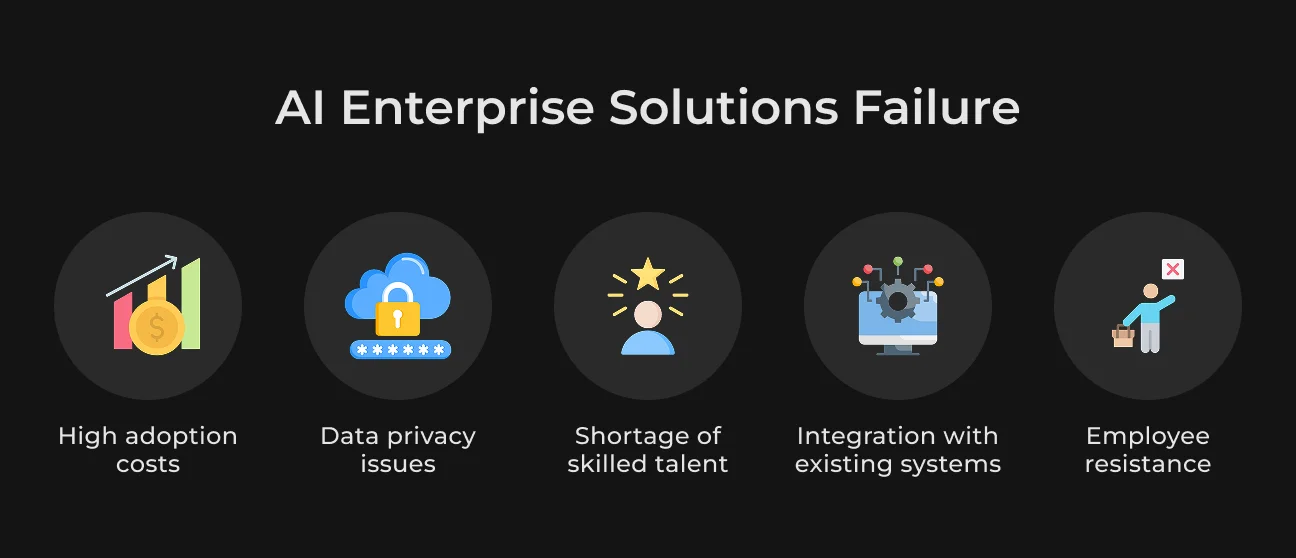
High Implementation Costs
The promise of AI is transformative, but the initial price tag often triggers immediate sticker shock. The challenge iss a combination of hidden expenses like massive computing power and the labor of cleaning messy legacy data.
If a company builds a custom infrastructure from day one, they risk sinking millions into a "black hole" before seeing a return. This is worsened by model drift, meaning AI requires constant, costly updates to stay accurate as the world changes.
To avoid a budget meltdown, smart organizations are moving away from all-at-once deployments. Instead, they use a "value-first" approach, targeting a single department where the return on investment is easy to track and prove.
The most effective solution is utilizing cloud-based AI services to swap massive upfront costs for flexible, pay-as-you-go fees. This allows businesses to rent powerful supercomputers only for the minutes they actually need them.
Leaders are also choosing to buy rather than build. By using pre-trained models and AI features already baked into their current software, they drastically reduce the need for expensive development.
If you make AI absorb the repetitive tasks that drain human productivity, the technology pays for itself. It allows a company to scale without needing a proportional increase in headcount.
Data Privacy Concerns
AI systems are prime targets for cyberattacks because they often hold valuable information. These platforms process vast amounts of sensitive data, making them a goldmine for fraudsters and hackers.
In 2025, the threat dynamics shifted dramatically, with AI now powering roughly 80% of phishing scams. Additionally, 87% of companies dealt with AI cyberattack the previous year.
Beyond external attacks, companies also face the risk of data leakage when employees accidentally upload trade secrets into public AI tools.
The solution starts with treating AI security with the same rigor as financial software. This means implementing a zero trust architecture, where no user or system is granted access to the data by default.
Enterprises must also adopt differential privacy techniques. This allows AI to learn from a dataset and spot patterns without ever actually seeing or exposing a specific user’s personal information.
Also, clear governance is essential. Companies need to establish strict rules on what data can be fed into AI models and who has the authority to view the results, ensuring total transparency.
Shortage of Skilled Talent
There's a serious lack of people who understand how to build and manage AI systems, while the need for AI experts is only growing. Machine learning engineers, for example, are at the peak of job growth, with job listings for them shooting up by 40% from 2024 to 2025 — the biggest surge for any job.
Companies can address these skill gaps by training their employees. They can collaborate with schools or fund further education to grow talents. Plus, AI-as-a-service platforms might reduce the need for in-house experts.

Integration with Existing Systems
Adding AI software to current business operations and IT is another challenge that takes effort and patience. Old systems might resist, causing compatibility issues.
Businesses should first take a look at what they already have and then make changes bit by bit. Partnering with an experienced AI software development company can ease and streamline this process.
Employee Resistance
AI can stress out employees used to doing things a certain way.
To settle everyone’s fears about change, make your teams eager, not afraid, about new ideas. Talk with your team about how AI can make their work and lives easier. Get your team members involved in putting AI systems to use.
Enterprise AI Implementation Checklist
Creating a successful enterprise AI solution involves honing in on strategic goals, the technical setup, and your organization's readiness. SapientPro's tech experts have put together a checklist with essential points to help you through the process.
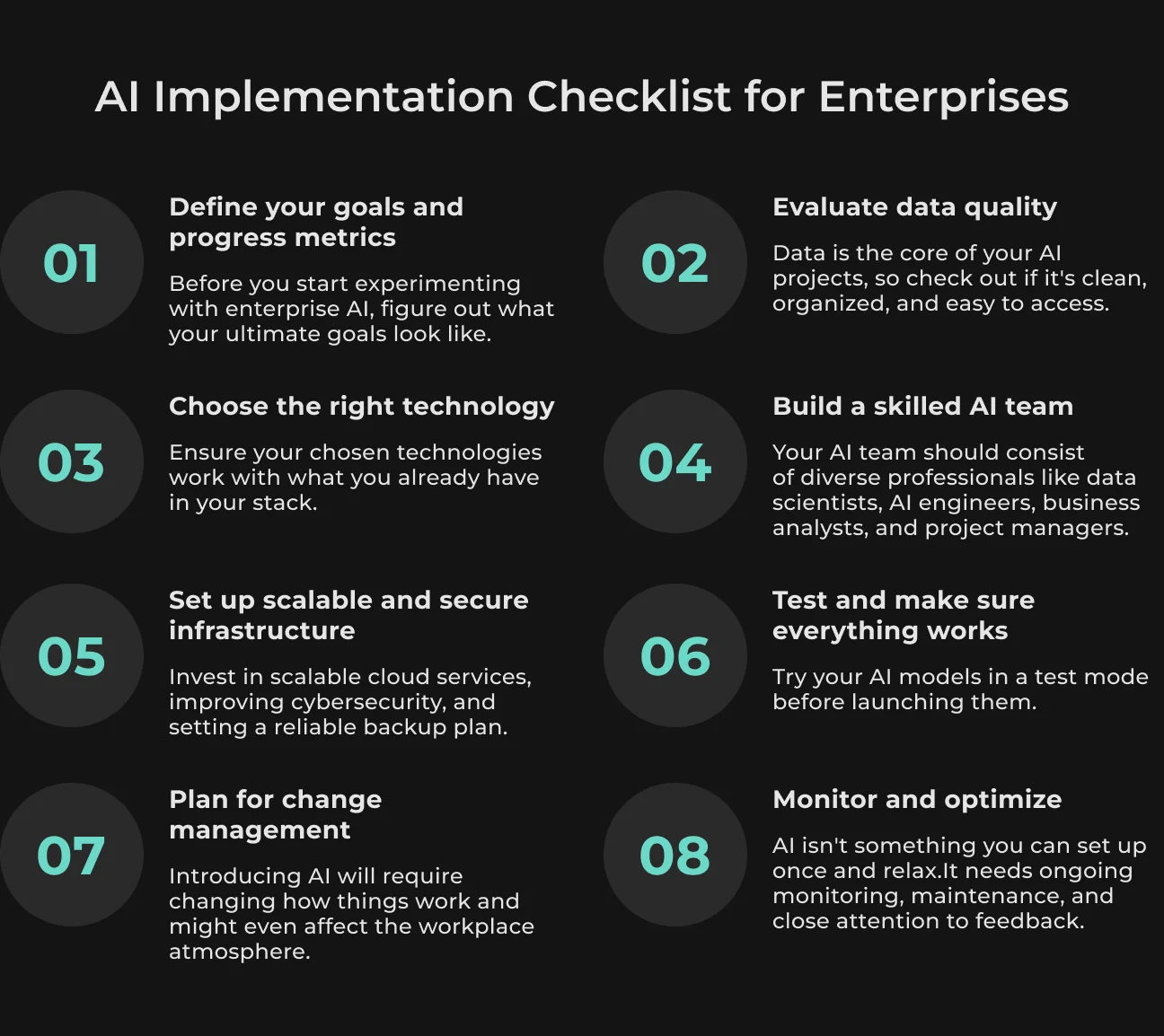
1. Define Your Objectives and Progress Metrics
Before you start experimenting with enterprise AI, take a moment and figure out what your ultimate goals look like. You might want to enhance customer service, automate challenging or routine processes, or improve your data analytics.
Along the way, make sure to set some metrics to see how successful your progress is.
2. Evaluate Data Quality and Availability
Data is the core of your AI projects, so you need to ensure it's neat. Check out if it's clean, organized, and easy to access. You might have to improve how you manage data, clean it up, or even find additional data to fill in any missing pieces.
3. Choose the Right Technology and Tools
Ensure your chosen technologies work with what you already have in your stack. Plus, it must scale as you grow and be adjustable without breaking, so make sure to check this out.
Machine learning frameworks, natural language processing, cloud services like AWS, and other tech should also match your business goals and current tech lineup.
4. Build a Skilled AI Team
Your very own AI team should consist of diverse professionals like data scientists, AI engineers, business analysts, project managers, etc.
This team will guide the process of development and implementation of AI solutions. Ensure they remain leaders in the rapid world of AI, upgrading their skills with continuous education.
5. Set Up Scalable and Secure Infrastructure
As the use of AI grows, your technology setup also needs to remain strong and updated. It needs to take more action and keep data safe. This suggests investing in scalable cloud services, improving cyber security, and setting a reliable backup plan.
You'll also need a lot of storage and computing power for your AI projects.
6. Conduct Testing and Make Sure Everything Works
Try your AI models in a test mode before launching them. Make sure these models function in different situations and check their accuracy with real-world data. Regular testing helps catch biases or weird behavior, so you can fix them in time.
7. Plan for Change Management
Introducing AI will require changes to how things work and might even affect the workplace environment. Create a plan to help everyone get used to it. Talk about the benefits of AI, provide adequate training, and address any concerns directly.
8. Monitor and Optimize Regularly
AI isn't something you can set up once and relax. AI requires ongoing monitoring, maintenance, and close attention to feedback.
Regularly updating models with new data keeps your AI effective, and ensures its success.
Future Trends in Enterprise AI Solutions
Artificial intelligence is a great boost for the global economy, with the potential to generate $15.7 trillion by 2030. This amount would exceed the current combined economic output of China and India. About $6.6 trillion of this value might come from increased productivity, while $9.1 trillion could come from consumer benefits.
Moreover, recent breakthroughs in computing and AI chips can reduce human error and the time people spend on low-value tasks by 25% to 40%.
AI systems can manage sudden data traffic increases without hiring extra staff. Plus, they can accelerate business processes in finance, procurement, and customer operations by 30% to 50%.
Of course, AI's future success depends on how responsibly enterprises will use it. Responsible AI usage can boost ROI and efficiency for nearly 60% of executives. Over half see improvements in customer experience and innovation.
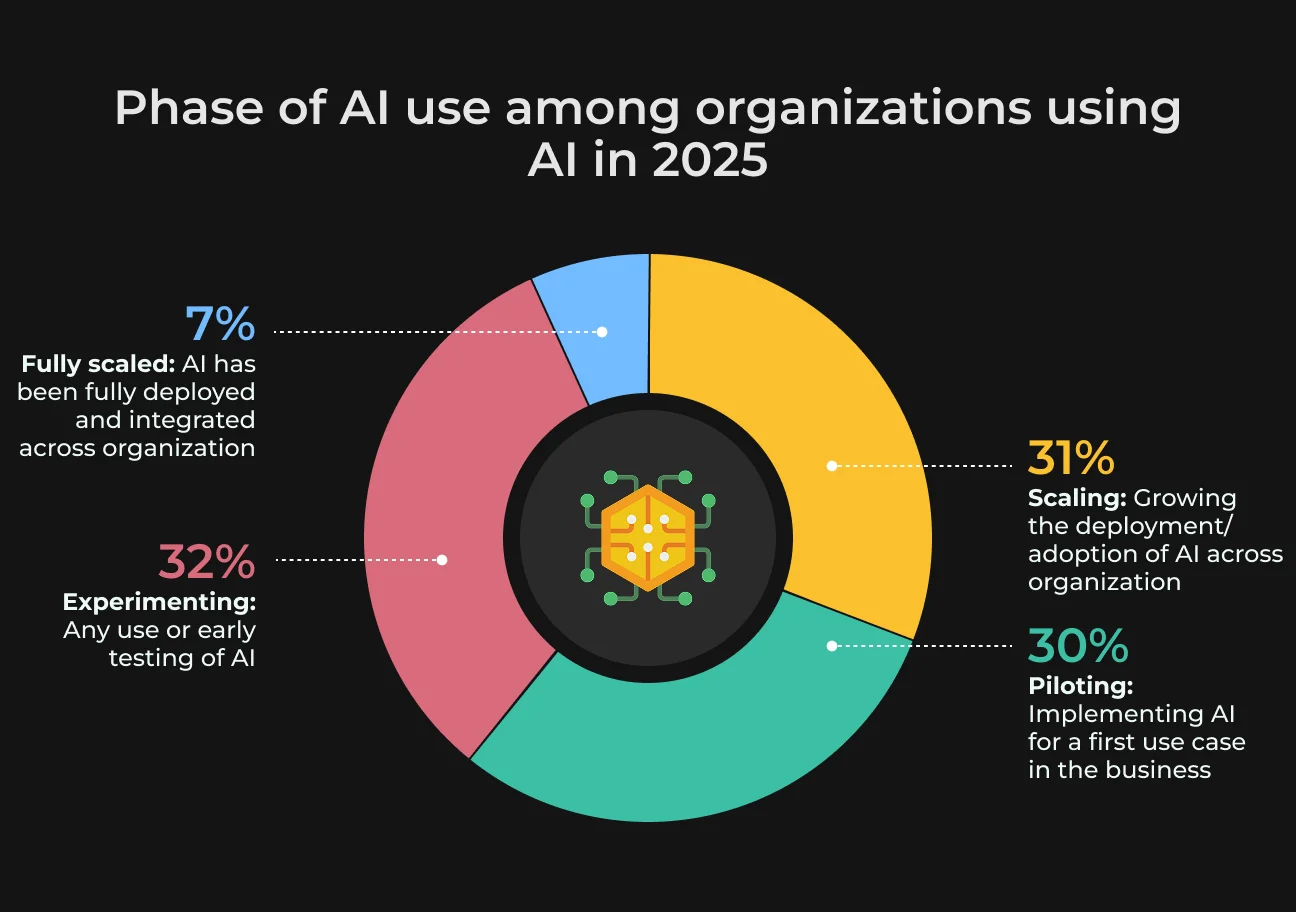
The goal is to make responsible AI work on a large scale, and that’s a big task for many. Companies that do this successfully build systems that grow, show real results, and win over those involved.
Partner with SapientPro to Implement AI into Your Enterprise
For more than 9 years, SapientPro's talented engineers have been developing high-level enterprise AI use cases. As experts in computer vision, NLP, machine learning, GenAI, and a variety of other technologies, we understand that each project is unique.
SapientPro has a proven track record across various industries.
Take a look at some of our AI use cases:
- AI Platform for Safety Data Sheet Automation
- AI-Powered Language Tutor With Live Avatars
- Conversational AI Assistant for Smarter E-Commerce
Let's team up to advance your projects through innovation, integrity, and quality.
Build Your AI Solution with SapientPro