All Common Security and Architecture Gaps in AI-Generated Prototypes
August 21, 202615 min read


A five-minute demo gives an AI-built prototype every advantage: clean data, one user, and a predictable path through the product. Production removes those advantages. The same application must handle customer records, different permission levels, unreliable integrations, and failed requests without exposing data or disrupting a business process.
In a 2025 evaluation, experts found that AI-generated code introduced risky security flaws in 45% of the tests. A feature can appear to work and still fail a security review.
DORA’s 2025 study of nearly 5,000 technology professionals points to the same concern. AI reflects the engineering practices already in place. Careful testing and code review help teams move faster with confidence, while weak controls make it easier for defects to reach production.
Read this guide from Ihor Hamal and Max Tatarchenko to learn which AI code security risks and architecture gaps deserve attention before your AI-generated prototype goes live.
AI Code Security: The Real Problem Is Missing Context
An AI coding tool only knows what's in the prompt and the files it can see. That's exactly what makes it good at a narrow task like adding an endpoint, validating a form, or wiring up a database call. And that’s precisely what it can't compensate for on a wider one.
The code it produces can run perfectly and still make a decision that quietly conflicts with everything else the system needs to be true. The prompt rarely carries the full picture. The model knows what the code is supposed to do, but it usually doesn't know which fields are sensitive or who's allowed to see them.
In a multi-tenant system, that gap turns into a specific and common failure: a permission check that works exactly as written in the file where it lives, and still lets a user reach another customer's records, because the access rules that would have caught it live somewhere the prompt never reached.
Catching that after the fact means scanning for what already got out.
Ihor Hamal, COO at SapientPro, argues the fix has to happen earlier, at the process level:
The only way to guarantee this is to build the process so the LLM never gets access rights in the first place. You can't rely on instructions or a prompt for that. We use tools like OneCLI, which keep passwords and API keys out of the LLM's reach. When a request goes out, OneCLI injects the credentials directly, so the model never touches them.

Ihor Hamal
Production adds a second layer of risk that has nothing to do with correctness. Code that behaves fine in a simple test can fail under real load, or behave unpredictably the moment a connected service retries a request it already sent.
It can also simply ignore how the company already builds and monitors software — the compliance and maintenance obligations that shape how data gets handled aren't things a prompt tends to mention, so they're the first things a prototype skips.
Both problems point to the same conclusion: reviewing AI-generated code for whether the requested function works is necessary but not sufficient.
Reviewers need to check it against the application's security model, its production workload, the team's engineering standards, and who owns it long-term—because the most dangerous gap is usually not inside the code that was generated. It's in what the code was never told.
Why Functional Code Creates False Confidence
A feature can compile, pass the expected test, and still be unsafe.
Many AI code generation security vulnerabilities remain hidden because these checks cover only the scenario the developer planned for. They do not show what happens when a user changes an ID in a request, repeats the same action, or reaches the feature through an unexpected path.
A clean structure can hide these assumptions because the implementation already looks finished:
- Functional correctness shows that the feature delivers the expected result during normal use. The requested action works, and the user sees the right outcome;
- Security correctness covers what happens when the feature is misused. Access rules must still hold, and unsafe input must not expose data or system functions;
- Architectural fitness concerns production use. The implementation needs to cope with real traffic, provide enough information to trace failures, and remain manageable as the product changes.
A happy-path test covers only functional correctness. It cannot confirm that the code is secure or suitable for the wider system, which is why a working feature often creates confidence too early.
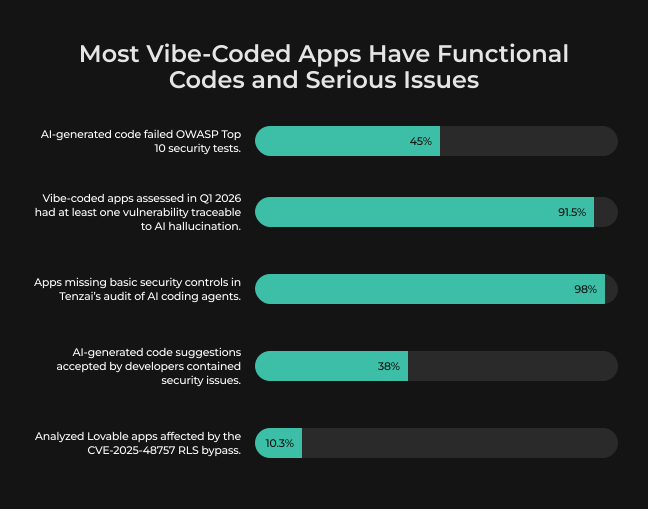
Vibe Coding Security Risks Grow with Project Scope
That's precisely how a prototype outgrows its original plan. One feature that looks finished justifies building the next one on top of it, and the team keeps moving because the results keep looking good.
Architecture and ownership decisions get postponed because nothing is visibly broken—so generated parts start running side by side without anyone checking how they behave as one system. The risk compounds the moment those modules get treated as finished work instead of drafts.
A component that looks clean may quietly depend on a package nobody chose, inherit more access than the feature needs, or send data somewhere the team never decided it should go. The failure cases hide just as well: a retry duplicates a record nobody meant to create twice, a partial update leaves two systems disagreeing about the truth, and nothing about the code's appearance gives that away.
At that point, the question stops being “Does it work?” and becomes something closer to “Does anyone understand this well enough to be responsible for it?”
Ihor Hamal, COO at SapientPro, has seen where that question tends to go unanswered the longest:
We start every engagement with an audit. If the codebase can take a new feature without doubling the work or without breaking something else, we keep building on what's there. If we find blockers or architectural problems, we fix those first. Code quality comes down to how much time it takes to maintain going forward, not just for the LLM, but for the human engineer who inherits it.
Ihor Hamal
Common AI-Generated Code Vulnerabilities
AI-generated code vulnerabilities mostly look like the weaknesses teams already know how to find:
- Broken access control;
- Weak validation;
- Exposed secrets.
What's different is the speed: a pattern that would normally show up in one place can get copied across several endpoints or services before anyone notices it's a pattern at all. That gap between how the code looks and how much it should be trusted shows up in the numbers too.
In 2025, 46% of survey respondents said they distrusted the accuracy of AI tools, while only 33% trusted them—and just 3% reported a high level of trust.
Even developers who rely on these tools daily aren't assuming the output is safe by default. A security review earns its place even when the code looks clean and runs correctly the first time.
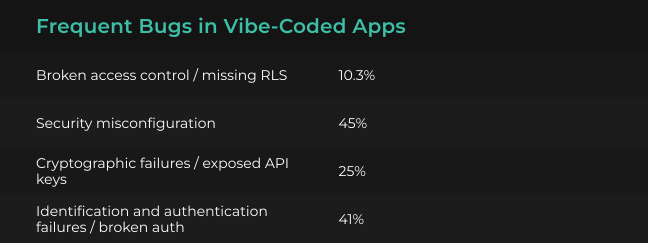
Here's where that review tends to find something—roughly in the order a request itself would move through the system.
Broken Authentication and Authorization
This is usually the first door left unlocked.
A successful login confirms who someone is—it says nothing about what that account should be allowed to touch. Generated prototypes often enforce roles only in the interface, while the backend quietly accepts requests from any authenticated user regardless of role.
Pair that with broad admin permissions or a missing tenant check, and one weak access rule turns into a much larger data exposure than anyone intended to build.
Weak reset tokens and loose session handling create the same risk from a different angle, and a shared database account makes it harder to limit what any single operation is allowed to do.
Reviewers need to test the API under different roles and tenants, check permissions at the level of individual objects, and examine reset flows and database access directly. Authorization has to be enforced on the server, on every request, with no exceptions for “the UI already checked.”
Even when the front door holds, what comes through it still needs to be checked.
Weak Input, API, and Data Validation
AI tools are built around the examples they were given, and prompts usually include the input that's supposed to arrive—not the input that actually will.
Production traffic is far less well-behaved: malformed data, oversized requests, paths nobody mapped out, values crafted specifically to find the edge the prototype never tested. Without server-side validation, that input travels wherever the code lets it go:
- Database queries;
- System commands;
- Templates;
- File paths;
- Deserialization logic.
A check running only in the browser stops nothing, since an attacker can call the API directly and skip the interface entirely. Schema testing, API fuzzing, static analysis, and load tests that deliberately include invalid requests are how teams find these gaps before production traffic does.
Unvalidated input causes the same kind of damage well outside typical web APIs, too.
Hardcoded Secrets and Unsafe Data Handling
The input made it past validation—the next question is what it touches on the way through, and what leaks out alongside it. AI-generated examples often place API keys or tokens directly in the code, because that's the fastest way to make a demo run.
Those values don't stay contained to the demo: they persist in commit history, sample environment files, logs, and error messages long after the prototype stage is over.
Sensitive data escapes through quieter paths too. Test records drift into production. Confidential content gets sent to an external AI service with no clear rule for how long it's retained, whether it's encrypted, or when it's deleted.
Secret scanners catch exposed credentials reliably, but closing this gap also means reviewing repository history, logs, and the actual data flow—tracing where sensitive information has already been, not just where it is now.
Dependency and Software Supply Chain Risks
One imported package can pull in far more code, and far more indirect dependencies, than a small feature seems to justify. AI-generated modules can end up leaning on abandoned libraries, loose version ranges, vulnerable subdependencies, or licenses that were never cleared for commercial use.
Even the package names need a manual check. OWASP has warned that coding assistants can suggest dependencies that don't exist—and attackers have started registering those exact names and publishing malicious code under them, a tactic known as slopsquatting.
Reviewers reduce this risk by confirming every package in its official registry, pinning versions, and checking maintenance history and license before it ships. Lockfiles, software composition analysis, and an SBOM extend that check across the full dependency chain.
Missing Logs, Evidence, and Incident Controls
And when one of the first four things goes wrong, the last question is whether anyone would know.
Prototype logs are usually built to catch the one error a developer saw during local testing—nothing more. Production needs a lot more than that: who changed an access right, which tenant a background job actually affected, how a suspicious request moved between services on its way through the system.
Audit records need to cover permission and administrative changes specifically, and request or correlation IDs need to link related activity across APIs and background jobs so a single event can be followed end to end.
Logs also need filtering of their own—tokens, personal data, and database details shouldn't become a second source of exposure sitting inside the very system meant to catch the first one.
The real test: can the team trace one suspicious transaction from the first request to the final change and know which alert or response process it should have triggered along the way?
Vulnerability | Description | Detection |
| Broken authentication and authorization | Backend permissions, sessions, or tenant boundaries allow excessive access | Role-based API tests, tenant isolation tests, privilege review |
| Weak input and API validation | Hostile or malformed requests reach unsafe code paths | Schema tests, fuzzing, SAST, rate and size tests |
| Hardcoded secrets and unsafe data handling | Credentials or sensitive data leak through code, logs, or external services | Secret scanning, history review, data-flow mapping |
| Dependency and supply chain risks | Packages are vulnerable, unverified, unpinned, or invented | SCA, SBOM, lockfile, registry and licence checks |
| Missing logs and incident controls | Teams cannot trace sensitive actions or investigate failures | Audit-log review, trace exercises, alert testing |
Is Your Prototype Ready for Production?
Get a security and architecture review before you scale past the demo stage.

Common Architecture Gaps in AI-Generated Prototypes
Architecture flaws usually cost more to fix than an isolated code vulnerability. One poor design choice can affect several modules and business workflows, especially once new features begin to depend on it.
Evidence from public repositories shows how long early problems can survive. In a dataset of 302,600 verified AI-authored commits, every tool studied introduced an issue in more than 15% of its commits. At the latest repository revision, 22.7% of those issues were still there.
Prototype Architecture Becomes the Production Architecture
The first version works because it only has to prove one idea—and that's exactly the problem, once the team keeps building on the shortcuts that made it work. The same service quietly ends up handling authentication, business rules, integrations, and scheduled jobs all at once.
A module built for one feature becomes the thing three other features depend on. Storage that was meant to be temporary stays exactly where it was, and the logic that actually matters stays buried inside routes, controllers, or UI code instead of living somewhere it can be found.
Past that point, even a small change can ripple through far more of the product than the person making it expects. An early architecture review is the difference between replacing a temporary choice and rebuilding around one.
Unclear Service Boundaries and Duplicated Business Logic
Generated modules often arrive one feature at a time. As more of them appear, the lines between their responsibilities begin to blur. One module reaches into another’s data, and the same permission or validation rule ends up in several places.
This makes changes less predictable.
A fix may update one workflow while leaving another copy untouched. Shared database tables create similar problems. A billing change can suddenly affect reporting, an integration, or a background job. Core rules become even harder to manage when nobody clearly owns them.
The answer is not always microservices. A modular monolith can work just as well when each component has a clear role, keeps its rules in one place, and exposes a stable interface to the rest of the product.
Fragile Integrations and Incomplete API Contracts
An integration can look reliable in a demo because every request follows a controlled path.
Production APIs paginate data, change response formats, slow down, and enforce rate limits. Generated code may read only the first page, wait without a timeout, ignore a rate-limit response, or record an external error as a successful operation.
A timeout does not always mean the provider rejected the request. The operation may have completed before the response was lost, so a retry can create a duplicate order or payment. The contract needs idempotency, clear retry rules, and a response to repeated failures, like a fallback or circuit breaker.
Scalability and State-Management Assumptions
A prototype keeping session data or job progress in memory works fine for a few users—right up until a restart wipes it out, or a second application instance has no idea the first one's state ever existed. Slow tasks running in that same process hold up every other request behind them.
Without a clear traffic target to test against, inefficient queries stay invisible until real usage arrives and makes them visible the hard way. Caching and queues, in practice, tend to get added only after the system has already started slowing down in front of users.
Two updates can overwrite each other. A retry can process the same event twice. None of that shows up in a test that never restarts the service, never runs two instances, and never sends the same request twice on purpose — which is exactly what production testing needs to do.
Missing Operational Architecture
A demo hides release problems the same way it hides everything else—by running entirely inside one controlled environment.
Real environments aren't controlled that way by default: development data or credentials can end up in staging or production simply because nobody separated the environments deliberately, and a manual release process raises the stakes further, especially with no tested rollback waiting behind it.
Past deployment, the team needs to see quickly whether the application is actually healthy—monitoring that surfaces slow requests and failed jobs, recovery testing that proves backups can restore the service rather than just exist, feature flags and gradual releases that limit how many users feel it when a change goes wrong.
This is the pattern DORA's 2025 research keeps confirming: AI adoption on its own still correlates with worse software delivery stability, not better. What offsets it is exactly the operational architecture described above—automated testing, mature version control, fast feedback, and a loosely coupled architecture that lets a team absorb a higher volume of change without every failure spreading.
The system-level risks above are half of what CTOs and security leaders are now expected to manage around AI projects.
See more
Learn how CTOs and security leaders can protect AI projects from LLM security risks in 2026.
Read moreHow to Assess Whether AI-Generated Code Is Secure Enough to Keep
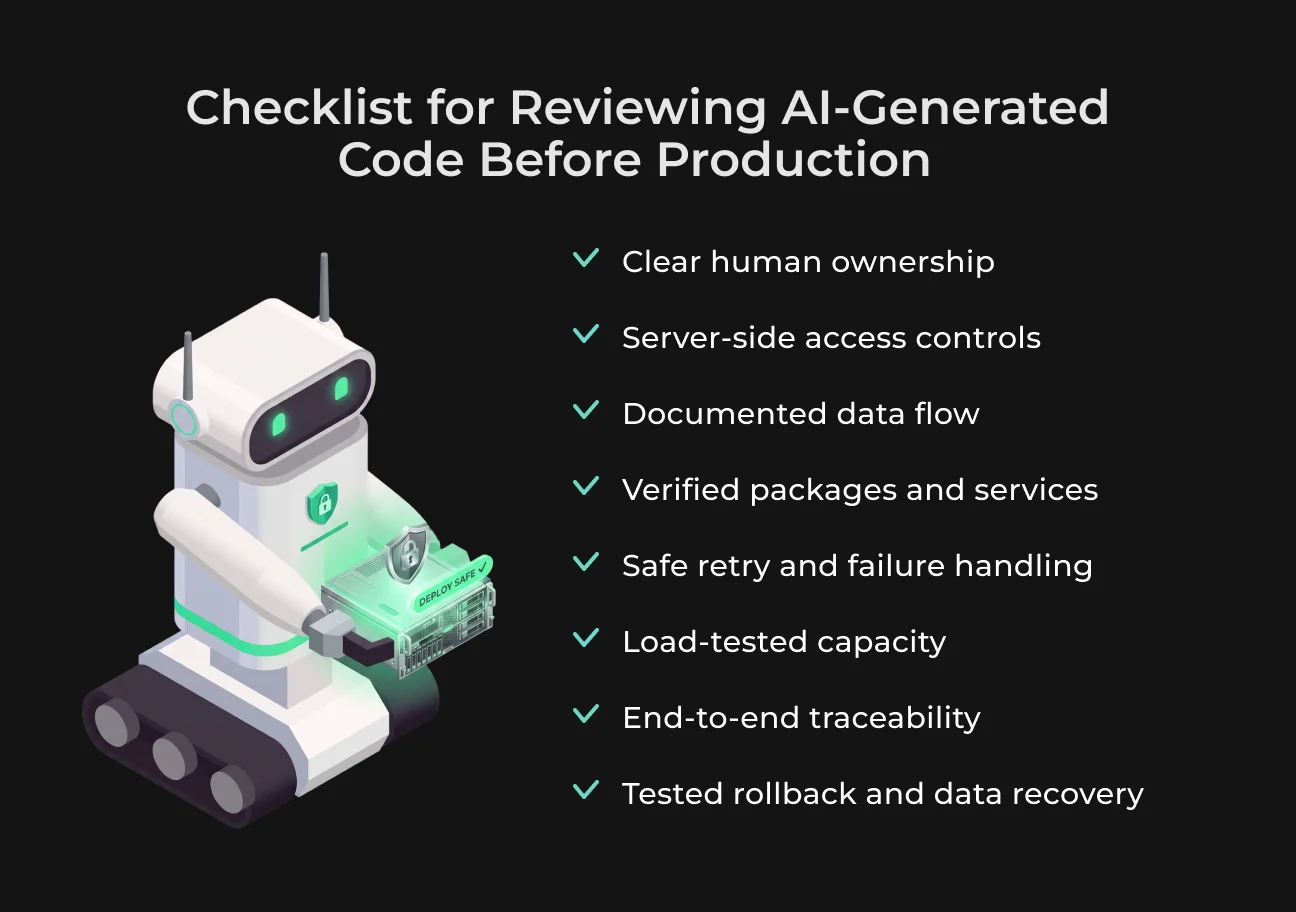
Some modules are easy to approve because the team understands them. Others still carry AI-generated code security risks linked to unclear access, unknown data flows, or weak failure handling. Those questions matter more than clean formatting or a successful demo.
Review each module against these points:
Verification Point | Review Standard |
| Ownership | One engineer can explain the code, maintain it, and approve future changes. |
| Access | Permissions are enforced on the server for every role, user, and tenant. |
| Data flow | The team knows what information enters the module, where it goes, and when it is removed. |
| Dependencies | The team has verified the source, maintenance status, license, and known vulnerabilities of every package and external service. |
| Failure handling | Timeouts, retries, restarts, and partial failures do not damage or duplicate data. |
| Capacity | Tests reflect the traffic and concurrency expected in production. |
| Traceability | Logs connect requests, background jobs, permission changes, and failed transactions. |
| Recovery | The team has tested how to roll back a failed release and restore lost or damaged data. |
The code can stay when its behavior is understood, and the remaining risks are limited. Unclear ownership, unknown data flows, or an untested recovery path usually call for deeper changes before release.
How to Secure AI-Generated Code Before Production
Working code is not the same as production-ready code.
Veracode’s Spring 2026 testing found that more than 95% of AI-generated samples were syntactically correct, but only 55% passed its security tests. In the other 45% of tasks, the generated code introduced a known security flaw.
1. What should you document before changing AI-generated code?
Freeze the current baseline before major refactoring starts. Record the workflows that already work, the services and databases the application depends on, its authentication and authorization paths, external integrations, and the modules known to have been created or heavily modified with AI.
You probably can't reconstruct which historical lines came from an AI assistant. Don't try.
Start tracking AI-assisted changes from this point forward instead. OWASP recommends assigning a human owner to AI-generated changes and maintaining an audit trail that can include the approving developer, AI tool, and model version.
Add characterization or integration tests around critical existing behavior as well. They give developers something objective to compare against while the prototype is being cleaned up.
2. Which AI-generated security issues should you fix first?
Start with vulnerabilities that can expose systems or data: leaked credentials, broken access control, injection risks, unsafe file or command operations, publicly accessible infrastructure, and vulnerable dependencies that create a meaningful exploitation path.
Do not prioritize formatting and minor code smells ahead of those issues. AI-generated code can look clean and execute correctly while still implementing an insecure pattern. Veracode's benchmark illustrates that gap: approximately 45% of its tested generation tasks contained a known security flaw despite much higher syntax-correctness rates.
Dependencies deserve particular attention in vibe-coded projects. OWASP recommends verifying AI-suggested packages before installation and checking generated dependency lists for known vulnerabilities because coding assistants may suggest nonexistent, outdated, or vulnerable packages.
3. When does the architecture of a vibe-coded prototype need to change?
Rework the architecture when important security decisions depend on assumptions that users or client-side code can bypass. Authentication, authorization, permissions, payment validation, and other security-sensitive rules should be enforced within trusted server-side components.
Define which service owns each type of data, what privileges it needs, and where important business rules belong. Review whether databases, third-party integrations, and internal services have broader access than necessary.
The goal is not to replace AI-generated architecture simply because AI produced it. Keep structures that have clear responsibilities and appropriate trust boundaries; redesign the parts that create security, maintainability, or scaling risks.
This also aligns with NIST's Secure Software Development Framework, which recommends integrating security practices throughout software development rather than treating security as a final pre-release check.
4. How do you keep AI-generated changes visible and secure in CI/CD?
Move repeatable checks into the delivery pipeline.
Run automated tests, secret scanning, dependency analysis, and appropriate static security checks before changes are merged or deployed. Require human review for security-sensitive code and for changes to CI workflows, build scripts, container definitions, and deployment configuration.
AI visibility matters here because the reviewer should be able to see not only that AI was involved, but also what the change affected. OWASP recommends human ownership of AI-assisted changes and heightened review of build and deployment files modified by coding agents.
Tests need similar scrutiny. An AI agent can make a test suite pass by weakening assertions, adding inappropriate mocks, or deleting failing tests.
OWASP therefore recommends independent review of AI-generated test changes and additional negative or adversarial tests for security-critical functionality such as authentication and authorization.
5. How should you release and monitor AI-generated code?
Avoid moving a heavily vibe-coded prototype directly from local development to all production users. Release it through staging and then limit early exposure with internal testing, a beta group, feature flags, or canary deployment where appropriate.
Once the code is live, visibility shifts from who changed the code to how that code behaves. Monitor application errors, authentication and authorization failures, latency, dependency failures, abnormal resource usage, and other signals relevant to the system. Security-sensitive actions should leave enough logging to investigate unexpected behavior.
Keep a rollback path as well. The previous stable application version should remain recoverable, and database or infrastructure changes should have a defined recovery approach before deployment.
Focus on reducing known risks, not proving every AI-generated line is safe before release. Keep changes reviewable, limit the impact of failures, and make sure the team can detect and respond when production behavior differs from what the prototype suggested.
Security flaws and architecture problems often need different fixes.
Ihor Hamal explains which work deserves attention first.
We always follow up with a security audit from a human engineer, who looks for the problems an LLM tends to miss. A model doesn't see edge cases the way an experienced engineer does. Data security needs special attention here too, especially making sure one user's data stays properly isolated from another's. That's exactly the kind of basic security question an LLM often overlooks.
Ihor Hamal
Should You Refactor or Rebuild the Prototype?
Some prototypes are worth repairing. Others keep pulling the team back into the same problems because the fault runs through permissions, data structures, or core workflows. The table below helps distinguish a contained cleanup from a case where rebuilding may cost less than repeated fixes.
| Refactoring may be enough when | Rebuilding may be safer when |
| The core business logic is correct and still fits the product | The permission or tenant model is flawed at its foundation |
| Modules can be separated without rewriting the rest of the system | Business rules are duplicated across most of the codebase |
| The team can create a reliable test baseline | The team cannot clearly explain or reproduce system behavior |
| Existing data structures can support planned use cases | The database model blocks stronger security or future growth |
| Security controls can be added in a few central places | Security fixes require changes in almost every module |
| Deployment problems can be resolved with focused work | Small changes repeatedly break unrelated features |
Refactoring makes sense when the problems are contained and the existing structure can support what comes next. Rebuilding becomes the more practical call once every repair exposes another dependency, or forces the same change across the same core workflows again and again.
How SapientPro Moves AI-Generated Prototypes Toward Production
SapientPro helps teams turn AI-built prototypes into systems that hold up in production. We start with the code you already have, find out what's solid and what isn't, and take it the rest of the way.
What we do with your prototype:
- Security and architecture review;
- Refactor-vs-rebuild assessment;
- Critical vulnerability fixes;
- Production-ready architecture rework;
- CI/CD security integration;
- Staged rollout and post-launch support.
You get a system with the real gaps closed, a clear owner for every part of it, and a tested path to production — plus a team that stays on after launch instead of handing over a report and leaving.
Contact SapientPro to discuss your prototype and find out what it needs before production.
Take Your AI Prototype to Production
Talk to SapientPro about the security, architecture, and ownership gaps still open.