All SaaS Architecture Best Practices in 2026
June 5, 202610 min read


SaaS architecture is more than designing your services, databases, and APIs. This is, in fact, how your system learns, grows, and scales after deployment.
Basically, what modern SaaS platform architecture defines is:
- How your application is built and deployed;
- How services communicate and scale;
- And how AI capabilities are embedded into every layer.
In this guide, we draw on SapientPro’s hands-on experience delivering SaaS products to show how architectural choices impact real-world systems. You’ll learn the seven core pillars of modern SaaS architecture, the most common pitfalls to watch for, and SaaS architecture best practices.
What Is SaaS Architecture?
SaaS architecture is the framework that outlines how a cloud product is organized and represents an abstraction of how its different components interact with each other. And how it scales when in real use.
This is going way beyond services and databases for a technical audience. The other part is building a system that works under unpredictable load, continues to deliver, and behaves well with AI.
For SaaS systems of earlier ages, architectural decisions were primarily around the reliability and scale: how to break a monolith, keep distributed services up, eliminate bottlenecks, etc.
Those fundamentals, of course, mean something, but they are not enough. Modern SaaS architecture patterns also require real-time data processing, inference costs for AI, latency constraints, and adaptive UI/UX.
From Monoliths to AI-Native Systems
The method we use to create business software basically progressed through waves. We've reframed what ownership, scalability, and the end-user experience mean, all while reshaping our tech choices over these stages of evolution.
These stages changed not just what tech choices were available but also changed how organizations think about ownership, scalability, and the end-user experience. In the ’80s, mainframes were where software lived. All was centralized: infrastructure, data, and control.
Corporate systems have been either in-house running or accessed via time-sharing services. Vendors like IBM, Amdahl Corporation, and Digital Equipment Corporation sold perpetual licenses, while others introduced early subscription-like models based on usage.
In the late 1990s, software started going web-based. The apps were still on the customer infrastructure, but their interface had shifted to a web browser. That client-server model reduced friction for users, but the architecture remained dense, monolithic, and difficult to scale.
Finally, the 2010s arrived, and with cloud computing, everything changed. SaaS first came on top: centrally-hosted, subscription-based, and constantly updated. Admittedly, numerous early SaaS solutions remained monolithic.
In 2020 or so, teams began to decompose these systems into microservices to facilitate quicker deployment, improved fault isolation, and independent component scalability. It solved real problems — but also introduced new ones, especially around distributed system complexity, data consistency, and observability.
SaaS cloud architecture had matured. Things like Kubernetes, serverless, and event-driven architectures entered the stack. At the same time, AI entered products — but mostly as an extra layer. Recommendation systems, chatbots, and predictive analytics were added on top of existing architectures rather than built into the core.
In 2026, leading SaaS platforms are being designed as AI-native systems from the ground up. Instead of treating AI as a feature, it becomes part of the system’s logic.
This impacts everything — from storage (vector databases instead of just relational ones) to performance optimization (semantic caching instead of simple key-value caching) to interfaces that are increasingly conversational. Getting this foundation wrong costs 10x more to fix at scale.
By 2035, agentic AI may represent approximately 30% of service revenue in enterprise applications. This suggests that companies waiting too long to change their architecture might lose the race for customers a lot more quickly.
For technical leaders, this creates a narrow window to act. Moving toward AI-native architecture is no longer about experimentation — it’s about building systems that can compete in a market where intelligence is part of the infrastructure.
The Three-Stage Evolution of SaaS Infrastructure Architecture
The shift toward AI-native systems becomes clear when you break it down across how software actually operates in practice. Below, we compare three stages of SaaS evolution across key architectural dimensions.
Execution
Execution is fully deterministic in conventional systems — each input maps to a predetermined output. While in AI-native architectures, it's partly dynamic.
Traditional SaaS | AI-Assisted SaaS | AI-Native SaaS |
| Deterministic logic and tightly defined workflows | Hybrid execution with AI-based specific tasks | AI-driven execution where models and agents influence core flows |
Role of AI
Older SaaS products were not dependent on AI or limited to rule engines. AI-assisted platforms use machine learning, but it's an additional feature.
AI native systems, on the other hand, embed AI into the reasoning layer of the product and directly influence outputs, workflows, or even behavior at run time.
Traditional SaaS | AI-Assisted SaaS | AI-Native SaaS |
| Minimal rule-based automation | AI as a feature layer | AI embedded into core product logic and decision-making |
Data Interaction
Traditional systems have clean, structured, and transactional data. AI-assisted architectures broaden this as pipelines and analytics layers.
And AI-native systems shift the model in nature: it is based on unstructured data, embeddings, and real-time retrieval mechanisms.
Traditional SaaS | AI-Assisted SaaS | AI-Native SaaS |
| Structured data (SQL/NoSQL) | Mix of structured and unstructured data | Real-time, context-rich data including embeddings and semantic retrieval |
Future-Proof Your SaaS Architecture
Create scalable systems that support AI, performance, and revenue growth with SapientPro.

7 Pillars of Modern SaaS Architecture in 2026
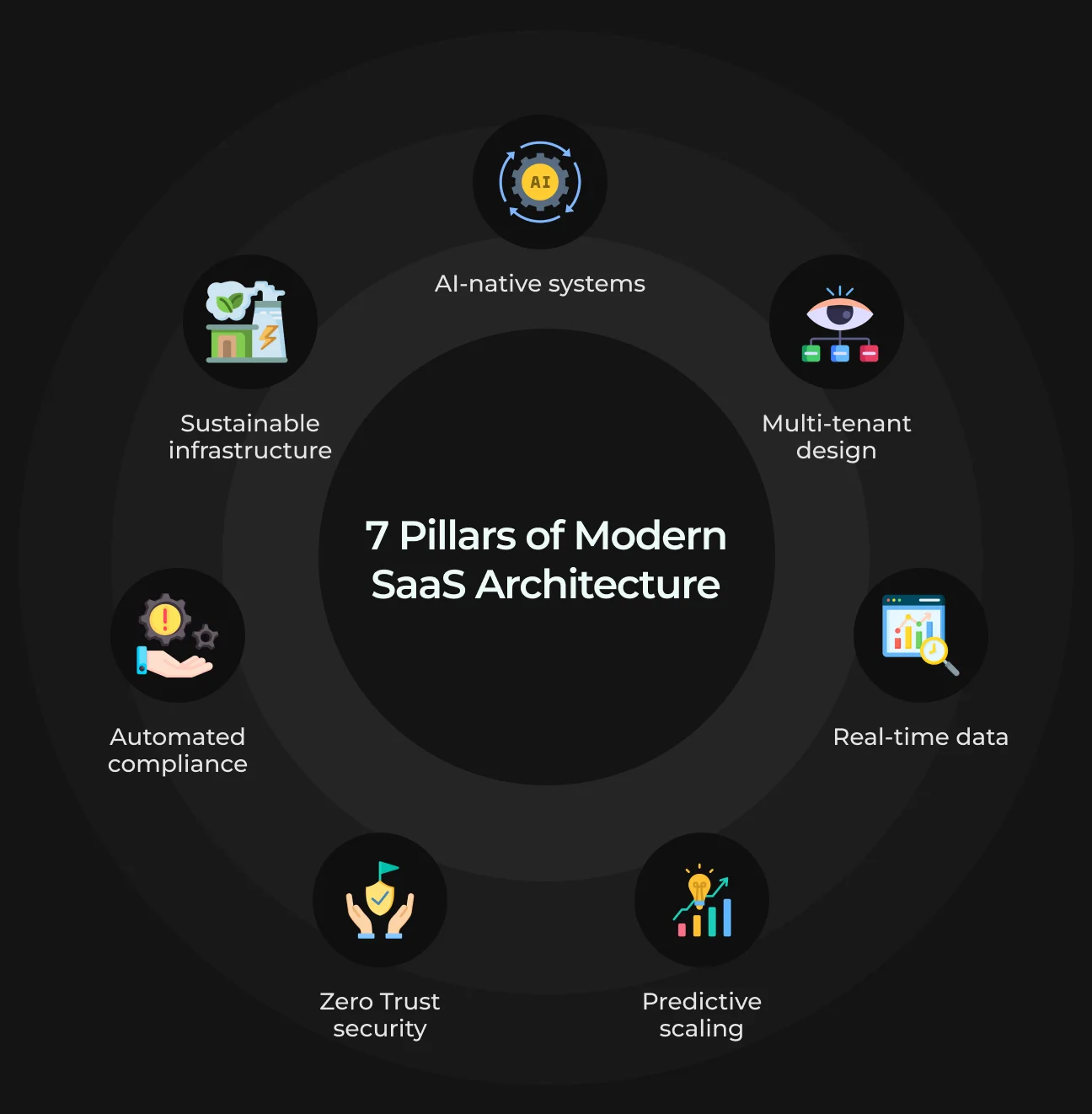
Modern SaaS architecture in cloud computing extends past the infrastructure options alone. These next seven pillars describe the architectural framing of large-scale SaaS platforms.
1. AI-Native Architecture: Building AI as the Core, Not an Add-On
In 2026, AI as a feature is a curse. Best-in-class SaaS applications have an architecture based on layers that maintains flexibility by separating concerns and implementing an AI-first approach.
In SaaS architecture, the biggest mistake is treating scalability as something you fix later. Once AI, tenant isolation, real-time data, and cost control enter the product, architecture becomes a business decision, not just an engineering one. The teams that win are the ones that design for growth, compliance, and operating costs from the first version.

Illya Vorobets
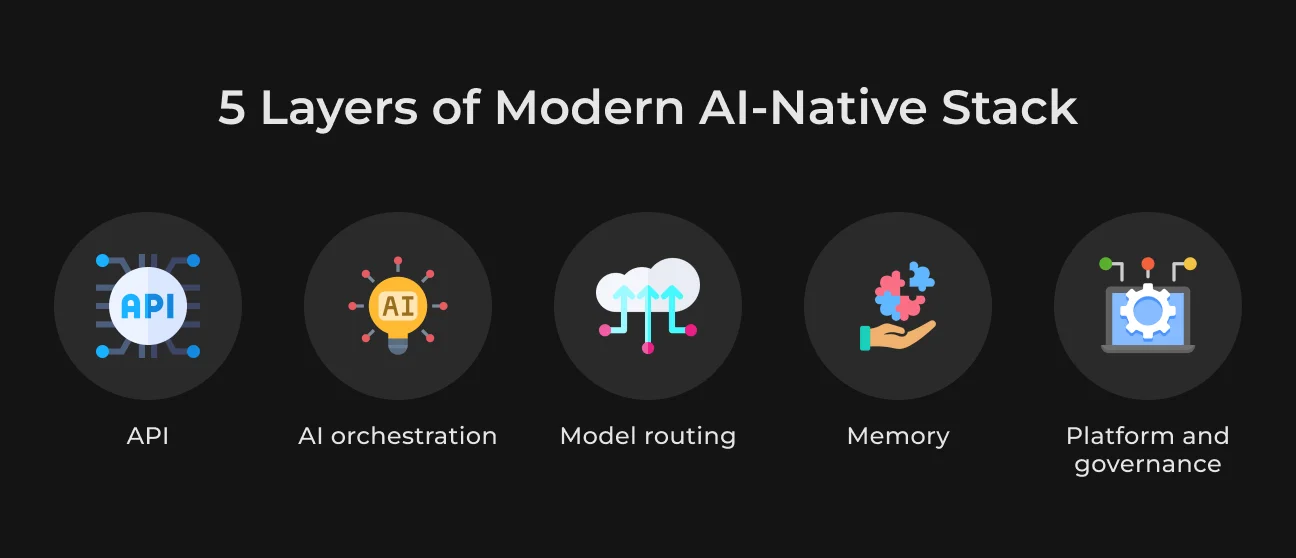
The modern AI-native stack generally has five layers:
- Product/API layer. This is where users and outside systems interface with your application. It exposes endpoints, UI flows, and integrations, but shifts all intelligence to lower levels rather than embedding logic;
- AI orchestration layer. This part handles your prompts, workflows, use of tools, and tasks related to their responses. It serves as the brain for AI usage throughout the product, enabling consistency, observability, and optimization;
- Model routing layer. It dynamically routes requests to models based on cost, latency, or task. This allows teams to tune performance and costs in real time instead of relying on a single provider;
- Memory layer. It includes vector databases, embeddings, and contextual memory systems. It helps applications fetch relevant knowledge, contextualize the conversation, and improve response quality over time;
- Platform and governance layer. This layer handles monitoring, security, compliance, and cost control. It ensures AI usage is auditable, safe, and aligned with business constraints.
2. Multi Tenant SaaS Architecture
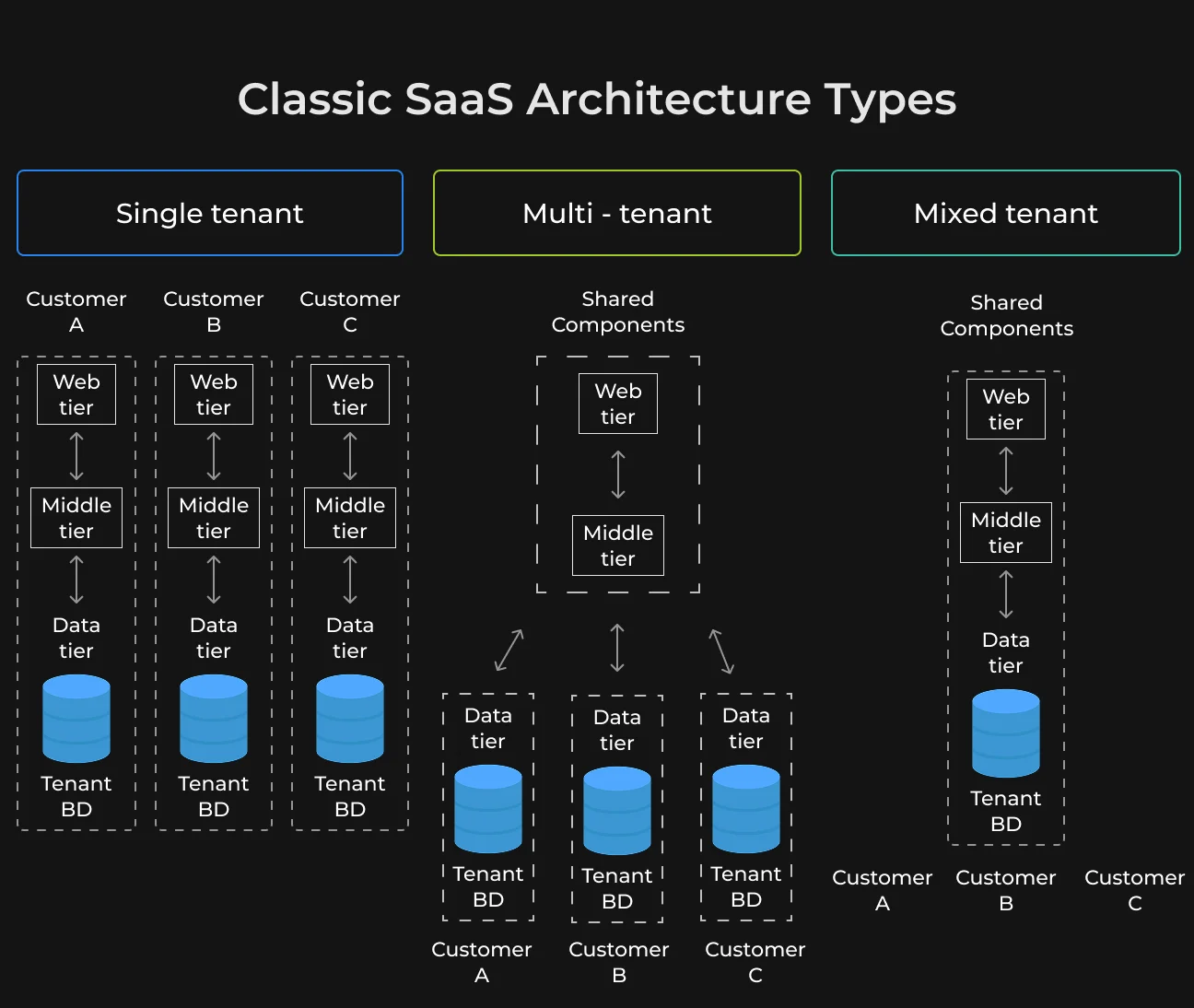
At the heart of SaaS scalability is multi tenancy. But with AI comes a new level of complexity, basically, with regard to data isolation and performance consistency.
There are three primary models:
Model | Decsription | Cost per tenant |
| Pool | Shared infrastructure and database | $50–$400 |
| Bridge | Shared infrastructure, separate schema per tenant | $150–$1,200 |
| Silo | Fully isolated infrastructure per tenant | $500–$5,000 |
AI-native systems introduce a new dimension: RAG isolation. It’s no longer enough to separate data at the database level. Isolation must exist across four planes:
- Data (raw records);
- Vector storage (embeddings);
- Orchestration (prompt logic and workflows);
- LLM interaction (context boundaries).
Another emerging challenge is the noisy neighbor problem. When tenants share AI infrastructure, one tenant’s heavy usage can degrade performance for others. Tenant-aware rate limiting and workload prioritization solve this by ensuring fair resource distribution.
The bridge model (schema-per-tenant) is the de facto standard for 2026 with growth-stage SaaS. It strikes a balance between cost and readiness for compliance. Choosing a tenancy model is one of those calls that resists change once a product has customers, which is why it belongs inside minimum viable product development rather than a later migration.
3. Real-Time Data Architecture: From Batch-and-Store to Stream-and-Reason
Batch processing is a core feature on which we buid traditional SaaS systems. That model breaks down in AI-native systems where context must be fresh and decisions happen instantly.
Streaming systems like Apache Kafka will help power real-time data fabrics that modern architectures depend on. New developments like KRaft protocol and incremental rebalancing (KIP-848) made Kafka scalable and able to handle very large scale, e.g., millions of partitions.
At the same time, vector databases have become a core componentю For example,
| Pinecone | Managed, large-scale production workloads |
| Qdrant | High-performance open-source vector search |
| Milvus | Billion-scale vector storage |
| pgvector | Simplicity within PostgreSQL |
| Weaviate | Hybrid search and semantic APIs |
A major evolution is the combination of knowledge graphs with vector search, often referred to as KG-enhanced RAG. This hybrid approach improves reasoning accuracy by combining semantic similarity with structured relationships.
For example, Lettria, an AWS partner, showed that adding graph-based structures to RAG workflows can significantly improve results — boosting answer accuracy by up to 35% compared to using vector search alone.
4. Scalability SaaS Architecture Diagram
Many SaaS systems still use reactive autoscaling — scaling up when we hit CPU or memory thresholds. But in 2026, large-scale systems will predict demand. And tools like KEDA (Kubernetes Event-Driven Autoscaling) allow you to scale on events, queues, and external signals.
Predictive scaling can forecast demand by using statistical analysis from time-series models. This reduces latency spikes and enhances user experience.
One of the simplest ways to save resources is to scale to zero. Instead of running services all the time, you shut them down when they’re not in use and start them again only when needed.
With KEDA, this is easy to set up and gives quick results. Idle computing just wastes money. So it’s best to apply this first to batch tasks or background jobs like image processing.
5. Zero Trust SaaS Security Architecture
The traditional security model built around network perimeters is losing its effectiveness because of many modern SaaS systems, all hosted in the cloud.
Actually, Zero Trust has a far simpler idea to it: never trust, always verify.
This is how that looks in practice:
- Protect surface mapping. Identify critical assets;
- Micro-segmentation. Isolate services and data stores;
- Identity-first controls. MFA and SSO across all systems;
- Device posture evaluation. Ensure trusted environments;
- Continuous monitoring. Detect and respond in real time.
AI brings new security risks. If systems are not properly isolated, data can be corrupted, prompts can be hijacked, and there is a risk of information leakage between tenants.
The teams then address these risks through filtering prompts, automated tests (known as red teaming), and rigorous data separation.
Micro-segmentation is a great first step. Harden your most important systems, one step at a time — isolate those core systems from the rest, and then whatever lies outside becomes easier to secure.
6. Compliance Automation: Engineering Trust as a Product Feature
Modern SaaS systems are built with some level of compliance from the very beginning. Platforms must be quite literally trained to talk this way about their security, transparency, and control. Not least once laws like the EU AI Act come into effect in 2026.
One new approach on the scene is the continuous digital audit twin (CDAT). This system eliminates the need for manual preparation for audits because compliance data is tracked and recorded in real time.
Platforms in this space typically include:
- Vanta for startups;
- Drata for enterprise environments;
- Sprinto for regulated industries;
- Hyperproof for compliance teams;
- SecureSlate for cloud-native workflows.
Enterprise clients usually ask for certifications like SOC 2 or ISO 27001, even before the procurement process begins. SapientPro integrates compliance into the architecture from the outset, ensuring you have a competitive advantage.
7. GreenOps and Sustainable Architecture: Carbon as a Technical Metric
Sustainability as branding is now also an engineering reality. Carbon impact is becoming a new metric for modern SaaS teams to analyze alongside cost and performance.
Basically, green engineering operates across three levels:
- Code. Programming languages differ significantly in energy efficiency. In some benchmarks, compiled languages like Rust outperform interpreted ones like Python by orders of magnitude in energy consumption;
- Architecture. Efficient system design reduces unnecessary computation. Lean, modular architectures minimize overhead and improve utilization;
- Infrastructure. Carbon intensity data has become accessible to teams from cloud providers, which empowers them to assign workloads considering energy footprint.
Carbon-aware scheduling is one of the simplest optimization techniques. High-priority workloads, for example, model training or batch processing, can be run at times when energy grids are cleaner.
Lower compute usage directly reduces infrastructure costs. Smaller models, better caching strategies, and efficient code all translate into lower cloud bills.
Frontend Architecture for High-Performance SaaS
Frontend architecture in all modern SaaS products goes beyond the UI rendering.
With product interactivity and complex AI, frontend systems need to be fast across devices, regions, and network conditions. That means performance has to be built into the architecture from the beginning, not later when issues occur.
Edge Computing and Middleware: Reducing TTFB to Milliseconds
A major technique to improve frontend performance is to move critical logic to the user. By processing requests close to the end user and not sending everything back to a central server, edge computing and middleware help speed up Time to First Byte (TTFB).
At the edge, you can handle things like authentication, redirects, localization, A/B testing, and personalization almost instantly. Instead of waiting for the backend, these decisions happen closer to the user, which makes your app faster and more reliable — especially for global traffic.
WebAssembly (Wasm): A Production-Grade Performance Multiplier
WebAssembly empowers frontend teams to run almost native performance code inside the browser. This is invaluable for high-throughput SaaS applications where the product itself includes heavy client-side tasks (real-time data processing, image editing, video rendering, analytics, encryption, and AI-assisted entry).
Instead of going on to do everything in JS, teams can simply leverage Wasm for the parts that require it from a performance standpoint. And leave all else in its natural place within a traditional frontend stack.
SaaS Business Architecture to Align Tech Decisions With Revenue Models
The best SaaS products are more than simply the result of technology choices. Architecture must enable the product to earn money and scale revenue over time. This connection is more solid than ever through 2026.
This is typically where most teams start to go astray. They think about optimizing for performance or speed but neglect to see how their decisions impact margin. This can result in a great product with no sales.
Usage-Based Pricing and Consumption Engineering
SaaS pricing is changing. With AI products, costs aren’t fixed — they depend on usage, like API calls, tokens, or compute time. And this is the reason why flat subscriptions fail at scale.
There is a growing trend of shifting to usage-based or hybrid pricing, which is far better aligned with how customers use the product.
Here’s how the main models compare:
Model | How it Worls | Best Fits |
| Usage-based | Pay per request, token, or API call | APIs, AI tools, infrastructure products |
| Hybrid | Base subscription + usage overages | SaaS platforms with variable usage |
| Outcome-based | Pricing tied to results or value | Automation, AI agents |
| AI credit bundles | Prepaid credits for AI use | LLM-powered products |
You can’t support usage-based pricing without knowing exactly how resources are being consumed in real time. That means:
- Real-time metering of usage (API calls, tokens, compute);
- Cost visibility across services and tenants;
- Infrastructure that can scale up and down (especially GPU workloads).
Basically, this is all about the concept of consumption engineering. A partnership of engineering and finance involves designing systems with closely aligned cost, use, and pricing. Reliable tech teams, like SapientPro, build cost-aware systems from the infrastructure up.
API-First and Composable Architecture
Composability is also one of the new major paradigm shifts around SaaS. This changes how products grow. For example, when every capability is API-first:
- New features can be reused across web, mobile, and integrations;
- Partners can build on top of your platform faster;
- Enterprise clients can integrate your product without heavy customization.
It makes you many times faster in terms of time-to-integrate, which is one of the biggest blockers in enterprise sales. It also future-proofs the product. API-first systems can absorb new technologies with ease, be they a new AI model, an edge environment, or a device, without the need for expensive rewrites.
SaaS Architecture Checklist: What to Prioritize in 2026
The checklist below comes as a prioritized roadmap that simplifies our seven architecture pillars.
Focus Area | Phase 1: Do Now | Phase 2: This Quarter | Phase 3: Next Year |
| AI strategy | Standardize connections: Set up your AI so you can switch providers easily and don't get locked into one vendor | Control and quality: Start tracking different versions of your AI instructions (prompts) to keep results consistent. | Internal platform: Create a toolkit so that your team can deploy new AI capabilities faster than the competition. |
| Costs | Monitor usage: Have real-time meters to quantify (in AI fees) how much each customer actually costs you. | Create dashboards: Write straightforward reports, connect what money you are spending on tech with the revenue you are generating. | Dynamic pricing: Based on the value that users really get out of your services, you could offer more creative pricing models using the data you have. |
| User privacy | Isolate data: All customer data must be isolated and secure. | Manage traffic: Take steps to ensure one user doesn't make the system sluggish for everyone else. | Offer premium security: Provide enterprise-level isolation for customers who require their very own personal space. |
| Performance | Instant response: Move key logic closer to the user so the app feels fast and responsive. | Real-time flow: Update your data systems. So information moves instantly rather than waiting for page refreshes. | Global scale: Build an architecture that is fast and reliable for users anywhere in the world, regardless of traffic. |
| Intelligence | Search by intent: Leverage vector tech so your search knows the intent behind a query rather than just its keywords. | Add more context: Cross-reference your data points to give the AI an understanding of how one bit of information relates to another. | Collective learning: Get better models based on trends throughout the app. |
| Efficiency | Remove waste: Find and shut down unused resources to lower your monthly cloud bill. | Predictive scaling: Use automation to grow your system before a rush happens. | Sustainability: Optimize your code to use less energy. |
| Security | Verify everyone: Shift to Zero Trust and verify every login and action. | Automate audits: Leverage tools for security compliance (SOC 2) so that you are audit-ready at any time. | Proactive defense: Use AI-enabled security that reacts to hackers before they can act. |
How to use this checklist:
- Phase 1. Focus on what you do now. These steps prevent technical debt and security risks from hurting your reputation early on;
- Phase 2. Focus on quarterly efficiency. This allows your business to be profitable. And for your team, it means they can help more users without a greater burden;
- Phase 3. Focus on strategy. These are the moves that turn your technology into a major competitive advantage.
Best practices only hold when someone owns the decision to depart from them. Teams between technical leads often retain a fractional CTO, which keeps architecture accountability in one place.
Common SaaS Application Architecture Mistakes to Avoid
What seems like a perfectly fine architectural decision at a small scale tends to become expensive, slow, or risky at scale. These are the general architecture mistakes to avoid while working with your SaaS system.
Treating AI as a Feature, Not a Layer
Many teams approach AI as a feature on top of an existing system instead of designing with it. This normally results in weak integrations that behave inconsistently and cannot be scaled.
AI-native products need a layer for orchestration, memory, and management of models. And without it, every new AI feature becomes increasingly more difficult to maintain or evolve.
Using a Single Multi Tenancy Model for All Customer Tiers
Choosing one setup for all customers involves a dilemma between price and privacy. What is good enough for small customers may not be sufficient to meet the needs of enterprise clients.
As products grow in adoption and use, you generally require more flexibility. For example, a co-located model for smaller tenants and more hardened environments for regulated customers.
Otherwise, you either invest too much in infrastructure or are unable to close larger transactions.
Reactive Scaling Without Predictive Forecasting
Standard scaling (waiting for CPU or memory to max out) is too slow for unpredictable AI workloads. By the time a system reacts to a sudden spike, users are already experiencing lag and errors.
Predictive scaling can fix this by preparing resources in advance, rather than just reacting to trouble. Research shows that predictive models can identify the optimal resource setup for up to 87% of unseen workloads.
Compliance as an Afterthought (Especially Post EU AI Act)
If we see compliance as something to worry about later, we literally set a cap on how far we can grow.
New regulations, like the EU AI Act, will require businesses to show transparency and auditability in their systems, as well as control of those systems right from the start.
Ignoring Cross-Tenant Data Isolation in RAG Systems
RAG systems add new risks, which many teams underappreciate. If the two tenants do not have strong isolation, embeddings or prompts can leak context between tenants even if databases are separated.
It was found that roughly 45% of AI news-related queries contained inaccuracies or errors. Without strict isolation, these errors can expose sensitive data.
Building Vendor Lock-In Into Your AI Orchestration Layer
Being too tied to any one provider of AI will limit flexibility and eventually increase costs as time goes on. Models change rapidly, pricing is not fixed, and new players enter the marketplace.
As soon as your architecture is tightly coupled to a single vendor, the switch becomes slow and expensive.
How SapientPro Architects SaaS Systems Built to Scale
SaaS products rarely break because of one bad technical decision. They break when architecture cannot keep up with the business.
AI costs grow faster than expected. Data pipelines become harder to control. Small feature updates start affecting system performance. Over time, every new release takes longer, and scaling becomes more expensive than it should be.
At SapientPro, we treat architecture as a product growth layer, not just a technical foundation. Our teams build SaaS systems with scalability, cost control, performance, and future AI capabilities in mind from the first release.
A good example is Contentoo.
SapientPro helped build the MVP on a simple but scalable architecture, even with a limited budget. That foundation made it possible to add more complex functionality later, including freelancer onboarding, financial automation, and tools for managing quality and messaging.
The product expanded to 18 countries, grew from 1,900 to 3,000 users in one year, and supported a €6M funding round.
Another example is MasTrack.
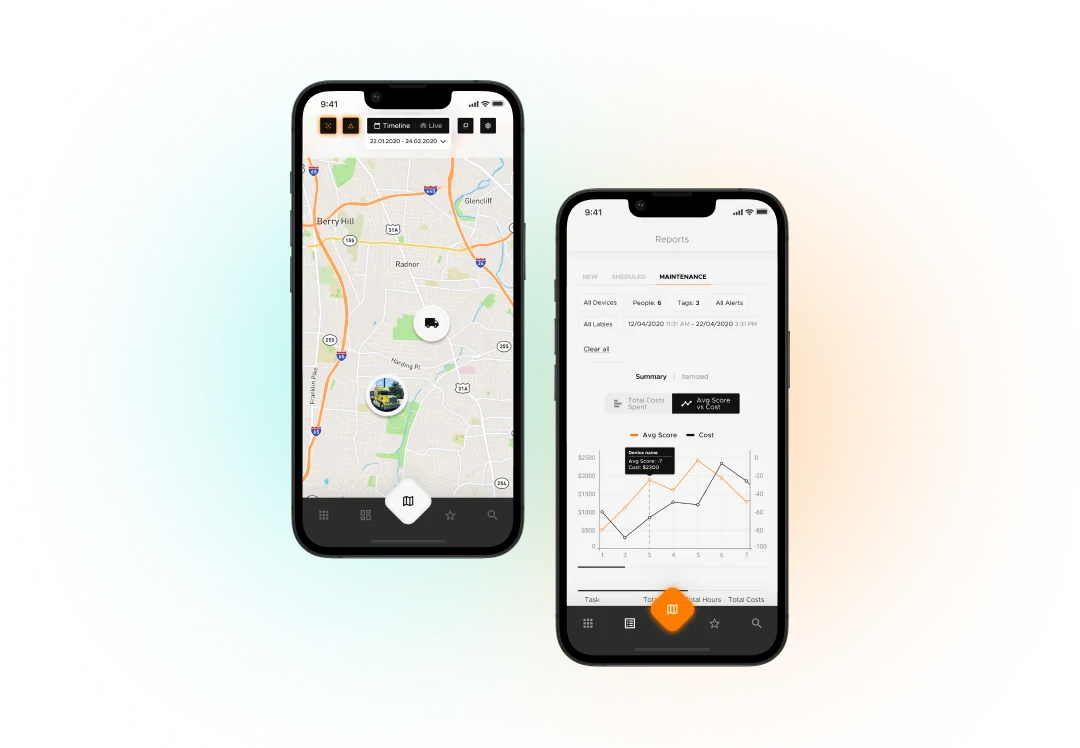
The company needed to move beyond a legacy system that could no longer support real-time performance. Instead of adding temporary fixes, SapientPro rebuilt the platform into a high-performance GPS tracking system with real-time insights and up to 10x faster operations.
The new architecture improved speed, reliability, and scalability, helping the business grow subscriptions by 30%.
Partner with SapientPro to Build Your SaaS Product
SapientPro helps teams design and build scalable SaaS products that are ready for real users, growing workloads, and changing business needs.
Whether you are launching an MVP, modernizing a legacy system, or adding AI capabilities to an existing product, we help you build the architecture behind sustainable growth: fast, reliable, cost-aware, and ready to scale.
Let’s turn your SaaS idea into a product built for long-term growth.
Plan Your SaaS Architecture Right
Get expert guidance from SapientPro before infrastructure limits your product growth.