All Smart Contract Security: Vulnerabilities, Exploits, and How to Prevent Them
July 24, 202615 min read


Smart contract vulnerabilities drained over $840 million from DeFi protocols in the first five months of 2026 alone, across more than 50 distinct malicious incidents. That's a 70% year-over-year jump in financial damage compared to the same period in 2025.
Bridge infrastructure now holds over $21.94 billion in total value locked. These cross-chain systems account for roughly 40% of all stolen value in the history of decentralized finance, and the number keeps growing because developers connect unverified protocols together without mapping the resulting risk.
Adjusted total incoming illicit cryptocurrency activity rose to approximately $158 billion in 2025, reversing a multi-year decline. Attackers now run automated decompilers across thousands of deployments, finding mistakes before the engineers who wrote them even know they exist.
Understanding these smart contract security threats isn't optional. By the end of this guide, you'll know how to structure your development cycle to shut down these attacks before they empty your treasury. We'll walk through the vulnerabilities that keep showing up in the incident reports and what actually stops them.
Why Smart Contract Exploits Are So Destructive
What happens when a protocol gets hit for a massive sum? Many founders assume they can pause the system, patch the bug, and carry on. The reality is worse than that. Direct losses hit immediately, then token prices crash and liquidity pools dry up within minutes.
Recovery is close to nonexistent in decentralized finance.
Once a hacker routes funds through a mixer, they're gone. No central authority can reverse the transactions because the code executes autonomously on-chain. That structural finality makes every exploit permanent, leaving the affected team with bad debt and a broken reputation.
These flaws are well documented across the industry, and teams still miss them under rushed production schedules. Most projects only go looking for blockchain security solutions after the exploit has already happened, and by then the damage is done. In our experience, known vulnerabilities get ignored repeatedly because speed to market wins out over safety.
The shadow contagion effect is what makes 2026's attacks uniquely dangerous.
The KelpDAO rsETH bridge exploit in April 2026 produced $292 million in direct losses. Aave V3 had accepted rsETH as collateral, and the root flaw sat two hops upstream from Aave in the dependency graph. Within 36 hours of the exploit, Aave Ethereum Core liquidity contracted by roughly $6.6 billion.
A localized breach becomes a systemic crisis almost instantly, and institutional capital reacts violently when it does. Basis trade compression and funding carry disruption followed the April exploits: the annualized CME basis dropped sharply, triggering a broad unwind of institutional basis positions.
Perpetual funding rates stayed negative for over 46 consecutive days, which weighed directly on lending activity across the board. Technical failures dictate macro market mechanics now. That's the case for proactive blockchain security over reactive cleanup.
Most Common Smart Contract Vulnerabilities in 2026
Rushed teams often gloss over major blockchain security issues to speed up launch.
In this section, our team breaks down the common smart contract vulnerabilities.
Access Control and Input Validation Failures
A single access control failure can wipe out years of work.
Developers forget to restrict critical functions, and anyone can call an admin function that's missing the right modifiers. Input validation failures cause equal damage: a program trusts external parameters blindly, skipping checks for zero addresses or negative values.
Recent hacks caused by problems with access control in Web3 projects:
Target Protocol | Stolen Value | Attack Vector | Date |
| Wasabi Protocol | $5M | Compromised deployer admin key | April 2026 |
| TrustedVolumes | $6.7M | Missing allowlist controls | May 2026 |
| Hyperbridge | $2.5M | Forged admin transaction | April 2026 |
| Foom Cash | $2.3M | Logic and access control flaw | March 2026 |
| Dango | $1.9M | Missing positive integer check | April 2026 |
Address poisoning and malicious approvals is just as damaging.
Attackers tricked users into signing off-chain messages, stealing $1.51 billion in 2025, with address poisoning alone accounting for another $52.41 million. These tactics manipulate human behavior rather than code, so the defense has to include strict parameter checks and visual warnings baked into the interface.
Oracle Manipulation and Flash Loan Attacks
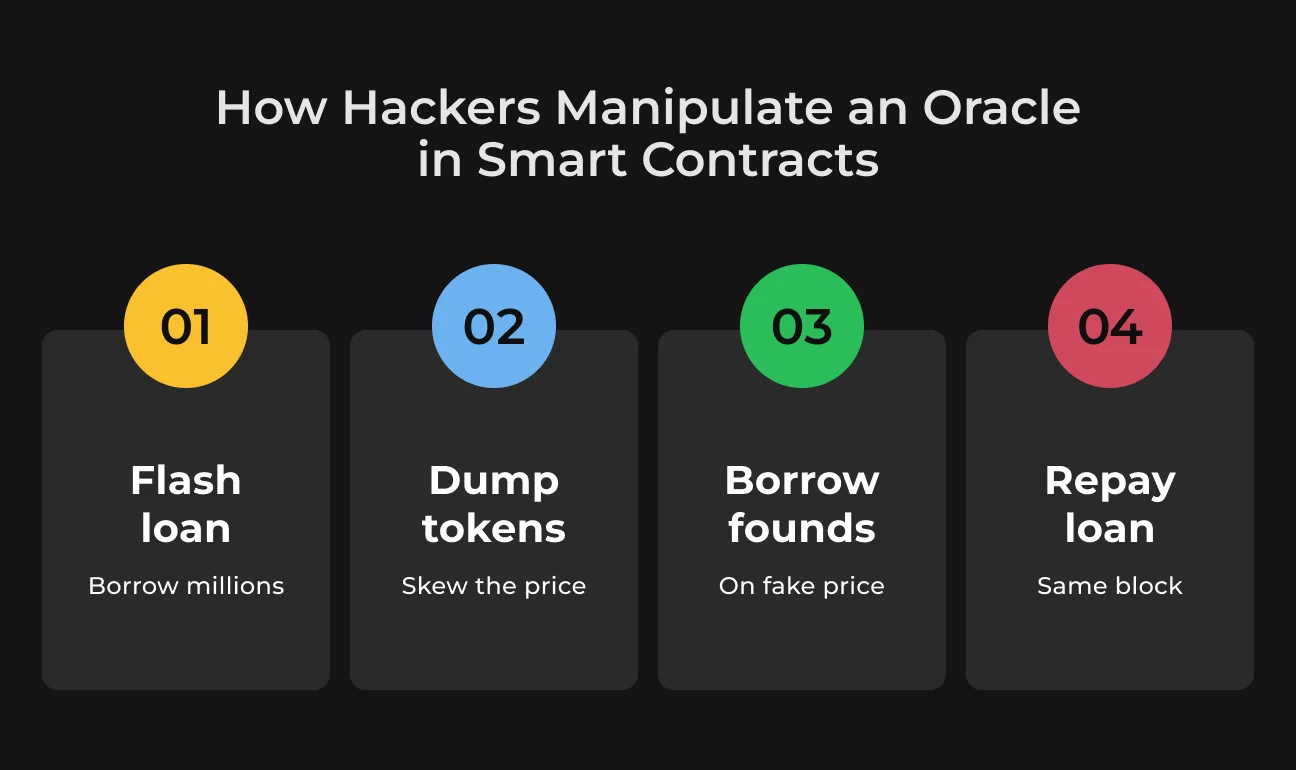
Oracle manipulation is brutal. A protocol pricing collateral off a simple Uniswap spot price is asking for trouble. The attack pattern is consistent:
- Use flash loans to borrow millions;
- Dump tokens into a low-liquidity pool to distort the spot price;
- Borrow against that fake valuation;
- Repay the loan in a single block.
If a system breaks the moment someone shows up with enough capital, it has a fatal design flaw.
Recent examples:
- Polter Finance priced its BOO market directly from SpookySwap liquidity pools. An attacker skewed the reserves, posted the token as collateral at a fictional value, and walked away with the profit.
- UwU Lend lost $19.4 million to similar Curve spot manipulation.
- Venus Protocol accumulated $2.15 million in bad debt from Thena token manipulation.
- YieldBlox lost $10.2 million when an attacker inflated collateral values on Stellar.
- TMM on Binance Smart Chain lost $1.6 million to reserve manipulation.
- Bunni lost $8.4 million to a repeated flash loan loop.
Time-weighted average prices and L2 sequencer uptime checks are what keep oracle feeds honest. Skip either one, and you're pricing collateral off a number an attacker can move in one transaction.
Unverified Contracts and Integer Overflows
Unverified code caused $36.7 million in losses early this year. Cetus Protocol lost $223 million to a Move-language overflow, and Aperture Finance and Ekubo suffered similar fates with hidden code.
Truebit lost $26.4 million to an integer overflow in an old Ethereum deployment. The pricing function, compiled with Solidity v0.5.3, lacked automatic overflow checks. An unguarded addition wrapped around to near-zero when called with a large enough value, and the attacker minted millions of tokens for free.
Decompilers and AI tools make it easy to find these vulnerabilities on-chain now. Attackers reverse-engineer hidden logic without much effort, and obscurity buys you nothing. Proxy contracts hiding bugs get hunted down actively, not eventually.
Smart Contract Security Best Practices 2026: What Actually Works
Applying smart contract security best practices in 2026 protects your treasury against novel attacks.
Design Phase: Threat Modeling and Access Control Architecture
The KelpDAO bridge exploit exposed a 1-of-1 verifier configuration failure. Radiant Capital lost $50 million to state-sponsored social engineering. Both cases point to the same lesson: Web3 security has to start at the design phase, not after launch.
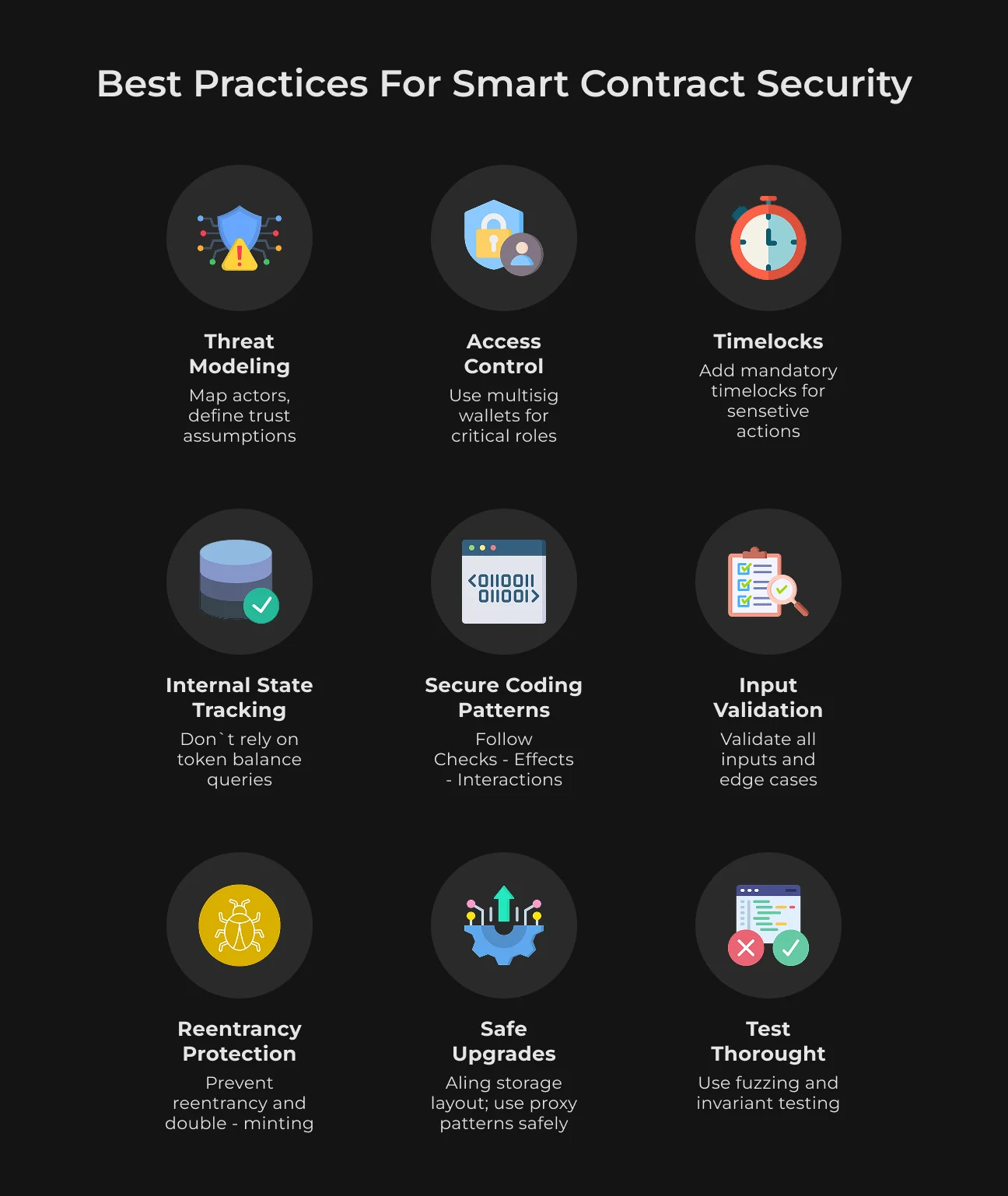
Safety starts on the drawing board. Your technical team needs to map out every actor and define trust assumptions before writing a single line of Solidity. Role-based access control should be spread across multiple multisig wallets. A compromised single admin key means the protocol is toast.
Drift Protocol lost $285 million in April 2026 after attackers ran a six-month social engineering campaign against multisig signers. The Security Council had migrated to a 2-of-5 configuration with zero timelock, and the attackers drained the funds five days later. A mandatory timelock gives the community a real window to react before funds move.
Development Phase: Patterns That Block Known Exploits
Never trust token balances directly.
Use internal state trackers instead, because direct token transfers can manipulate balance queries. Double-minting errors are a real risk here: Solv Protocol lost $2.7 million to a self-reentrancy flaw handling ERC-3525 deposits.
Delegatecall functions need extreme caution, and storage slots have to align perfectly across proxy upgrades. Don't reorder variable types. Commit-reveal schemes and batch auctions protect users from front-running. Rhea Finance lost $18.4 million to a bug in its slippage protection, and Aftermath Finance lost $1.14 million to a flaw in its fee system.
SapientPro's smart contract development follows the Checks-Effects-Interactions pattern on every build:
- Validate inputs first
- Update internal state next
- Perform external transactions last
This order blocks reentrancy attacks by design.
Testing: Fuzz and Invariant Testing Are Not Optional
Unit tests aren't enough on their own. Engineers need stateful fuzz testing, throwing thousands of random inputs at functions to surface edge cases nobody thought to write a test for.
Invariant testing matters even more, because it checks that economic rules hold under pressure — total debt should never exceed total posted collateral, and the fuzzer's job is to try to break that rule. A broken invariant is a critical exploit path waiting to be found.
When to Get a Smart Contract Security Audit and How to Prepare
Scheduling an external review must happen before any mainnet deployment. It must also happen after any significant upgrade. Not just once. Your team must prepare your codebase properly to reduce the time needed for a smart contract security audit.
Preparation Step | Purpose | Required Threshold |
| Code Freeze | Prevents shifting targets during review | Exact commit hash locked |
| Test Coverage | Ensures basic functions work as intended | Minimum 95% |
| Documentation | Explains role assumptions and math | Full architectural diagrams |
| Static Analysis | Catches syntax errors and basic flaws | Zero linting errors |
Good preparation lets auditors spend their time on complex logic instead of surface-level issues. SapientPro's smart contract audit service helps teams structure and prepare codebases before external review and supports upgrade reviews after launch.
Secure Your Smart Contract Before Launch
Get an audit-ready codebase and catch vulnerabilities before attackers find them first.

Why Infrastructure & Operational Security Is Part of Web3 Security
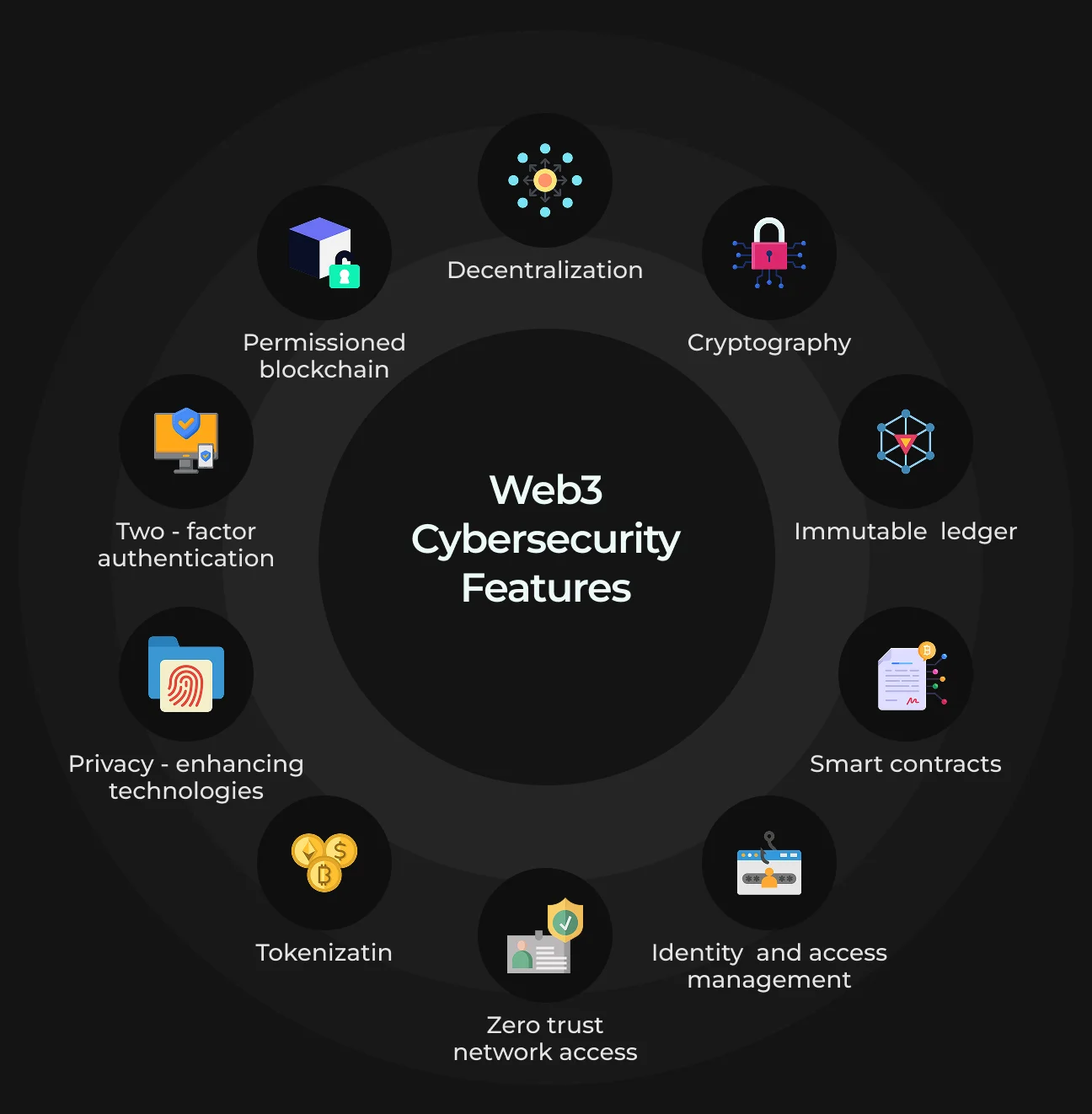
Many teams secure the code and nothing else. Indeed, securing decentralized platforms requires combining on-chain and off-chain blockchain security solutions.
Cloud and key infrastructure are a major blind spot.
The Resolv protocol lost $26.8 million in March 2026 after an attacker compromised its AWS Key Management Service and signed unauthorized minting requests for 80 million USR stablecoins. A secure application sitting on top of a compromised key manager is still fully exploitable.
DNS and domain hijacking deserve just as much attention because they bypass technical defenses entirely. CoW Swap lost $1.2 million in April 2026 to a DNS attack. The application logic was untouched; users were simply redirected to a malicious interface through a compromised DNS registry. One vulnerability in a domain registrar was enough to compromise trust in the whole platform.
The Axios NPM package compromise let attackers distribute a remote access Trojan to developer machines, hijacking deployer keys before the code ever reached the blockchain. Disabling install scripts globally and enforcing strict allowlists is a baseline defense. Tools like LavaMoat isolate dependencies to prevent unauthorized code execution.
Other notable exploits that highlight the necessity of Web3 security:
- Step Finance lost $27 million to compromised deployer keys on Solana;
- IoTeX lost $8.9 million when private keys controlling a cross-chain bridge were stolen;
- PlayDapp lost $36 million due to a private key phishing attack.
AI-enabled scam operations are 4.5 times more profitable than non-AI campaigns, and impersonation attacks surged 1400% year-over-year.
Real-time on-chain monitoring tools like Forta, Tenderly, or OpenZeppelin Defender need to run alongside automated circuit breakers. Monitoring without a pause mechanism only covers half the problem: if you spot an anomaly but can't pause the contract, your response window may be seconds.
Once funds reach an exchange, that window narrows to roughly 10-15 minutes. Attackers move stolen funds through multiple hops in 99% of cases, which is exactly why that window is worth protecting.
How SapientPro Integrates Smart Contracts in Business
SapientPro offers custom smart contract development solutions for retail and trading projects.
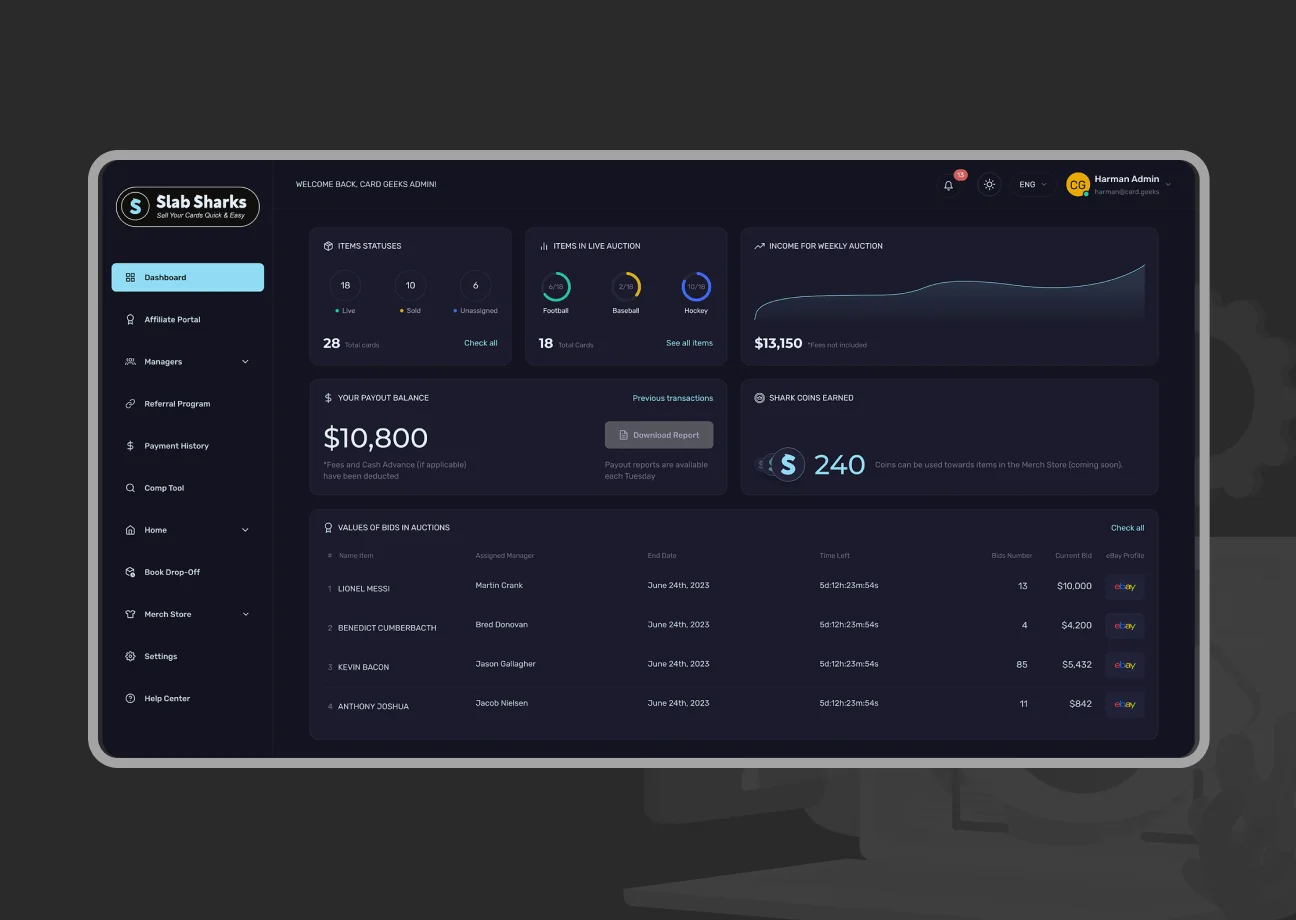
For Slabsharks, our team digitized a Canadian consignment business for sports cards. The platform connects to the eBay API, manages payout rates transparently, and tracks sales through real-time dashboards and mobile apps, with product data updating live to keep prices and bid counts accurate.
For the Steam Items Marketplace project, our engineers built a secure skin trading platform where CS2 players buy and sell in-game skins for USDT.
We developed on-chain checkout flows specifically for this use case, with Steam bots handling inventory interactions and transfers automatically, bypassing traditional restricted limits. The checkout itself stays minimal so users complete purchases without friction.

Summary
Smart contract security in 2026 covers code, infrastructure, governance, and real-time response, not just the contract itself. Skipping any one of those leaves an opening.
Most teams that get hit treated blockchain security as a one-time chore instead of an ongoing practice. Assessing both on-chain and off-chain threat vectors together is what actually reduces protocol risk.
If you're building or planning to deploy on-chain, the question isn't whether to invest in defense. It's when in the build process you do it. Earlier is cheaper.
Partner with SapientPro for Smart Contract Development
Launching on-chain without a security-first build process is how protocols end up in the incident tables above. SapientPro works with founders and CTOs to build smart contracts that hold up under audit and under attack.
Our team can help with:
- Custom smart contract development;
- Smart contract audits and pre-audit codebase preparation;
- Blockchain due diligence for teams evaluating a protocol, integration, or acquisition;
- Blockchain asset management systems for tracking and securing on-chain holdings;
- Infrastructure and operational security reviews.
Reach out to discuss your technical requirements.
The earlier security work happens in your build process, the less it costs you later.
Build Smart Contracts That Survive Audits
Work with engineers who follow the Checks-Effects-Interactions pattern on every deployment.