All How to Create a Cardano Smart Contract: Blockchain Development Guide for 2025
September 25, 202515 min read


Cardano has quickly grown into one of the most discussed cryptocurrencies for its ability to support smart contracts. Founded by Charles Hoskinson, one of Ethereum’s co-creators, Cardano stands out for its research-driven approach and focus on long-term growth.
A key milestone in its journey came in September 2021, when ADA soared to an all-time high of $2.96 after the Alonzo upgrade unlocked smart contract functionality, fixating Cardano’s position as a serious contender to Ethereum.
In this article, SapientPro’s experts break down the essentials of Cardano: how it works, what makes its smart contracts unique, and a step-by-step look at creating your own.
What are Cardano Smart Contracts?
The blockchain industry is evolving, and we're now entering the era of Blockchain 3.0. Cardano is a platform gaining close attention in this new phase because it helps with challenges like scalability and privacy. It’s a decentralized open-source platform that many see as an improved version of Ethereum. It provides robust support for decentralized applications.
Charles Hoskinson, who left the Ethereum team in 2014, created Cardano to develop a commercial blockchain. It aims to outperform Bitcoin and Ethereum by being more interoperable, scalable, and sustainable.
One of Cardano’s major innovations is its consensus mechanism. Instead of relying on Bitcoin’s energy-intensive proof of work (PoW), it leverages a proof of stake (PoS) protocol, making this technology both greener and more efficient. Combined with its unique multilayer architecture grounded in detailed academic research, Cardano has positioned itself as a leader in the cryptocurrency world.
Key Features of Smart Contracts on Cardano
Cardano now has over 1,300 projects and has handled beyond 94 million transactions.
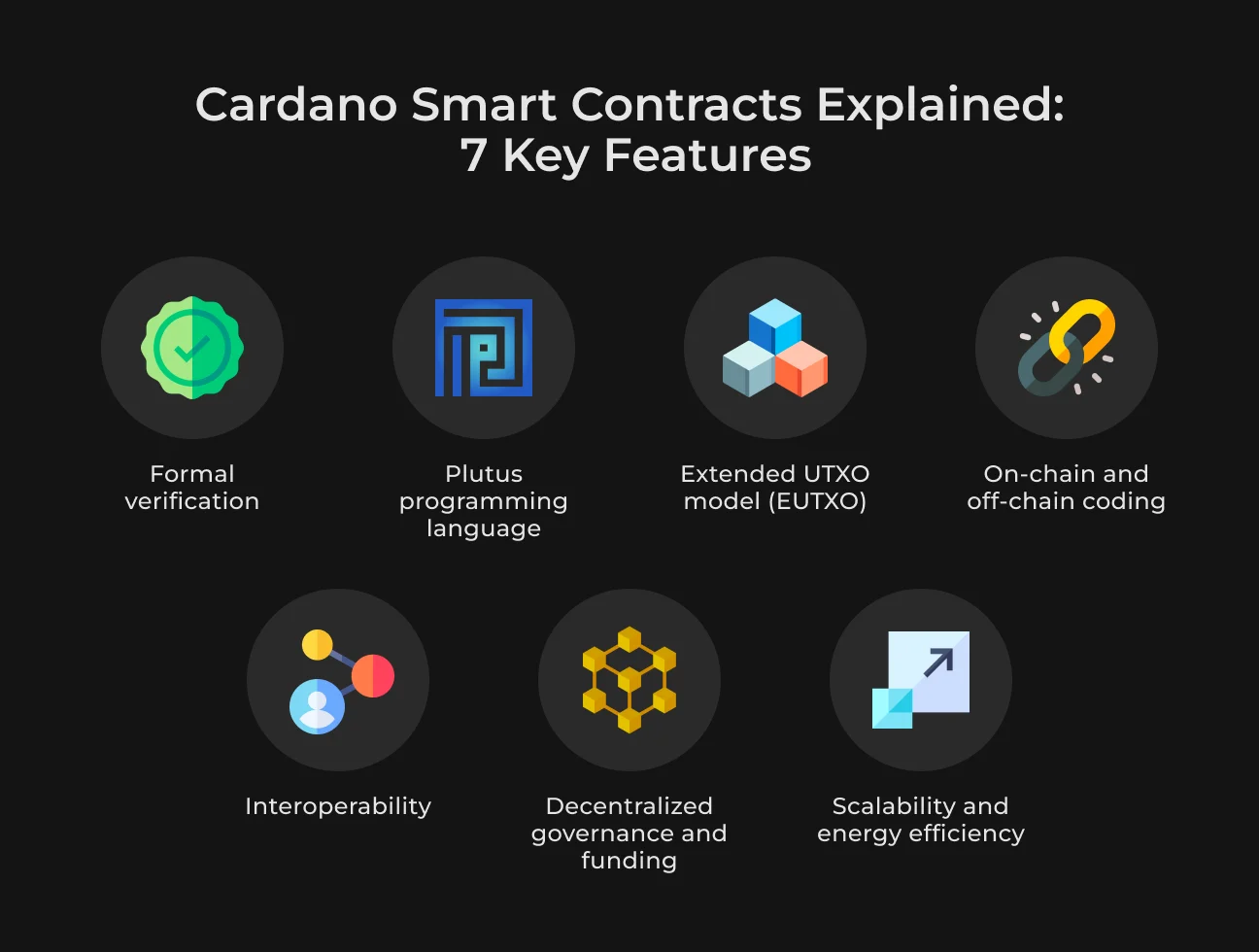
Check out what unique features make Cardano popular and distinguish it from other platforms:
- Formal verification: Cardano focuses on security and reliability by using formal verification, a mathematical method to confirm that smart contracts work correctly. This helps ensure the contracts do what they're supposed to and lowers the risk of errors;
- Plutus programming language: Cardano smart contracts use Plutus. It’s a programming language that uses Haskell's reliability to build safe and clear code for developing software applications;
- Extended UTXO model (EUTXO): Cardano's smart contract system is based on an Extended Unspent Transaction Output (EUTXO) model. It improves Bitcoin's UTXO model by allowing smart contracts. With EUTXO, there are several benefits like parallel processing, predictable outcomes, more complex transactions, improved scalability, and stable costs;
- On-chain and off-chain code: Plutus-based contracts consist of on-chain code, which runs on the blockchain, and off-chain code that runs on user devices. This setup increases efficiency and simplifies interaction between the blockchain and external systems or users;
- Interoperability: Cardano can connect with other blockchains and systems. Its layered design allows for upgrades without causing issues, which keeps everything compatible as it grows and changes;
- Decentralized governance and funding: Cardano uses a system called Project Catalyst to manage governance and development in a decentralized way. It lets the community propose and vote on funding projects;
- Scalability and energy efficiency: Cardano improves scalability with its Ouroboros proof-of-stake system. This approach uses less energy than traditional proof-of-work systems, allowing the blockchain to manage many smart contracts and transactions.
Cardano’s academic research and peer reviews create a secure platform for smart contracts. It combines the benefits of decentralized finance (DeFi) with the ability to scale globally and follow regulations.
Programming Languages Used for Cardano Smart Contracts
Here's a closer look at the programming languages used and why Cardano is a strong platform for smart contracts.
Plutus
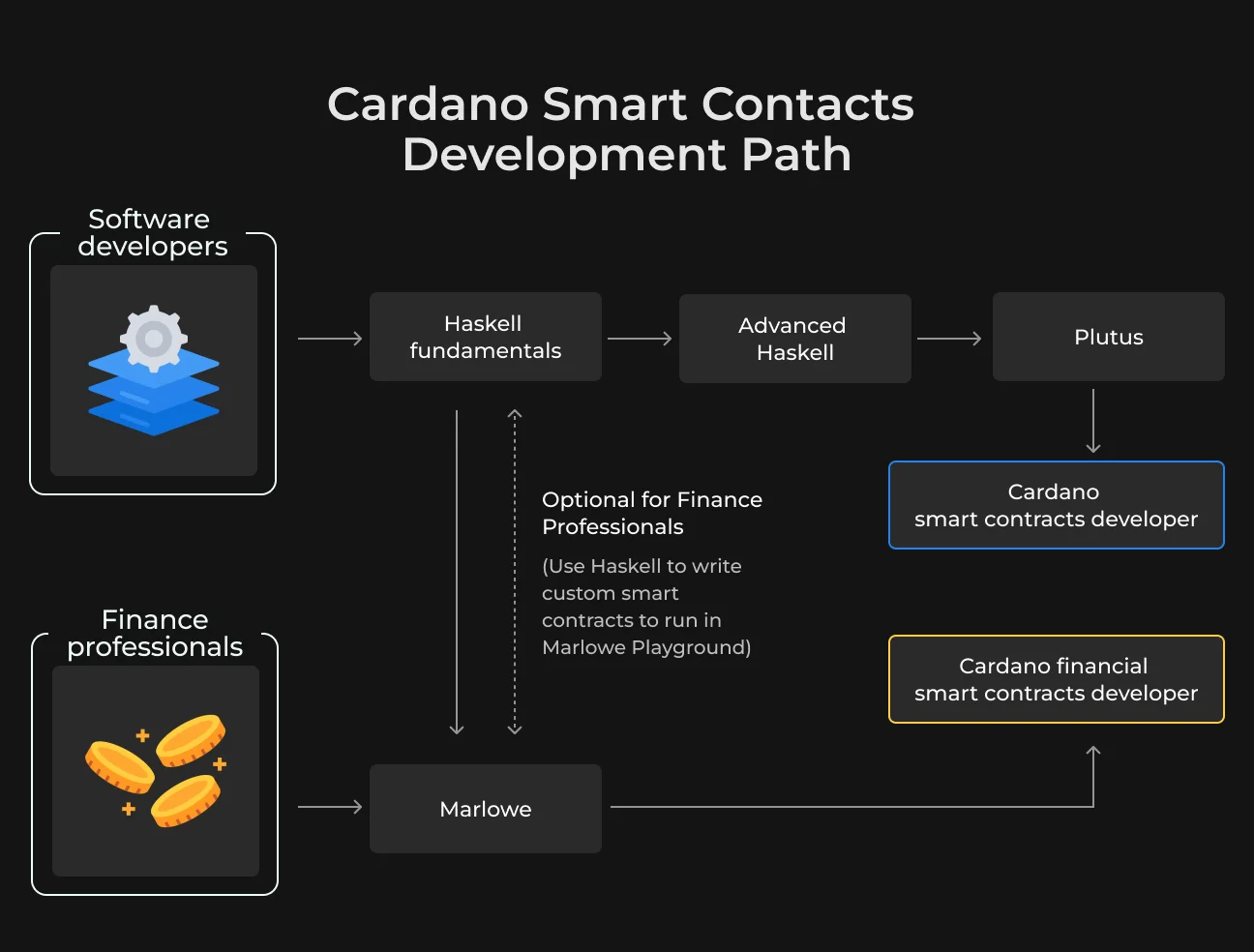
Plutus is the main language used to write smart contracts on the Cardano platform. It's based on Haskell, which means Plutus contracts are actually Haskell programs. This setup ensures your smart contracts work correctly, using advanced research and the secure environment of Haskell, a top functional programming language.
The number of Cardano Plutus scripts increased by 16.42%, rising from 113,786 to 132,474.
You can use the Plutus Application Framework (PAF) to create off-chain code and compile it with the Glasgow Haskell Compiler (GHC). The Plutus compiler takes care of compiling the on-chain code into Plutus Core.
Haskell
Haskell is a functional programming language that uses functions to manage data instead of changing variables or using objects. This approach simplifies expressing complex ideas. A major feature of Haskell is its purity, meaning functions don't cause side effects.
A big plus of Haskell is its static type system that checks types before running the program, ensuring the code is reliable. Because of this, Haskell is great for systems like the Cardano blockchain, where accurate and secure code is important.
Marlowe
Marlowe is a collection of open-source tools that simplify creating, testing, and using secure smart contracts on the Cardano blockchain. It's designed to be user-friendly for developers of all skill levels, offering simple ways to build smart contracts. Marlowe is based on peer-reviewed research, with formal proofs and thorough testing to ensure its safety.
Marlowe works with several programming languages like JavaScript, TypeScript, and Haskell. It also has a Blockly editor for visual programming.
Why Is Cardano Used for Smart Contacts
Smart contracts on Cardano are rapidly gaining traction due to their scalability, energy efficiency, strong security, and innovative architecture. This growth shows Cardano’s growing role as a key hub for decentralized applications and DeFi projects.
The ecosystem itself is expanding quickly. Cardano wallets recently grew by 4.28%, surpassing 5.3 million, with an average of 2,275 new wallets created daily. At the heart of Cardano’s smart contract system is a unique two-part design.
The on-chain component, called the validator script, enforces contract rules directly on the blockchain by validating transactions. Meanwhile, the off-chain component acts as a program that generates transactions in line with those rules. This part is highly flexible, allowing developers to write it in almost any programming language.
Combined with specialized tools and domain-specific languages designed for smart contract creation, Cardano’s approach provides high accessibility in blockchain development.
7 Steps to Develop a Cardano Smart Contract
To create a smart contract on Cardano, you need a clear plan to ensure it functions properly and is safe. Here's a step-by-step guide to the whole process.
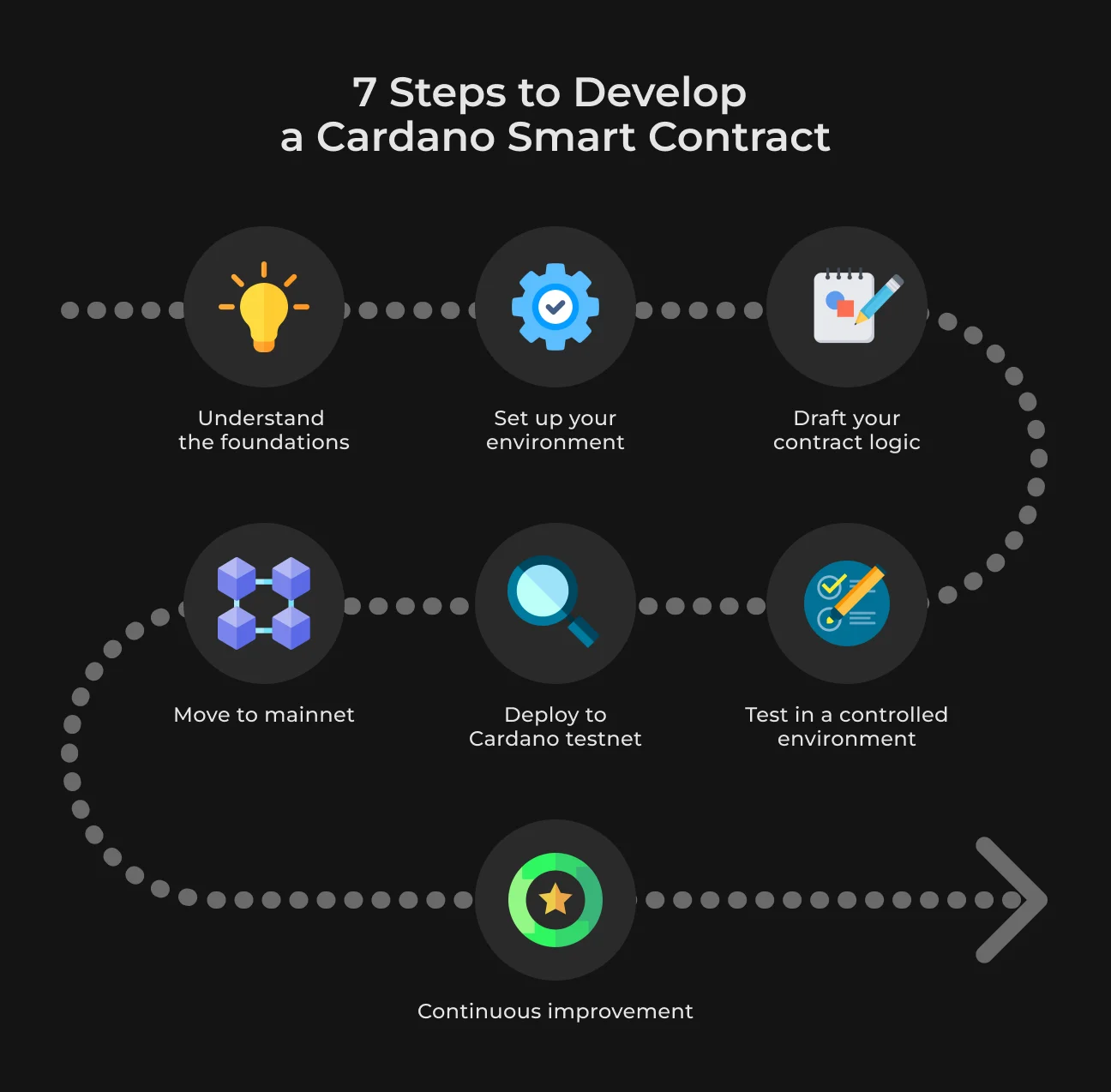
1. Understand the Foundations
Before you start coding, take time to understand how Cardano works. Unlike Ethereum’s account-based system, Cardano uses Extended Unspent Transaction Output (EUTXO), which makes transactions more predictable and secure.
Think of it like receiving change when paying with cash. Each UTXO represents a separate “unit” of value stored for future use.
Learn about Ouroboros, Cardano’s proof-of-stake consensus mechanism, which is both scalable and energy-efficient. You should also get familiar with its smart contract languages:
- Plutus (based on Haskell, best for complex, high-assurance contracts);
- Marlowe (designed for simpler financial applications).
This foundational knowledge is essential for designing and building reliable contracts.
2. Set Up Your Environment
A proper environment makes development smoother. Start by installing the Plutus Application Backend, which is required to create and deploy contracts. You’ll also need Haskell, since Plutus is built on it.
Use a strong code editor like Visual Studio Code with Haskell extensions for syntax highlighting and analysis. For testing, try tools like Plutus Playground, which let you run contracts in a browser before moving to more complex setups.
3. Draft Your Contract Logic
With your tools ready, focus on the contract’s purpose and logic.
Ask yourself:
- What problem does this contract solve?
- What data will it manage?
- What conditions trigger actions?
For complex logic, choose Plutus. For direct financial use cases, Marlowe may be enough. Keep the logic as simple and transparent as possible because a clear design reduces vulnerabilities and improves reliability.
4. Test in a Controlled Environment
Since blockchain transactions can’t be reversed, testing is critical. Use Cardano’s Plutus Playground to simulate various scenarios and verify how your smart contract behaves under different conditions.
Thorough testing helps uncover logical flaws, security gaps, and performance bottlenecks early. Refine your code iteratively until it performs reliably.
5. Deploy to Cardano Testnet
When your contract is stable in simulations, deploy it to the Cardano testnet. This step mimics real-world conditions without financial risks, allowing you to observe:
- How your contract interacts with the network;
- Its resilience to updates and fluctuations.
The testnet is your last safety net before going live with Cardano’s smart contracts.
6. Move to Mainnet
Once your contract is validated on the testnet, you’re ready to go live on the Cardano mainnet. This will let your contract process real transactions and offer value to users. Double-check your configuration to ensure it’s optimized for the mainnet environment.
After launch, monitor your contract carefully to ensure smooth performance and a reliable user experience.
7. Continuous Improvement & Growth
Deploying on the mainnet is the start of your smart contract's journey. It's crucial to monitor and maintain it to quickly solve any issues or respond to user feedback. Use performance data and user interactions to make improvements. Also, stay updated on changes in the Cardano ecosystem that might benefit your contract.
Cardano Smart Contracts Use Cases
The Cardano blockchain fits businesses that need scalable, secure, and transparent solutions. It's known for its safe and energy-efficient decentralized technology, commonly used in supply chains, global payments, asset tokenization, and more.
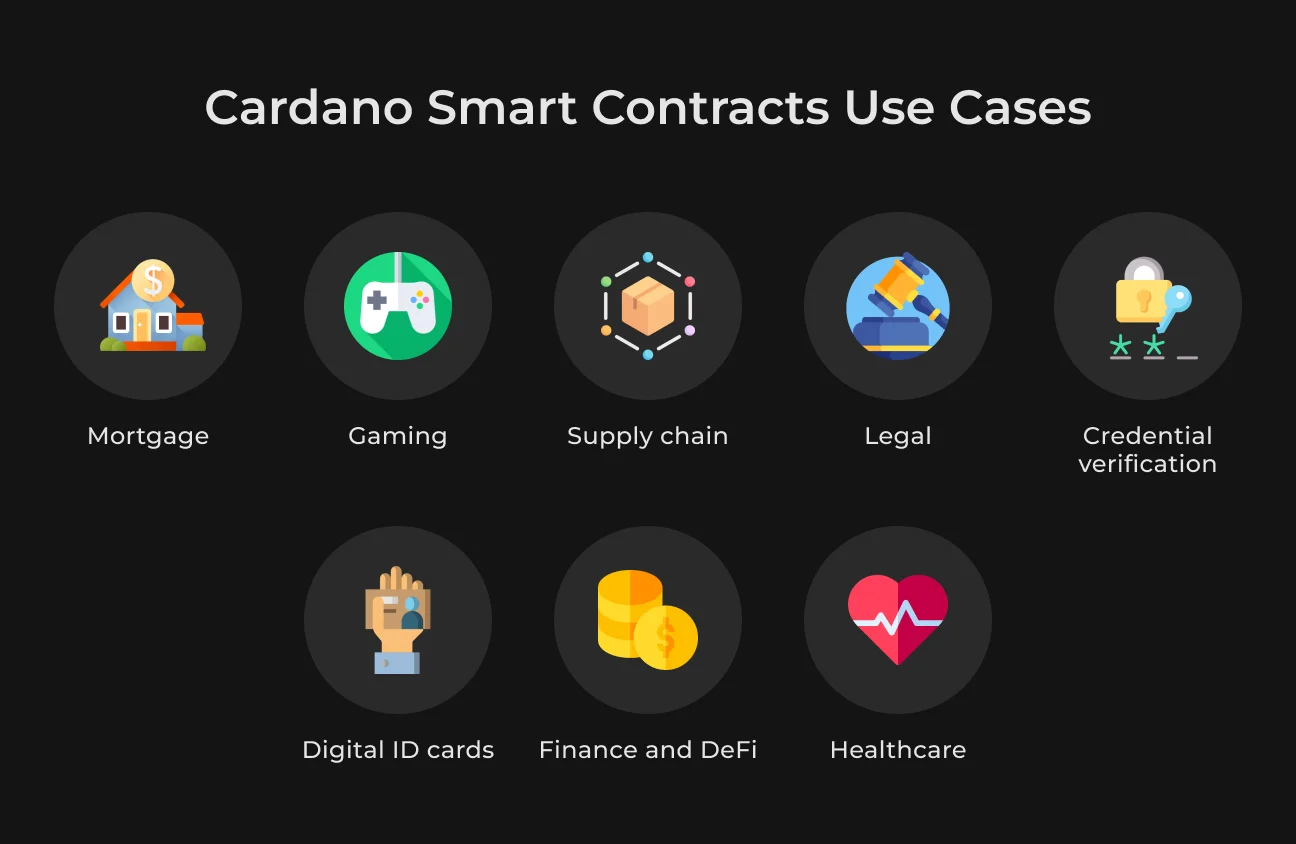
Let’s take a look at some common uses for Cardano smart contracts.
Mortgage
Cardano smart contracts can streamline the mortgage process by automating tasks like verifying borrower information, tracking payments, and managing escrow accounts. This minimizes the need for middlemen, reduces costs and paperwork, and speeds up approvals. An unchangeable ledger makes auditing easy and strengthens trust among all parties.
Gaming
Integrating Cardano smart contracts into gaming helps manage in-game assets, secure transactions, and ensure fair play. These contracts also create NFTs for game items, allowing players to own, trade, and profit from their digital assets across various platforms.
SapientPro’s team built a custom NFT minting site for the metaverse using Ethereum, ensuring it works perfectly with all devices. We can now use this expertise for gaming, virtual real estate, and digital collectibles.
Supply Chains
Smart contracts help logistics companies track each step of their products' journey, improving traceability and tracking the entire supply chain. By storing key information like origin, production, shipment, and delivery on the blockchain, they help prevent errors, theft, and losses.
SapientPro developed SteelTrace, a digital platform that improves transparency, traceability, and efficiency in the steel supply chain for the petrochemical industry. This ensures products don't get lost during transit and meet high-quality standards.
Legal
Smart contracts automate legal agreements, accounting for 26.20% of the global smart contract market. They let parties finalize deals without manual effort, which saves time and money. For example, smart contracts can manage lease agreements by automatically processing payments and renewals once specific conditions are met.
They can also help with wills and inheritances, making sure assets go to the right people. This automation reduces errors and disputes by ensuring everyone follows the agreed terms.
Credential Verification
Smart contracts on Cardano can make credential verification easier and safer. Schools, professional groups, and employers can issue and verify digital credentials without needing a central authority.
This decentralized system ensures credentials are real, easy to access, and protected from fraud. It boosts trust and speeds up verifying qualifications and skills, helping both the people who hold the credentials and those who need to verify them.
Digital ID Cards
Digital cards use smart contracts to maintain digital assets and reputation data. This helps create a unique digital identity. They link with online services so others can access information without exposing personal details. For example, they can use credit scores to help lenders fairly evaluate borrowers. Likewise, job applicants can submit resumes without concerns about gender bias in hiring.
Finance and DeFi
Cardano is a great platform for creating DeFi apps that enable lending, borrowing, and yield farming without intermediaries. Smart contracts on Cardano can automate loans, manage collateral, and ensure reliable transactions.
You can also use Cardano smart contracts to create stablecoins linked to fiat currencies. This offers a stable choice for crypto exchanges, making trade payments, remittances, and cross-border transactions less volatile.
Healthcare
Cardano lets patients control who sees their medical data using blockchain technology. They can digitally approve who can access their medical records or use tissue samples for research. These approvals turn into smart contracts, which are then securely stored on the blockchain.
For example, if a patient gives temporary access to their medical history for a drug trial, the smart contract automatically cancels this access once the trial ends, requiring no further actions from the patient. Cardano's blockchain ensures patient consent aligns with their data privacy preferences.
Cardano also simplifies billing by automatically processing payments when services are provided.
Future Trends in Smart Contract Development
In 2024, the global smart contracts market was worth $988.68 million. By 2033, it's expected to reach $134,407.22 million, growing at an annual rate of 67.5% from 2025 to 2033.
This growth is fueled by blockchain's impact on supply chains and industries, as well as the increasing popularity of decentralized apps (dApps), NFTs, cryptocurrencies, and online banking. Let's take a deeper look at some upcoming trends in smart contracts.

Connecting with the Internet of Things
As IoT devices become more widespread, they provide more opportunities to automate tasks with smart contracts. For example, they can process payments once a delivery is confirmed or react to temperature changes detected by sensors.
This reduces the need for human intervention and makes processes more efficient and accurate, especially in fields like logistics, manufacturing, and smart homes.
By 2030, there are expected to be about 25.44 billion IoT devices. This growth leads to a higher demand for secure, automated systems, which could increase the use of smart contracts.
Rise of Decentralized Autonomous Organizations (DAOs)
Decentralized autonomous organizations rely on blockchain and smart contracts to manage decisions and funds without a central authority. This setup allows stakeholders to vote directly. DAOs have been increasing by about 30% annually as various industries explore this form of governance.
They're gaining popularity in finance, entertainment, and charity because of their transparent, automated decision-making. This helps minimize corruption and inefficiency often present in traditional systems.
Increased Use of Green Smart Contracts
Traditional blockchains, like Bitcoin's proof-of-work systems, consume a lot of energy and raise environmental issues because of high carbon emissions. Green smart contracts are designed to be more energy-efficient and reduce the environmental impact of blockchain technology.
Its use can cut carbon emissions by 52.31% compared to regular peer-to-peer blockchains with 1000 nodes. Green smart contracts can also support new applications like decentralized energy markets and carbon credit trading, focusing on reducing environmental impact.
Improvements in Smart Contract Security
As smart contracts are becoming more popular, there's a strong focus on making them more secure because of increasing hacks and exploits. In 2024, crypto scams generated at least $9.9 billion, and this could rise to $12.4 billion as more data comes in.
To ensure smart contracts are safe and reliable, developers use tools like formal verification and security audits. Formal verification ensures the accuracy of a smart contract, minimizing errors and potential weaknesses.
Focus on secure coding and security-based platforms makes smart contracts more resistant to attacks. With better security, trust will increase, which will lead to more use of blockchain applications and make them safer and more reliable in various industries.
Partner with SapientPro to Build Your Cardano Smart Contract Solution
SapientPro offers sustainable business solutions with a focus on Web3 development. We create decentralized software that is secure, high-performing, and easy to use. Our 8+ years of expertise include building blockchain-based smart contracts to automate agreements, reduce costs, and improve security.
Let's work together to create custom smart contracts on Cardano that fit your industry needs. Contact us to talk about your project.
Build Your Cardano Smart Contract Today
Talk to SapientPro's engineers to see how we can bring your idea to life and get an estimate.