
All QMS Software: Definition, Development, and Steps to Seamless Integration
December 12, 202515 min read


Quality management system software is no longer optional for many businesses. It’s the fastest way to standardize processes, meet certification requirements, and keep product quality consistent.
A custom QMS helps you stay compliant, reduce errors, and improve operational efficiency as regulations and industry standards continue to tighten. Read on to find out everything you need to know about about QMS development from SapientPro’s experts.
What is a Quality Management System (QMS)?
A quality management system (QMS) is a practical management framework that covers both internal operations and external interactions. Built on a set of proven principles, it helps companies organize work so their products or services consistently meet customer expectations.
To achieve this, a QMS relies on structured planning, data collection and analysis, and economic calculations to guide decisions and improve performance.
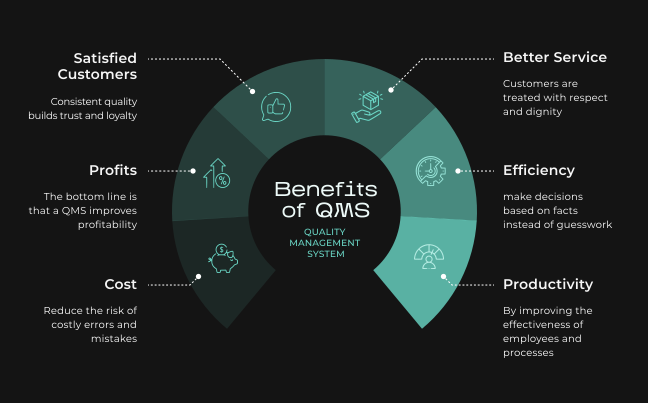
Advantages of a certified quality management system for external activities:
- New market for services or products: participation in tenders and contracts with already certified enterprises, including foreign ones.
- Increased customer loyalty: production of quality products due to the quality control system and study of customers' desires.
- High status among consumers, partners, and competitors: the certificate proves the organization's commitment to the development and improvement of activities.
Benefits of a certified quality management system for internal activities:
- Awareness of the management about the processes and staff participation in them;
- Optimization of production;
- Traceability to identify weaknesses in processes;
- Order in office work;
- Ability to motivate staff and increase their passion.
Based on these facts and real experience, you can draw conclusions about why you need a quality management system in terms of financial benefits:
- Reduction of product scrap;
- Profit from a new sales market;
- Optimization of procurement costs;
- Improved staff performance.
Also, in some areas, the presence of the certificate is mandatory to obtain authorization for activities.
Difference Between eQMS vs. QMS
An eQMS (electronic quality management system) is the digital evolution of QMS, where quality management processes are automated and managed through specialized software.
While both systems serve the same basic purpose of ensuring quality standards, eQMS offers considerable advantages in terms of efficiency, accuracy, and scalability. However, a choice between them most often depends on the following factors:
- Organization size and complexity;
- Available budget;
- Industry requirements;
- Technical capabilities;
- Geographic distribution of operations;
- Regulatory environment;
- Long-term growth plans.
The trend is increasingly moving toward adopting eQMS because organizations seek to use a digital business environment. Here is a сomparison of QMS vs eQMS.
Feature | QMS (Traditional) | eQMS (Electronic) |
| Definition | A structured system to manage quality processes manually or on paper. | A digitalized system to manage and automate quality processes. |
| Implementation | Typically involves physical documentation and manual workflows. | Utilizes software to streamline and automate processes. |
| Accessibility | Limited to on-site access and physical records. | Accessible from anywhere via cloud or on-premises software. |
| Data Management | Relies on paper-based records or local databases. | Centralized, digital storage with real-time updates and data analysis. |
| Compliance Tracking | Manual tracking of compliance and audits. | Automated compliance monitoring and reporting features. |
| Scalability | Difficult to scale; more resources are needed for growth. | Highly scalable, suitable for growing organizations. |
| Efficiency | Time-consuming and prone to human error. | Faster and more efficient due to automation and digital workflows. |
| Audit Preparation | Requires manual preparation of documentation. | Simplifies audits with instant access to organized, searchable records. |
| Cost | Lower upfront costs but higher long-term operational costs. | Higher initial costs but lower operational costs over time. |
| Environment | Paper-based, less environmentally friendly. | Digital, eco-friendly, and reduces paper waste. |
| Integration | Limited integration with other systems. | Integrates with ERP, CRM, and other enterprise systems. |
| User Experience | Manual processes require more training and effort. | Intuitive interfaces with user-friendly tools and training. |
| Analytics and Reporting | Requires manual data compilation for insights. | Provides advanced analytics and real-time reporting. |
Essential Elements of a QMS in 2025
Let’s take a look at the key elements of QMS:
Quality Manual
This foundational document outlines the organization's quality management framework. It details:
- Organizational quality objectives;
- Management responsibilities;
- System scope and boundaries;
- Key performance indicators;
- Quality policies and commitments.
Device Master Record (DMR)
The DMR acts as the complete manufacturing blueprint, containing:
- Manufacturing procedures and instructions;
- Component specifications;
- Assembly drawings and diagrams;
- Quality control requirements;
- Packaging and labeling specifications;
- Testing protocols.
Quality Procedures
These documents define the systematic processes that transform inputs into outputs, including:
- Standard operating procedures (SOPs);
- Work instructions;
- Process flow diagrams;
- Resource allocation guidelines;
- Control measures and checkpoints.
Quality Records
These are documented evidence demonstrating QMS implementation and compliance:
- Audit results;
- Training records;
- Inspection reports;
- Test data;
- Calibration certificates;
- Nonconformance reports.
Design History File (DHF)
The DHF maintains a comprehensive record of product development, including:
- Design inputs and outputs;
- Risk analysis;
- Verification and validation data;
- Design reviews;
- Design changes and justifications;
- Technical documentation.
Device History Record (DHR)
The DHR tracks the complete manufacturing history of each device unit or batch:
- Production dates and conditions;
- Component traceability;
- In-process testing results;
- Final inspection results;
- Device identification and shipping details;
- Deviation reports and corrective actions.
Each of these components works together to create a robust system that supports consistent product quality and continuous improvement.
QMS Software Features
A quality management system (QMS) does more than improve internal operations. It directly strengthens a company’s competitiveness. As customer expectations and industry standards keep evolving, a certified QMS helps businesses stay compliant and ahead of the curve.
Proven, consistent quality builds trust with customers, partners, and investors, supporting growth and protecting reputation. By enforcing clear standards across every stage of delivery, a QMS also helps companies adapt faster to changes in the market.
1. Document Management
A QMS handles a large volume of internal and external documents—and they must be tightly connected. For example, a nonconformity may relate to a specific clause of a standard, while an update to an external requirement should automatically trigger actions to align internal documents and related workflows.
2. Audit Trail
A QMS should support the full audit lifecycle—from goal setting and planning to reporting and sharing results across other modules. The most in-demand capabilities include audit scheduling, resource planning, and workload management for auditors and auditees.
3. CAPA Workflow Automation
Any nonconformity (or potential nonconformity) should initiate corrective and preventive actions (CAPA). This module typically covers planning, execution, effectiveness checks, historical records, and reporting.
4. Complaints and Claims Management
This is a mandatory part of a QMS. ISO 9001 requires complaint handling, while the ISO 10000 family provides detailed guidance. A solid system supports:
- Preventing complaints by improving customer satisfaction practices;
- Internal complaint handling when issues arise;
- External dispute resolution when internal resolution isn’t possible.
5. Process monitoring
Process monitoring is the structured observation and measurement of product and process parameters to confirm compliance with defined requirements. It also provides evidence of continuous improvement through systematic measurement, recording, evaluation, and follow-up.
6. Other Features
Depending on your industry and compliance needs, QMS software may also include:
- Risk management;
- Training management;
- Supplier quality management;
- Equipment and calibration management;
- Change control;
- Reporting and analytics;
- Mobile access;
- Integration capabilities;
- Quality events management;
- Regulatory compliance management.
Build a Custom QMS Solution with SapientPro
Key Industries That Benefit from Quality Management System Software
Implementing a quality management system helps companies standardize processes, reduce risks, and improve workforce efficiency. In practice, it creates a measurable competitive edge, making it easier to enter international markets, qualify for large tenders, and win contracts with global brands, which ultimately strengthens financial performance.
Manufacturing
QMS software for manufacturing is used to tighten process control, automate quality checks, and align with standards such as ISO 9001 and ISO 14001.
Automation improves production workflows, reduces defects, and strengthens supply chain performance—supporting consistent product quality and higher customer satisfaction.
Pharmaceutical
Quality management system software for the pharmaceutical industry is essential for meeting strict regulatory and quality requirements such as ISO 13485, ISO 9001, and GMP. It enables strong document control, deviation tracking, and batch traceability.
An electronic QMS (eQMS) also improves audit readiness, streamlines compliance tasks, and reduces human error—helping ensure safe, effective medications.
Aerospace & Defense
With zero tolerance for error, aerospace and defense organizations use QMS software to comply with AS9100 and ISO 9001.
It supports supplier quality, risk management, and full product traceability—improving operational reliability and meeting demanding government and industry requirements.
Medical Devices
Medical device companies rely on QMS solutions to comply with ISO 13485, FDA 21 CFR Part 820, and other regulations. An eQMS streamlines risk management and product lifecycle tracking, while automation of CAPA, audits, and reporting helps shorten time-to-market without compromising quality.
Oil & Gas
QMS software helps oil and gas companies manage operational risks, safety programs, and compliance with standards such as ISO 29001 and ISO 14001. Automation supports maintenance planning, incident reporting, and audit tracking—reducing downtime and mitigating risk in a high-stakes environment.
Others
QMS software is also widely used across:
- Automotive: IATF 16949 for production quality and supply chain performance;
- Food and beverage: ISO 22000 for food safety and hygiene;
- Construction: ISO 9001 to improve project quality and process efficiency;
- Energy and utilities: ISO 50001 to optimize energy use and sustainability;
- Logistics and transportation: ISO 9001 and ISO 28000 to strengthen quality and supply chain security;
- Chemicals: ISO 9001 and ISO 14001 for quality and environmental compliance;
- IT and software development: ISO 9001 and ISO/IEC 27001 for consistent delivery and information security;
With automation, advanced reporting, and eQMS capabilities, companies in these sectors can scale quality programs faster and support sustainable growth.
How to Develop QMS Software for Your Business in 2025?
Building an electronic quality management system takes more than “going digital.” To get real ROI with faster audits, fewer nonconformities, and reliable compliance, you need a clear plan.
Here are six steps to guide development.
1. Outline Clear Goals
Start with the problems you need to solve and translate them into measurable objectives, such as:
- Reducing compliance violations;
- Improving audit efficiency;
- Automating manual workflows;
- Increasing data accuracy;
Bring in stakeholders from QA, operations, compliance, IT, and leadership. Then set KPIs upfront so you can measure success after launch.
2. Prepare Data
Consolidate quality-related information in one place: policies, SOPs, audit logs, training records, deviations, complaint data, and compliance documentation.
Digitize what’s still paper-based, clean inconsistencies, and map everything to your workflows (document control, CAPA, audits, monitoring). Well-structured data is the foundation of a reliable QMS.
3. Choose Your Tech Stack
Pick a stack that supports security, integrations, and future growth. A typical foundation includes proven back-end technologies and a modern front end (React, Vue, or Angular). In 2025, many QMS products also benefit from:
- AI for anomaly detection, predictive insights, and smarter reporting;
- IoT for real-time monitoring in manufacturing and asset-heavy operations;
- RPA for repetitive tasks like data entry, updates, and routine reporting;
A cloud infrastructure (AWS, Azure, or Google Cloud) keeps the system accessible, scalable, and easier to maintain across locations.
4. Pick Key Features
Start with core modules that support both operations and compliance:
- Document management;
- Audit trail;
- CAPA workflow automation;
- Complaints and claims management;
- Process monitoring;
Then add advanced capabilities based on your use cases—mobile access, analytics dashboards, or AI-assisted decision support.
5. Design & Develop the Solution
Consider three points here:
- Design. The design should be user-centric, easy to use, and intuitive. Conduct user research and develop wireframes and prototypes to test usability before moving into full-scale development.
- Development. The QMS shall be developed incrementally using the Agile methodology. The development should first start with the MVP, developing a very basic feature set, which would then be extended with enhancements through feedback received. Ensure the codebase is modular and extendable for further development.
- Testing. All forms of testing, such as functional, usability, security, and compliance, are strictly performed to ensure the system's robustness during all phases of development.
A strong maintenance strategy keeps your code quality high in an electronic quality management system.
6. Deploy and Maintain the Solution
Roll out gradually—pilot the system in one department, gather feedback, and refine before scaling. Plan user training and adoption support. After launch, maintain the platform with regular updates, security patches, and improvements aligned with new regulations and business growth.
Monitor performance and user satisfaction to keep the eQMS effective long-term.
Partner with SapientPro
Our engineers will provide a free consultation and help you build an efficient solution.
Tech Trends in QMS Software Development
Let’s take a look at the top 5 tech trends in custom QMS development in 2026.
Blockchain
Blockchain technology in quality management system software ensures secure, immutable record-keeping. Enhanced traceability and accountability across supply chains are guaranteed. Its decentralized nature makes it ideal for managing audits, certifications, and compliance, particularly in industries requiring high data integrity. We mean pharmaceuticals, aerospace, and food safety.
IoT
The integration of IoT devices into quality management software for manufacturing provides real-time monitoring of production processes and equipment. By collecting and analyzing sensor data, IoT:
- Improves predictive maintenance;
- Reduces downtime;
- Ensures consistent quality,
IoT strengthens process automation.
AI & ML
AI and machine learning transform electronic quality management systems with advanced analytics, anomaly detection, and predictive insights. These technologies:
- Automate decision-making processes;
- Streamline compliance tasks;
- Improve overall quality control.
They are extremely beneficial in industries like pharmaceuticals, manufacturing, and oil & gas.
AR & VR
AR and VR bring immersive solutions to training and quality inspections. They allow employees to interact with virtual production environments, helping industries implement the elements of QMS more effectively. These technologies reduce human error, improve skills development, and improve adherence to quality standards.
RPA
RPA (robotic process automation) optimizes routine tasks in quality management system software for the pharmaceutical industry and other sectors. It automates data entry, compliance reporting, and document reviews. Thanks to it, greater efficiency and accuracy are guaranteed.
How Much Does Custom QMS Software Development Cost?
A custom QMS typically costs more upfront than an off-the-shelf product, but it’s designed around your exact workflows and compliance requirements. You can integrate it cleanly with ERP/CRM and other internal systems, avoid paying for unused features, and scale without platform limitations. It also gives you full data ownership and stronger control over security—reducing risks tied to compliance violations and breaches.
Over time, a custom solution can be more cost-effective by avoiding recurring license fees and vendor lock-in. It also gives you flexibility to add differentiators such as predictive analytics, control the product roadmap, and release updates on your schedule—not a third-party vendor’s.
Here is a table showing how much it costs to develop custom quality management system software.
Development Phase | Estimated Cost Range (USD) | Timeframe | Key Cost Factors |
| Discovery & Planning | $15,000–$30,000 | 2-4 weeks | - Business analysis - Requirements gathering - Technical specification - Project planning |
| UI/UX Design | $20,000–$40,000 | 4-6 weeks | - User interface design - User experience planning - Prototype development - Design iterations |
| Core Development | $80,000–$150,000 | 3-6 months | - Basic QMS functionality - Document management - User management - Core workflows |
| Advanced Features | $50,000–$100,000 | 2-4 months | - CAPA management - Audit management - Risk management - Advanced reporting |
| Integration Development | $30,000–$60,000 | 1-2 months | - ERP integration - CRM integration - Third-party APIs - Legacy system connections |
| Quality Assurance | $25,000–$45,000 | Ongoing | - Testing - Bug fixing - Performance optimization - Security testing |
| Deployment | $10,000–$20,000 | 2-3 weeks | - Server setup - Cloud configuration - Data migration - Initial launch |
| Training & Documentation | $15,000–$25,000 | 2-4 weeks | - User manuals - Training materials - Knowledge base - Admin documentation |
Total Cost Range | $245,000–$470,000 | 6-12 months |
Partner with SapientPro to Build Your QMS Software Solution
SapientPro develops custom quality management system software tailored to your workflows, compliance requirements, and industry specifics. We combine hands-on domain experience with modern technologies like AI, IoT, and RPA to automate quality processes, reduce errors, and improve operational performance.
We can deliver scalable, secure solutions such as:
- Quality management software for manufacturing;
- Robust electronic quality management systems (eQMS);
- QMS software for the pharmaceutical industry;
- … and any custom product for your needs.
Partner with SapientPro to build an innovative QMS that helps you maintain quality at every stage and scale with confidence.
Build a Custom QMS Solution with SapientPro

