All How to Handle Noisy Data in Machine Learning
March 23, 202615 min read


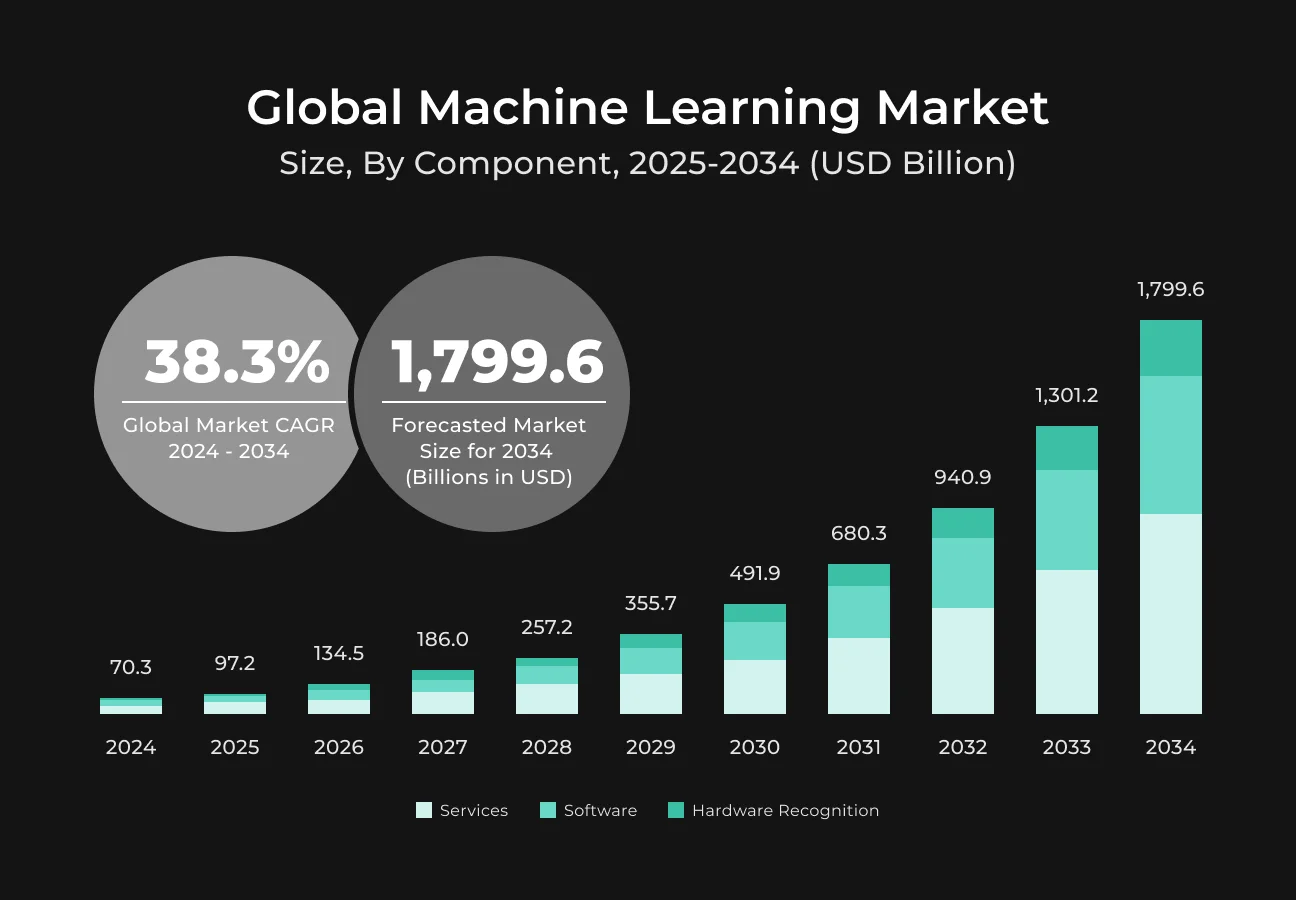
How to prepare data for machine learning is the defining challenge of the modern AI era. As the machine learning market heads toward a projected $1 trillion valuation by 2033, the transition from "magic box" hype to industrial ROI depends entirely on data integrity.
The industry's fundamental rule remains "garbage in, garbage out." Without rigorous cleaning and pipeline management, advanced neural networks don't just fail—they propagate errors that cost businesses an average of $12.9 million annually.
SapientPro’s engineers prepared a detailed guide explaining the data cleaning process to remove all noise and get maximum value for your company. Read on for more!
Data Cleaning for Machine Learning: What Happens with the Market?
AI spending is set to surpass $2 trillion by 2026, yet a critical paradox remains: investment in model architecture is outpacing investment in data quality. Despite a 34.8% CAGR in demand for analytics, poor data quality remains the primary market restraint.
The "80/20 rule" is now a systemic failure in data preparation for machine learning: data scientists spend 80% of their time cleaning data, leaving only 20% for innovation.
Poor data quality is a financial drain:
- Revenue loss: average enterprises lose 15-25% of revenue due to bad data;
- Project failure: 30% of GenAI projects are expected to be abandoned by the end of 2025 due to poor data and weak governance;
- Market response: the ETL (Extract, Transform, Load) market is surging toward $18.60 billion by 2030 as organizations scramble for better integration tools.
This reflects the urgent need for tools that can integrate disparate data sources.
Market Segment | 2024/2025 Value ($) | 2030-2035 Forecast ($) | CAGR |
| Machine Learning Market | $72.10 Billion (2024) | $1,059.61 Billion (2033) | 34.8% |
| Machine Learning-as-a-Service (MLaaS) | $45.76 Billion (2025) | $209.63 Billion (2030) | 35.58% |
| DataOps Market | $4.22 Billion (2023) | $17.17 Billion (2030) | 22.5% |
| AI in Manufacturing | $7.60 Billion (2025) | $62.33 Billion (2032) | High Growth |
This growth is driven by:
- A surge in cloud-based machine learning platforms;
- Increased demand for predictive analytics across healthcare, retail, and BFSI.
However, as data volumes grow, so does the prevalence of machine learning noise.
What Is Noisy Data in Machine Learning?
In the context of machine learning data preparation, noise refers to any random or irrelevant information that interferes with the learning process.
It is critical to distinguish between different types of data issues, as each requires a unique intervention in the data cleaning for machine learning workflow:
- Noisy data.
This is a corruption of the true signal. It results from inaccurate measurements, poor collection techniques, irrelevant information being treated as a feature, etc. It is inherently meaningless.
- Outliers.
These are data points that deviate significantly from the rest of the distribution. Unlike noise, an outlier may represent a real, albeit rare, event. Distinguishing between a valuable anomaly (like a large fraudulent transaction) and noise (like a sensor glitch) is a core task for data scientists.
- Missing data.
This is the absence of values. While noise is incorrect data, missing data is silent data.
- Corrupted data.
This usually refers to structural errors. These are broken links, unrecognizable characters, non-identical duplicates that prevent processing, etc.
The mechanism of noise determines how easily it can be mitigated. Random noise (stochastic noise) is unpredictable. It results from inherent variability or transient errors, such as a temporary drop in signal strength during data transmission.
Because it is non-systematic, it is often smoothed out through large-scale averaging or ensemble methods.
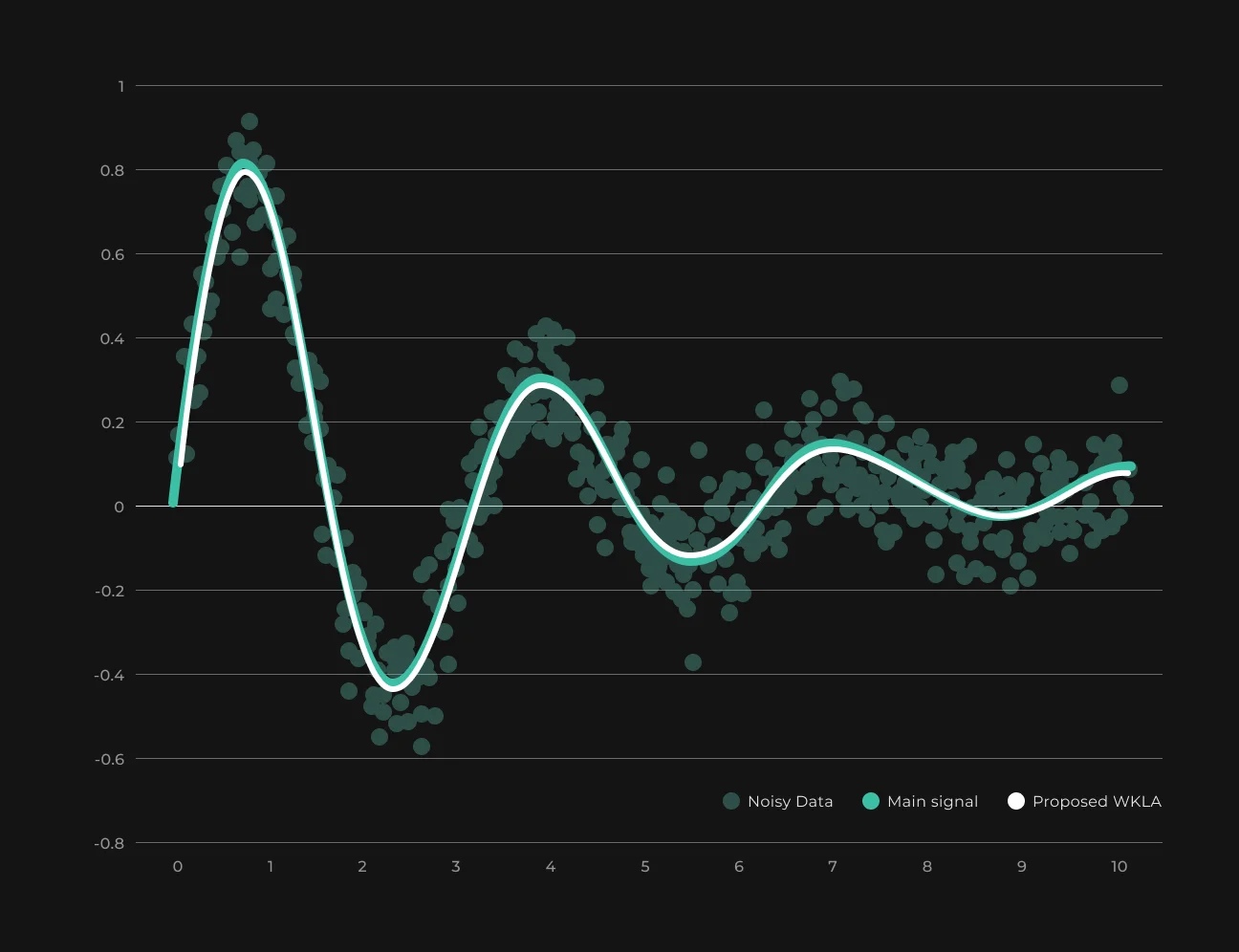
Conversely, systematic noise (bias) is recurring and predictable. It often stems from miscalibrated instruments, consistent human error (such as a specific clerk consistently misentering a code), or flawed data integration logic.
Systematic noise is particularly dangerous because the machine learning model will interpret the bias as a legitimate pattern. This will lead to high-confidence but incorrect predictions that are difficult to debug without external validation.
Types of Noisy Data
The distinction between feature noise and label noise is important to understand, as it impacts the model at different stages of the learning lifecycle.
Noise Category | Focus Area | Example | Consequence |
| Feature Noise | Input Variables (X) | A thermometer recording 25.5°C as 28°C due to proximity to a heat source. | Increases the complexity of the learning task; can lead to overfitting on irrelevant cues. |
| Label Noise | Target Variable (y) | A medical dataset where a benign tumor is incorrectly labeled as malignant. | Directly misguides the model's optimization, leading to fundamentally flawed outcomes. |
| Background Noise | Contextual Data | Street noise captured in a voice-command training set. | Distracts the model from the primary signal (the user's voice). |
Label noise is widely considered the more insidious of the two. Even low error rates in labeling can significantly impair a model's ability to generalize to new data. For instance, replacing just 0.001% of training tokens with misinformation in medical LLMs can lead to models that consistently propagate medical errors.
Sources of Noisy Machine Learning Data
To prepare data for machine learning effectively, your business must map the chaotic journey data takes from its source to the analysis environment.
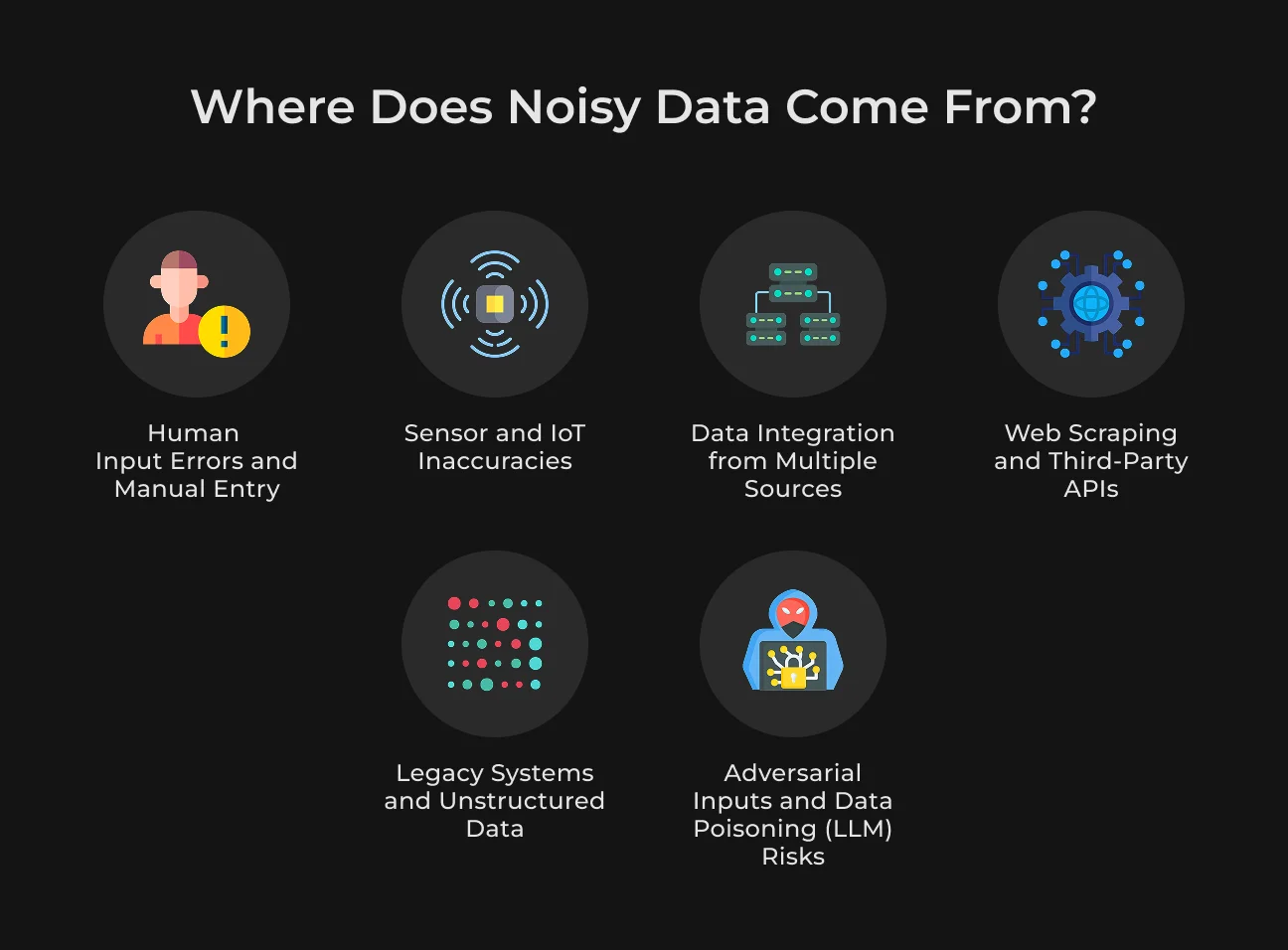
Human Input Errors and Manual Entry
The most common cause of noise is still human error.
Manual entry carries a 4.8% baseline error rate. Inconsistencies in naming conventions ("NYC" vs. "New York") and conflicting date formats "26/02/2026" vs. "2026-02-26") force data scientists to rebuild datasets from the ground up rather than trusting existing records.
Sensor and IoT Inaccuracies
In Industry 4.0, environmental factors frequently corrupt hardware outputs. Electrical interference or power surges can create "stray signals" that mimic mechanical failure. In predictive maintenance, a malfunctioning sensor is often indistinguishable from a machine on the verge of breakdown.
Data Integration from Multiple Sources
Scaling organizations often juggle disparate CRMs, ERPs, and legacy databases. These systems frequently have different standards, unit conversions (USD vs. EUR), and varying quality levels. What happens without a unified data strategy? The integration process itself becomes a factory for noise.
Web Scraping and Third-Party APIs
Web-scraped data is often used by modern analytics and LLMs. This data is known for being very messy because it has HTML artifacts, content made by bots, and ads. Also, third-party APIs can change their output schema at any time without notice. This causes data to drift. Sudden waves of null or bad records come in.
Legacy Systems and Unstructured Data
Legacy systems often store data in non-indexed or flat formats. They lack the metadata required for high-quality ML training. Unstructured data, such as images, audio, and free-text documents, contains inherent linguistic or visual noise (slang, shadows, grammatical errors).
It must be parsed using advanced machine learning data preprocessing techniques.
Adversarial Inputs and Data Poisoning (LLM) Risks
In the era of generative AI, data poisoning has emerged as a high-stakes security risk.
This is an adversarial attack where malicious actors intentionally inject poisoned data into training sets to influence model behavior. Options include:
- Direct poisoning. Injecting harmful examples during pre-training or fine-tuning.
- Indirect poisoning. Placing malicious content on public websites, hoping it will be scraped into future LLM training sets.
- Backdoor attacks. Creating sleeper agents where a model functions normally until it encounters a specific trigger, such as a hidden command in a prompt.
To mitigate these threats, you must implement advanced data cleaning techniques, such as anomaly detection and robust outlier reduction.
Why Data Quality Matters for Machine Learning Outcomes
For the COO and CEO, the business impact of machine learning data preparation is a matter of financial sustainability. Poor data quality is a direct drain on pricing power and growth potential.
Business impact of not preparing data for machine learning:
- Misguided strategic decisions.
Dashboards and predictive models trained on noisy data guide leaders to misjudge market performance or misprice offerings. For example, Uber lost millions due to incorrect driver incentive data, and Samsung faced costly supply chain corrections because of bad demand data.
- Erosion of customer trust.
If an AI-driven chatbot or recommendation engine provides erroneous or biased information, brand credibility is damaged. Zendesk reports that 91% of CX trendsetters believe AI can personalize experience, but only if the data is accurate.
- Compliance and regulatory risk.
Under GDPR and CCPA, organizations are accountable for the accuracy of the personal data they hold. Weak data validation can lead to hefty fines and reputational damage.
Technical consequences of not preparing data for machine learning:
- Overfitting to noise.
A model that is too complex will memorize the noise in the training data. While it may show 99% accuracy on the training set, it will perform poorly on real-world, unseen data.
- Amplification of flaws.
Machine learning models often act as force multipliers. If the input data contains bias or noise, the model will not only replicate these flaws but amplify them across downstream systems.
- Retraining and recovery costs.
Unity reported $110 million in lost revenue tied to underperforming models and the subsequent need for retraining. The cost of fixing a model post-deployment is exponentially higher than the cost of rigorous machine learning noise reduction during the initial preprocessing phase.
A 2025 report by the IBM Institute for Business Value (IBV) found that 43% of chief operations officers identify data quality issues as their most significant data priority.
At the same time, over 25% of organizations estimate they lose more than $5 million annually due to poor data quality, with 7% reporting losses of $25 million or more. We think these are hard reasons to invest in machine learning data preparation steps in 2026.
Forget About Noise in Your Data
SapientPro's engineers will help you get clear & validated data formats.

10 Data Cleaning Techniques for Noisy Data
The following machine learning data cleaning techniques represent the industry standard for transforming messy datasets into high-fidelity signals. These are the 10 techniques required for success.
1. Handling Missing and Inconsistent Values
It is one of the most basic machine learning data preparation steps that involves identifying null values. First, you need imputation. It is about filling in missing values using the mean, median, or mode. Advanced techniques use K-Nearest Neighbors (KNN) to predict missing values based on similar data points.
Removal also happens here. You need to delete rows or columns with high missing rates. This must be done carefully to avoid introducing selection bias.
2. Outlier Detection and Noise Filtering
For detecting anomalies before they distort the model you can use:
- Statistical thresholds. You need z-scores to flag data points that are more than 3 standard deviations from the mean;
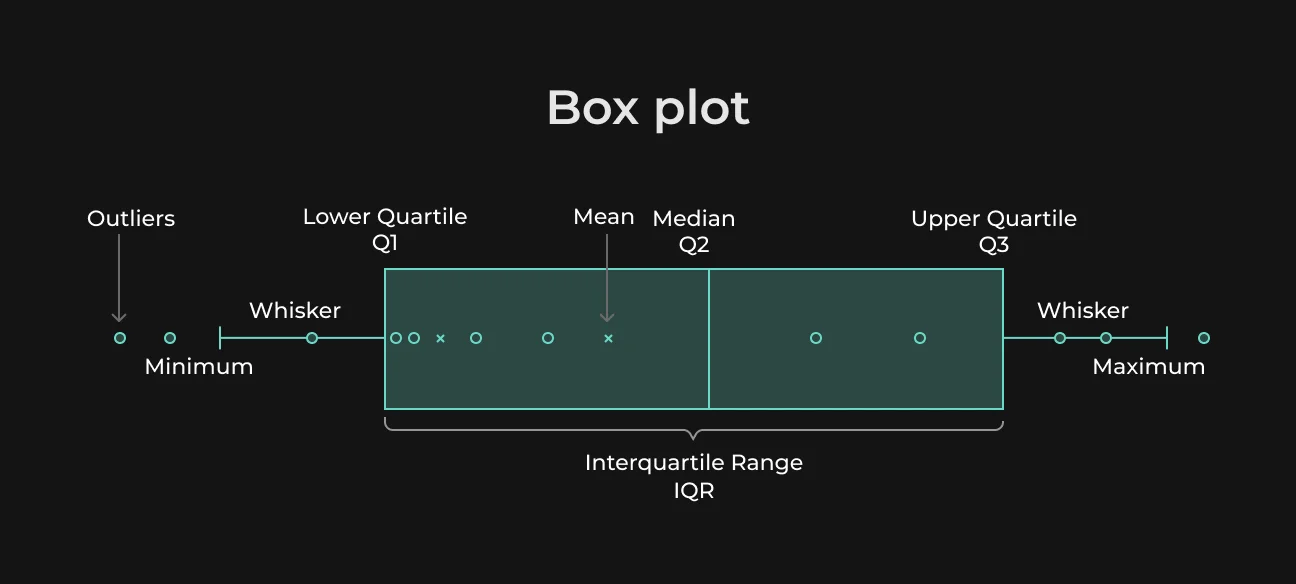
- Visualization. You need box plots and scatter plots to identify data points that fall outside the "whiskers" of normal distribution;
- Clustering for outliers. You need to group similar values into clusters. Data points that do not fit into any cluster are treated as outliers and removed.
Suppose you are looking at home prices in a suburban neighborhood and most houses are priced between $300,000 and $500,000. Imagine several houses have prices like $400,005, $399,992, and $400,010. Those tiny $5 or $10 differences are noise.
They don't reflect a real change in market value. They are just random fluctuations. When we filter noise, we might round these numbers or use a smoothing algorithm to make the overall trend easier to read.
3. Principal Component Analysis (PCA)
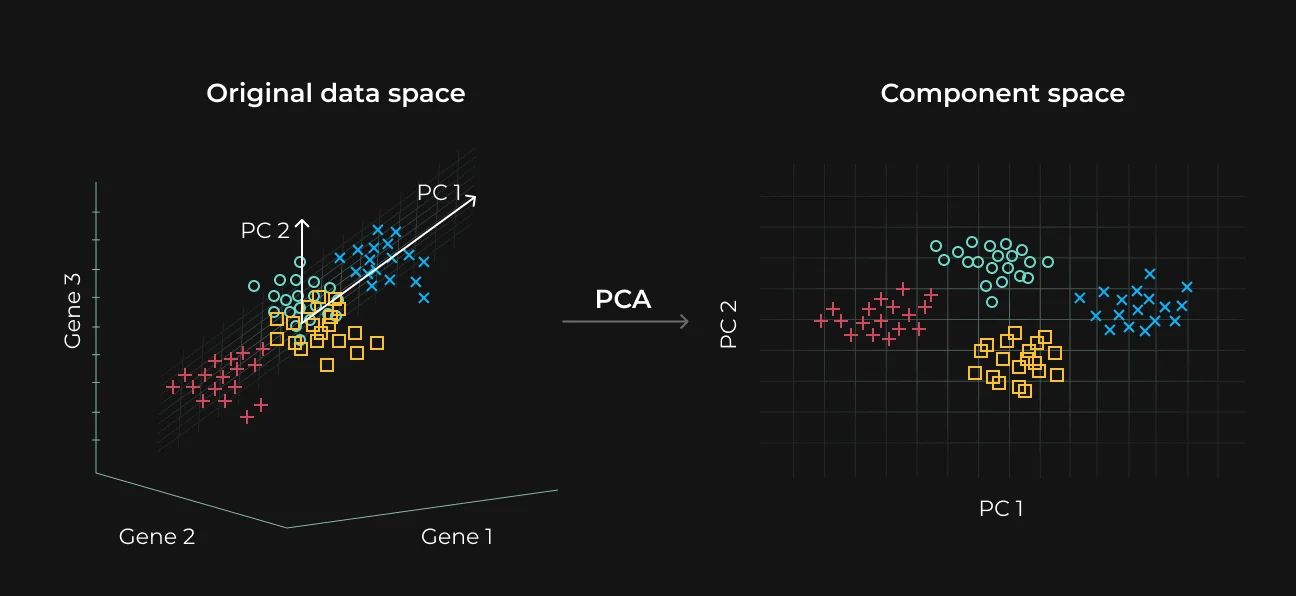
PCA is a dimensionality reduction technique that focuses on the most informative dimensions (maximum variance) while discarding dimensions that primarily consist of noise. This is essential for preventing the model from learning patterns from redundant or irrelevant features.
4. Regularization (L1 and L2)
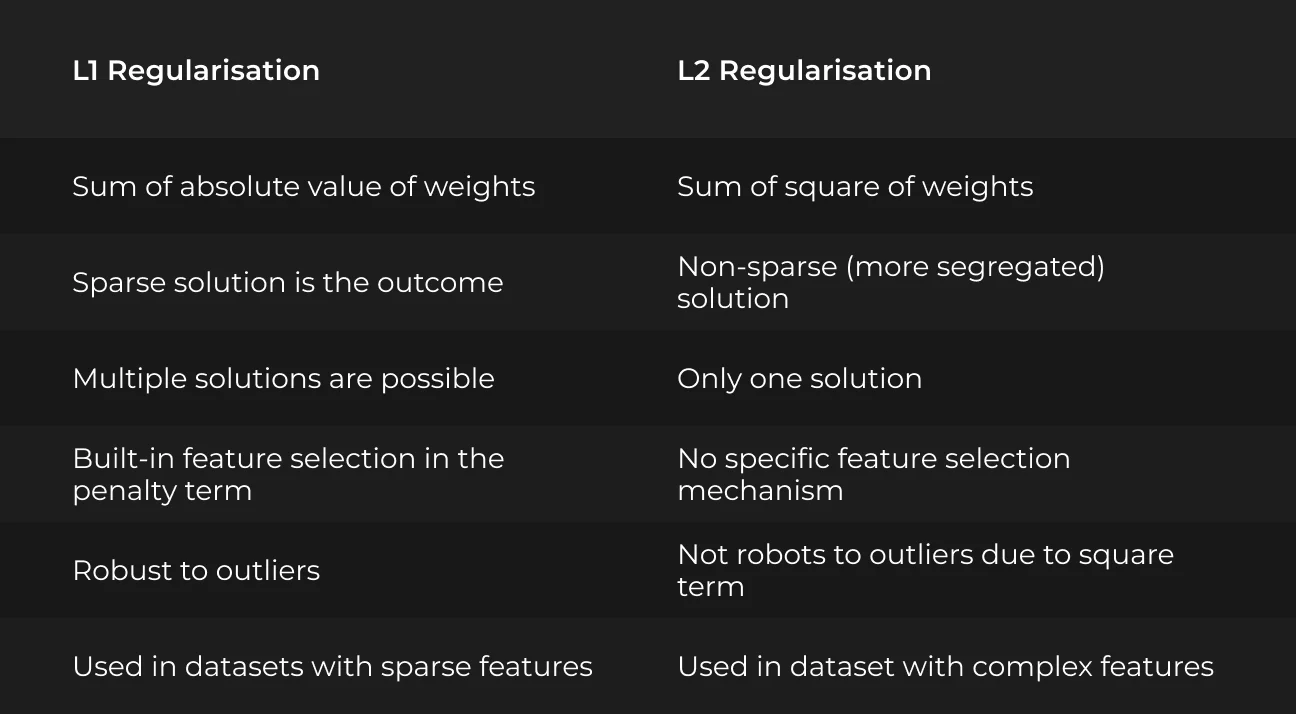
Implementing strategies like Lasso (L1) or Ridge (L2) regularization penalizes model complexity. By adding a cost to larger weights, these techniques prevent the model from overfitting to noisy data points. Instead, it prioritizes the most robust patterns.
5. Fourier Transforms for Frequency Filtering
In time-series or signal data, noise often manifests as high-frequency static. The Fourier Transform shifts the data into the frequency domain. After this, specific noise frequencies can be identified and filtered out before converting the signal back to the time domain.
6. Feature Smoothing (Binning)
Smoothing reduces the impact of small, random fluctuations in numerical data. You can use:
- Smoothing by bin means.
Every value in the bin is replaced by the average of that bin.
- Smoothing by bin medians.
Every value is replaced by the middle value of the bin.
- Smoothing by bin boundaries.
Each value is replaced by the closest edge or boundary of the bin (either the minimum or maximum). This local smoothing helps the model focus on broad trends rather than high-frequency noise.
Imagine you're analyzing a retail dataset with customers aged 21, 23, 24, 45, 46, 47, 82, and 83. By smoothing these ages into bins, the model stops worrying about the specific year someone was born and starts focusing on the broader demographic trend.
It prevents overfitting and makes the final results much more reloiable.
7. Ensemble Architectures and Model Stacking
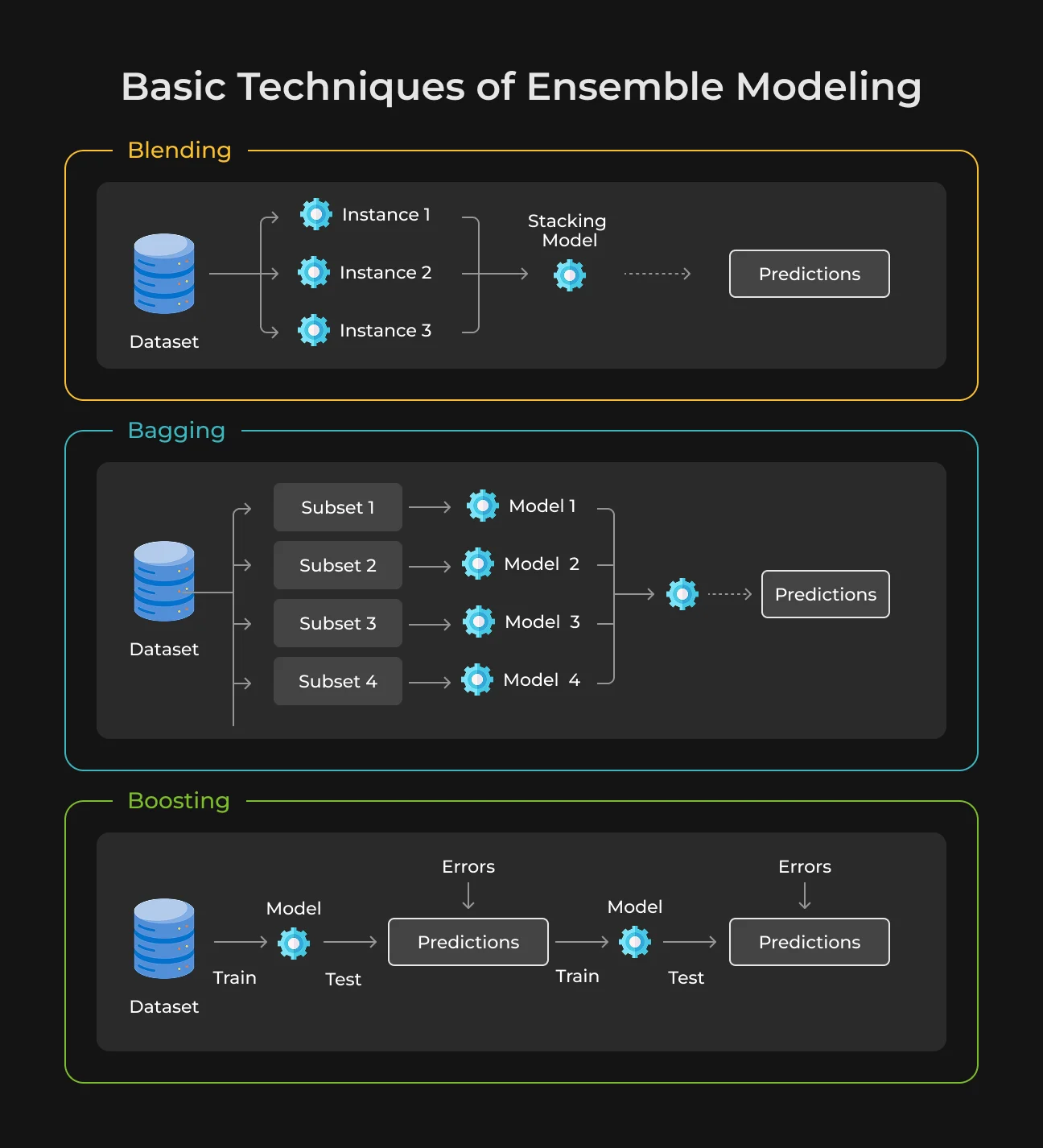
Combining multiple diverse models (for example, Blending, Bagging, Boosting) can aggregate predictions and reduce the variance caused by individual models overfitting to noise. The "wisdom of the crowd" in ensemble models often cancels out the errors introduced by noisy data points.
8. Feature Scaling and Transformation
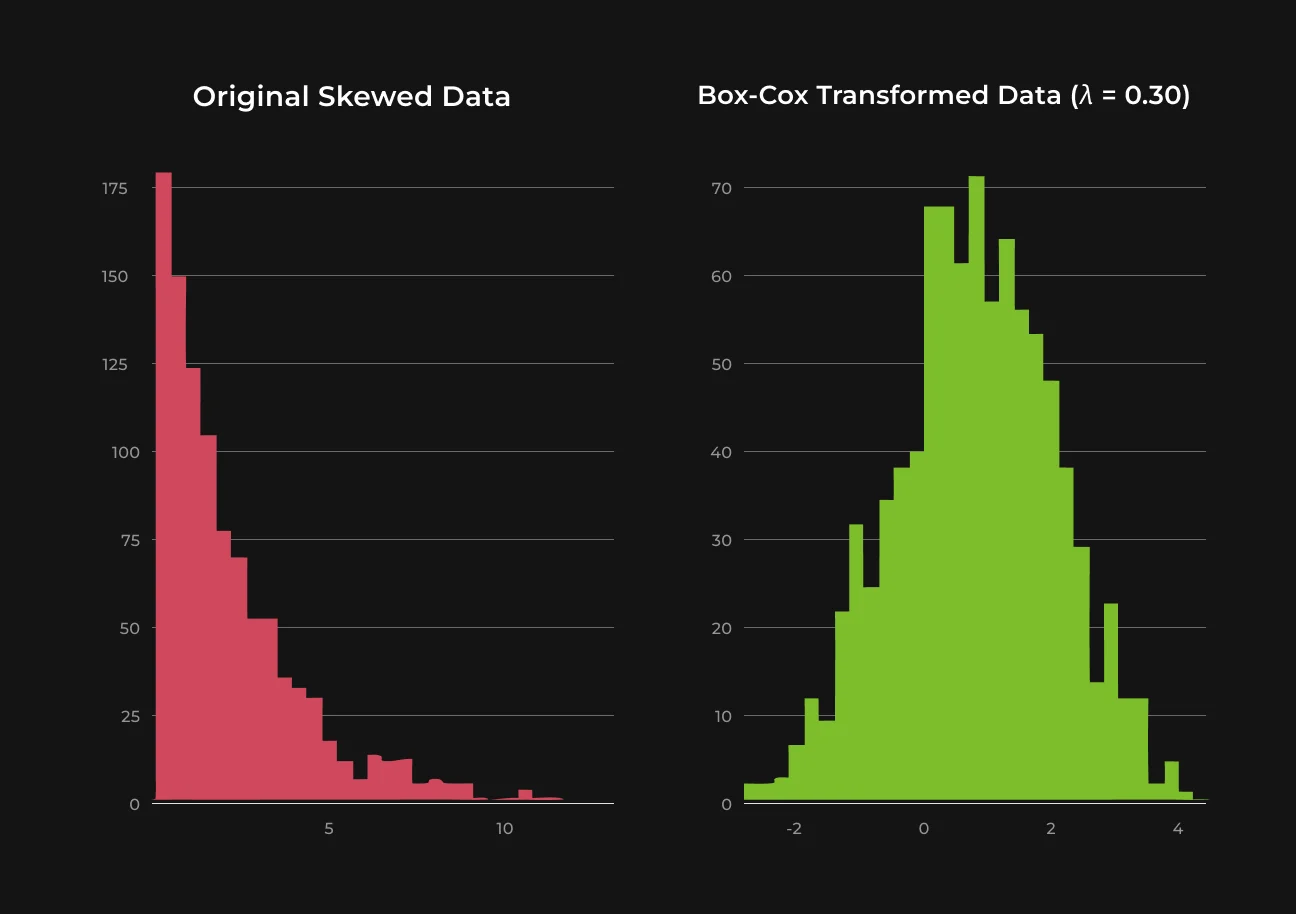
Applying logarithmic or Box-Cox transformations stabilizes variance across a dataset. Standardization implies that you scale data to have a mean of 0 and a standard deviation of 1. It ensures that features with high noise levels do not disproportionately influence the model's learning process.
9. Label Noise Detection with Confident Learning
Confident learning (CL) is a theoretically grounded framework for identifying label errors. It uses a model's out-of-sample predicted probabilities to estimate the joint distribution of noisy labels and true labels.
Pruning is about removing samples where the model's confidence in an alternative label is high. Ranking is about sorting labels from most to least likely to be an error, enabling targeted human review.
Think about a sentiment analysis tool for movie reviews:
- Review. "I hated every second of this film";
- Given label. Positive (1);
- Model prediction. Negative (0) with 99.9% confidence.
Confident learning recognizes that the 99.9% confidence is much higher than the average confidence for positive labels. It identifies this specific review as label noise and flags it for removal to prevent it from confusing the model during final training.
10. Automated Data Governance and Observability
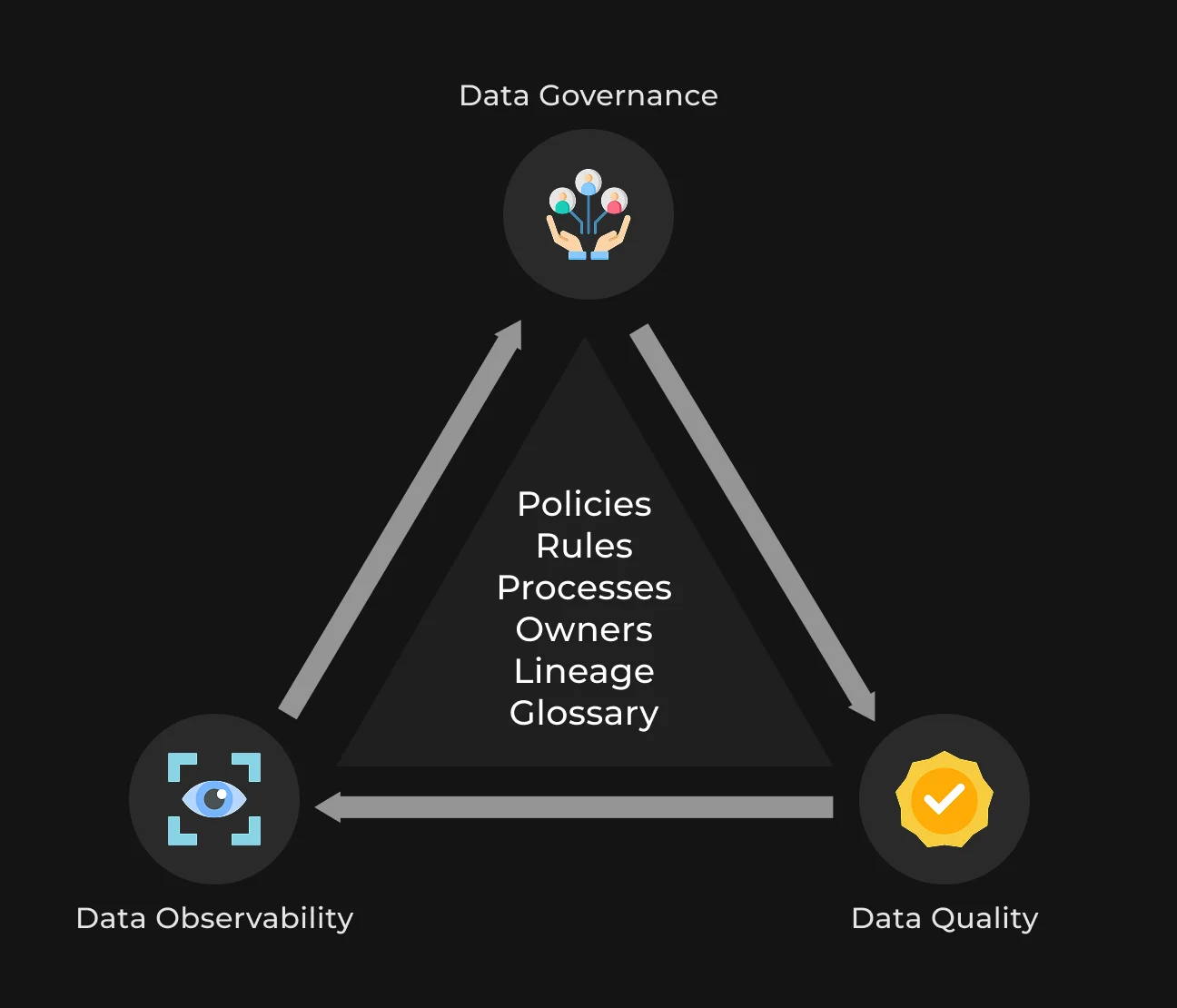
The modern approach to data preparation for machine learning involves continuous monitoring. Automated systems apply rules and flag anomalies based on statistical thresholds. They also document every transformation step to maintain a complete audit trail.
5 Best Practices for Preparing Data for Machine Learning
For most business leaders, the goal is to build a data-centric culture where data quality is a KPI tracked with the same rigor as revenue. We recommend that you:
- Lead with ROI milestones. Avoid technical jargon when presenting to investors. Frame data cleaning as a way to recover 20% of lost revenue or reduce GenAI abandonment risk.
- Modernize the data strategy. Data must be in the cloud, integrated, and unified. Siloed data is the primary impediment to AI effectiveness.
- Implement a "Lighthouse" project. Start with a high-impact, low-complexity use case. For example, it can be automating customer service tagging or developing custom LMS systems to pilot AI-driven personalized learning paths. Quick wins build stakeholder buy-in. They also prove the value of clean data before scaling to the entire enterprise.
- Invest in data observability. Use tools that provide real-time alerts on data lineage, anomalies, and errors. This shifts the focus from fixing data to preventing noise.
- Address the skills gap. Data scientists should not be doing clerical work. Invest in automated data scrubbing tools to free up specialists for innovation.
Establishing these best practices ensures that data quality machine learning is managed as a core business asset. By systematizing data cleaning machine learning workflows, you eliminate the persistent data noise that derails ROI and build a robust perimeter against serious risks like data poisoning LLM.
Examples of Data Cleaning Tools for Machine Learning
To implement the techniques described above, you need to rely on a combination of open-source and enterprise-grade tools.
1. OpenRefine (The Open Source Powerhouse)
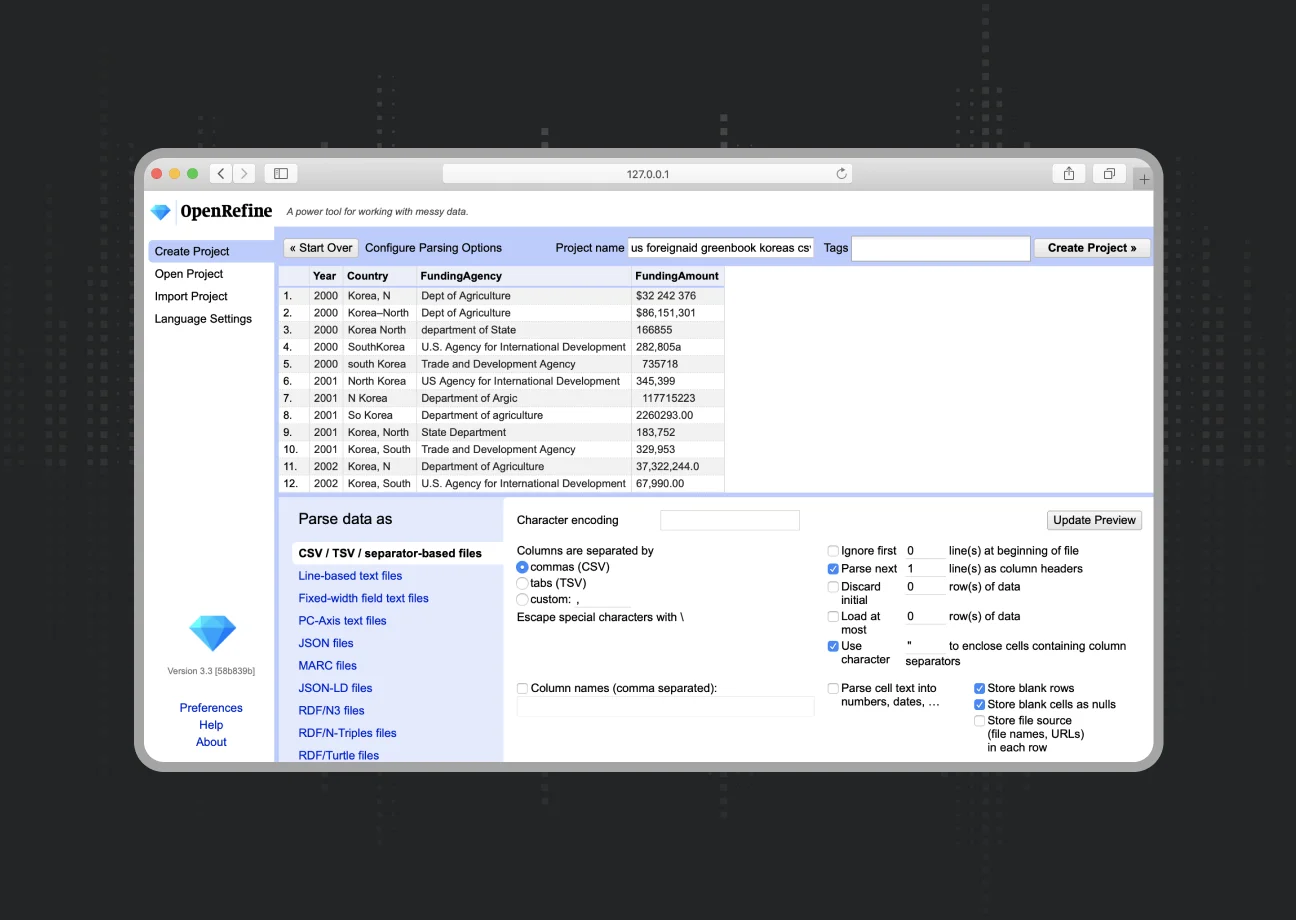
Formerly Google Refine, OpenRefine is a free tool ideal for cleaning messy datasets. Its core strength lies in its clustering algorithms. They use fuzzy matching to identify and merge inconsistent entries (for example, merging "Apple Inc." and "Apple").
The 4.0 OpenRefine release (2025) introduced Apache Spark integration, allowing it to handle terabyte-scale datasets.
2. Alteryx Designer (No-Code Efficiency)
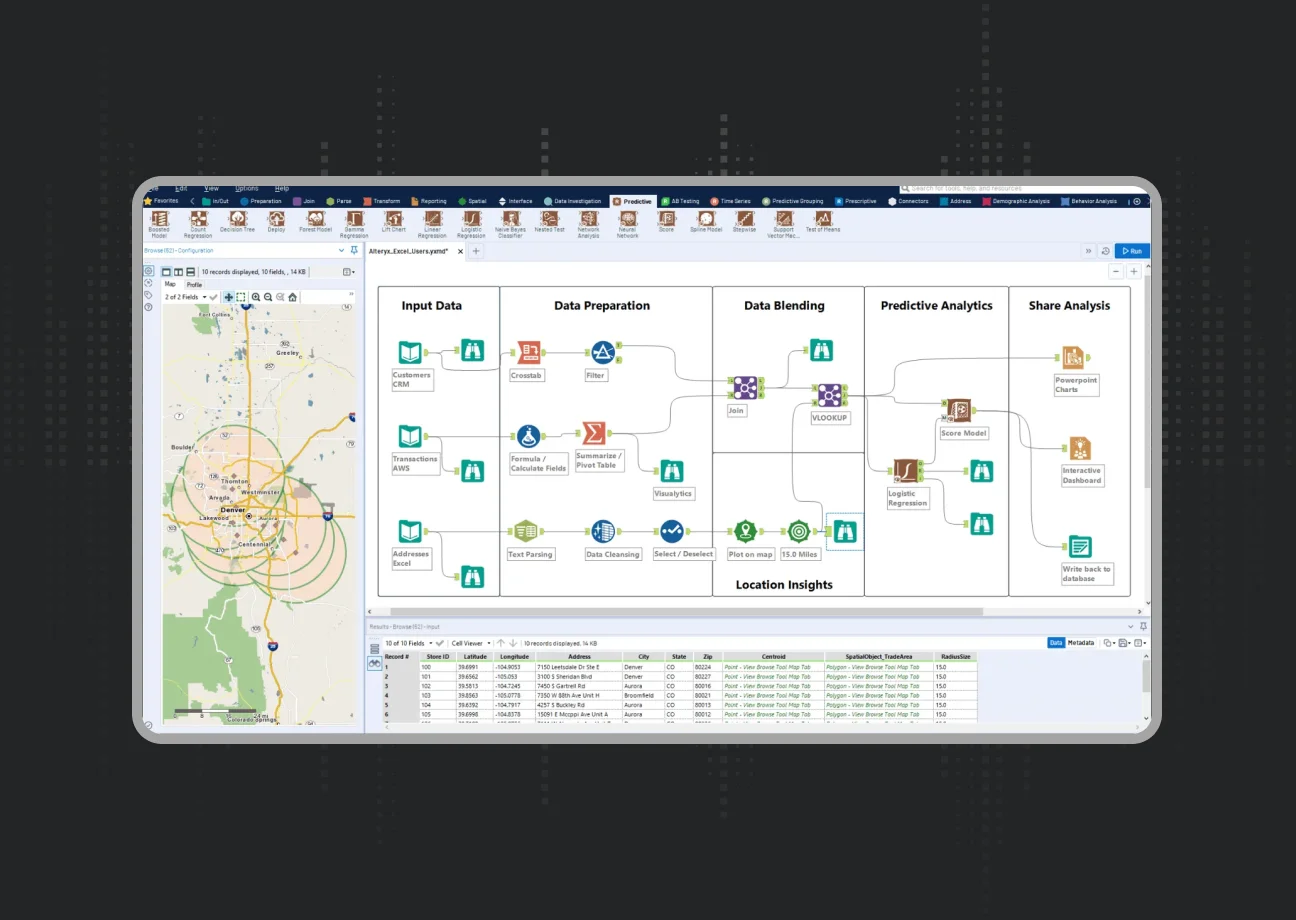
Alteryx provides a drag-and-drop interface for analysts who want to build repeatable data prep workflows without writing code. It is highly valued for its ability to integrate data from cloud platforms, databases, and spreadsheets into a single, clean pipeline.
Its built-in tools for geospatial and statistical analysis make it a leader for "data mastering" in mid-to-large enterprises.
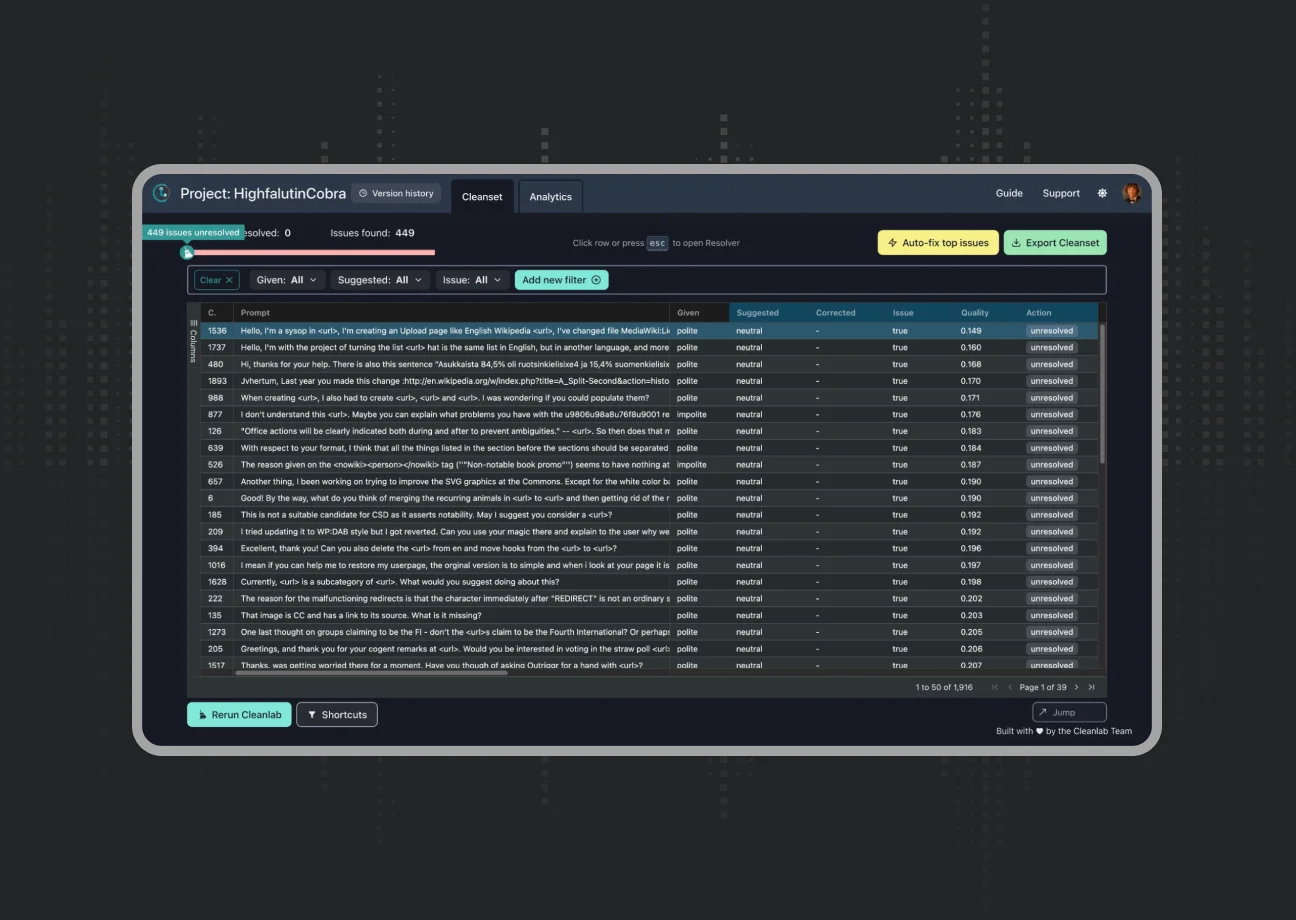
3. Cleanlab (The Data-Centric AI Standard)
Cleanlab is specifically designed for the ML age. It automates the detection of label noise using Confident Learning. It is uniquely powerful because it works with any model to identify the samples with the highest likelihood of being incorrect.
It saves immense amounts of time in manual data review, especially when working with standard regressions or deep learning neural networks.
Partner with SapientPro for Machine Learning Services
Founded in 2017, our team of 70+ experienced developers and engineers has successfully completed over 200 projects, helping clients build successful products that provide a competitive advantage. We specialize in AI development services that minimize downtime and enable faster, data-driven decisions.
Our expertise covers the entire AI lifecycle, including:
- AI feasibility assessments;
- Advanced data processing with RAG;
- Development of custom LLM chains
- Predictive analytics models, and more.
We have a proven track record in reducing development timelines and providing businesses with high ROI.
Here are some examples of our solutions:
- 87.5% faster inspection speed with AI-assisted product quality automation;
- 320 hours automated each month for AI-powered CV processing;
- 80% accuracy in a dialect-sensitive AI voice assistant.
If you need to develop a custom LLM, implement predictive analytics models, or require end-to-end AI development services, SapientPro is your reliable tech partner.
Get in touch with our team to start your project.
Data Transformation That Works
SapientPro will help you get clear & usable data for your AI & ML solutions.