All How to Build an AI CRM System: Features, Benefits, Challenges
March 16, 202610 min read


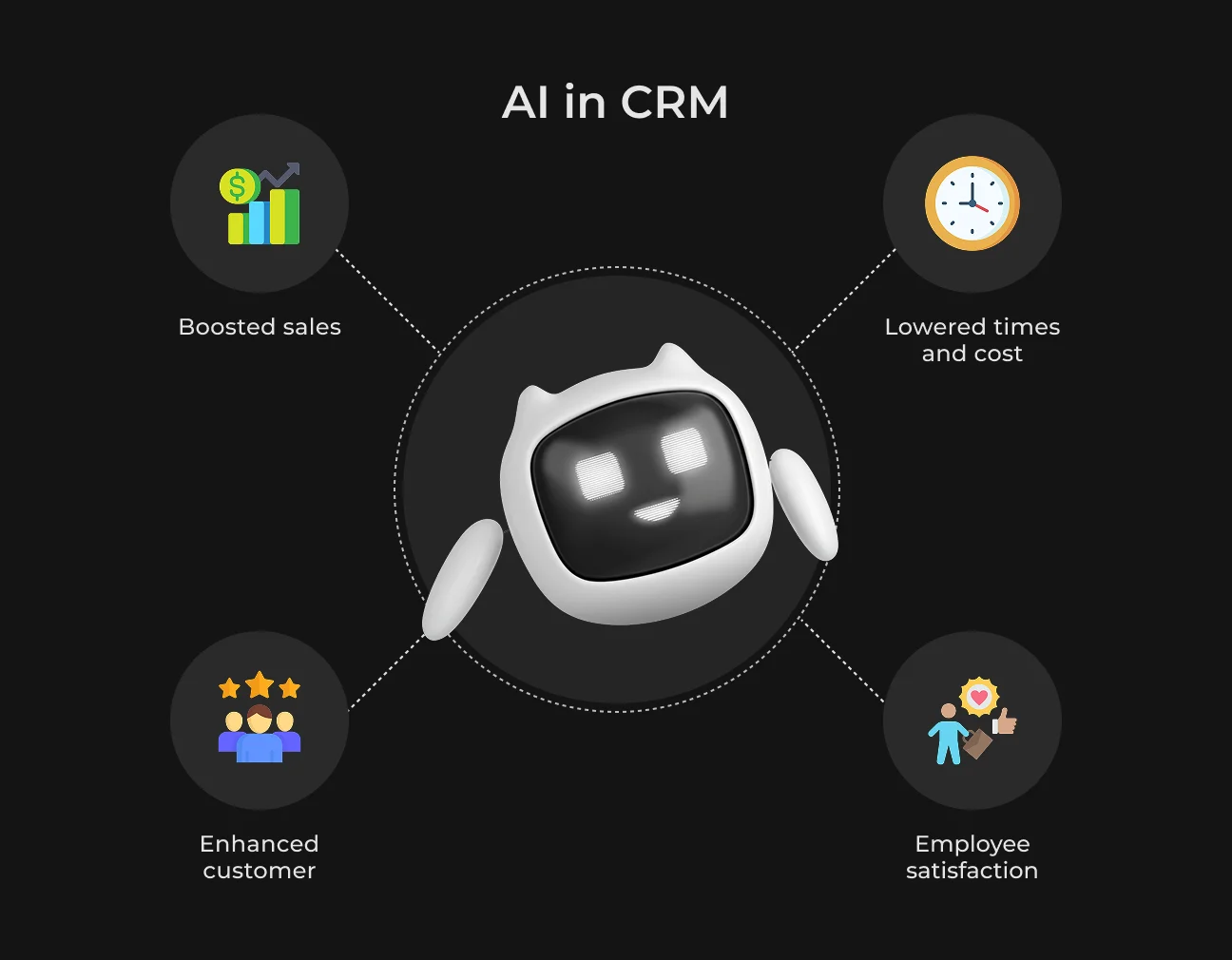
AI has shifted from being a nice extra to an essential component in CRM systems. Software fueled by AI can monitor customer actions, trigger responses on the fly, and deliver personalized experiences at scale. It’s what makes AI so critical for the productivity of sales teams and delivering a better buying experience.
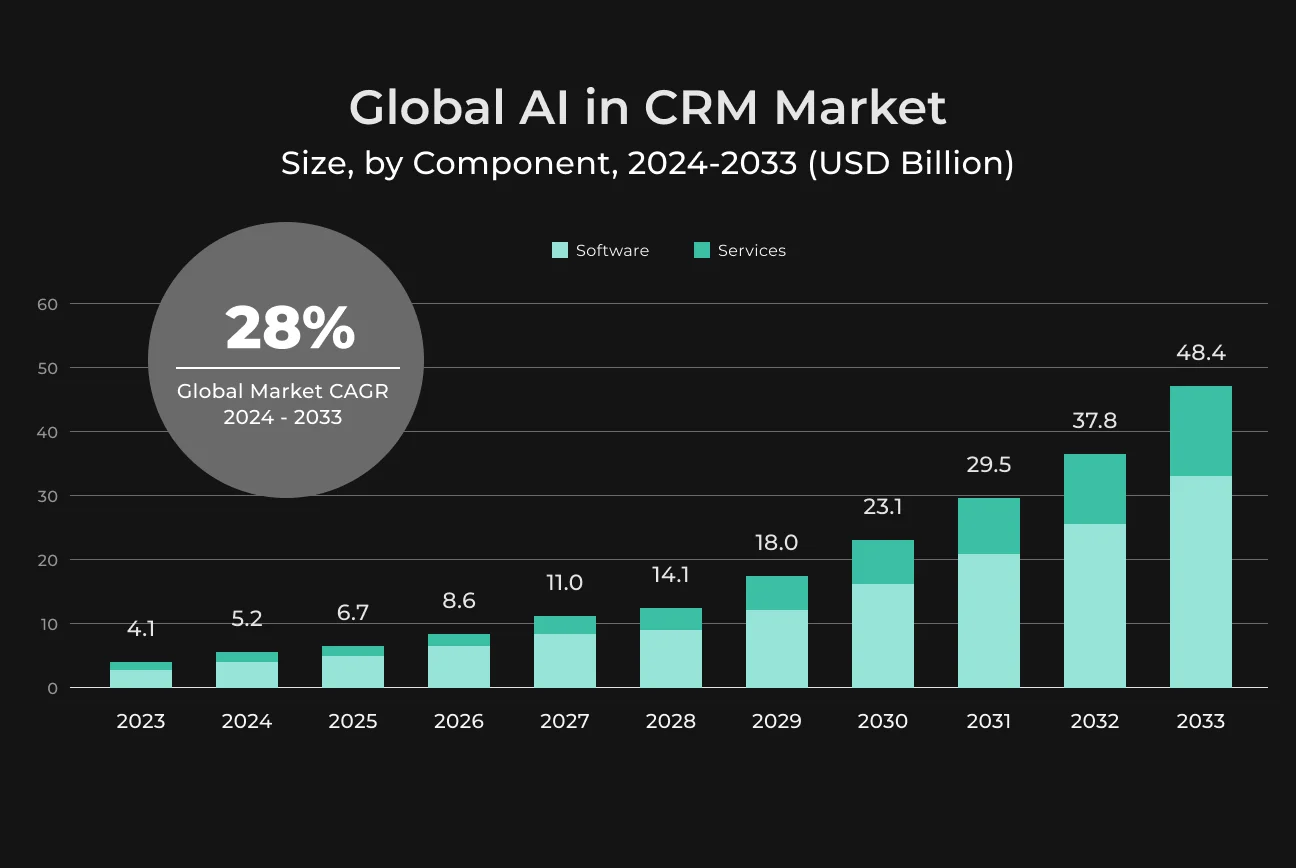
AI CRM makes intelligible trends that salespeople might otherwise miss, and accelerates workflows by automating routine tasks. AI in CRM could hit $48.4 billion globally by 2033. And over the next three years, 61% of companies plan to add AI capabilities to their CRM systems.
Read this article to find out what AI does in CRM, how you can benefit from it, and build your own AI-powered CRM system. This guide will walk you through all of it, step by step.
Significance of AI in Customer Relationship Management
Enterprises have traditionally leveraged proprietary tools for data collection and customer engagement via CRM. But the majority are now tuning into AI, social media, and automation to better understand their customers' thoughts and challenges. And perhaps they can improve that.
There’s more customer data available to businesses than ever before, which, of course, gives them an edge. In 2010, Google’s CEO Eric Schmidt pointed out that we were creating as much information every two days as had been created from the dawn of humanity up until 2003.
But to compete, companies need to apply intelligent analytics to their CRM processes, not just automate them with AI technologies.
What Is an AI CRM System?
If we talk about AI in CRM, we actually refer to the fusion of artificial intelligence technologies (ML, NLP, and deep learning algorithms) and sophisticated CRM systems.
These developments help ensure that your CRM is doing more of the work automatically. Something like analyzing vast amounts of data and making better forecasts about what your customers would like (and do) next.
Let's dissect what is most exciting about AI in CRM.
- Large-scale data analysis. AI supports the rapid and precise analysis of extensive customer-relevant data;
- Customer interaction automation. Daily queries can be answered by chatbots or virtual assistants that employ AI;
- Predictive analytics. Based on what has happened in the past, AI can predict customer behaviors and trends of the future. This allows businesses to engage with customers before they know they need something.
Difference Between Classic CRM and AI-Native CRM
Traditional CRM systems are designed to capture and maintain customer data, serving mainly as an efficient database for day-to-day business functions. Although such systems are effective in processing administrative tasks, they depend significantly on manual entry and review.
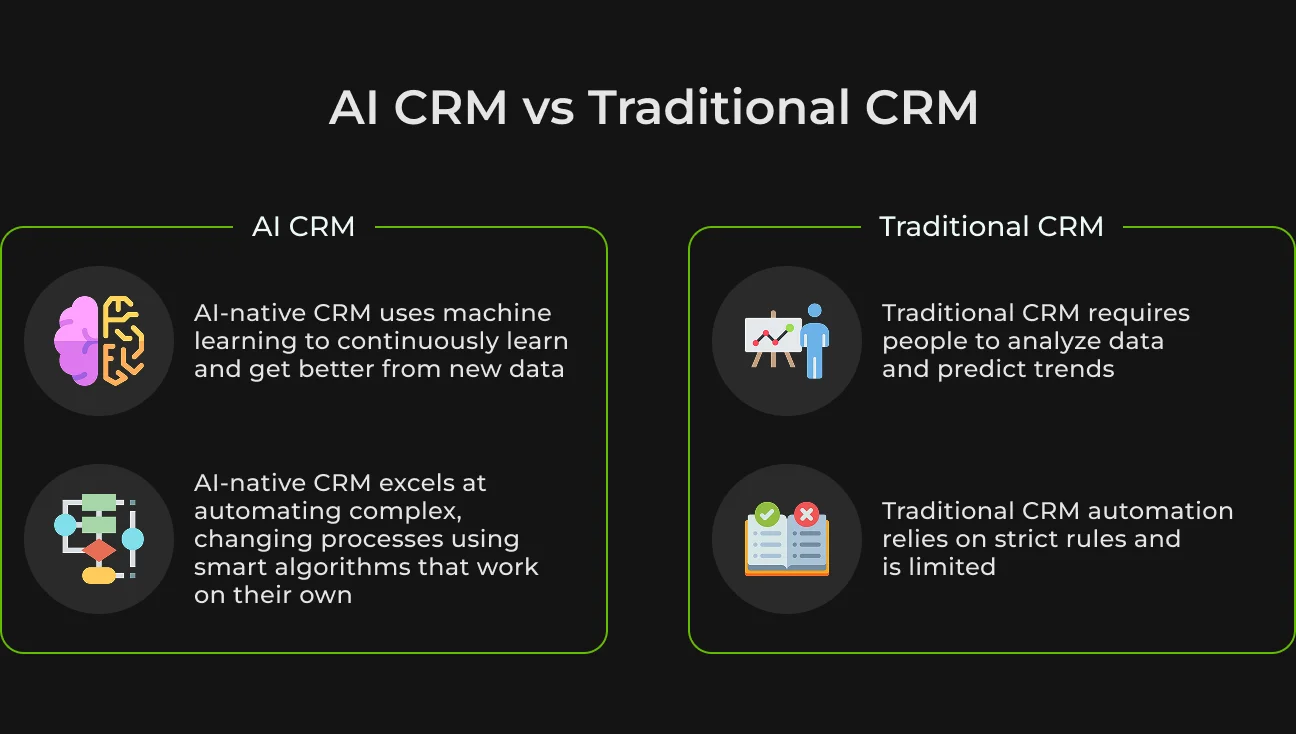
By comparison, AI-native CRM systems do more than manage customer data; they learn from it. That in turn makes them better at developing their responses and tactics. Here’s exactly how they differ.
Their learning capability:
- Traditional CRM depends on human analysis to generate insights with user knowledge and interpretation;
- AI-native CRM leverages machine learning algorithms that continuously improve by learning from new data. These are evolving and refining models for greater accuracy and relevancy.
In their predictive power:
- With classic CRM, companies analyze data, interpreting what might be the trend for the future based on a historical overview;
- AI-native CRM uses analytics to predict needs in real time, future tendencies, and suggest the best course of action.
In automation:
- Traditional CRM automation is rule-based and restrictive — which means it needs constant user tuning and modification;
- AI-driven CRM performs incredibly well at automating complex, variable processes using intelligent algorithms that run independently and self-adjust.
CRM with AI moves beyond traditional customer service and relationship management to a predictive and data-based service model.
How AI Works in a CRM Platform
CRM platforms don’t become incredibly robust unless AI is integrated into them. These platforms leverage machine learning, natural language processing (NLP), predictive analytics, and other techniques to not only handle data but also to generate actionable insights to optimize CX.
Machine Learning Models
This is why AI-powered CRM systems rely on machine learning models.
- ML models “see” massive amounts of data. They basically look for patterns that humans might not otherwise catch. These could be trends in buying behavior or service consumption, as part of a customer relationship management strategy or marketing/sales planning;
- By identifying unusual customer behavior, machine learning allows companies to spot fraud or issues. This enables them to react immediately, and limit the potential risk of data breaches or unsatisfied customers.
Natural Language Processing (NLP)
In CRM, AI needs to apply natural language processing to help systems comprehend and interpret human language.
- NLP can help CRM systems work out how people feel from the loose wording in their emails, social media posts, or chats;
- NLP allows virtual assistants and chatbots to respond immediately to consumer inquiries by providing the right answer quickly;
- NLP teaches CRM systems how to read conversations, providing service agents with the proper answers or call scripts.
Predictive Analytics
By studying customer data over time, AI can help an organization predict which customers will be most valuable to them and make decisions on how to allocate tasks.
Another classic use case is customer churn prediction. AI can predict the churn risk of a customer with different behavioral indicator models like active engagement, transactions, or filed complaints.
Generative AI and AI Agents
Generative AI and agents bring ingenious and interactive solutions to intricate customer relationship issues. Sixty-two percent of people surveyed said their companies are experimenting with AI as agents.
These agents can interact with customers on the spot. For example, to offer recommendations and advice using customer-related information analyzed in real time.
In addition, Gen AI can also emulate many customer interaction scenarios. This allows teams to practice for all types of customer service interactions.
Why Invest in AI-Powered CRM Software
Opting for a CRM system with AI is not just another tech update — it’s a strategic decision to keep you ahead in the game of customer relationship management. AI could increase global economic output by 15% over the next decade.
Today, 19% of companies employ generative AI for B2B transactions, with another 23% planning to implement the technology.
AI-powered CRM software is ever more common. The CRM space is projected to reach $97.3 billion in 2026. You can get robust data analytics, improved customer intelligence, and a lot more automation.
These AI-based CRM solutions can generate incremental revenue by monetizing data and predicting sales. Companies are observing a 34% increase in performance within the first two months of implementing sales AI, with potential revenue gains of 10% or higher.
Basically, AI-powered CRM is a great decision and fits perfectly into the current market trends. Not to mention how many long-term benefits they have for businesses.
Key Benefits of AI-Based CRM
Consider these four critical benefits of CRM software to learn how they transform companies for the better.
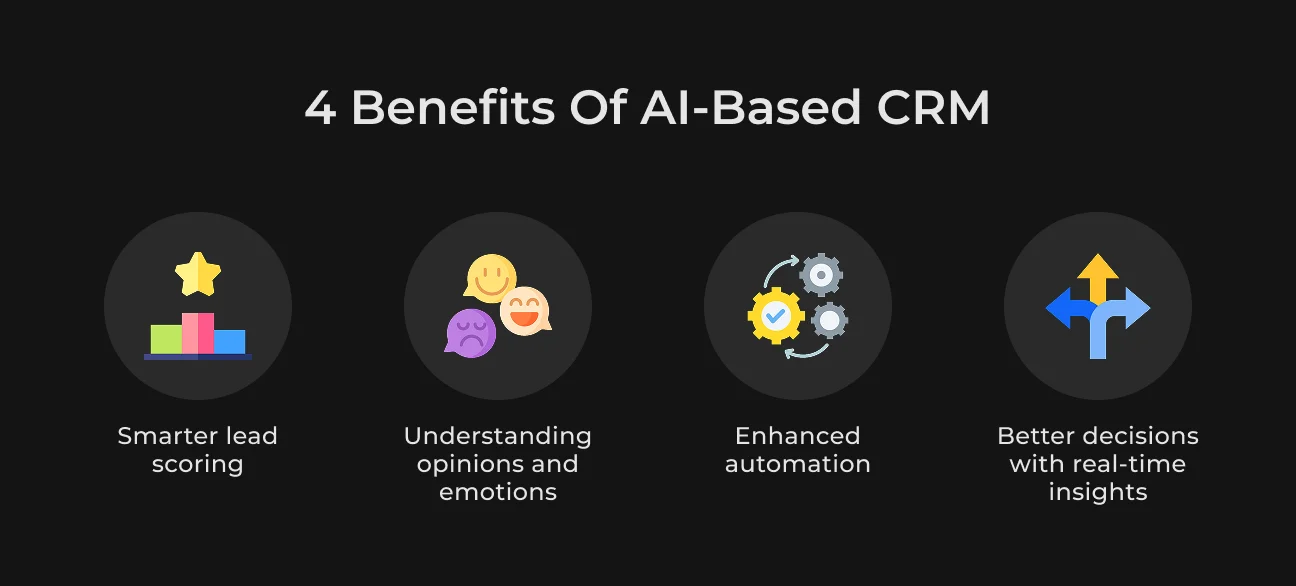
More Intelligent Lead Scoring
AI lead scoring uses technology to identify the best leads using demographic and behavioral analysis. That enables sales representatives to prioritize the most promising leads and improve prospects for a sale (or upsell).
Boosted Automation
While AI and automation are not the same, they are great companions. Chatbots, virtual assistants, and other AI-enabled robots can handle routine customer queries around the clock.
Understanding People's Mood and Emotions
We are all on social media, and AI is great at analyzing feedback from customers on Facebook, Twitter, or whatever channel a person uses.
And all that is in real time, so brands can respond quickly if they need to — and build long-term brand loyalty.
Improved Decision-Making with Real-Time Insights
CRM with AI translates raw data to basic and readily usable knowledge, allowing for instant data-driven decision-making inside organizations. It makes them dynamic in adapting strategies — not only to capture opportunities, but also to manage risks.
Business leaders will always have the latest insights they need to remain flexible and competitive in fast-moving markets.
AI CRM Use Cases Across Departments
AI-powered CRM systems have transformed companies in every industry. Here, we’ll focus on a few cases that illustrate the AI‘s role in sales, marketing, and customer support.
Predictive Lead Scoring
AI CRM tools have increased the productivity of 73% of salespeople. For example, AI-powered lead scoring reduces the need for teams to devote time to low-quality leads by 27%.
Businesses that have implemented AI-based lead-scoring processes have experienced up to a 79% increase in the quality of leads.
Next-Best-Action Recommendations
Artificial intelligence can look at what the customers are doing and where the market is headed, and recommend whom to call next to win new business.
AI can increase customer satisfaction by 15 to 20%, grow revenues by up to 5 to 8%, and decrease service costs by about $30.
AI-Assisted Deal Forecasting
AI can take a vast number of factors in combination, including specifics around deals, buyer activity, signals from the competition, macroeconomic data, and an organization’s past success. As a result, top companies can predict results with 90% accuracy.
AI-Driven Content and Email Optimization
AI can use data to optimize content and email strategies with insights into how customers engaged in the past. Almost 29% of marketers believe leveraging AI on advanced content creation and analysis will significantly impact email marketing.
Looking forward, 70% envision artificial intelligence handling at least half of their email practices in 2026. Add 18% who anticipate that AI will take on 50-75% of their email marketing duties.
Automated Ticket Routing
AI ticket prioritization and routing is the use of artificial intelligence to rapidly analyze support requests, assign priority levels, and route requests to the most appropriate agent in real time.
This form of AI removes the manual process delay and gets important issues to the right agent within a matter of seconds. Because being just 15 minutes quicker might decide if you keep a loyal customer or lose them to a competitor.
Churn Prevention Models
Churn rates for most services range between 15–30% annually. Churn reduction is crucial since acquiring new clients is more expensive than keeping existing ones.
By integrating with contact center platforms, agents receive live-time risk scores and customer insights. Businesses can identify which customers are more likely to lose interest and personalize their experiences. For example, valued customers are usually given priority technical support even before they have any issues.
Core Features of an AI CRM Platform
AI-driven CRM systems are deep and sophisticated systems that come with a whole range of modern features. Below are some of the core ones that make these platforms a must-have for businesses in this age.
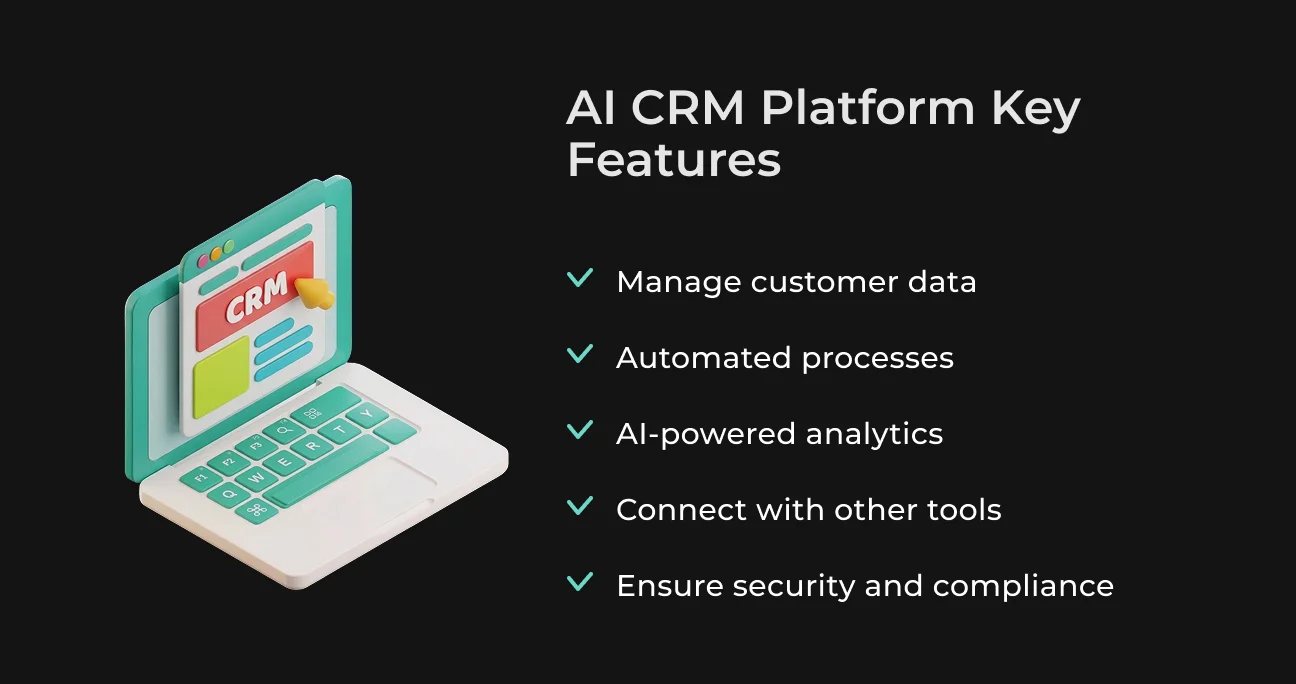
Customer Data Management
AI CRMs are adept at collecting huge amounts of customer data from multiple sources. Along with storing this data, they also provide intelligent processes for data cleansing, deduplication, and enrichment.
For example, CRM with AI allows a bank not only to ingest customer details but also to evaluate their spending habits or investment tendencies.
Automation Engines
AI native CRM comes with an in-built automation engine that automates all the repetitive tasks. A marketing team can run multiple campaigns hands-free with automated email campaigns, follow-up, or task reminders.
AI-Driven Analytics Dashboards
AI dashboards use dynamic data processing rather than static charts and tables based on scheduled batches of pre-collected data. They come with machine learning, anomaly detection, and natural language query features to facilitate the analysis. This allows users to ask questions and get instant responses.
Integration with External Tools
AI-assisted CRM can effortlessly integrate with other enterprise systems such as ERP, marketing automation platforms, or analytics tools. In this kind of integration, data flows freely from platform to platform. And businesses get a unified view of all customer touchpoints.
Security, Compliance, and Data Governance
AI CRM systems focus heavily on protecting customer data to the point that they comply with privacy laws. These involve encryption, access controls, and compliance checks.
Using AI CRM, a healthcare provider, for example, benefits from HIPAA compliance, as it means the data is secured and there are audit trails.
How to Build a CRM System: Step-by-Step Guide
Now, here is a quick checklist summarizing the salient steps to take in building an AI CRM system.
Step | Action Item | Key Objective |
01 | Requirement Definition | Identify business goals, pain points, and stakeholders. |
02 | Data Planning | Map existing insights and plan for new data acquisition. |
03 | Tool Selection | Select scalable AI platforms (ML & Automation support). |
04 | System Architecture | Map data flow and detail all technical components. |
05 | Accuracy Baseline | Use historical records to ensure data integrity. |
06 | AI Model Creation | Build models for lead quality and behavior predictions. |
07 | System Integration | Connect to existing stacks (SAP, Marketing, etc.). |
08 | Security & Compliance | Implement encryption, IAM, and regulatory checks. |
09 | Pilot Phase | Launch to a limited user group for feedback. |
10 | Training & Guides | Conduct workshops and distribute user manuals. |
11 | Full Rollout | Launch to everyone with active performance monitoring. |
Estimate Your Project's Costs
SapientPro's engineers will provide a free estimate for your CRM development ideas.
Tech Stack for AI CRM Development
Let us explore elements of the tech stack specifically used to develop AI CRM.
Category | Recommended Tools | Purpose & Use Case |
| Cloud Infrastructure | AWS S3, Google Cloud Storage | Storing massive datasets with high security. |
| Databases | PostgreSQL, MongoDB | PostgreSQL for structured data; MongoDB for unstructured/rapidly changing data. |
| ETL Tools | Apache NiFi, Talend | Automating data processing and integration. |
| API Management | Apigee, MuleSoft | Integrating the CRM with external applications and services. |
| ML Frameworks | TensorFlow, PyTorch | TensorFlow for production suites; PyTorch for research and lab work. |
| NLP Tools | spaCy, BERT | Contextualizing language and understanding user behavior. |
| RPA Tools | UiPath, Blue Prism | Automating complex workflows and mimicking human data entry. |
| Access Management | Okta, AWS IAM | Securing applications and ensuring privacy/compliance via user access. |
| Encryption Services | AWS KMS, HashiCorp Vault | Protecting sensitive data to maintain trust and regulatory compliance. |
Cost of Building an AI CRM System
Building a custom CRM may seem like the ideal path for tailored operations, but it is important to view it as a living ecosystem rather than a "fixed tool." The total investment scales based on your requirements, but can generally be categorized into three pillars.
1. Core Development Investment
The baseline for a custom CRM typically requires a significant initial capital outlay. This covers the foundational architecture, database design, and UI/UX. Expect a standard mid-to-high six-figure range for a professional-grade MVP.
2. AI & Automation Integration
Layering intelligence such as predictive lead scoring, sentiment analysis, or automated workflows adds a specialized tier of expense. This typically adds a 15% to 25% premium on top of the base development costs due to the need for data scientists and ML engineers.
3. Recurring Maintenance & Evolution
Software is never truly "finished." To keep the system secure and compatible with new APIs. Budget for annual maintenance costs totaling roughly 15–20% of the original development cost.
In total, the cost to start and launch AI CRM software can vary significantly based on your needs. That's why it’s highly recommended to cooperate with an experienced technical partner like SapientPro to get a precise estimate of these costs.
Challenges and Risks in AI CRM Application Development
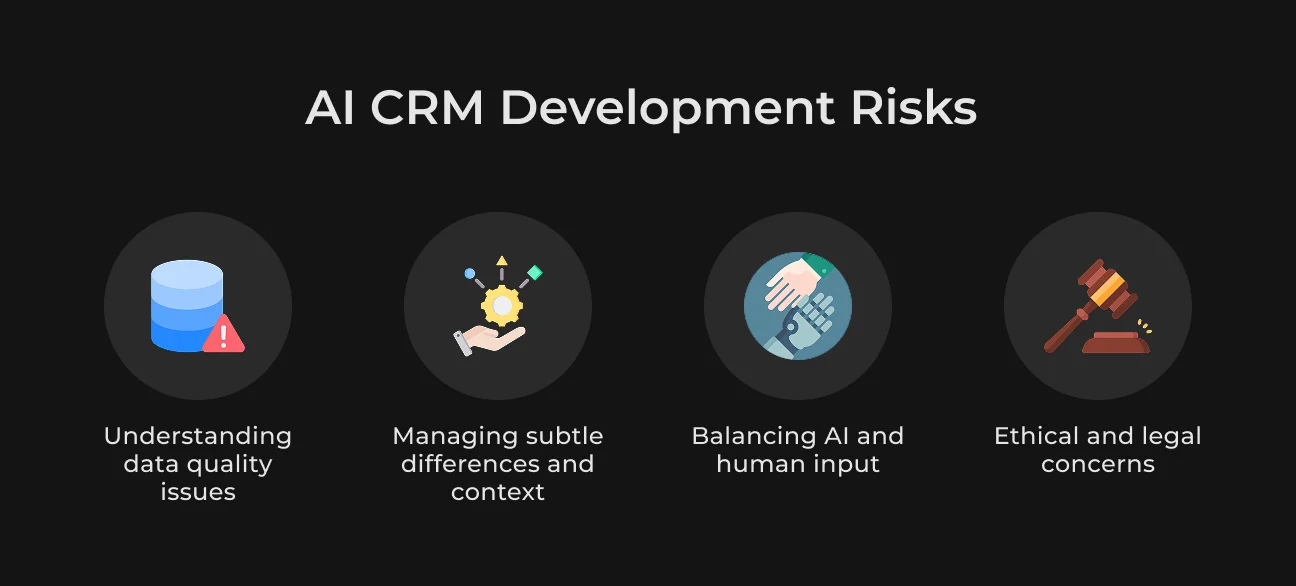
Nobody said AI is without faults. As we explore here, AI-powered CRM can have or create issues, leading to work stoppages and degrading customer relationships. Let us examine the four major challenges of AI-powered CRM.
Problems with Data Quality
If your data is a mess with duplications, obsolete information, or gaps, then somewhere AI may show more errors. It doesn’t know which data is good or bad and will consider all of it correct. The result: you get incorrect predictions.
Finding a Middle Ground Between AI and Human Services
With increasing automation of CRM systems geared toward artificial intelligence, there is a risk that human interaction may diminish because of machine automation.
That means customers might miss the personal touch of traditional customer service.
Tricks With Nuance and Context
AI can match a basic sentiment but cannot identify sarcasm, frustration, or nuanced changes in tone. It often lacks context to understand what customers actually mean, which can induce misunderstanding.
Ethical and Legal Risks
Customer support pulls data from both inside and outside your organization. That is often sensitive personal information about customers that needs to be stored securely and legally.
Discuss how customers can be confident that their data is used and saved only for specific purposes.
Future of AI in CRM Systems
Even though AI CRM platforms have their pitfalls, traditional CRM cannot handle the modern needs for faster responses, personalization, and data handling. This opens a huge scope for AI in customer relationship management. And now, we come to future trends and opportunities.
AI Agents and Autonomous CRM
Progress happens when systems build trust and coordinate routine tasks without losing any performance. Achieving this requires developing smarter models and considering all kinds of customer behavior to guide future decisions.
So the next generation of CRM systems will have AI agents that require less hand-holding. These agents will be capable of autonomously performing tasks like scheduling, following up on leads, and even negotiating with customers.
It is also projected that the global market for autonomous AI and agents will reach $70.53 billion by 2030.
Deeper Generative AI Integration
The anticipated value of generative AI in the customer relationship management market is $144.9 million by 2033. Salesforce (with its Einstein GPT) is an example that illustrates how generative tools can enable more dynamic and less human-dependent CRM systems.
Generative models can personalize sales presentations and emails specific to each customer profile and prior interactions. Generative CRM also enables marketers to enhance ROI from their campaigns. It can study the effectiveness of marketing campaigns and produce reports to improve future strategies.
Predictive and Prescriptive CRM Systems
This is how CRM services will change in the future, moving beyond giving digital tools to customers and becoming more predictive. Rather than merely capturing data, it now enables businesses to predict what customers will want next.
Predictive CRM can tell when a customer might buy something or if they're likely to stop using a service. For example, a CRM system could forecast the buying behavior of customers and suggest discounts on products, or when it is best to follow up for selling.
How SapientPro Created AI Agents for Sales
The company wanted a smart speech recognition system that could detect pauses and hesitations to make conversations sound natural and human.
Taking on this challenge, SapientPro made the client's ideas a reality.
We began with basic chatbots, like those used in customer service. Although they didn’t use the latest NLP technology, these chatbots provided a solid foundation for creating a system that answered common spoken questions with good interaction quality.
We included a large language model to make the chatbot more dynamic and flexible. LLM does this by deconstructing everything it gets into parts, each known as a token, and then responding with contextually relevant outputs quickly.
Now, the second version of the conversational AI can switch between languages and accents fluently based on users’ preferences. It's now much easier to set up and configure the chatbot for the first time because users can quickly manage it internally.
Partner with SapientPro to Build Your AI CRM Software
SapientPro is the perfect tech partner for boosting your business with strong CRM solutions. For over 9 years, we've developed customized operational, analytical, and collaborative CRM systems for businesses of any kind.
Our engineers can equip your current solution with groundbreaking tech like AI, predictive analysis, language processing, or computer vision. If you need something individually made for your business, we can make it from scratch to match your needs.
Contact us to get your custom solution and full estimates from our experts.
Integrate AI into Your CRM