All Top 10 CRM Security Best Practices in 2026
March 4, 202615 min read


If cybercrime was a country, it would have the third strongest economy in the world after the United States and China. And modern CRM systems are now a hot target for internet hackers, which isn’t a surprising fact.
They store a lot of customer data, transactions, and behavior insights. It’s a risk that has grown more acute as many companies have shifted to the cloud, APIs, artificial intelligence, and third-party services.
For example, the hacking group Scattered Lapsus$ Hunters took credit for stealing personal information from more than 200 companies through Salesforce. They leveraged a vulnerability in a third-party support app from Gainsight to do this.
To help you stay on the right side of the data rules and maintain customer trust, SapientPro’s engineers prepared the current CRM security best practices based on their experienced and the industry’s trends. Read on for more!
Importance of CRM Data Security
In the digital economy, information is the new oil and fundamental to building sustainable customer loyalty. That is especially the case when it comes to customer relationship management systems, as data is what drives marketing, sales, and support — not to mention keeping customers coming back.
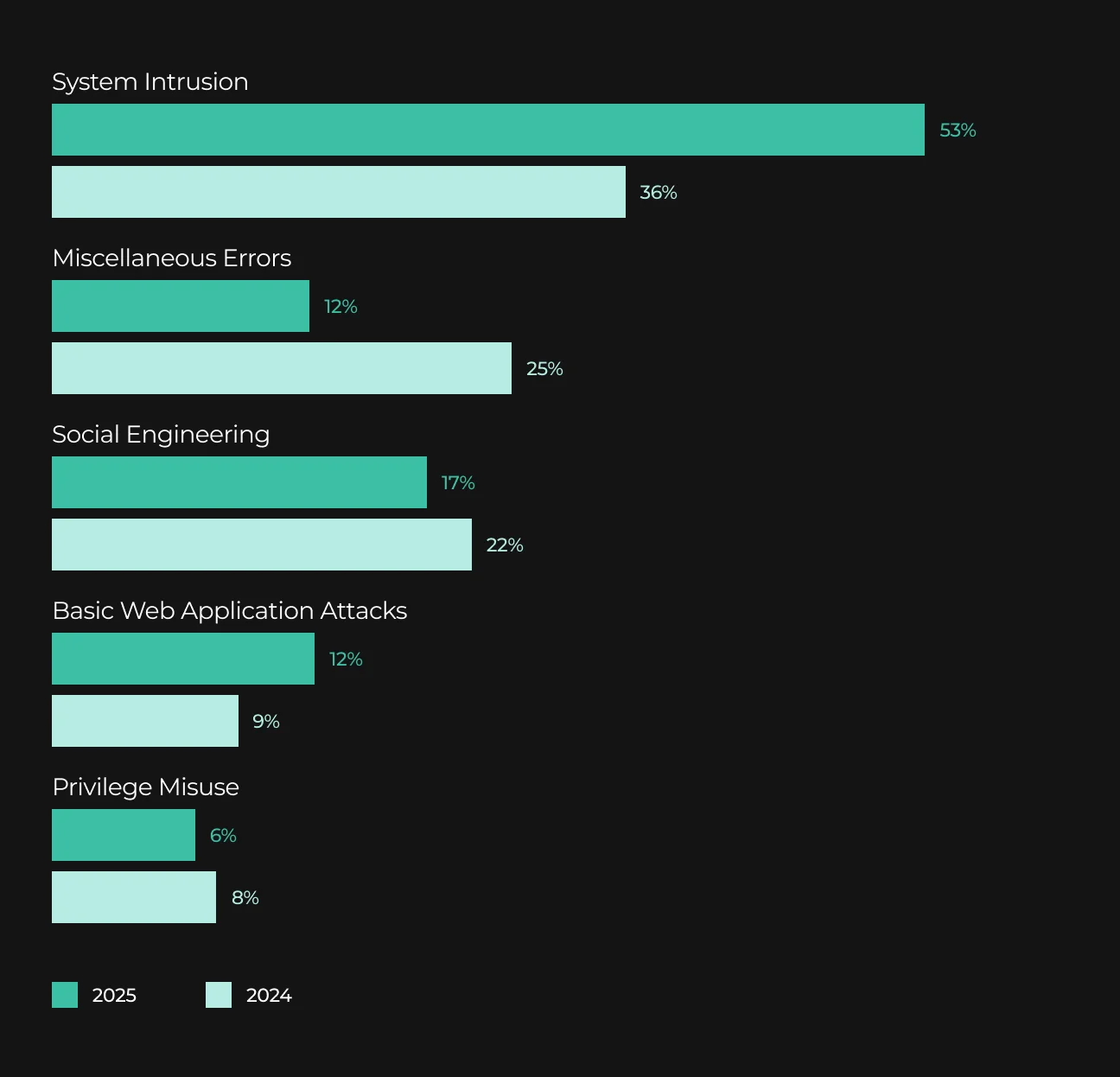
Security threats evolved over the years. Twenty years ago, nearly half of breaches were caused by lost or stolen devices, and only 10% by breached systems. Most violations today happen because of malicious activity, like phishing and insider threats.
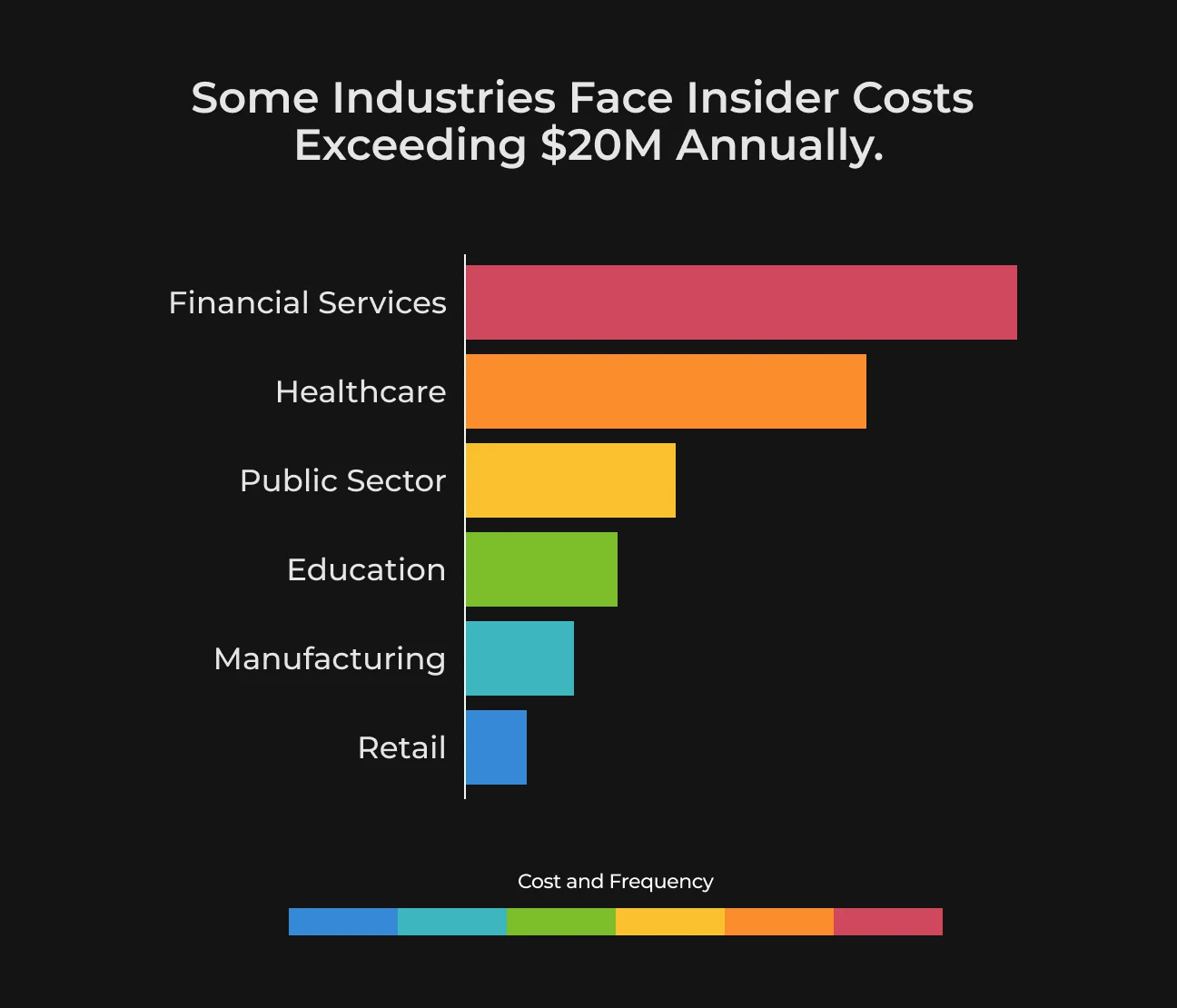
The 2025 report shows that 86% of data breaches are caused by external attackers looking for financial gain. Insider threats (including those resulting from human errors like stolen credentials) account for 60% of breaches.
Moreover, regulation still falls as artificial intelligence has been deployed at a rapid pace. Basically 97% of AI-related security issues involve systems lacking proper access control.
Businesses should focus on their CRM safety as a critical business need, not just to meet compliance requirements, but to protect their most valuable assets.
Modern CRM Cybersecurity Risks in 2026
AI-based attacks are advancing faster than older defense tools can handle. Besides, using cloud-based SaaS platforms can pose privacy problems for CRM data management due to access control issues or unreliable third-party integrations.
Let’s have an in-depth look at the expected CRM security threats for 2026.
1. Data Breaches and Insider Threats
Bad habits like reusing passwords or the careless use of third-party plugins may leave you exposed. It’s very simple, for example, to impersonate a login page or click an attachment that contains malware.
Attackers, after breaking into these systems, can then interfere with them by sending counterfeit (but realistic-looking) messages.
To resist these threats, zero trust is essential. This involves validating all requests, even from insiders. And training staff on the significance of secure data processes goes a long way towards preventing these breaches.
2. API Abuse and Insecure Integrations
CRM systems are now at greater risk of API misuse. More than half (57%) of surveyed businesses suffered at least one data breach because of the misuse of APIs over the previous two years.
Many APIs also have rate limits to prevent abuse. The API may automatically start refusing requests, or the service may be stalled or slow if we go beyond them.
For enterprises that rely on their data environment or manage large amounts of information, this can be a challenge. It is thus advisable to decrease the speed at which API requests are submitted so that they cannot be abused.
3. Misconfigured Access Roles
The critical question in many security systems is who gets access to what. When access controls are not configured properly, an organization is vulnerable. And it could be simple for malicious actors to access data.
It's better to have a mature role-based access control (RBAC) in place, so that CRM users only have access to what they need.
4. Weak Encryption During Data Processing and Migration
Poor encryption algorithms can result in the theft of sensitive information by allowing hackers to break in. These algorithms might have flaws, such as the use of short key lengths or a recognizable pattern.
Strong encryption algorithms, such as the Advanced Encryption Standard (AES) with 256-bit keys, can offer a greater level of security.
Not to mention, over 80% of data migration projects last longer and cost more than planned. That’s because migrations are much riskier than we tend to think.
CRM implementation risks like data loss, breaches, or prolonged downtime might only be noticed after weeks of the project implementation.
5. Supply-Chain Vulnerabilities in CRM Plugins and Extensions
Plugins and extensions may represent hidden threat vectors for cyber attacks. Malware can be hosted inside a plugin, behaving like a Trojan horse. So when the plugin is compromised, attackers can steal sensitive data.
Before you add any 3rd-party module, judge the vendor’s security history and practices. That would include reviewing the security certifications they have, reading about their previous security problem history, and understanding how they update and patch.
See How Sprinkle got +45% income
SapientPro's engineers helped Thailands largest water delivery brand get 75k+ users during our collaboration.
10 CRM Security Best Practices in 2026
There is no question that CRM data security is a business issue, not only an IT one. The importance of doing everything in your power to protect sensitive customer information cannot be underestimated.
The most successful approach is to maintain these good security habits on a regular basis.
1. Zero Trust Architecture in CRM Systems
In 2009, Forrester created the Zero Trust model as a new approach to security instead of the old perimeter-based methods. It soon became the top choice for security teams looking to prevent major breaches.
In traditional network security, getting in from the outside is difficult, but once inside, everyone is trusted. The issue is, once someone is in, they can roam throughout the network unchecked.
Zero Trust improves this situation. It insists on positive verification of identity for everyone who tries to either evaluate or use network resources — whether they are inside the network perimeter or out.
Zero Trust’s foundational concept is simple: trust no one. That means no device, user, or app is considered secure by default. Everything is viewed as a potential threat that must be checked out.
2. AI-Driven Threat Detection & Monitoring
Every interaction with a CRM system generates metadata, like time, username, or IP address. Machine learning models use this information to form user and role profiles, learning normal patterns of activity.
As an example, a local customer support agent may normally update CRM records at 10:00 AM and 7:00 PM local time and almost never exports more than 150 rows at a time.
When it diverges from these patterns, it’s a warning signal. This could mean a script that's attempting too many logins, non-admin users trying to export orders in massive numbers, or repetitive connections made at lightning speed.
AI models can assign scores to these unusual activities. Predictive intelligence powered by AI is used to analyze user patterns and system behavior to find threats before they become bigger problems.
3. Stronger Regulatory Pressure
It’s time to add ISO 27001 and GDPR to your CRM security strategy — privacy baselines that organizations leverage to understand how to use personal data.
The GDPR is a European Union law that affords people greater rights over their personal data and restricts the way in which companies can harness it.
Like GDPR, CCPA is a California law that allows residents to see what personal information businesses are collecting about them and ask companies to delete it.
Both GDPR and CCPA share the concept of giving people control over their personal data. The specifics vary, but they all notify consumers that the service’s data practices can be reviewed and how to correct any inaccuracies.
That way, companies can tailor their policy to whatever people want.
4. Shift Toward Secure-By-Design CRM Implementation
Security by design is a development approach that considers security as an integrated part of the design and system planning processes from the outset. It really ensures that software applications are already stronger and can manage malicious cyberattacks from the beginning.
A key benefit of security by design is that it helps organizations meet relevant regulations. For example, it aligns with ISO 27001 against secure coding. It is tailored to PCI DSS requirements and NIS 2 principles for supply chain security, cryptography, and multi-factor authentication.
Security by design also contributes to GDPR readiness by enabling safer handling of PII and encouraging best practices in change management.
5. Multi-Layered CRM Data Encryption (Rest & Transit)
When securing data, stored data is most important. That is to say, making data unreadable to anyone without authorization, including when someone attempts to access the storage device physically.
The way to do that is by encrypting data at rest, which transforms the data into something unintelligible without the proper decryption key. For CRM systems, data encryption directly in the database can be used to protect tables, columns, or files.
Many cloud services let you turn on built-in encryption with just a single setting.
Securing data as it travels across the networks is data in transit. The only way to protect the data is to encode it in a jumbled form that nobody other than the intended recipient can make any sense of.
This begins when the client and server (two parties) agree on an encryption to use and exchange keys safely. After the encrypted connection is established, anything you transmit over it is in code. So even if someone intercepts what’s being sent, it’s still a jumble.
6. Fine-Grained Role-Based Access Control
Let’s imagine a scenario. A support team member is working on solving an issue and inadvertently changes client data via the admin screen of your CRM. This can result in accidental changes to the data, compliance problems, and long hours of correction.
The problem at hand was not so much the mistake of an agent, which it indeed was, but also in the system of authorization that made it possible. These issues are not uncommon as contemporary systems get more complicated and layers of technology (and integration) keep adding up.
Which is why real-time and context-aware access control is so critical. Fine-grained authorization has an answer for this. Unlike other high-level access control methods, this one allows you to manage exactly who can access a particular piece of data.
Granular access means permissions are precisely the ones your business requires.
7. Mandatory Adaptive MFA
Yesterday's means of authentication, such as usernames and passwords, are weak or hackable. Whoever has the credentials can then employ those to enter and, potentially, steal or alter sensitive data. Multi-factor authentication can address those risks.
It does so by adding a second layer of CRM security requirements to prove a user’s identity. It pairs two or more mechanisms of verifying that a person is who they say they are — a password (something you know or something you have) with a code from an authenticator app, for example, or from a text message.
Adaptive MFA systems can also change security gains depending on the user role and risk. For example, an IT administrator could be subjected to more frequent security reviews than a local support agent.
8. API Security & Third-Party Audits
Since developers continue to build new applications and services (most of which are connected with systems of record like CRM), there is an increased dependency on APIs to sync with data.
The wider the adoption of APIs, the higher the risk for security breaches. Literally all (99%) of organizations have become victims of security problems surrounding an API in the past 12 months. And in over a third of these cases, sensitive data has been exposed.
API security audits need to be routine, not occasional, like at a couple of the high-impact stages of development:
- At regular intervals. Run monthly scans and quarterly manual reviews of high-risk APIs. For the least risky, aim for annual scans and yearly reviews;
- During CI/CD. Employ automation to conduct static analysis, schema validation, and detect secrets on every code commit. Catch issues before they are introduced into production;
- After an incident. If you’re compromised or suspect foul play, do a thorough audit to discover what’s broken;
- On structural changes. Audit after migrations, updates, and authentication method upgrades. Small changes in the conformation may lead to increased exposure.
When you protect your APIs as the essential component of your application security, you get not just more secure CRM software but also trust from users and partners.
9. Secure CRM Data Migration
Data migration for customer relationship management software may appear to be easy at first, but it can become sticky fast due to duplicate records, missing content, or files that don’t pair up.
And when you are pulling data from a variety of systems (spreadsheets, old CRM systems, and so on), even small discrepancies (like how emails are formatted) can be the reason for duplicates. There is no one-size-fits-all approach for moving CRM data.
It requires following some organized steps.
One version of the plan integrates all stakeholders and engineers on the same page. Robust authentication is essential for the secure integration of CRM. There has to be a safe way to store and protect the CRM API tokens, like OAuth, SSO, API keys, or mTLS.
10. Immutable Data Backups
Immutable backup is a data protection service that creates unchangeable backups that cannot be modified or deleted for a certain period. These backups imprinted the data into read-only tables, preventing anyone from hacking it.
Then, data is stored in a compressed form to save memory and speed the recall.
CRM Security and AI-Driven Systems
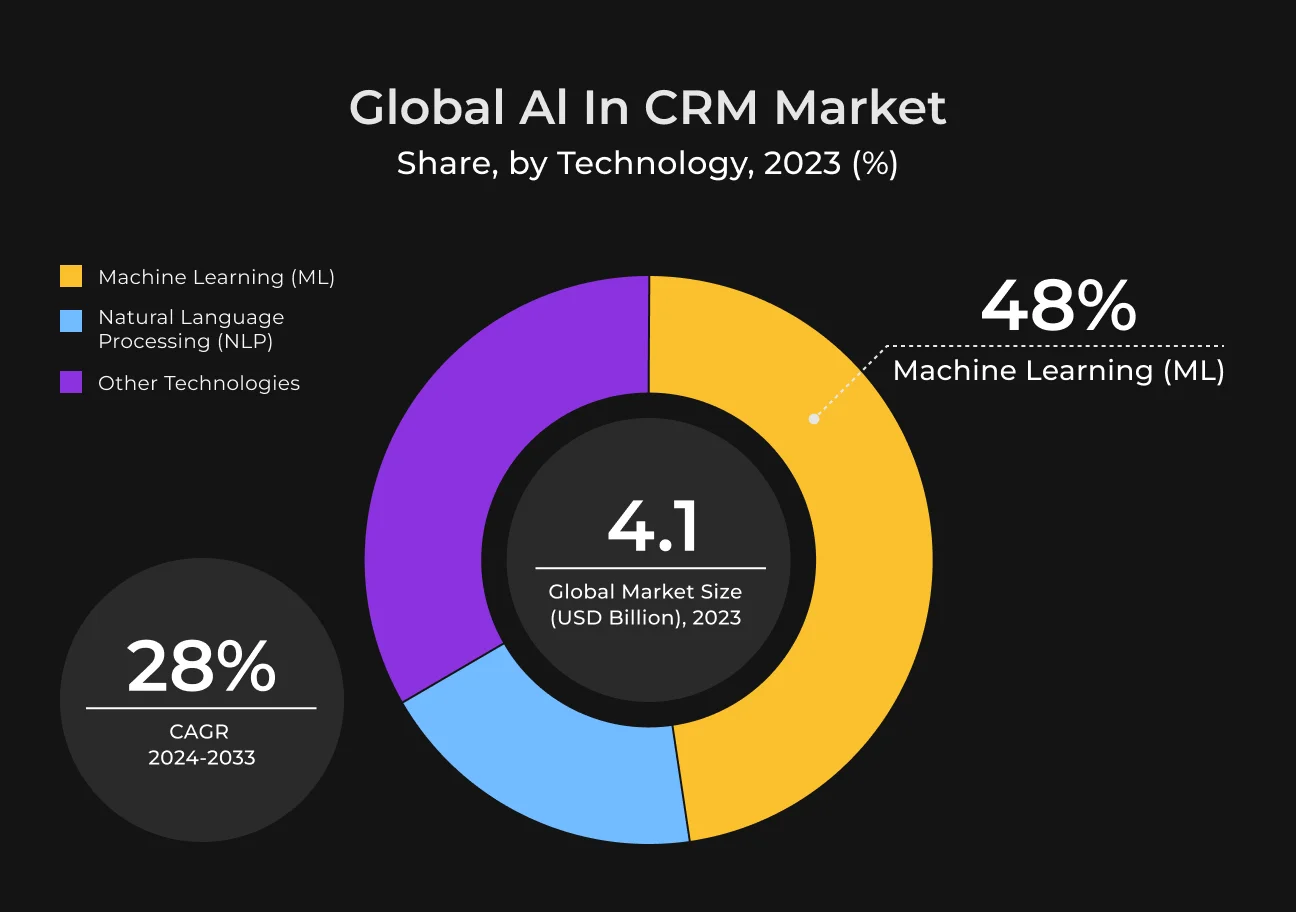
AI-based CRM systems are indispensable tools that help collect, analyze, and personalize customer data. For example, Salesforce with Einstein GPT is used to automate tasks and give uniform AI responses to benefit both business and customers.
But these developments expose us to newer security challenges that we have to manage. Let's explore everything below.
Benefits of AI in CRM
AI in CRM systems can provide businesses with powerful tools to help them understand and connect with customers. Here's how:
- Companies can analyze huge quantities of data to make sales forecasts. For example, a retail shop will have the ability to predict which products are going to be popular during the holiday season and stock supply accordingly;
- AI can tailor campaigns to people’s tastes. Imagine if a streaming service can tell you what to watch next, knowing what you have already seen;
- Routine work (like data entry or taking customer queries) is also something that can be easily automated. Basic customer service questions can be run by AI chatbots at any time of the day. They offer instant answers and lower the likelihood that customers will have to wait around for answers.
Security Challenges in AI-Driven CRM
While the benefits are remarkable, AI-enabled CRMs do have several potential security vulnerabilities:
- Data exposure. Consider a scenario where an online store is hacked and its CRM system compromised, revealing personal and payment information of thousands of customers. This, of course, can result in a loss of trust and liabilities;
- Explainability. AI systems are black boxes, making it difficult to understand the reasoning process. So, for example, if an AI agent (and not a human employee) refuses credit to someone who has applied for a loan, the bank should be able to explain why they withdrew that request;
- Access control. It is important to restrict access to the CRM system to only those who need it. For example, an employee in marketing will need to access contact information but not sensitive financial data (if it is not relevant to their job).
Importance of Explainability and Controlled Access
In a McKinsey survey, 40% of respondents indicated that explainability is one of the greatest risks associated with implementing generative AI. Yet, just 17% are currently tackling the problem.
A side effect of that is this desire for more AI explainability (XAI), a way to allow organizations to interpret their AI systems and also make sure they’re fair and unbiased.
The EU AI Act, for example, prescribes the level of transparency in an application-specific manner based on how risky the AI system is. For especially risky AI systems (like resume evaluation tools used to pare down job applicants), companies will be required to make public detailed explanations about:
- How the system works;
- What its limitations are;
- What the training process was like;
- And details of the data it uses in decision-making.
CRM Compliance and Regulations in 2026
CRM systems must adhere to significant data protection laws in 2026. In addition to GDPR and CCPA, there are several other important laws on the books.
For example, HIPAA is important for CRM solutions that store health data. So, information of patients is kept confidential and used by authorized personnel only.
If you deal with payments, all systems must have the PCI DSS standard. It ensures the safety of cardholder data through encryption and access restrictions.
What are some best practices to help remain compliant?
- Keep transparent and user-friendly privacy policies that contain information on the data stream;
- Regularly train personnel to handle data securely;
- Set advanced security features, like encryption, and select a CRM solution that comes with compliance built in.
Get some control of your own, and your enterprise can ensure its CRM systems are compliant — and customer data is intact.
CRM Security Audit Checklist for Your Business
This checklist will help you identify potential security risks in your CRM and ensure you perform a comprehensive security audit.
| Access control management | Audit the levels of user access and delegate based on job role. |
| Data encryption | Enforce a centrally managed and safe encryption key system |
| API security | Test APIs for penetration testing and implement strict monitoring (with logging) of all API access. |
| Third-party plugin and extension management | Check and document the security fields used by third-party vendors for the CRM. |
| Data backup and recovery | Ensure that all data is backed up frequently, and these backups are recoverable. |
| Compliance check | Ensure CRM processes comply with all privacy laws (like GDPR and CCPA). |
| Incident response plan | Perform periodic checks of your incident response plan. Ensure clear roles and communication structure. |
| Employee training | Modify training content to reflect the latest phishing trends and social engineering techniques involving CRM software. |
Partner with SapientPro to Secure Your CRM Software
SapientPro is a team of 70+ experienced professionals with different industry backgrounds. We provide the know-how necessary to get your product off the ground.
SapientPro engineers have extensive experience in cutting-edge custom tech solutions and can quickly mend any discovered threats in CRM systems. Our team is proficient in the most modern-day security practices like encryption, access control, and API protection.
Get in touch to trust your CRM security to a reliable partner.
Secure Your CRM Today
Don't leave space for risks that could hurt your business.