All How Much Does It Cost to Build an MVP?
September 23, 20265 min read


MVP development costs usually land between $10,000 and $50,000, and the useful question is which end of that range fits your product. A single-feature validation tool and a Web3 marketplace running custom smart contracts both qualify as MVPs, and their price tags differ by a factor of ten.
If you have already collected a few quotes and they came back nowhere near each other, that is how this industry prices things. This article breaks down what an MVP costs and what moves the number, with the source behind every figure.
How We Calculated These Numbers
Every figure here rests on two inputs. The first is our own record of MVP projects delivered between 2017 and 2026, spanning a range of complexity. The second is open market data on software development rates, drawn from sources such as Clutch and Index.dev.
Read the result as a planning range for your budget rather than a fixed price.
Four things move the total MVP development costs:
- Feature complexity: the single largest influence on the total;
- Niche and integration count: regulated niches and long integration lists both add hours;
- Team location: regional hourly rates move the same scope by a factor of three;
- Deadline pressure: a compressed timeline gets met by adding people, and the total rises with them.
Averages assume your complexity, integrations, location, and timeline.
A scoping review doesn't — SapientPro’s technical team walks through your actual answers to those four questions before any number goes on your product.
MVP Development Cost: A Quick Answer
How much does an MVP cost at each level of complexity? The bands below come from nine years of SapientPro's MVP builds, grouped by the factor that moves the price most: complexity.
Complexity | Cost range | Timeline | Best for |
| Fast MVP | $10,000 to $12,000 | 6 to 10 weeks | Testing a single hypothesis with a narrow feature set |
| Medium MVP | $20,000 to $40,000 | 3 to 4 months | B2B SaaS and operational tools with several core workflows |
| Complex MVP | $40,000 to $85,000+ | 5 to 8 months | Web3, hardware integration, or heavy compliance requirements |
Products that outgrow a single hypothesis without reaching several core workflows land between the first two rows, at $12,000 to $20,000.
Cost Breakdown by Development Stage
A medium-complexity MVP around $30,000 splits across stages like this:
Stage | Share of budget | Approximate cost |
| Discovery and planning | 10% | $3,000 |
| UI/UX design | 20% | $6,000 |
| Core development | 50% | $15,000 |
| QA and testing | 15% | $4,500 |
| Deployment | 5% | $1,500 |
That shape holds up against outside data.
ISBSG, the international body that maintains the software project benchmarking repository, analyzed 317 agile projects with a median size near 1,000 function points and found development absorbing 54% of total effort and testing 26%. Our core development share lands in the same place.
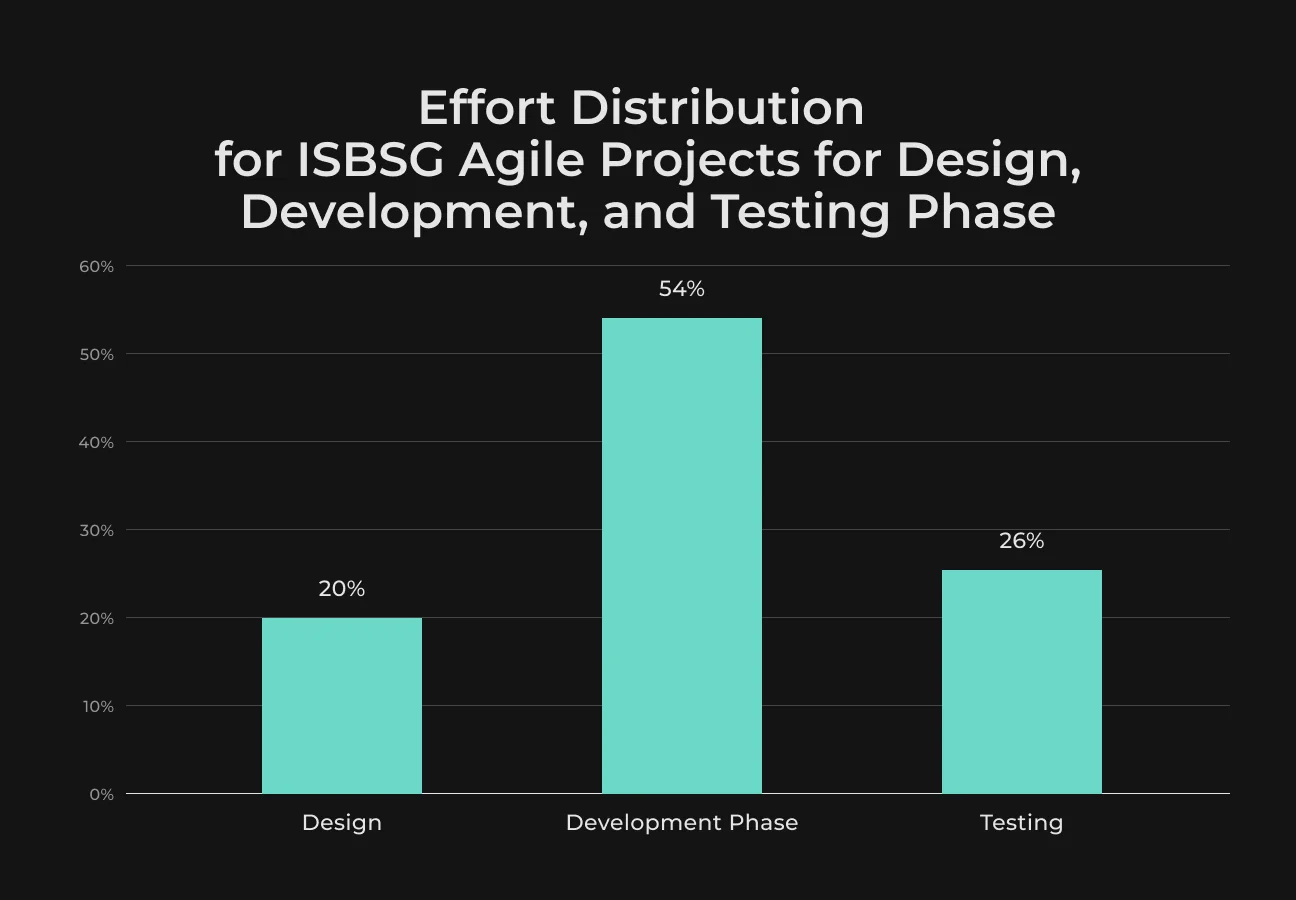
Our QA figure runs lower than that benchmark, at 15% against 26%, and the reason is scale. A thousand function points describe an enterprise system rather than a first version, and an MVP has fewer integration surfaces to test.
The QA share climbs toward the benchmark as the product grows into one.
Discovery is the line item most teams shrink to save two weeks. Requirements shift once the build is underway, and correcting course costs more than those two weeks were worth.
Build Your MVP Today
SapientPro's engineers will provide a detailed estimate and help you get a working prototype.
5 Key Factors Behind Your MVP Cost
Five variables account for most of the spread between a $12,000 build and an $85,000 one.
Here is how each one moves an MVP development cost estimate.
Feature Scope and Complexity
The gap between a fast and a complex MVP is rarely the number of screens.
It is what happens behind them. Three conditions push scope upward faster than any screen count:
- Real-time or offline behavior. One feature that has to hold up offline against unpredictable input can carry more engineering than a dozen screens of forms and tables.
- Regulated domains. A fintech or health product inherits audit trails and access rules a consumer utility never touches.
- Cryptographic or on-chain work. Smart contracts bring audit cycles that fall outside normal QA.
Our own record shows the distance this creates.
Klokhet, an EdTech platform we’ve been working on, took 800 hours to create.
A Web3 marketplace for Steam trading, built on 8 custom smart contracts, took roughly 1,700.
Tech Stack Choices
Stack decisions set the hour count before a single feature gets built:
- Established framework over custom backend. A modern web stack on a mature framework moves faster than a backend engineered up front for extreme scale.
- Existing platform over writing one. Building on an existing platform routinely halves the hours for operational tools across our record.
- Sizing to real demand. Build for your first 1,000 users, and the project stays in the medium range. Size it for a hoped-for million, and it moves into the complex one.
Team Model
The same hour carries a different price depending on who works it:
- In-house. Salary plus recruitment and payroll overhead, which earns its place once a product moves out of a defined build phase into continuous development.
- Outsourced team. One contracted rate covering project management and QA, suited to a fixed MVP scope.
- Freelance. Index.dev’s 2026 freelance rate data puts developers at $80 to $140 an hour in North America against $40 to $70 in Eastern Europe, and platform rates run 20 to 30% below direct hiring.
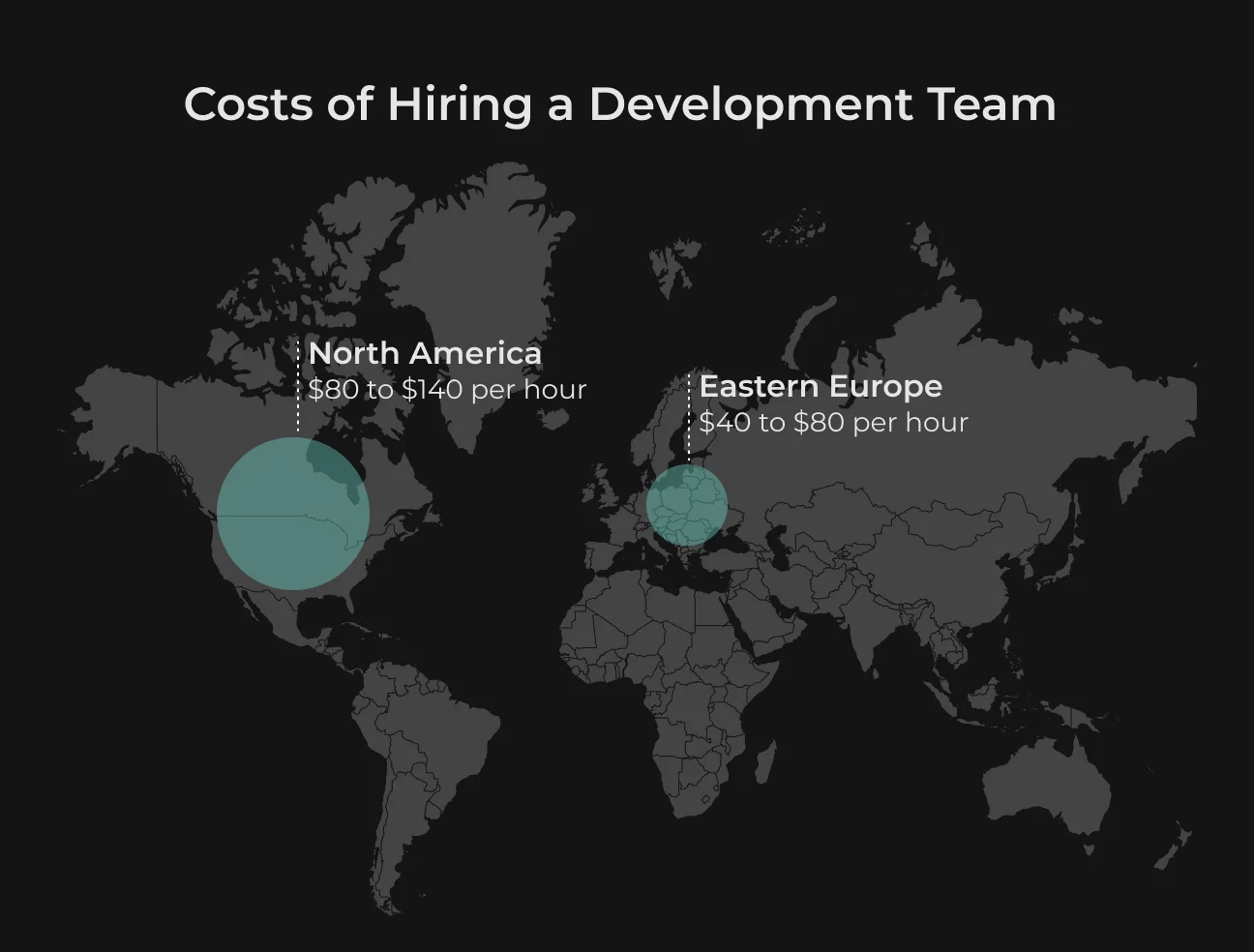
The same research names a figure most budgets miss. Compliance fees and currency conversion on cross-border work add 15 to 25% on top of the headline rate.
Third-Party Integrations
Every integration adds setup time plus a monthly fee that outlives the MVP phase. What separates a predictable integration from an open-ended one is how well-trodden it is:
- Documented mainstream APIs.
A payment processor or mapping service is estimable work against published references.
- Enterprise connectors.
A CRM or ERP link needs sandbox access and a data-mapping pass before anything gets built.
- Undocumented services.
Anything requiring you to reverse-engineer a service carries no reliable estimate until a spike is done.
Two or three integrations belong in a normal MVP. Five or six behave like a second product.
Security and Compliance Requirements
A platform handling regulated data and a consumer to-do app do not share a risk profile. Compliance work rarely earns its own line item. It surfaces as extra QA hours covering data residency and audit trails and as access rules that shape the data model before anyone designs a screen.
Which regime applies determines the workload:
- HIPAA alongside FDA rules for software classed as a medical device for health products;
- PCI DSS for card payments, governing how card data gets stored and transmitted;
- GDPR for EU personal data, governing residency and deletion rights;
- EU AI Act for AI systems placed on the EU market, whose obligations phase in through 2026.
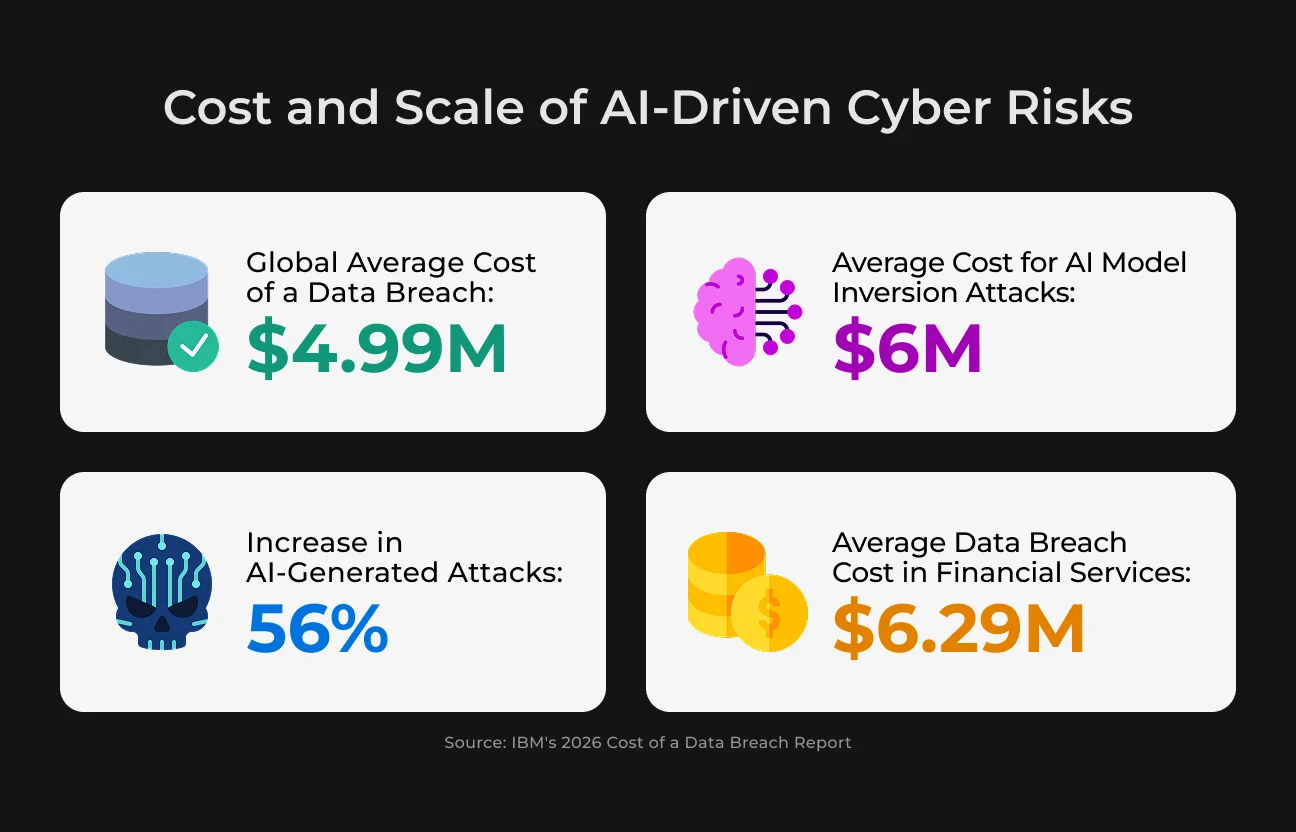
The exposure behind that work is documented. IBM’s 2026 Cost of a Data Breach Report puts the global average breach at $4.99 million, a record high and 12% up year-over-year.
AI-Assisted MVP Development Changes the Math
AI assistance changes the arithmetic on some parts of an MVP build and leaves others untouched.
The three sub-sections below separate them.
What AI-assisted development actually replaces
AI coding tools handle the parts of an MVP that don't require judgment:
- Boilerplate;
- CRUD scaffolding;
- Test stubs;
- Repetitive UI work.
They don't handle decisions like what the product should do or whether the architecture holds up under real users. As Vlad Opaets, full-stack engineer at SapientPro, puts it:
- “AI agents are not magic and do not replace the developer.”
They're a tool that strengthens someone who already knows how to build the thing, not a substitute for knowing it. Our breakdown of how AI is transforming coding and development covers where the hours go.
Where it saves 20-40% and where it does not
Boilerplate and scaffolding are where the savings are real – typically 20 to 40%.
Past that, the evidence gets thin.
METR ran a randomized controlled trial with experienced open-source developers across 246 real tasks. Developers who used AI tools took 19% longer to finish the work.
The gap is in perception: those same developers had predicted a 24% speedup and, even after the trial, still believed AI had made them 20% faster. That's why an AI-assisted estimate shouldn't be discounted just because a team feels like it's working.
Security is where the savings reverse outright.
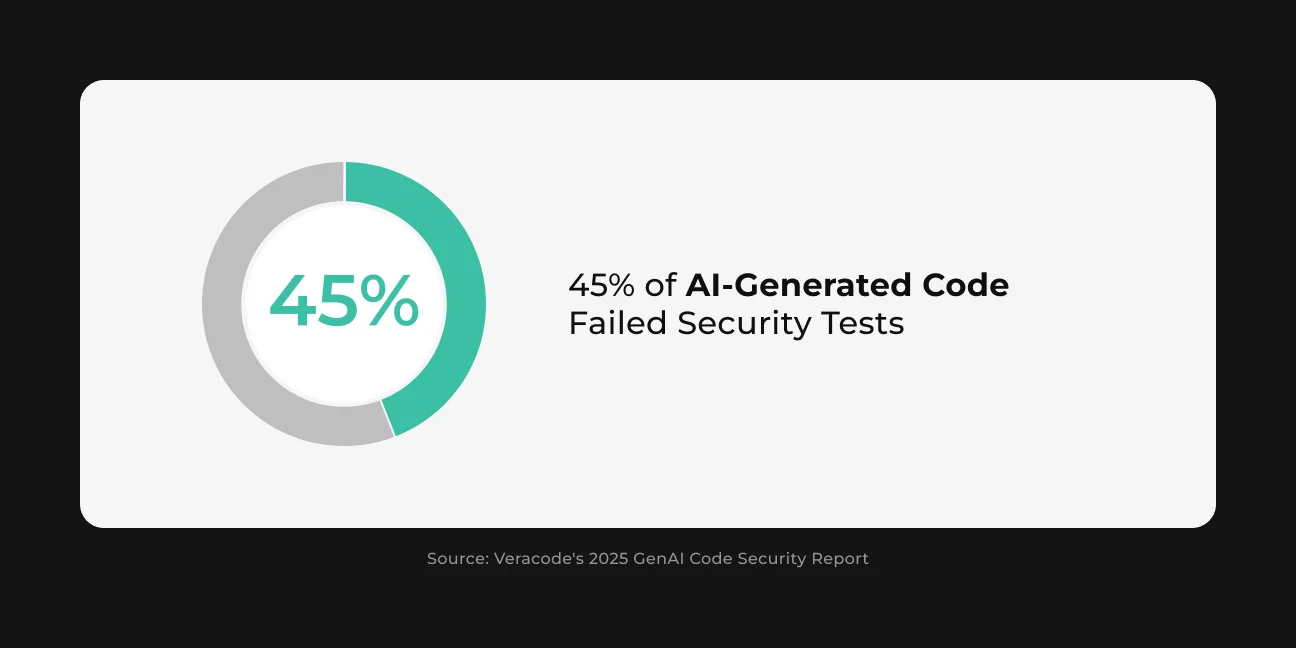
Veracode tested more than 100 large language models and found 45% of code samples failed security tests, introducing OWASP Top 10 vulnerabilities. Its spring 2026 update puts pass rates near 55% – unchanged across two years of model releases.
When AI assistance is a bad idea for an MVP
Payment data, health data, or any other compliance requirement changes the rule.
AI-generated code in that context needs at least as much human review as anything a person wrote – often a full second pass instead of a skim. Skip that, treat the AI draft as production-ready, and the 45% failure rate from the last section stops being an abstract stat and becomes your launch risk.
Real MVP Cost Examples from SapientPro’s Portfolio
We have been building MVPs since 2017, across fields as different as EdTech and Web3 infrastructure, and every range on this page comes out of that record.
The three below cover the full spread, from entry budget through to complex build. Every figure is one the client published themselves.
EdTech attendance platform, €12,000
Klokhet replaced paper registers at a Dutch school with QR check-ins and admin dashboards. Administration of attendance records dropped to 5 hours, down from 165. The school's review on Clutch puts the budget at €12,000, roughly $13,000, which places it in the band between fast and medium described above.
Scope changes are where a fixed budget usually breaks.
I thought they were flexible. Even if something wasn't in the scope, it was easy to make changes without being charged more.

Sander Cramer
B2B ERP platform, medium complexity, €20,000
A consulting company came to us for a web-based ERP MVP on a Laravel backend with a React frontend. The founder published the budget on Clutch, roughly $21,400, which buys a full operational tool carrying several core workflows and puts it in the lower half of our medium range.
SapientPro not only meets their deadlines but also stays under budget.
Consulting Company
Web3 marketplace, complex, $85,000
A blockchain marketplace for in-game item trading runs on 8 custom Solidity smart contracts plus a full backend and frontend. Asked in his Clutch review what he had invested, the founder answered approximately $85,000, more than the build alone would suggest, because smart contract development carries audit and blockchain QA costs of its own.
They delivered on time and accommodated multiple extensions as our plans and feature set evolved.
Luke Baker
Somewhere between those three is a project shaped like yours.
Send us the scope, and we will tell you which one it resembles and what it costs.
Hidden Costs After Launch
An MVP budget covers the build.
It rarely covers the months right after, the part founders leave out of the pitch deck.
Post-launch cost | What to budget for | Why it matters |
| Maintenance | Ongoing monthly support after launch | Most MVPs need light support once the first version is live. Add this line from the first month after launch. |
| Hosting and infrastructure | Cloud hosting, storage, databases, bandwidth, monitoring | Costs are modest at first but rise with usage. Flexera’s 2026 State of the Cloud report found that 29% of cloud spend is wasted, while 85% of respondents named cloud spend management a top challenge. |
| Third-party API subscriptions | Payment, maps, analytics, email, AI, and other external services | Many services become paid once an MVP exceeds free-tier limits or usage thresholds. |
| Marketing and user acquisition | Advertising, content, outreach, launch campaigns, sales activity | Getting the product in front of real users usually requires a separate budget beyond development. |
| Iteration budget | Product changes after initial user feedback | The first release shows what needs to change. Reserve funding for at least one meaningful round of improvements. |
This does not need to sink a budget. It needs a line item, which most spreadsheets skip.
How to Reduce MVP Costs Without Cutting Corners
Most of what follows is discipline applied before the invoices arrive.
Cost-saving approach | What it means | Why it helps |
| Run a ruthless prioritization pass | Use MoSCoW to rank every feature by priority | Keeps the build focused on what actually needs testing. |
| Build on an existing platform where one fits | Use existing solutions for authentication, payment processing, or basic CRM instead of building them from scratch | Configuring a proven platform can cost less than building an equivalent solution. |
| Release in phases | Launch to a small user group before the full release | Helps catch problems while fixes are still cheaper to make. |
| Use AI assistance for boilerplate | Apply AI to routine work that does not require senior-level judgment, with human review of the output | Can speed up repetitive development work while keeping judgment calls with people. |
Cut one feature you were already unsure about, and the rest of this list gets easier.
How SapientPro Builds MVPs
Every MVP created at SapientPro starts with a discovery phase before anyone writes a quote, because a number based on a five-minute call is a guess dressed up as an estimate.
Our dedicated team works through your requirements first, mapping what the product truly needs against what it can skip. You can learn more about the groundwork of building an MVP for a startup in our recent guide prepared by SapientPro’s engineers.
A typical engagement runs 3 to 4 months: discovery takes the first two to three weeks, design overlaps the start of development, and QA runs alongside the build rather than after it.
If you are looking at a spreadsheet and trying to make a fixed number stretch into a working product, have that conversation before you commit to a figure from an article, this one included.
Our MVP development services for startups start there, and our software development for startups practice covers what comes after launch.
Talk to an Expert
SapientPro's engineers will help you understand what is needed to bring your app idea to life.

FAQ
How long does it take to build an MVP in 2026?
Most MVPs take 3 to 4 months. Narrow, single-feature products can move in 6 to 10 weeks. Blockchain infrastructure and hardware integration push the timeline to 5 to 8 months, and heavy compliance requirements do the same.
Can I build an MVP under $25,000?
Yes, for a tightly scoped product with a small feature set and a standard stack. That budget covers a product testing one hypothesis properly rather than a full feature suite, which in our record has been enough for an AI tutor app or a marketing SaaS platform.
What is the difference between an MVP and a prototype?
A prototype demonstrates an idea and skips working backend logic. An MVP is a functioning product real users can rely on, even though some secondary features are still missing. Prototypes validate a concept. MVPs validate demand.
Should I outsource my MVP or hire in-house?
For most first-time founders, outsourcing to a team that has already built several MVPs beats hiring and onboarding in-house for a single product. In-house makes more sense once a product moves out of a defined build phase into continuous development.
MVP development cost is as much a scoping question as an engineering one. How tightly you define the first version says more about the final number than your industry does, and it decides which end of the range you land on.
Getting an accurate number takes a technical team looking at specifics, and that costs nothing.