All Unstructured Data to Structured Data with AI: Methods, Tools, and Real-World Use Cases
May 1, 202610 min read


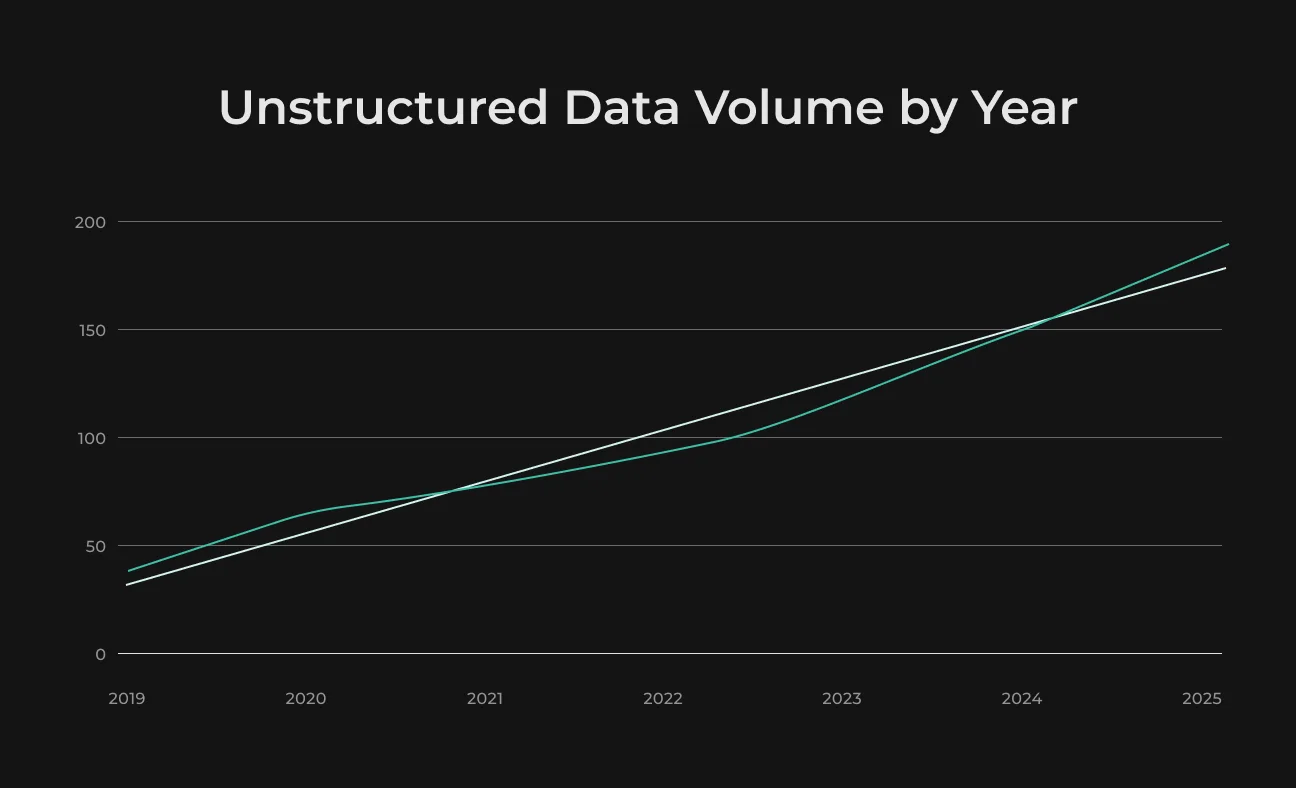
By current estimates, 80% to 90% of all newly generated enterprise data is entirely unstructured.
The information locked inside emails, social media threads, video recordings, and legal contracts is a real problem for businesses trying to do anything analytical with it. To close that gap, companies are turning to AI-powered document automation to transform that chaos into data they can actually query.
This article covers the difference between structured and unstructured data, how to parse unstructured CRM data into structured JSON, and how to convert unstructured data to structured data.
Structured vs. Unstructured Data: What’s the Real Difference?
Any serious AI data transformation project starts with understanding what you're working with. Here's how structured, semi-structured, and unstructured data differ across the dimensions that matter most.
Attribute | Structured Data | Semi-Structured Data | Unstructured Data |
| Model | Predefined Schema (Rigid) | Self-describing (Flexible) | No Schema (Non-existent) |
| Storage | Relational Databases (RDBMS) | NoSQL, XML, JSON Files | Data Lakes, Object Storage |
| Scalability | Vertical (Harder to scale) | Horizontal (Easier to scale) | Infinite (Elastic) |
| Analysis | Easy (SQL, BI Tools) | Moderate (Parsers needed) | Hard (Requires AI/NLP) |
| Standard Use | Inventory, Finance, Billing | Web APIs, Configuration | Emails, Media, Documents |
Structured data lives inside a rigid, predefined schema. It sits in fixed fields within records or files, typically in relational databases or spreadsheets, and it's machine-readable out of the box.
A transactional record in an ERP system with a SKU number, a quantity, and a price is the classic example. It's the primary input for traditional ML and business analytics because the computer knows exactly where every piece of information lives.
Unstructured data has no predefined model. It can't be organized into the row-and-column grids of Excel or a SQL database. It's descriptive, qualitative, and highly variable: customer support emails, meeting recordings, PDF contracts, raw IoT sensor streams.
A SQL table might tell a CFO that revenue is up 10%. The unstructured data in customer reviews and support tickets explains why. That's the real difference between structured and unstructured data is that structured data gives you the measurement, while unstructured data gives you the meaning.
Why Unstructured Data is Hard to Manage Without AI
Unstructured data is hard to manage without AI because the two types of data differ at a fundamental level. The volume alone would overwhelm any manual process, but the deeper issue is structural.
Lack of Schema and Consistency
There's no consistent pattern to unstructured data, which means traditional parsing algorithms can't reliably find or extract specific data points. This is one of the main drivers of technical debt and operational inefficiency in data-heavy organizations.
High Manual Parsing Costs
Businesses that rely on people to read documents and type information into a database hit a wall quickly. A finance department processing 9,654 invoices a month spends hundreds of human hours on data entry. Those are hours that could go toward actual financial planning.
Poor Analytics and Automation Outcomes
If you can't query your unstructured data, you're missing the full picture.
CRM notes are a classic example. Sales reps often write rich, narrative detail about client needs, objections, and next steps directly into the CRM. Without AI, that information sits there doing nothing. It can't trigger automated follow-ups, predict churn, or surface cross-selling opportunities across the broader sales team.
CRM, documents, and emails are key pain points
Compliance and risk management raise the stakes further. Regulatory bodies increasingly demand transparency and rapid reporting across both structured and unstructured formats.
Scanning thousands of legal contracts for non-compliant clauses, or auditing years of email communication for evidence of market manipulation, is not something a human team can realistically do at scale. Companies without an AI unstructured data strategy here remain exposed to serious fines and reputational damage.
Can AI Process Unstructured Data?
Modern AI models don't process text by searching for keywords. They model the semantic relationships between words in a multi-dimensional mathematical space.
Through embeddings, AI converts raw text into numerical vectors. In that vector space, "battery life is short" sits mathematically close to "power consumption is high", even though the two phrases share no identical words.
That's what allows the AI to cluster related concepts together, and it's the foundation of the deep learning and transformer architectures driving this field. NLP provides the toolkit for handling the messiness of human language.
The key steps include:
- Tokenization: breaking text into units;
- Part-of-speech tagging: identifying nouns, verbs, and other grammatical roles;
- Lemmatization: reducing words to their root forms.
These steps prepare data for large language models, which then handle the more demanding undstructured data extraction tasks: summarization, sentiment detection, entity relationship mapping.
One of the more meaningful shifts in current AI technology is the move from rule-based parsing to AI-driven extraction. Traditional parsers rely on predefined templates. Change an invoice layout slightly and the parser breaks. AI-driven systems are layout-agnostic.
They use visual and textual cues to locate information regardless of where it appears on the page. An AI model knows that a number sitting next to the word "Total" and preceded by a "$" is probably the invoice amount, whether it's in the top-right corner or buried in a footer.
That layout independence is what makes AI unstructured data solutions practical at scale.
How AI Converts Unstructured Data into Structured Data
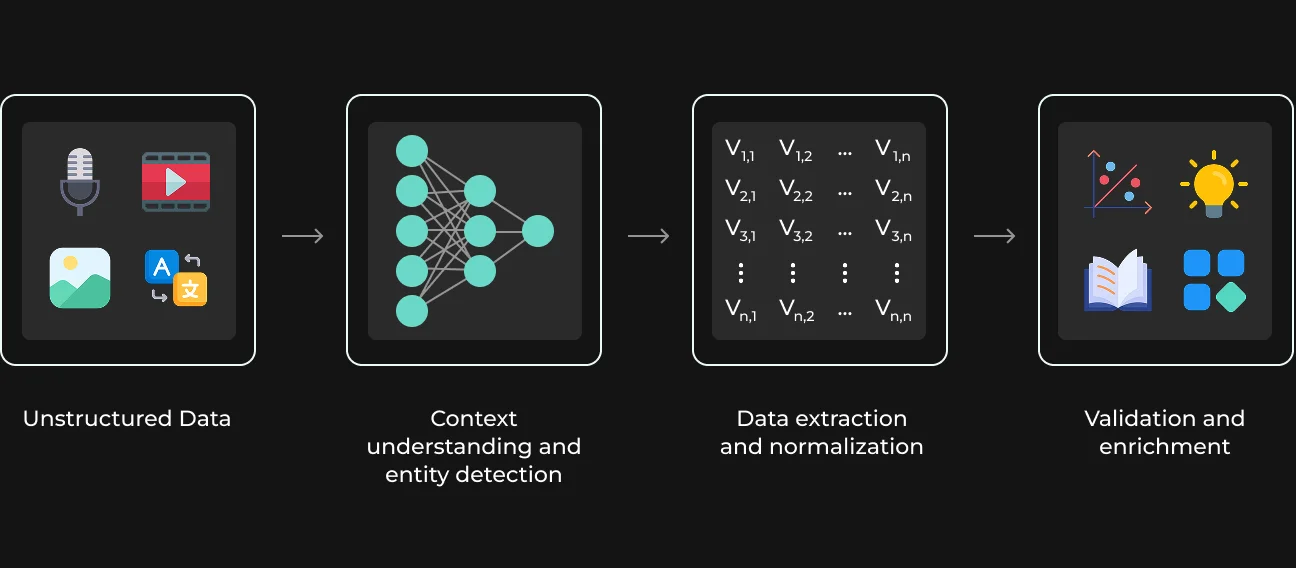
The process of how to convert unstructured data to structured data is a multi-stage pipeline that takes raw, noisy input and produces clean, validated, queryable output. The AI layer provides the cognitive step that maps varied inputs into a consistent format.
Data Ingestion (Documents, CRM Records, Text)
The first step is pulling data from wherever it lives. Typical sources include:
- CRM systems (Salesforce, HubSpot): emails, activity notes, deal attachments;
- Email servers (Microsoft 365, Google Workspace): inbound customer requests, invoices, legal correspondence;
- Cloud storage (S3, Azure Blob, Google Drive): contracts, reports, scanned documents;
- Operational systems via webhooks: support tickets, form submissions, chatbot conversations.
Each document gets enriched with metadata that travels with it through the pipeline.
That typically includes:
- Source system and object ID (e.g., CRM record ID);
- Timestamps for creation and ingestion;
- Document type or channel (email, invoice, contract, chat);
- Owner or responsible team;
- Language and file format.
For non-textual inputs like scanned PDFs or image files, OCR runs at this stage to digitize the content and make it readable for downstream AI models.
Context Understanding and Entity Detection
Once the text is digitized, AI data transformation determines what kind of document it's dealing with and who or what it's about. The system classifies the document type first: is this a bank statement, a resume, or a contract? That classification determines which extraction rules apply next.
Named Entity Recognition then identifies specific data points within the text. The AI looks for people, organizations, locations, dates, and specialized codes. It can differentiate between "Apple" the company and "apple" the fruit based on the surrounding sentence structure, with no keyword rules required.
Data Extraction and Normalization
After entities are detected, the AI pulls the relevant values into a staging environment. Raw extraction is rarely clean. One document might list a date as "January 21st, 2026"; another uses "21/01/26".
Normalization converts those varied formats into a single, standardized convention, ISO 8601 for dates or USD for currency. This step is critical for structuring unstructured data and making it statistically comparable across a full dataset.
Without it, a database treats the same date as two separate entries, which produces flawed reports.
Structuring into Tables or JSON
With data normalized, it gets mapped into its final destination format. For many modern applications, this means parsing unstructured CRM data into structured JSON. JSON is well-suited to representing nested relationships in a form that web applications and NoSQL databases can easily ingest.
Alternatively, data can be mapped into SQL tables with predefined columns and primary keys. During this stage, AI models use constrained decoding or response schemas to ensure output strictly follows the required syntax.
Validation and enrichment
The final stage is quality control. Extracted data is checked against business rules. Does the "Total Amount" on the invoice match the sum of the extracted line items?
The data can also be enriched by cross-referencing external databases. If the AI extracts a vendor name, it can look up that vendor's official ID or tax status in a master database to produce a more complete record.
Transform Your Data Into Profits
SapientPro's engineers will help you turn unstructured data into a valuable asset.

AI-Driven Unstructured Data Transformation Techniques
To convert unstructured to structured data, businesses deploy specialized techniques. These approaches are often used in combination to handle the diverse data shapes found within a modern corporation.
Technique | Core Mechanism | Enterprise Application |
| NER | Identifying names, dates, amounts | Legal contract review, CV parsing, Medical records |
| Classification | Labeling text by category/intent | Support ticket routing, Sentiment analysis |
| Schema Mapping | Defining data relationships | Database migration, API integration |
| Validation | Logical and cross-source checks | Invoice reconciliation, Fraud detection |
Named Entity Recognition
NER is arguably the most foundational technique in the unstructured data extraction toolkit.
It identifies and categorizes key information into predefined groups. In a healthcare context, those groups might include drug names, dosages, and patient symptoms. The underlying deep learning models, particularly Transformers, analyze the full context of a sentence to determine each word's role.
That's a significant step beyond keyword matching: the system can identify entities it's never seen before based purely on their syntactic position.
Text Classification
Text classification is used to assign one or more categories to a segment of text. This is widely used for sentiment analysis and for automated ticketing in support centers.
In terms of sentiment analysis, it categorizes a customer review as:
- Positive;
- Negative;
- Neutral.
For investors looking at market trends, classification can be used to scan thousands of news articles and tag them by industry, sentiment, or relevance to a specific portfolio company. By automating this, firms can process a volume of information that would be impossible for a human analyst team to monitor manually.
Schema Mapping
Schema mapping defines how extracted concepts relate to the target database structure. AI-driven schema generators can now examine a raw dataset and infer an efficient database design, identifying likely primary keys and table relationships.
This cuts the time to deploy new data projects from months to days, and the resulting database is built for both storage efficiency and query speed.
Contextual Validation
Contextual validation uses the logic of the data to verify its own accuracy. That includes cross-field checks (the shipping date shouldn't be earlier than the order date) and confidence scoring.
Every extraction gets a probability score. If that score falls below a defined threshold, say 93.6%, the system automatically routes the document to a second AI model for re-examination, or flags it for human review. This approach is what makes straight-through processing rates above 90% achievable.
Extracting Structured Data from Unstructured Text and Documents
The gains from this kind of extraction show up clearly in CRM data. Sales teams often sit on a goldmine of information inside meeting notes and email history that standard reporting never touches. By converting unstructured CRM data into structured JSON, companies can actually use it.
An AI model scanning a year's worth of sales notes can extract fields like Budget Status, Competitors Mentioned, and Timeline for Decision. Leadership can then build sales forecasts that reflect what's actually happening in deals, not just what busy reps remembered to log.
A great example is an AI-powered CV processing tool built by SapientPro.
A high-volume HR agency was facing a real bottleneck: over 1,200 applications a month, legacy software that couldn't handle varied resume formats, and recruiters spending up to two hours manually reformatting a single CV into their internal template.
SapientPro built a system using Azure OpenAI and OCR to automate the extraction process for resumes. The tool handles DOC, PDF, and image-based scans and uses AI to identify and extract key fields: education, work experience, skills, and projects.
Metric | Before AI Implementation | After AI Implementation |
| Processing Time per CV | ~120 Minutes | ~5 Minutes |
| Manual Labor Saved | 0 Hours | 320+ Hours / Month |
| Searchability | Poor (Keyword only) | Advanced (Indexed via AI Search) |
| Format Consistency | Low (Original layouts) | High (Unified corporate format) |
The result of this AI data transformation was a 90% reduction in processing time.
This allowed the agency to scale its operations without increasing headcount. Furthermore, the extracted data was used to create a "searchable candidate index", enabling recruiters to filter candidates by complex criteria that were previously hidden within the unstructured text.
This project is a good illustration of how AI development services can solve specific, high-friction operational problems rather than just adding general-purpose automation.
Common Challenges in AI Data Transformation
The business case for structuring unstructured data is clear enough. Getting it done is harder. The technical and legal problems are real, and they require engineering and legal teams to work through them carefully.
Handling Data Quality and "Dark Data"
The classic problem applies here: garbage in, garbage out. If the source material is poor, a blurry scanned image or a badly recorded audio file, the extracted output will be unreliable. At scale, organizations also risk building a data swamp of redundant or conflicting information.
Structuring unstructured data requires a solid preprocessing layer that can handle data drift. Document formats change over time. So does the way people write and talk. You need to monitor input quality continuously and make sure only clean, relevant data reaches the AI models.
Model Hallucinations and Accuracy Thresholds
Generative AI systems can hallucinate: they produce answers that sound plausible but are factually wrong. In financial or medical contexts, that's not a tolerable error rate.
The standard fix is a combination of grounding and confidence scoring. Grounding means every extracted data point can be traced back to a specific sentence in the source document. Confidence scoring means the system flags uncertainty rather than guessing.
If the AI isn't 99% confident about an invoice amount, that record goes to a human reviewer.
Data Privacy and Security (PII)
Transforming unstructured data usually involves handling Personally Identifiable Information: social security numbers, medical histories, private financial details. Ensuring that data is redacted or encrypted during extraction is a legal requirement under GDPR, CCPA, and sector-specific regulations.
Businesses need to verify that their data pipelines are compliant with the standards that apply to their industry before going anywhere near production.
Managing the Human-in-the-Loop (HITL)
As AI takes on more of the processing work, the human role shifts from entering data to validating it. That transition isn't always smooth. Employees who don't trust the AI's output will double-check every record, which eliminates the efficiency gains. Those who trust it too much will miss subtle errors.
The right balance for unstructured data transformation is humans intervening only in high-risk or low-confidence cases. Getting there requires process design, not just technology deployment.
Best Practices for Structuring Unstructured Data with AI
For leadership evaluating or deploying unstructured-to-structured data pipelines, these practices make the difference between a project that delivers and one that stalls:
- Use human-in-the-loop (HITL) validation for critical workflows.
For high-stakes tasks like legal compliance or medical diagnosis, build a workflow where humans review low-confidence extractions. Don't rely on an autonomous system alone where 100% accuracy matters.
- Continuously retrain models on real data.
Document formats and business jargon drift over time. Feed the corrections that human validators make back into the model on a regular cycle so accuracy holds as the data evolves.
- Apply confidence thresholds and fallback logic.
Define what "good enough" looks like for your specific use case. An internal search engine might be fine at 85% accuracy. An automated billing system probably needs 99.9%. Use confidence scores to route uncertain records to a human or a secondary model.
- Enforce strict PII handling.
Encryption is mandatory at rest and in transit. Run automated PII detection to redact sensitive data before it reaches the extraction engine. This limits breach exposure significantly.
- Build schema-aware extraction.
When converting CRM data to structured JSON, make sure the AI knows the target schema's constraints: character limits, data types, required fields. This prevents technically valid outputs that your database can't actually ingest.
Use this checklist when evaluating a partner or tool for your unstructured data transformation project:
Consideration | Requirement | Why It Matters |
| Accuracy | Confidence scoring and grounding | Prevents hallucinations and ensures trust |
| Scalability | Support for asynchronous/batch processing | Handles spikes in document volume |
| Flexibility | Layout-agnostic (template-free) extraction | Reduces maintenance costs as documents change |
| Integration | REST APIs and SDK support | Allows the AI to talk to your existing CRM/ERP |
| Security | SOC2/HIPAA compliance and encryption | Protects sensitive enterprise and customer data |
Partner with SapientPro to Build Your Data Pipeline
Moving from chaotic unstructured information to a clean & queryable dataset takes more than off-the-shelf software. It takes engineers who understand the specific constraints of your industry and can build a pipeline designed around your data, not a generic template.
SapientPro builds custom AI data pipelines that handle the full lifecycle from raw unstructured input to structured output. That includes high-accuracy OCR for legacy documents, LLM chains for parsing unstructured CRM data into structured JSON, validation layers, and integration with your existing CRM and ERP systems.
We know that for most businesses, the metrics that matter are reduced operational costs and faster decisions. Those are what we build toward. Working with SapientPro means a dedicated team of engineers and project managers focused on code quality, clear communication, and outcomes that hold up after launch.
Let’s team up today!
Discover Your Data's Value
SapientPro's engineers will help you find out how your data can help you gain more value.