All How to Make AI Bookkeeping Software for Automated Finance
June 1, 202610 min read


AI bookkeeping software is no longer only about automating invoices, reconciliations, or financial reports. It now connects directly to one of the biggest problems in modern business: acquiring new customers has become painfully expensive.
CAC has climbed by about 222% over the last 8 years, including a 60% jump in the last 5.
Competition is tougher, paid ads cost more, and targeting has become less reliable after iOS 14.5 and the decline of third-party cookies. That changes the role of finance software.
Companies can no longer treat bookkeeping as a backward-looking record of what already happened. They need systems that act more like a digital accountant: tracking financial health in real time, spotting retention risks, forecasting cash flow, and helping teams protect net revenue retention.
Retention is where the numbers get hard to ignore. Keeping an existing customer can be 5 to 25 times cheaper than acquiring a new one, while even a 5% lift in retention can raise profits by 25% to 95%.
This is why AI bookkeeping matters. It turns finance data into a live operating layer for the business, helping leaders understand not only where the money went, but where revenue is likely to grow, leak, or stall next.
SapientPro’s engineers share how AI bookkeeping software works and how to apply it in your business.
What Is AI Bookkeeping Software
AI bookkeeping software is a financial intelligence system that uses machine learning, NLP, and autonomous agents to automate the end-to-end accounting lifecycle.
Unlike legacy ERP systems built on rule-based logic, AI-native platforms work as continuous accounting engines. By combining these technologies into a single workflow, the system can:
- Pull data from bank feeds and document uploads;
- Apply complex accounting rules;
- Update ledgers and resolve discrepancies;
- Generate predictive financial forecasts.
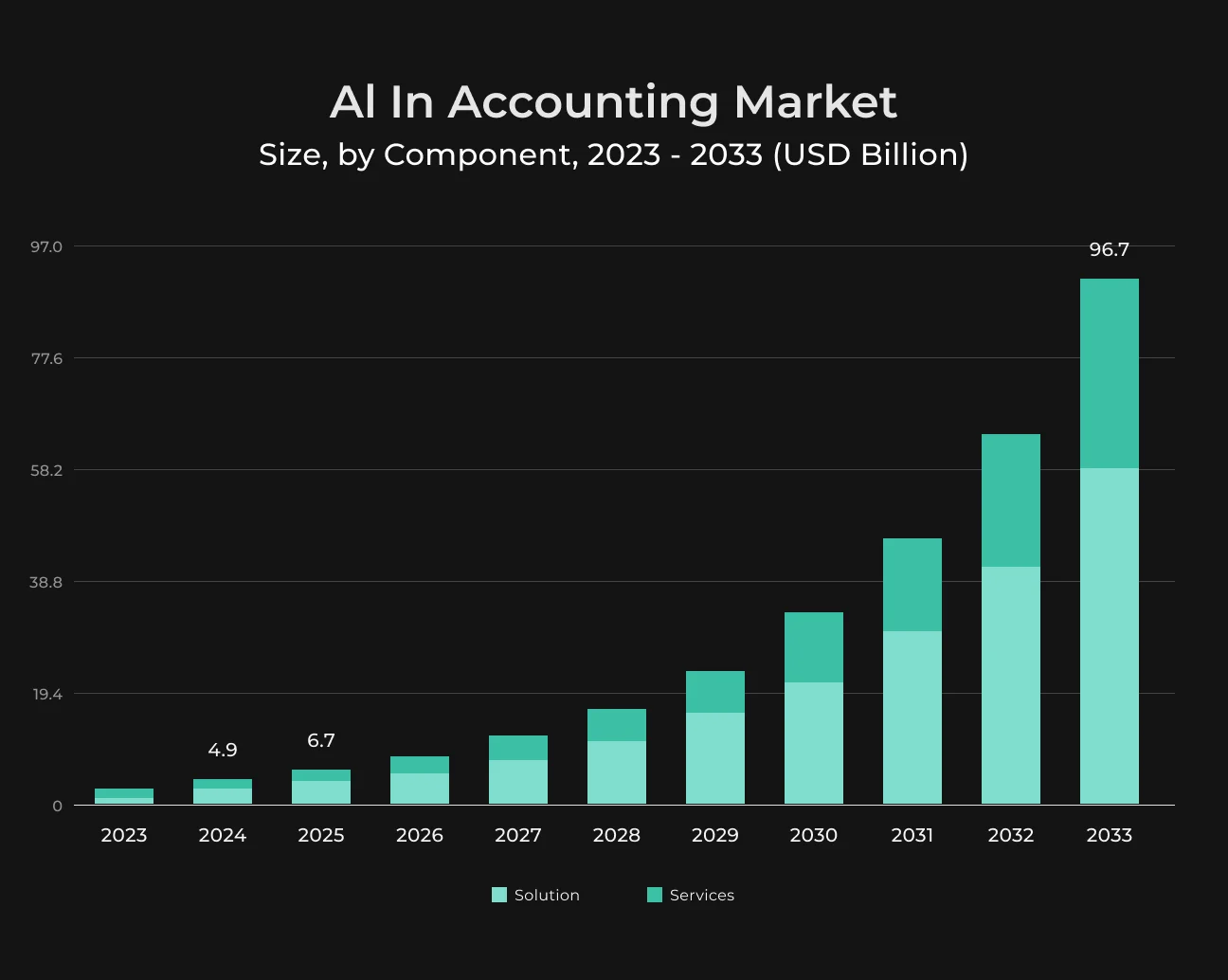
The AI in accounting market is projected to grow by $16 billion between 2024 and 2029, at a CAGR of 42.9%. That growth reflects a real shift in how organizations think about financial management.
Metric | AI in Accounting Market Insight |
| Forecast Period | 2025–2029 |
| Expected Market Growth | $16.0 billion |
| CAGR (2024–2029) | 42.9% |
| YoY Growth (2024–2025) | 36.7% |
| Leading Region | North America |
| North America Share of Growth | 37% |
| Fastest-Growing Component | Software |
| Software Segment Value (2019 Baseline) | $241.9 million |
| Leading Technology Segment | Machine Learning |
| Key Deployment Model | Cloud-based |
| Main Growth Driver | Automation and operational efficiency |
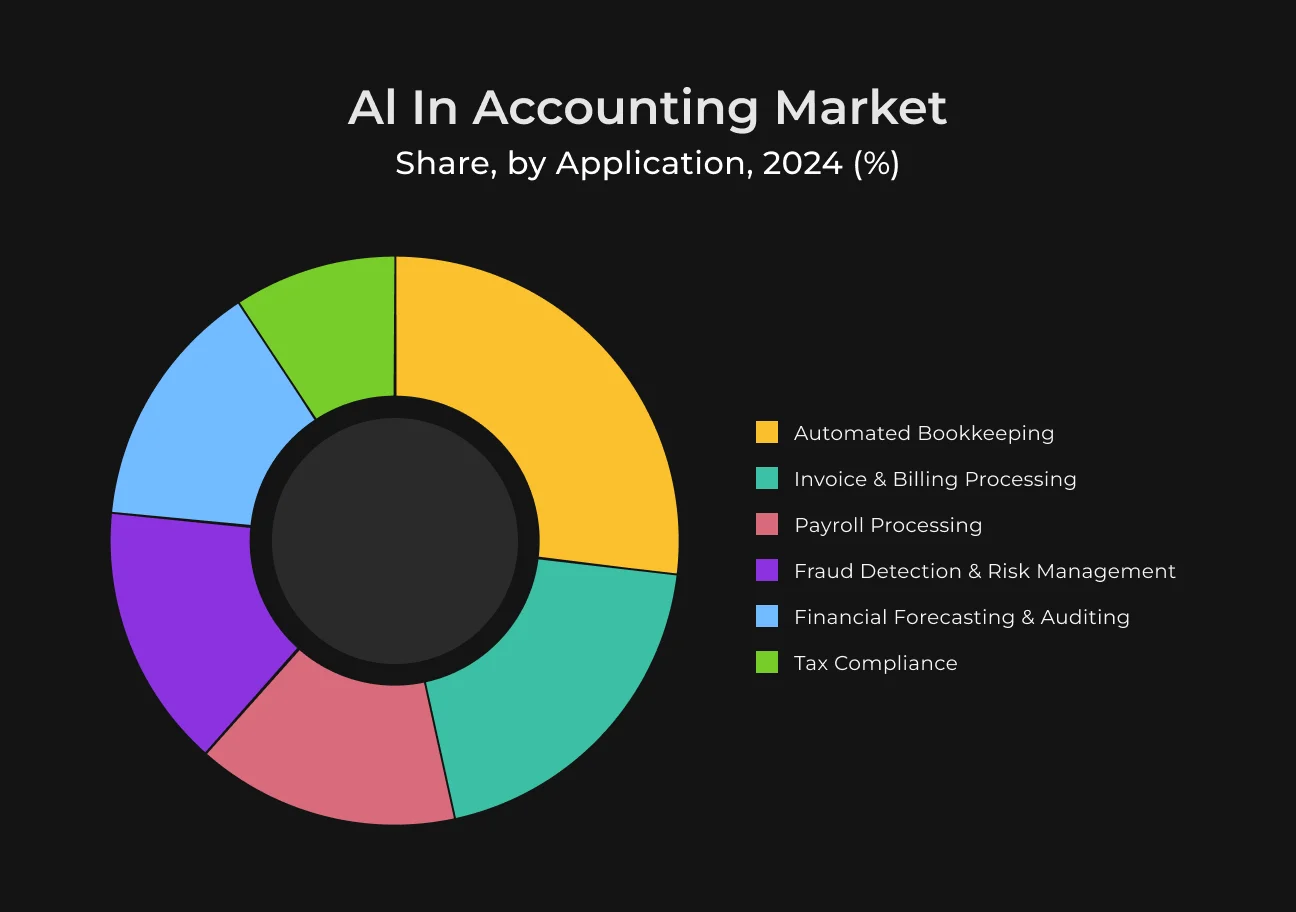
| Key Applications | Automated data entry, fraud detection, predictive analytics, invoice processing |
| Major Market Challenge | Data privacy and security concerns |
| Key Countries Covered | US, UK, Germany, Canada, China, France, Italy, Brazil, Japan, India |
| Market Structure | Fragmented |
| Key Enterprise Trend | AI-driven financial reporting and workflow automation |
| Popular AI Use Cases | Fraud detection, AI-powered tax prep, predictive analytics, audit automation |
| Notable Industry Development | KPMG acquired Arria NLG in 2024 to expand AI accounting capabilities |
| Major Vendors Mentioned | Intuit, Deloitte, KPMG, Sage, Xero, Zoho, BlackLine, FreshBooks |
What Can Be Automated in Bookkeeping with AI
To automate bookkeeping software, you need to target the specific points in the finance workflow where human error and processing delays are most common.
Intelligent Transaction Categorization and General Ledger Mapping
Categorizing transactions into the correct general ledger (GL) accounts is the most labor-intensive part of bookkeeping. Traditional automation uses rigid if-then rules that break when merchant descriptions change or when a single vendor provides multiple service types.
Modern AI addresses this with a hybrid model:
- Traditional ML (like XGBoost) handles high-confidence, recurring entries;
- LLMs take on complex, context-dependent cases.
Identifying whether a purchase at a generic retailer represents "Office Supplies" or "Software Subscriptions" requires context that goes beyond the transaction amount. Advanced systems ingest the company's entire accounting rulebook, sometimes a corpus of 50,000+ tokens, as a system prompt for the LLM.
This lets the system apply corporate policies and tax requirements accurately, including edge cases like distinguishing an IT freelancer from a construction firm making the same purchase at a hardware store.
Document Understanding: OCR and Generative AI Integration
OCR alone is no longer enough for document ingestion.
What automated bookkeeping actually needs is Intelligent Document Processing (IDP). Traditional OCR converts pixels to text. IDP uses ML and NLP to understand the semantic meaning of fields like "Total Due," "Tax ID," and "Net Terms."
Models like Azure AI Document Intelligence or fine-tuned versions of Claude 3.7 can handle varied invoice, receipt, and contract formats at above 95% accuracy.
Adding generative AI means the system does more than extract data; it reasons over it. An AI agent can compare an extracted invoice amount against a purchase order and a receiving report, then flag discrepancies or route the invoice for approval based on patterns from past behavior.
Continuous Reconciliation and Real-Time Ledger Updates
One of the most practical improvements AI bookkeeping delivers is replacing the month-end close with continuous reconciliation. In multi-channel environments like e-commerce businesses running Stripe, PayPal, and Shopify simultaneously, transactions arrive as millions of discrete data points.
AI-powered reconciliation software automatically matches these transactions across bank statements and internal ledgers, including complex 1:many and many:1 relationships.
Feature | Traditional Automation (RPA) | Agentic AI Automation |
| Matching Logic | Rigid, rule-based | Adaptive, fuzzy logic-driven |
| Discrepancy Handling | Stops/breaks on error | Resolves or routes with context |
| Scalability | Linear with manual review | Exponential with autonomous agents |
| Data Processing | Periodic/Batch | Real-time/Continuous |
Expense Management, Approvals, and Anomaly Detection
Leading accounting automation software solutions flag policy violations before reimbursements are processed. By analyzing patterns across thousands of vendor relationships, AI can detect anomalies that would be impossible for a human team to catch at scale:
- Duplicate invoices or repeated reimbursement requests;
- Fraudulent billing behavior and suspicious vendor activity;
- Unusual spending spikes or surge pricing anomalies;
- Expenses submitted outside approved company policies;
- Mismatched invoice amounts, dates, or tax information;
- Payments directed to unauthorized or recently changed bank accounts;
- Abnormal transaction timing, frequency, or geographic location patterns;
- High-risk vendor relationships based on historical financial behavior.
The best accounting software for automation features speeds up the internal workflow and reduces bottlenecked approvals.
Key Features of AI Bookkeeping Software
When building leading accounting automation software solutions, we recommend that you consider the following features.
Intelligent data ingestion and document understanding
The system needs a multi-source integration layer connecting directly to:
- Banking APIs (Plaid, Yodlee, Tink, TrueLayer, MX Technologies);
- Payment gateways (Stripe, PayPal, Square, Adyen, Authorize.net, Braintree);
- E-commerce platforms (Shopify, Amazon, WooCommerce, BigCommerce, Magento, eBay, Etsy).
The ingestion layer must be format-agnostic. It must be capable of processing:
- Excel;
- CSV;
- JSON;
- XML;
- PDF;
- Image files from mobile captures.
The standard to aim for is above 95% accuracy on document understanding, converting unstructured data into machine-readable formats that can be validated against tax rules and historical patterns.
AI-powered categorization engine
Good bookkeeping automation typically combines several models to balance speed with reasoning depth:
- XGBoost for structured tabular data: high-speed classification for common transactions;
- BERT for merchant name normalization and parsing abbreviated bank statement descriptions. Specialized models like Txn-Bert are trained specifically on financial transaction language, where entity names are often truncated to 25 characters;
- RLHF to incorporate user corrections: when an accountant recategorizes a transaction, the system learns from it. Over time, accuracy can reach 98%+.
Will bookkeeping be replaced by AI? Maybe partially. But it will definitely be augmented.
Predictive analytics & CFO insights
For executives and investors, the real value of AI bookkeeping is forward-looking intelligence. AI-native platforms provide live dashboards for:
- Cash flow forecasting: predicting future inflows and outflows based on historical seasonality and pending invoices;
- Burn rate and runway: continuously tracking cash depletion to identify the zero-cash date months in advance;
- Scenario modeling: AI agents can model the financial impact of a 12% revenue drop or a hiring freeze across specific departments;
- Board and investor reporting: automatically generating financial summaries, KPI dashboards, and executive reports.
Accounting automation software gives executives a clearer understanding of future financial health rather than simply documenting past transactions.
AI agents (bookkeeping AI agent)
Agentic workflows represent the current leading edge of financial software. An AI agent can perceive context, reason about a goal, and act across digital systems. In practice, a bookkeeping agent might:
- Notice a missing receipt;
- Email the employee to request it;
- Validate the receipt against the credit card charge once received;
- Post the completed entry to the ledger.
All of that without anyone touching it.
Types of Accounting Automation Software on the Market
Three main categories of accounting automation software exist, each with different levels of AI integration:
AI-Native Platforms
These are built on AI-first architecture. Digits developed the "Autonomous General Ledger" (AGL), which replaces static monthly reports with a continuously updating model. Puzzle focuses on accrual automation and real-time variance analysis for startups.
Hybrid Platforms
These combine AI bookkeeping engines with a human finance team in the loop. Zeni updates financials daily but also offers fractional CFO and tax services as part of the package. It works well for firms that want both automation and expert oversight.
Legacy Tools with AI layers
Established platforms are adding AI to existing frameworks. QuickBooks uses "Intuit Assist" for expense categorization and automated reminders. Broadly adopted, but these systems often lack the real-time updating of AI-native ledgers.
Each category has trade-offs. That's exactly why teams come to us to build something custom.
How to Build AI Bookkeeping Software (Step-by-Step)
The following checklist provides a roadmap for the custom AI bookkeeping system development.
Step | Technical Focus | Outcome |
| 1. Requirement Analysis | Define high-friction workflows (AP, reconciliation, forecasting). | Comprehensive project roadmap and KPIs. |
| 2. UI/UX Design | Build dashboards for real-time visibility and transaction review. | Intuitive interface for non-accountant users. |
| 3. Data Infrastructure | Integrate Plaid, Stripe, and ERP APIs; build format-agnostic ingestion. | Unified financial data stream. |
| 4. AI Training | Fine-tune BERT for merchant names; train XGBoost for classification. | High-accuracy categorization engine. |
| 5. Deterministic Layers | Implement hard-coded business rules to validate AI outputs. | Hallucination-free financial records. |
| 6. Compliance/Security | Encrypt data (AES-256); implement SOC2, GDPR, and SOX trails. | Audit-ready, compliant architecture. |
| 7. Deployment/Scaling | Launch MVP; integrate feedback loops for model self-learning. | Exponentially improving autonomous system. |
Ready to Automate Your Finance Workflows?
Tell us what's broken. We'll build the fix.

Key Development Challenges and How to Solve Them
When building AI bookkeeping tools, you will face some challenges. Here they are.
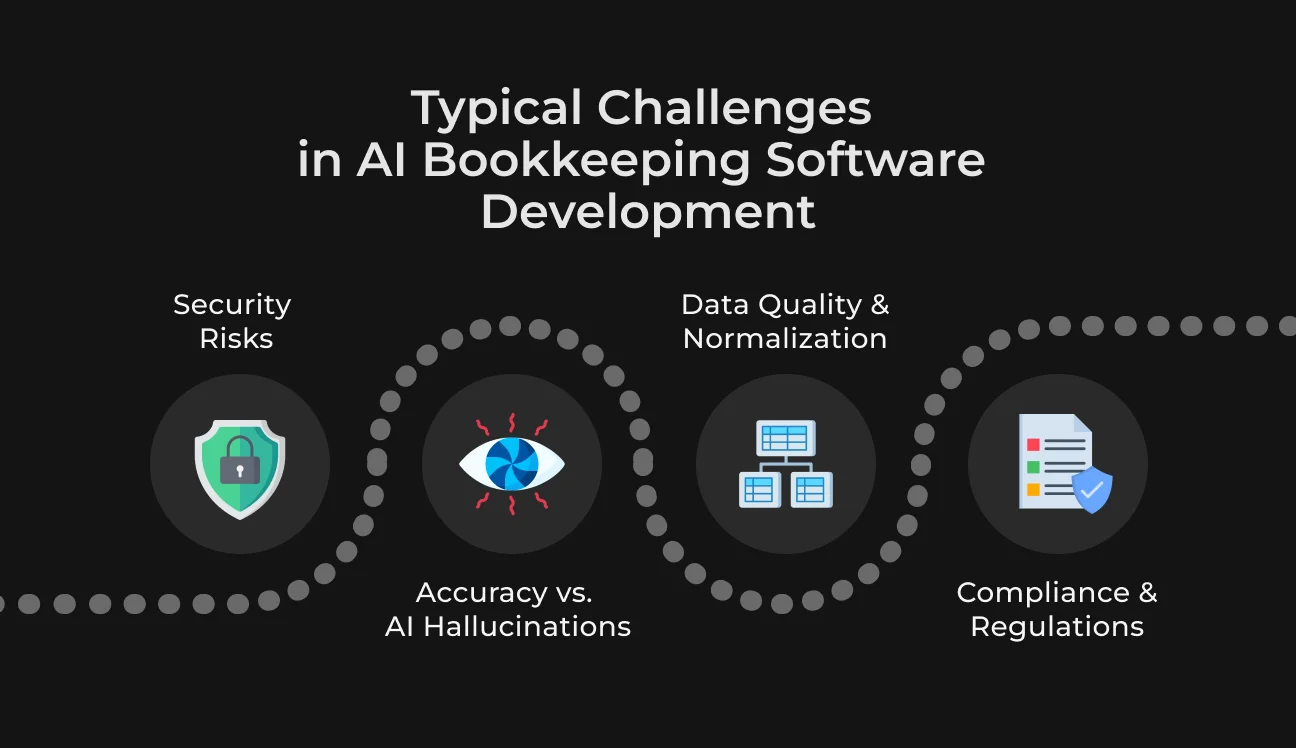
Security risks
Bookkeeping automation software holds sensitive customer data, payment information, and business-critical financial records. Data breaches cost the finance sector an average of $5.9 million per incident, the second-highest of any industry.
The solution here is enterprise-grade security protocols. This includes:
- AES-256 encryption for data at rest and in transit;
- Strict role-based access control (RBAC), where only high-level finance users have access to AI advisors;
- Mandatory multi-factor authentication (MFA) for all users accessing financial platforms, especially administrators and high-privilege accounts.
If you want to safely integrate AI technologies to automate bookkeeping software, we also recommend that you do regular security testing and vulnerability assessments.
Accuracy vs AI hallucinations
In finance, a probabilistic guess is not acceptable. Generative AI can occasionally produce inconsistent or incorrect outputs, even with the same prompt. The fix is a deterministic validation layer that anchors AI outputs to hard business rules.
Any pricing strategy or tax calculation generated by AI must be checked against a fixed database (such as servicePath for pricing or Workday for HR) before it executes. A multi-layered verification system can maintain mathematical consistency across 100% of the data.
Data quality & normalization
Financial data across banking and payment systems is messy.
A single merchant might appear under five different naming conventions across accounts. Specialized text encoders like Txn-Bert address this by decoupling the underlying intent (the merchant) from the legacy artifact (the bank description).
They are trained to recognize the abbreviated patterns specific to transaction data.
Compliance & regulations
Public companies and firms in regulated industries must meet Sarbanes-Oxley (SOX) and GDPR requirements. SOX requires CEOs and CFOs to personally certify the accuracy of internal controls.
The solution is immutable audit trails combined with Explainable AI (XAI). Every AI-driven decision must be logged with its reasoning, input data, and confidence score. NetSuite's System Notes, for example, records every insert, edit, and deletion.
AI can then scan those logs for outlier patterns while maintaining a complete traceability path for auditors.
Use Cases for AI Bookkeeping
The application of AI bookkeeping varies significantly based on the business model and funding stage.
Startups & SaaS
For venture-backed SaaS companies, the priority is keeping the Burn Multiple, the ratio of net cash burn to net new ARR, within a healthy range. Custom bookkeeping automation gives finance teams real-time visibility into these metrics instead of waiting for month-end reports.
Agentic AI layers can also monitor behavioral signals to flag churn risk up to 47 days in advance.
Those signals include:
- Declining product usage or reduced login frequency;
- Increased support escalations or unresolved tickets;
- Reduced engagement with core platform features;
- Delayed invoice payments or failed subscription renewals;
- Lower seat utilization across enterprise accounts;
- Negative customer sentiment in support conversations;
- Reduced participation in onboarding or training sessions;
- Contract downgrade discussions or pricing complaints.
In some cases, the best accounting software for automation features can flag potential churn up to 47 days in advance.
E-commerce
C-commerce brands derive 60% of their revenue from returning customers.
This is why accurate settlement validation is essential for cash flow. High-tier AI bookkeeping systems achieve 99% average accuracy when reconciling millions of discrete transactions across Stripe, PayPal, and Shopify. These systems handle timing differences by breaking down payouts into:
- Gross sales;
- Processing fees;
- Net deposits.
Leading accounting automation software solutions are then posting clean entries directly to the ERP.
SMBs
In the context of AI bookkeeping for small business, the primary objective is AI multiplication. It is about allowing small teams to handle enterprise-level workloads.
By using the best accounting software for automation features, a mid-sized retail firm can automate 90% of its invoice processing. According to our analysts, SMBs can save 40+ hours per month.
This transition allows accountants to move from data entry to cash-flow coaching. Live forecasts can help owners navigate margin fluctuations.
Accounting firms
Firms using AI bookkeeping tools can typically handle 40-60% more SME clients without adding headcount. AI-native tools allow firms to benchmark clients against anonymized industry data and run scenario-based margin experiments.
The accounting firm stops being a compliance function and starts operating as a growth partner.
Measurable Benefits of Bookkeeping Automation
After implementing bookkeeping automation AI, you can see significant improvements across KPIs.
1. Significant Time and Labor Reductions
Advanced users of AI save approximately 71% more time on daily accounting tasks than non-users. This translates to a 100x faster processing speed for high-volume reconciliations. Complex e-wallet audits can move from days to minutes thnks to bookkeeping automation AI.
2. Error Frequency and Cost Mitigation
AI-driven extraction produces 98% fewer errors than manual methods. That matters for margin calculations and tax filings, where small errors compound into significant revenue leakage.
3. Faster Financial Close Cycles
AI-native architectures make the month-end or year-end close a non-event. By reconciling transactions throughout the month, the ledger is always audit-ready. No scramble at close.
4. Strategic Capacity Unlocks
When bookkeeping automation AI handles compliance and entry, your finance team can forget about the data entry process. This shift is critical for 79% of accountants who now prioritize strategic advisory services over simple historical reporting.
Why Build Custom AI Bookkeeping Software Instead of Using Tools
Yes, off-the-shelf bookkeeping automation software exists.
But we see that teams often choose to build custom AI bookkeeping to achieve 3 main advantages:
Workflow Specificity
Custom builds align with organization-specific processes, especially for companies with niche revenue models or multi-entity global operations that generic tools weren't designed for.
Data Control
With custom AI bookkeeping, financial data stays internal. It isn't used to train third-party models. For many firms, that's a non-negotiable security requirement.
Integration Depth
Custom software can connect directly with legacy internal systems, proprietary CRMs, or specialized industry databases that off-the-shelf tools don't support.
AI in accounting is projected to grow 30% year-over-year through 2027. And in 2023, Gartner found that 80% of CFOs expected to increase AI spending over the following two years. The window for building a real competitive advantage here is narrowing.
How SapientPro Implemented AI Bookkeeping for Real Estate
SapientPro built a real estate management and insurance platform that automated tenant onboarding, property data management, payment workflows, and insurance operations.
The project required connecting financial, legal, and operational data across systems that had no native integration, which is exactly the kind of architecture that bookkeeping automation depends on.
The platform included:
- Secure rent payment processing through CreditGuard;
- Property and financial data synchronization via Origami;
- Tenant identity verification with Scanovate;
- Automated reliability checks through third-party APIs;
- Centralized data across landlords, tenants, payments, and insurance records;
- Eliminated manual verification steps, duplicate records, and payment-handling gaps;
- Improved visibility and control across all property stakeholders.
This project shows an architecture that can be used in AI bookkeeping solutions as well: validate users, process payments securely, synchronize financial data across sources, and cut manual back-office work.
Why Choose SapientPro for AI Bookkeeping App Development
SapientPro is a modern engineering team that builds custom automated bookkeeping software for the specific demands of modern finance teams and executive stakeholders. Working with us means getting 9+ years of experience in AI automation for your product.
Our work includes:
- Custom AI bookkeeping software: architectures that automate 90%+ of transaction lifecycles while maintaining GAAP and SOX compliance;
- Agentic AI for finance workflows: autonomous agents that reason, plan, and resolve discrepancies across fragmented data sources;
- Real-time financial dashboards: live interfaces tracking burn rate, ARR, and runway updated by the minute;
- Predictive analytics tools: ML models including XGBoost, BERT, and LLMs for forward-looking cash flow and market analysis.
Let’s team up and discuss your project today!
Cut 40+ Hours of Bookkeeping Per Month
SapientPro builds the automation. Your team handles the strategy.