
All Role of AI in Accounting: Benefits, Challenges, and Integration in 2025
July 23, 202510 min read


Accuracy, timing, and trust have always been valued in accounting the most. But in the modern business environment, being fast is just as important as being right. That's where AI in accounting becomes a life-saving tool, changing how companies handle numbers.
A Thomson Reuters survey found that 68% of tax and accounting firms believe generative AI tools have the potential to enhance the quality of tax work. And AI adoption is paying off. AI-powered tools are helping companies close books faster, detect fraud earlier, and cut routine accounting costs by saving up to 30 hours of routine work a week.
Our team has seen this technological shift firsthand. With over 8 years of experience building AI systems, we know what it takes to build software that actually improves your accounting workflow.
This article brings together insights from our engineering team to show you how AI can handle tedious tasks, reduce errors, and even provide you strategic information in real time.
If you've been wondering how to use AI in accounting or whether it's really worth the investment, this guide is for you. Let's discuss the real role of AI in accounting, the tech behind it, the risks, and how to make it work for your business.
Key Takeaways
- AI in accounting helps automate repetitive tasks like data entry, invoicing, and expense tracking, freeing up time for strategic work;
- It improves accuracy by detecting anomalies, minimizing human error, and ensuring consistent data categorization;
- Businesses gain real-time financial insights, enabling faster decisions and better cash flow management;
- AI supports regulatory compliance and streamlines audits with transparent, traceable data processing;
- Core technologies include machine learning, deep learning, NLP, generative AI, and OCR;
- Major benefits include cost reduction, scalability, and stronger forecasting capabilities;
- Challenges like data privacy, bias, and system integration can be mitigated with expert guidance and custom-built solutions;
- AI tools are evolving toward deeper predictive analytics, enhanced data summarization, and smarter practice management;
- SapientPro builds custom AI accounting solutions tailored to your specific needs and workflows.
What is AI in Accounting?
The use of artificial intelligence technologies helps businesses automate, analyze, and enhance accounting and finance tasks. Machine learning, natural language processing, and computer vision are used to power AI accounting software, making it smart.
Instead of simply recording numbers, the system can now learn patterns, detect anomalies, process invoices, generate reports, and even forecast future outcomes with incredible accuracy.
The main purpose of AI in accounting is to make repetitive, manual tasks faster and less prone to error. Here are the tasks that AI tools can handle more efficiently than a human accountant:
- Data entry;
- Invoice processing;
- Expense categorization;
- Compliance checks.
More advanced AI models go even further, offering projections about cash flow trends, financial health, and operational efficiency.
For example, modern accounting AI can analyze thousands of transactions in minutes, flag outliers for review, or suggest budget changes based on real-time spending.
These capabilities are already changing the principles of finance teams' work and where they should focus their attention. Instead of spending time reconciling spreadsheets, accountants now have more time to work on strategic tasks.
AI always speeds up processes. It allows you to gain better control over your finances. That's why businesses of all sizes are investing in AI in accounting and finance.
Will AI Replace Accountants?
Let's address the elephant in the room: Is AI coming for accounting jobs?
Short answer: no.
But it is changing what accounting work looks like.
AI in accounting and auditing is not designed to replace humans; its main purpose is freeing them from the tedious parts of the job. AI handles tasks like:
- Copying numbers;
- Categorizing expenses;
- Double-checking receipts.
It is not mature enough for strategic thinking, financial planning, regulatory interpretation, or client relationships. We still require human expertise for that.
A report from the World Economic Forum predicts that AI will create 97 million new roles by 2025, many of which will require human-AI collaboration. In accounting, that synergy means professionals who can use AI tools to generate better reports, provide sharper advice, and act faster than ever before.
The shift is already happening. Accountants are becoming data analysts, process designers, and tech-savvy advisors. Firms that adopt AI early are gaining an advantage — not by cutting people, but by giving them better tools.
Benefits of AI in Accounting
What may have started as a fancy add-on is now becoming a core part of modern accounting operations. AI-powered tools are helping businesses simplify complex tasks, improve performance, and make data-backed decisions.
Let's look at some of the clearest ways AI is changing the game for accountants and finance teams.
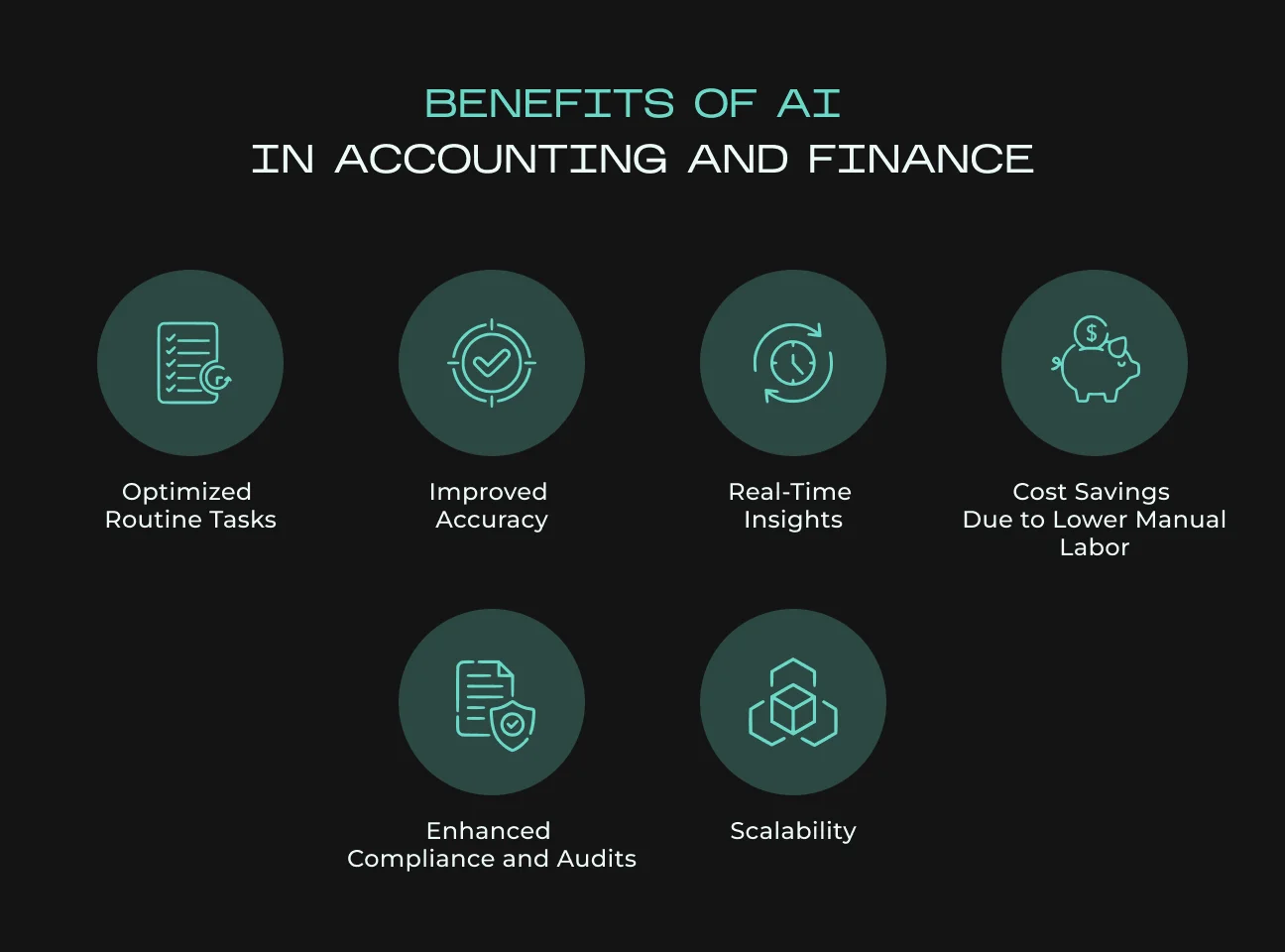
Optimized Routine Tasks
Here are repetitive tasks that have always been a major time sink in accounting:
- Manual data entry;
- Invoice matching;
- Expense tracking;
- Reconciliation.
These tasks require attention to detail but not much strategic thinking, and this type of work AI handles best.
AI accounting software can automatically extract data from receipts and emails, categorize transactions, flag mismatches, and even post journal entries without human input. These tools run 24/7, don't need breaks, and aren't affected by fatigue or distractions, which means a more consistent workflow.
For example, accounts payable teams can automate invoice approvals with rule-based AI bots. These bots check amounts, match line items to purchase orders, and route approvals based on thresholds, cutting processing time from days to hours.
AI frees up time so that finance professionals can focus on higher-value work, such as analysis and budgeting.
Improved Accuracy
Human error is one of the most common causes of financial misstatements. A single digit in the wrong place or a miscategorized transaction can lead to cascading problems and failed audits. AI dramatically reduces that risk.
By analyzing large sets of financial data, AI systems can identify anomalies, inconsistencies, or duplicate entries. These systems learn from past data, which allows them to adapt and flag suspicious patterns that may otherwise go unnoticed by human eyes.
Recent industry studies show that AI-based anomaly detection systems are able to lower false positives by 50-60% in comparison to conventional rule-based systems, while at the same time improving detection of genuine anomalies by as much as 45%.
Besides preventing errors, AI models can also correct them. If a transaction is misclassified, the system can reassign it based on past behavior or accounting rules, helping organizations stay compliant without needing a second round of manual review.
Real-Time Insights
Traditional accounting operates on a fixed schedule. You've got monthly closings, quarterly reports, yearly audits, and so on. AI breaks that timeline. With real-time data processing, companies can access financial insights as they happen.
Dashboards powered by AI can show cash flow trends, spending spikes, budget performance, and more without the need to pull and crunch spreadsheets. Instead of waiting for the end of the month to understand performance, CFOs can make decisions on the fly.
This kind of visibility is especially useful for fast-growing companies or those managing tight margins. When you can spot problems early, such as overspending in a department or delayed receivables, it's easier to adjust course before it affects your bottom line.
Real-time reporting also helps companies stay agile in today's market, where fast reaction time can make or break a quarter. AI gives them the financial clarity to move with confidence.
Cost Savings Due to Lower Manual Labor
One of the most immediate and measurable benefits of AI in accounting is the reduction in labor-related costs. Manual data entry, reconciliations, invoice processing, and other repetitive tasks often consume a large portion of an accounting team's time and budget. With AI handling these processes automatically, companies can significantly cut operational costs.
According to McKinsey research, companies using AI accounting and financial software report up to 40% savings on back-office expenses. This cost reduction doesn't necessarily mean cutting headcount; it means reallocating your team's time toward more value-adding work. Instead of spending hours copying and verifying data, your staff can focus on financial planning, risk management, or advisory roles.
AI also reduces the need for temporary staffing during busy seasons, such as tax filing or quarterly closings. Once configured, AI systems can handle large workloads without the need to hire or train additional support, which adds up to long-term savings.
Fewer errors also mean:
- Fewer costly corrections;
- Fewer compliance penalties;
- Reduced risk of financial restatements.
Enhanced Compliance and Audits
Besides keeping the books clean, accounting is all about meeting regulatory requirements, passing audits, and maintaining public or stakeholder trust. AI can play a critical role in performing these tasks.
AI in accounting and auditing helps enforce consistency and traceability across all financial processes. It can automatically monitor transactions for compliance with internal policies or external regulations, flag suspicious activity, and document every step for future audit trails.
For example, AI tools can scan thousands of transactions against tax codes or financial reporting standards in real time. If something looks off, like an incorrect VAT application or missing document, the system raises an alert before it becomes an issue.
When it's time for an audit, AI systems can quickly generate detailed reports showing what was processed, when, by whom, and why. This level of transparency reduces the friction of audit preparation and shortens the time auditors need to review your systems and records.
With regulations constantly evolving, AI can also help your company stay updated. Machine learning models can be trained to recognize changes in tax laws, reporting requirements, or internal policies and adapt workflows accordingly.
Scalability
As businesses grow, their accounting needs increase. More transactions, more vendors, more currencies, more reporting. Without scalable tools, finance teams either fall behind or get stretched thin trying to keep up. That's where AI can give your business a serious advantage.
AI accounting systems are built to handle large data volumes without performance loss. That scalability makes it easier for you to:
- Expand into new markets;
- Launch new products;
- Acquire other companies.
And you don't need to expand your accounting infrastructure.
AI also helps companies scale efficiently across departments or business units. If one division automates invoice approvals or budgeting with AI, those same tools can often be applied company-wide without rebuilding the process from scratch.
Finally, AI can support global scalability. Many platforms offer multilingual and multicurrency capabilities, plus built-in support for international tax laws. If your business is growing, you need smarter systems that grow with you. AI in finance and accounting makes that possible.
Technologies Used in AI Accounting Software
AI accounting software relies on several core technologies to automate, analyze, and improve financial processes. Each one plays a different role. Together, these tools enable a more adaptive approach to accounting and finance. Let's break down the main technologies driving progress.
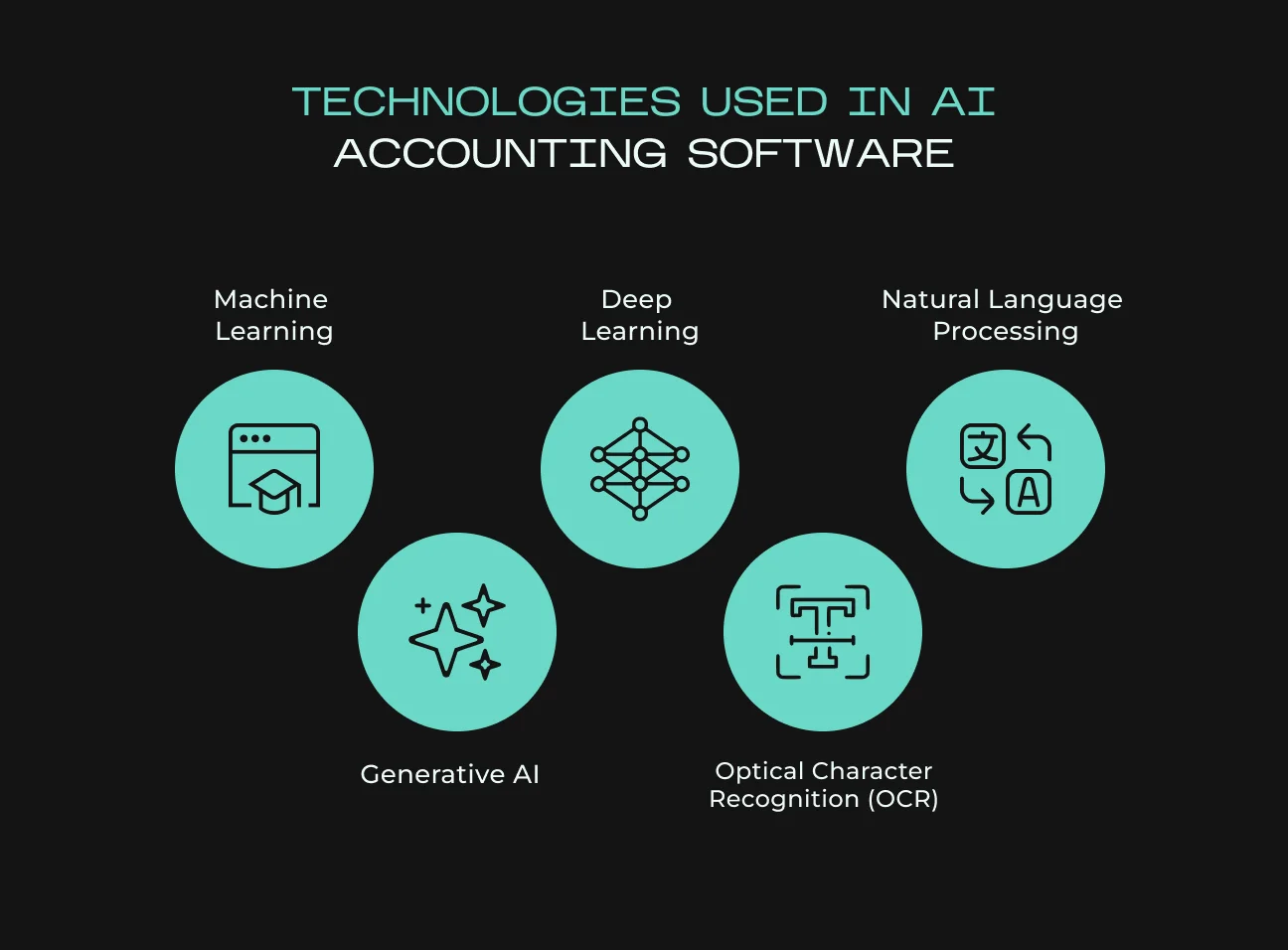
1. Machine Learning
Machine learning is the foundation of most AI in accounting and finance. It enables systems to learn from historical data and make predictions or decisions without being explicitly programmed. Over time, the software becomes more accurate by recognizing patterns in transactions, user behaviors, and accounting processes.
In accounting, ML can automate expense categorization, detect anomalies in financial records, and forecast cash flow based on past trends. It can also “learn” an organization's accounting policies, applying them consistently across various entries.
For example, if a user always assigns lunch receipts from a specific vendor to a certain expense account, the system will start doing it automatically.
2. Deep Learning
Deep learning is a subset of machine learning that uses artificial neural networks to model complex relationships in data. It is often used for processing unstructured data, such as scanned documents, bank statements, or handwritten notes, and finding patterns that are difficult to define with traditional rules.
In the context of accounting AI, deep learning enables more advanced capabilities, including:
- Fraud detection;
- Predictive analytics;
- Intelligent document processing.
It can recognize unusual transaction patterns or risky behavior far earlier than traditional systems.
For example, deep learning models can flag a series of small vendor payments that together might indicate fraud, even if no individual transaction appears suspicious. Auditors or compliance teams can use this information to take preventive action.
3. Natural Language Processing
Natural language processing (NLP) allows AI systems to understand and work with human language. In accounting, NLP is used to extract meaningful data from emails, contracts, invoices, and tax documents without manual input.
For example, an NLP-powered system can read an email from a vendor, recognize it as an invoice, extract the payment details, and match it to a purchase order. It can also help users interact with accounting platforms using plain language. You can type “show me unpaid invoices from May” and get results instantly.
NLP also supports compliance by scanning large volumes of legal and tax documents, identifying important clauses, and flagging anything out of alignment with company policy or law.
4. Generative AI
Generative AI goes a step beyond analysis. It can create new content based on input data, including:
- Writing reports;
- Summarizing transactions;
- Preparing client reports;
- Drafting responses to financial inquiries.
In accounting, generative AI is especially useful for producing readable summaries of financial performance or auto-generating audit notes based on transaction history. It reduces the burden of documentation while improving clarity and communication.
For example, instead of manually compiling end-of-month reports, a generative AI system can write a ready-to-read overview using real-time numbers pulled from your accounting platform.
5. Optical Character Recognition
Optical character recognition (OCR) enables AI systems to read and extract text from images, PDFs, or scanned documents. This technology is critical for digitizing physical invoices, receipts, contracts, or tax forms.
With OCR, your company can eliminate manual data entry from paper documents. The system captures text, identifies fields (such as invoice numbers, due dates, and totals), and inputs them directly into accounting systems with high accuracy.
For example, when an employee submits a scanned receipt, OCR reads it and populates the relevant fields in the expense management system. It can automatically assign categories and link the receipt to the right project or department.
OCR also improves record-keeping, helping companies move toward fully digital archives that are easier to audit and review. It's a key part of turning traditional paperwork into usable data.
Challenges of AI in Accounting and How to Mitigate Them
AI brings plenty of advantages to accounting, but it has its challenges. Data privacy concerns, regulatory complexity, and “black-box” behavior are just a few of the problems that finance leaders must solve. Still, none of these challenges are deal-breakers. When addressed properly, the risks become manageable. Let's discuss the most common issues companies face when adopting AI in accounting and finance and how to solve them.
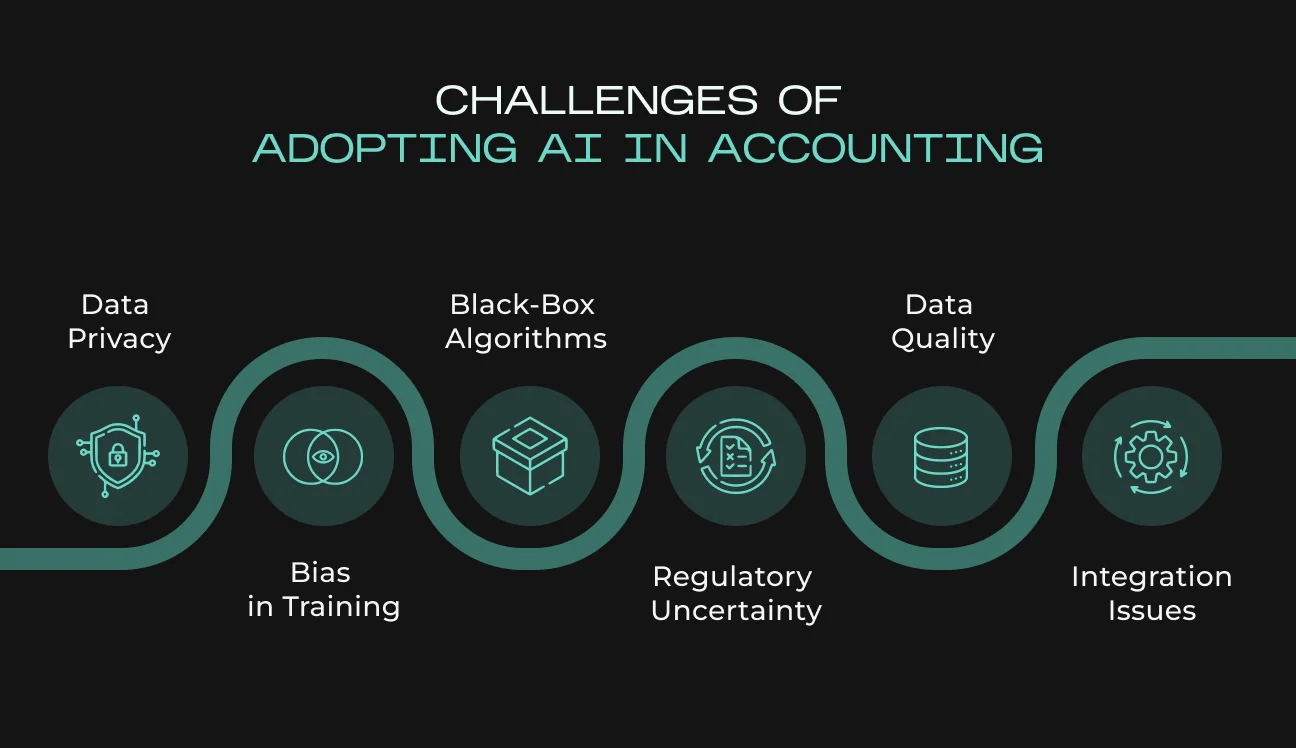
1. Data Privacy
AI systems often require access to sensitive financial and personal data, including employee salaries, tax IDs, client payment details, and so on. If not handled correctly, this access creates serious privacy and security risks.
How to Mitigate This Challenge
SapientPro applies strict data encryption, access control, and secure storage protocols to every project. We also help clients align their AI solutions with GDPR, CCPA, and other relevant privacy laws. Our development process includes privacy-by-design principles, so sensitive data never ends up where it doesn't belong.
2. Bias in Training
If the data used to train an AI model is flawed or incomplete, the results can be biased. For example, AI might unfairly flag some transactions based on location, vendor type, or historical patterns that don't reflect current business logic.
How to Mitigate This Challenge
Before training AI models, we conduct data audits. Our team builds datasets that reflect your current business operations, not just legacy records. We also use model monitoring tools to detect and retrain biased outputs, which improves accuracy over time.
3. Black-Box Algorithms
Deep learning AI models can make decisions without clearly explaining how. Traceability and accountability are critical in accounting, and the lack of transparency can be a major issue.
How to Mitigate This Challenge
SapientPro engineers use interpretable AI techniques wherever possible. We design models that provide clear reasoning behind decisions, especially in financial forecasting or compliance checks. Our platforms include user-friendly dashboards that show exactly how conclusions are drawn, which builds trust in the system.
4. Regulatory Uncertainty
The legal framework around AI in accounting and auditing is still developing. Laws may vary by region and industry, and what's allowed today may change tomorrow.
How to Mitigate This Challenge
We stay up to date with legal and industry developments and tailor each solution to the client's jurisdiction. SapientPro works with legal advisors to make sure all AI systems are built with future compliance in mind to avoid costly rework down the road.
5. Data Quality
Poor-quality data with missing fields, duplicates, or outdated records can cause AI systems to make inaccurate predictions or automate processes incorrectly.
How to Mitigate This Challenge
We start every AI accounting project with a deep data-cleaning and validation phase. Our engineers create automated data checks and feedback loops to maintain quality over time. This step ensures that the AI works with up-to-date information at every stage.
6. Integration Issues
Many organizations struggle to connect new AI tools with legacy accounting software or multiple data sources. Without proper integration, the benefits of AI are limited.
How to Mitigate This Challenge
We specialize in building AI tools that connect smoothly with your existing tech stack. Our business digitalization services ensure your cloud-based or on-premise AI accounting platform can talk to everything it needs without interrupting your workflow.
Features of AI Software in Accounting
The best AI accounting tools come packed with features that go far beyond basic data processing. They help finance teams understand trends, manage risks, and make faster decisions with less effort. Let's take a look at some of the key features businesses are now relying on in AI-driven accounting systems.
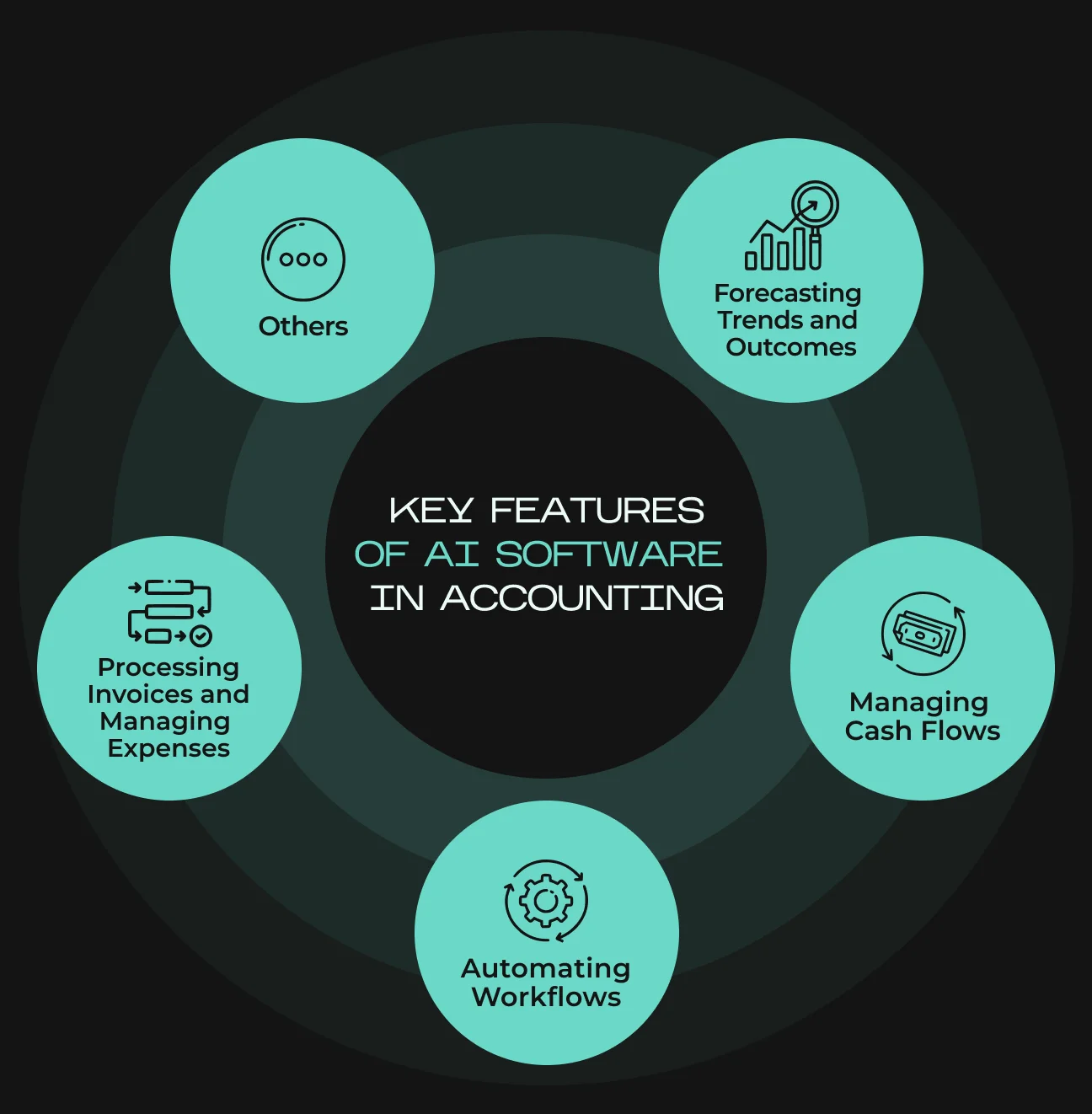
1. Forecasting Trends and Outcomes
One of the most powerful features of AI in accounting is its ability to predict what's coming. To generate accurate forecasts, AI tools analyze historical financial data, seasonal fluctuations, industry patterns, and even external signals like interest rate changes or supplier behavior.
These forecasts can cover:
- Revenue projections;
- Tax liabilities;
- Cash flow dips;
- Capital needs.
Instead of relying on spreadsheets, you can use this information to plan budgets, allocate resources, or assess financial health in advance.
For example, a CFO can receive automated alerts when spending trends suggest a potential cash shortage in two months, well before it becomes a crisis.
2. Managing Cash Flows
Cash flow management has always been one of the trickiest parts of accounting. AI tools can simplify this task by tracking income and expenses in real time, identifying payment delays, and even recommending ways to balance inflows and outflows.
AI can automatically flag late-paying clients, suggest follow-ups, and predict when recurring payments will hit. Some platforms can even recommend when to pay vendors to maximize available cash without risking late fees.
With AI, you can see a clear picture of cash movement at any given moment. You no longer need to wait for end-of-month reports.
3. Automating Workflows
AI software can automate entire accounting workflows. Once rules are set, the system executes tasks without human intervention, which saves time and reduces the chance of error.
Take expense management, for instance. Within minutes, AI can scan receipts, match them with company policies, assign the correct categories, and route them for approval. Similarly, journal entries can be generated automatically based on transaction data.
These workflows are adaptable, too. If an organization updates its approval thresholds or policy rules, AI can apply those changes instantly across the system without manual reprogramming.
4. Processing Invoices and Managing Expenses
Invoice processing is one of the most common use cases for AI in accounting and finance. AI can read, interpret, and validate invoice details using OCR and NLP technologies and match them with purchase orders or delivery notes.
This automation eliminates the need for manual entry, speeds up approvals, and ensures accuracy. The system also tracks spending patterns, identifies duplicate or fraudulent invoices, and keeps expense records organized for audits or reporting. For growing companies, automated invoice processing can scale easily.
5. Others
Many AI accounting platforms offer other helpful features:
- Fraud Detection;
- Audit Trail Generation;
- Tax Categorization;
- Multi-Entity Reporting;
- Custom Alerts.
These systems can identify suspicious transactions and alert teams in real time. They can assign tax codes and automatically generate filing-ready data. AI accounting tools can consolidate data across subsidiaries, branches, or regions in one place.
Together, these features make AI accounting software a powerful upgrade from traditional tools.
Future Trends of AI in Accounting
AI is rapidly changing the accounting sphere. It all started with basic automation, and now we see advanced strategic tools in action. Looking ahead, we can point out several key trends that will define how future accounting professionals will operate.
1. Using AI to Summarize, Organize, and Analyze Data
Processing large amounts of financial data is a task that typically takes a lot of time for accountants. AI is reversing this situation by allowing quick summarization, categorization, and analysis of complex data. Sophisticated AI tools decipher high volumes of financial data, picking out the most significant points and providing an easy-to-understand presentation. This functionality speeds up the analysis and increases accuracy, reducing the risk of human error.
AI-Powered Document Processing Solution
Learn how SapientPro automated Safety Data Sheet processing by integrating artificial intelligence.
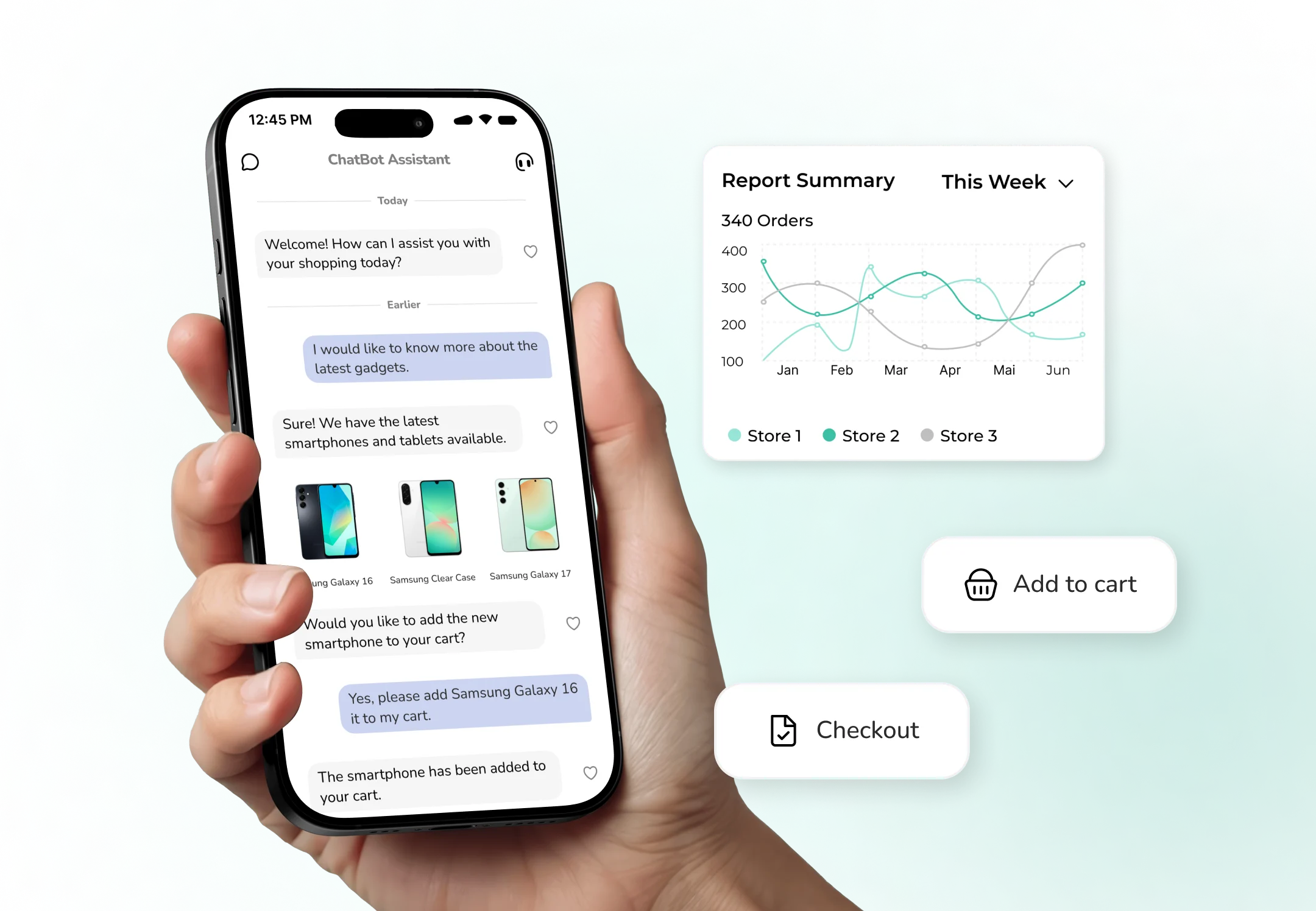
For example, AI-based platforms can automatically prepare executive summaries of complex financial reports, pointing out key metrics and trends. Now, accountants can focus on strategic thinking and advisory tasks instead of being mired in number-crunching.
Accounting firms implementing these technologies are gaining a competitive advantage by providing quicker and better financial analysis to clients.
2. Improving Predictive Data Analytics
Predictive analytics is becoming an essential part of modern accounting practices. Using AI, accountants can make data-backed decisions with greater confidence. AI models analyze all relevant factors to predict future financial outcomes, such as cash flow fluctuations, revenue projections, and expense patterns.
Thanks to predictive capabilities, organizations can address financial challenges and seize opportunities. For example, an AI system might forecast a potential cash shortfall in the coming quarter, warning the finance team to adjust budgets or seek additional funding in advance. In time, AI's predictive accuracy and utility in financial planning are expected to improve even further.
3. Embedding AI into Practice Management
Accounting firms are actively integrating AI into their practice management systems. These systems can perform various administrative tasks, such as:
- Scheduling;
- Client communication;
- Workflow management.
AI-powered tools can automate routine processes. For instance, AI can assist in managing client relationships by tracking communication histories, setting reminders for follow-ups, and even drafting initial responses to common inquiries. AI can optimize resource allocation by analyzing workload patterns and suggesting efficient task assignments among team members.
By embedding AI into practice management, accounting firms can enhance operational efficiency, improve client service, and adapt to changing business environments faster. It's already clear that the adoption of AI-based tools and methods will be vital for any organization to remain ahead of the competition.
To see how AI is integrated into financial services beyond accounting, check out our guide on AI in banking and its real-world applications.
Partner with SapientPro to Build Your AI Solution
Developing an AI system for your accounting and finance firm is the best way to leverage the latest tech trends and solve real business problems.
SapientPro’s engineers will help you get a fully customized solution that’s designed to fit your workflows, reporting needs, and compliance requirements. You’ll also get:
- Over 8 years of experience in AI development;
- Industry knowledge in accounting, finance, and artificial intelligence;
- A team that values your growth and brings any idea to life.
We create software that reduces manual labor, improves accuracy, supports audit readiness, and helps your team focus on strategy instead of spreadsheets. Get a free consultation today to discuss your project and see how we can help.
Get an Expert AI Development Team
SapientPro's engineers have extensive experience in creating various AI-powered solutions for accounting. We'll bring your idea to life.
FAQ
1. How is AI used in accounting?
AI is used in accounting to automate repetitive tasks, improve accuracy, detect anomalies, and provide real-time financial reports. It processes large volumes of data quickly, which helps with tasks like invoice scanning, expense classification, cash flow forecasting, and audit preparation.
2. What can AI do in accounting?
AI can handle data entry, match transactions, generate reports, flag irregularities, forecast trends, and support compliance. It reduces manual labor, speeds up decision-making, and enhances visibility across all financial processes.
3. Can SapientPro develop an AI accounting solution?
Yes. SapientPro can build custom AI accounting software designed to meet your business goals. Our team has 8+ years of experience in AI development and can deliver tools for automation, reporting, forecasting, or anything your accounting workflow needs.

