All How to Build Custom ESG Data Management Software for Reporting and Compliance
August 30, 20269 min read


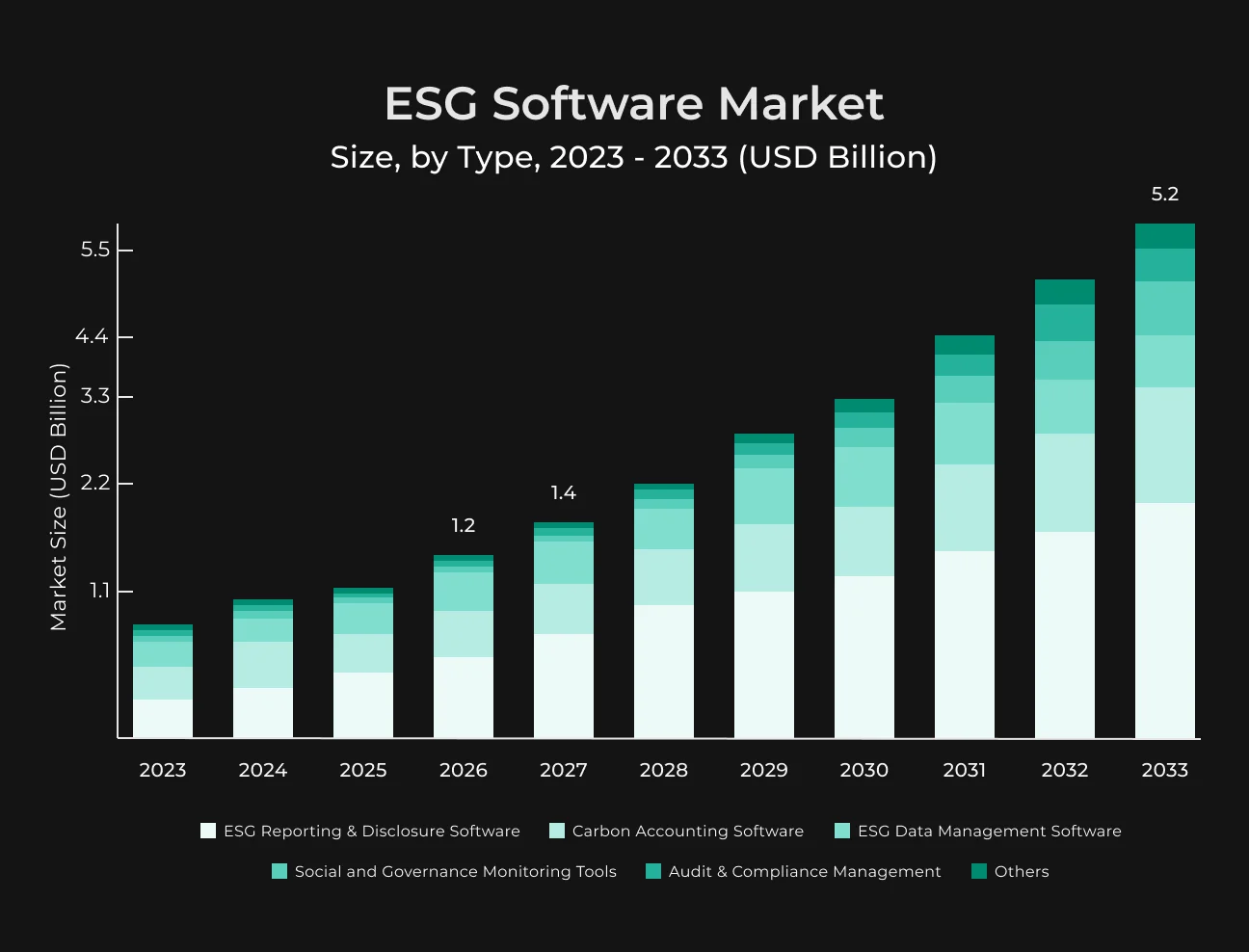
Business leaders need ESG software now — voluntary reporting is turning into a legal requirement.
Most enterprises aren't ready. Many multi-unit companies still track carbon, labor, and waste data across fragmented spreadsheets, a system that breaks down under real scrutiny.
Different divisions use inconsistent methodologies, and executive teams face audit deadlines with no verifiable proof files to show for it.
The pressure comes from every direction: the Corporate Sustainability Reporting Directive in Europe, the SEC's climate rule in the US, and the International Sustainability Standards Board's global standards.
Here's what building the right ESG software actually takes based on SapientPro’s experience.
Why Build a Custom ESG Software Solution
Pre-packaged platforms look convenient, but they often can't meet the structural needs of complex corporations. Most off-the-shelf ESG solutions use rigid, generic database designs.
Those designs rarely match a company's existing systems or ERP setup, so integrating data becomes a manual, error-prone task. The problem gets worse with older, legacy databases — packaged tools often can't sync with them at all, leaving data stuck in silos.
On top of that, vendors are slow to update their compliance logic when local regulations change.
Licensing adds another layer of friction. Per-seat pricing scales poorly once hundreds of suppliers need to input their own data. It also locks companies into the vendor's system.
Over time, many companies realize they don't actually own their compliance records — the records live inside the vendor's platform, not theirs.
The table below lays out the functional differences between generic pre-packaged offerings and custom sustainability data management software.
Evaluation Metric | Off-the-Shelf ESG Software | Custom ESG Compliance Solutions |
| System Connection | Relies on standard API bridges that fail when legacy systems update. | Built-in connections linked directly to internal database systems. |
| Data Adaptability | Fixed data models requiring manual manipulation of existing records. | Tailored data formats matching existing supply chain and HR structures. |
| Regulatory Updates | Slow updates for local compliance codes, creating compliance gaps. | Agile rule configurations matching specific framework demands. |
| Pricing Model | Per-seat licensing fees that grow as supply chain partners input metrics. | One-time development costs with unlimited user access. |
| Data Control | Restrictive storage policies causing lock-in on analytical databases. | Complete control over raw information, aiding audit verification. |
Core Components of Custom ESG Data Management Software
To build reliable custom ESG compliance solutions, you must construct specific operational layers that work together without friction.
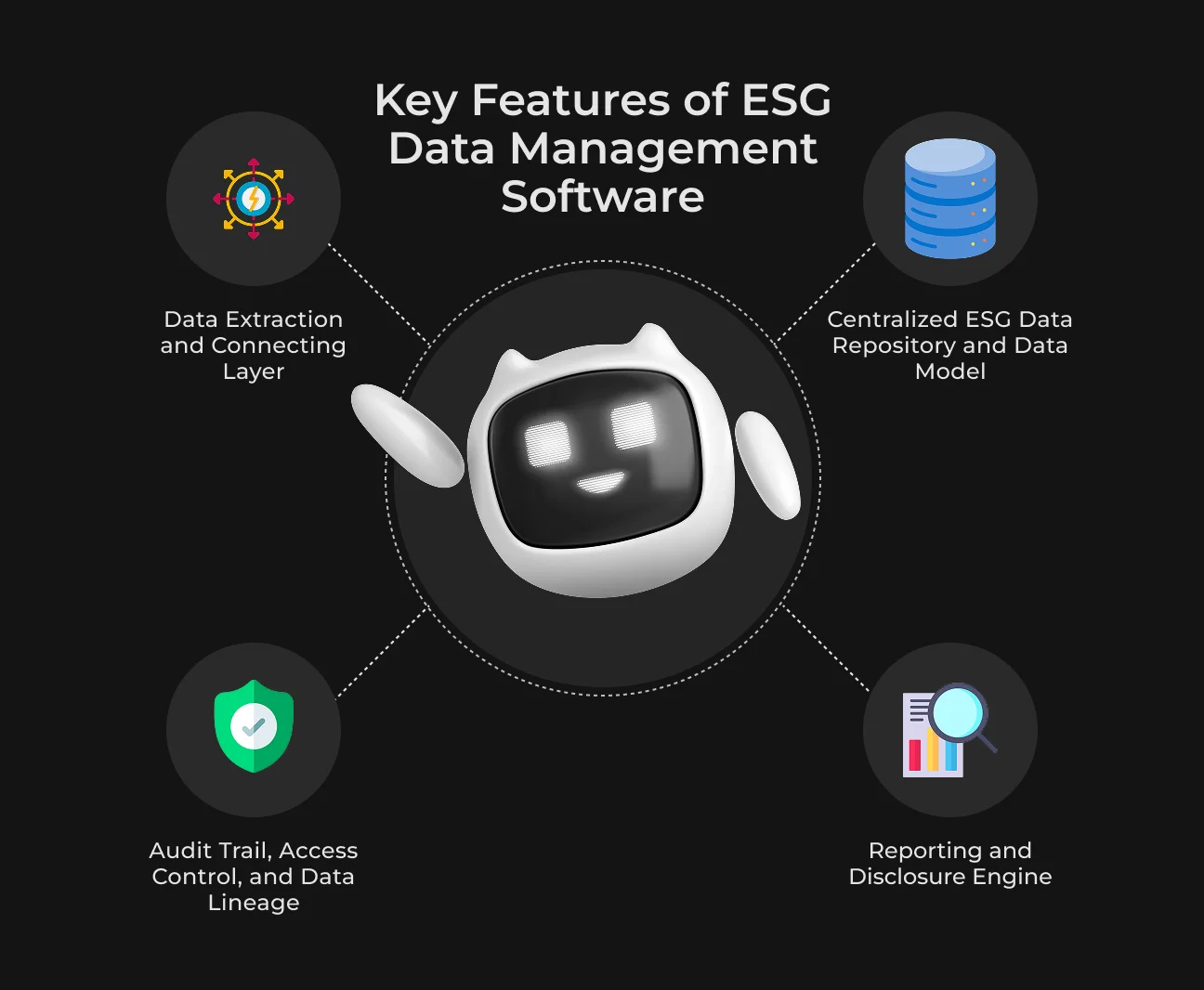
Data Extraction and Connecting Layer
Automated pipelines are what make environmental-metric collection possible.
Here's how they work:
- Extract.
Pipelines pull data from source systems — CRM platforms like Salesforce, Creatio, or HubSpot, email servers, and cloud storage like AWS S3 or Azure Blob. This includes documents such as invoices, energy bills, and delivery forms.
- Clean.
Scanned documents get cleaned up before processing. The software applies deskewing, noise reduction, and contrast enhancement so the records are readable.
- Normalize.
Data gets converted into matching formats. Dates convert to the ISO 8601 standard. Local currencies convert to a single target currency. This step prevents statistical errors downstream.
Technical teams build these pipelines to handle the extract-clean-normalize sequence. For more on how to build one, see our ETL services guide.
Centralized ESG Data Repository and Data Model
A central repository is the foundation for all sustainability data. It stores quantitative metrics like emissions values right alongside qualitative files: electricity invoices, vendor policies, supplier certificates. Keeping them together makes every data point queryable from one place.
The repository organizes unstructured inputs into standardized tables or flexible JSON formats. JSON works well for nested supplier data, where relationships are hard to flatten into rows. This turns messy inputs into a single source of truth, instead of scattered silos.
Reporting and Disclosure Engine
ESG software needs to translate raw figures into specific regulatory reports. A disclosure engine maps data points directly to taxonomies like GRI, SASB, TCFD, or CSRD, without manual re-tagging. That cuts the administrative workload significantly.
The engine applies logic rules that match incoming figures to each framework's requirements. Under a once-only system design, a single carbon metric can map to multiple disclosure sheets at the same time. The result: audit-ready outputs on demand.
Audit Trail, Access Control, and Data Lineage
Auditors expect absolute clarity. Every figure must trace back to its source, whether that's a supplier certificate or a utility invoice. Standards like ISSA 5000 make this traceability mandatory, which is why the platform needs Role-Based Access Control to manage editing permissions.
In practice, a Global Admin holds full editing rights. Client Admins and Client Employees are restricted to limited views or issue logging. Every file change, upload, or login gets saved to an unalterable audit log — a digital ledger that proves compliance during third-party audits.
Regulatory Deadlines Won't Wait For You
CSRD and SEC timelines keep moving — get a platform that's audit-ready before they land.
Key Regulatory Frameworks Your ESG Compliance Software Must Support
Four frameworks now shape how companies report on climate, social, and governance performance, and 2026 has moved each one in a different direction.
Here's where each stands and what it actually asks for.
Framework | 2026 Status | What It's Really About |
| CSRD / ESRS | In force, the scope was just cut by ~80% | Double materiality across the value chain |
| ISSB / IFRS S1–S2 | Mandatory in 20+ countries; voluntary in the US | Climate risk to enterprise value |
| GRI Standards | Voluntary global baseline | Impact on outside stakeholders |
| SEC Climate Rule | Facing a rescission vote | Scope 1–2 emissions, financial risk |
A functional environmental, social, and governance reporting platform must support several overlapping rules. Each requires unique system logic to process data correctly.
CSRD and ESRS
The European Corporate Sustainability Reporting Directive is active, and it requires ESG management software to run a structured double materiality assessment: scoring both financial effects and environmental impacts, and mapping those values across a company's own operations and its supply chain.
The platform also needs logic for transitional relief — letting companies document plans instead of hard numbers when Scope 3 supplier data isn't yet available.
On the “how much” side, the simplified European Sustainability Reporting Standards (ESRS), published via EFRAG, cut mandatory datapoints by roughly 60–70%, and the Commission is expected to formally adopt the simplified ESRS Delegated Act before the end of 2026.
That shift has moved the reporting timeline too: Wave 2 companies (large companies not previously subject to the NFRD) now report on FY2027 data, published in 2028, though voluntary early adoption of the simplified standards is permitted for FY2026.
GRI Voluntary Baseline
The Global Reporting Initiative remains the most common baseline for impact reporting, so software built around it must track impact materiality, not just financial risk.
That means recording metrics for labor rights, worker safety, and anti-corruption measures, and managing supplier audits that verify compliance with global human rights codes.
ISSB and IFRS S1-S2
IFRS S1/S2, issued by the International Sustainability Standards Board, is built around a single-materiality lens — enterprise value, not double materiality. It covers how sustainability-related risks and opportunities affect a company's cash flows, access to capital, and cost of capital over the short, medium, and long term.
That framing sets the platform requirements: software must support scenario analysis to test operational resilience, model how carbon transition pathways affect cash flows and capital costs over time, and connect those sustainability metrics directly to financial reporting.
SEC Climate Disclosure Rule
The SEC's rule sets specific requirements for publicly traded firms: carbon accounting that follows the Greenhouse Gas Protocol, with direct Scope 1 and indirect Scope 2 values calculated separately.
Software built for this rule also needs to link the financial impact of severe weather events directly to accounting footnotes — mapping to Article 14 of Regulation S-X.
How AI Strengthens ESG Compliance Software
Implementing AI in ESG reporting solutions changes how businesses manage incoming data. AI transforms static files into active records.
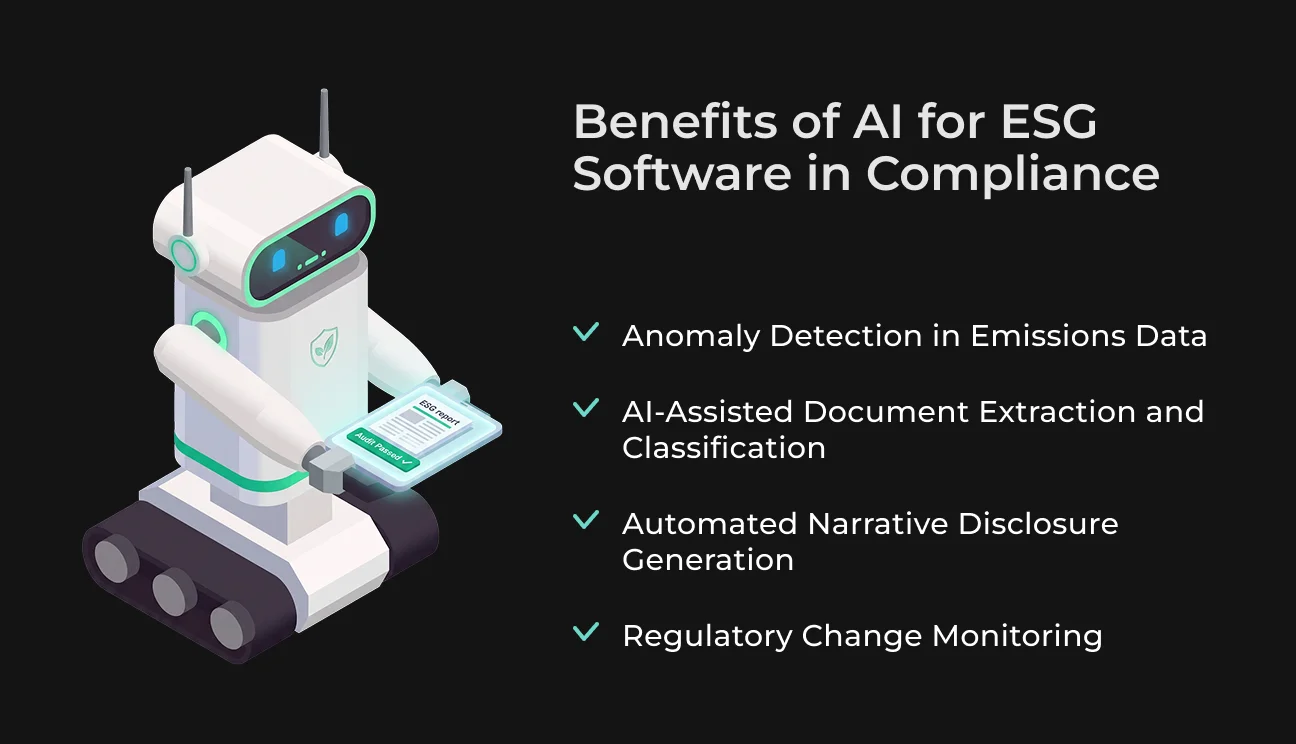
Anomaly Detection in Emissions Data
Manual review misses errors buried in high-volume data streams. AI watches incoming data in real time and flags odd spikes or patterns. The platform runs a hybrid model:
- Traditional ML monitors standard, recurring entries.
- LLMs evaluate complex, context-dependent cases.
If a single building reports a sudden jump in water or fuel usage, the platform flags it before the report compiles. The same detection logic catches duplicate bills, suspicious activity, and mismatched tax data.
For asset-heavy firms, this same error-prevention logic extends to product quality checks — see our AI Quality Control Use Cases Guide for more.
AI-Assisted Document Extraction and Classification
Enterprise teams process hundreds of incoming invoices and supplier certificates. Standard extraction systems fail as soon as a layout changes. Custom AI models read varying structures without a fixed template, adapting the way a human reviewer would.
Modern platforms use Vision Transformers to read documents as image-text hybrids, preserving the visual layout — how headers and columns relate to the data cells. Every extracted value gets a confidence score. High-scoring values get approved automatically; low-confidence fields route to a human reviewer.
This human-in-the-loop design keeps errors in check.
Automated Narrative Disclosure Generation
Compiling narrative compliance reports is labor-intensive.
LLMs read normalized tables and draft the narrative text that explains the numbers, aligned to specific ESG framework guidelines. They can explain the reasoning behind Scope 3 exclusions or summarize environmental policies. That speeds up report creation and cuts the risk of human error during translation.
Regulatory Change Monitoring
New rules get published constantly across global regions. AI tools monitor regulatory changes in real time, parsing legal updates to flag which ones affect the business. When a rule shifts in one region, the system checks it against requirements elsewhere and alerts the compliance team.
Manual rule-tracking is notoriously slow. This automated compliance monitoring keeps systems current without the delay of manual review.
How SapientPro Builds Custom ESG Management Solutions
If your ESG data lives across spreadsheets, PDFs, and disconnected systems, we can help. SapientPro's development team designs and builds custom ESG compliance software that turns messy data streams into structured, audit-ready records.
SapientPro can build you an AI document automation solution that parses files in multiple languages, including English and German, without needing pre-configured templates.
That means your platform keeps working even when a supplier changes their invoice format. It handles version flags, automated updates, and fast database queries, and we connect it directly to your existing ERP systems, so you're not rebuilding what you already have.
Our SDS automation platform shows what that looks like in practice. We built a custom web-based safety platform to manage GHS safety data sheets for Swiss compliance workflows. It became the client's primary system for managing complex compliance files across multiple locations.
What You Get | Implementation Details |
| Team Size & Delivery | Built by a team of 4 professionals in 1,400 development hours |
| Technology Stack | PHP, MySQL, OpenAI, Mistral, React, Next.js, and TypeScript |
| Data Partitioning | Secure, isolated datarooms keep each client's data separate |
| Access Management | Role-based access control across Global, Client, and Employee roles |
| Extraction Capability | AI structures hazards, chemical composition, and warning statements automatically |
| Search Features | Barcode-free metadata lookups, ingredient searches, and product code scans |
| Visual Flagging | Automated GHS hazard label assignments based on pictograms and phrases |
| Version Safeguards | Automated tracking of document updates, with email-to-database links |
We can build the same kind of system for you.
Using proven data structures like these, SapientPro builds custom ESG reporting platforms that run smoothly, without the recurring licensing fees of off-the-shelf tools — and keep your data secure, traceable, and ready for regulatory audit, every time.
Ready to build or upgrade your ESG management system?
Get in touch with our team to scope your project.
Don't Let Audits Catch You Unprepared
Give your compliance team verifiable, traceable data they can defend under scrutiny.