All How Much Does It Cost to Make a Mobile App?
September 29, 202610 min read


Two mobile apps can share a store category and a similar screen count, yet one takes months of engineering and the other years. The difference lies in what runs behind the interface.
A focused business app with its own server logic and admin panel usually starts at around $100,000, while a regulated platform handling financial transactions or medical records for a large audience can reach seven figures.
A narrowly scoped app or an extension to an existing system can cost much less.
For that reason, a mobile app development price quoted before anyone has seen the scope tells you little. This guide answers how much it costs to develop a mobile app, drawing on projects SapientPro’s engineers have delivered since 2017 and on public market data.
It covers five parts of the budget:
- Costs by product stage and category;
- Where the budget goes;
- Factors that change the total;
- Running costs after launch;
- Ways to lower the bill.
Mobile app development costs quoted from outside sources carry links to the original data.
How Much Does Mobile App Development Cost in 2026?
We calculate estimates from engineering hours at an average rate of $45. The ranges below draw on mobile projects delivered since 2017 and describe products with a mobile interface, backend, and admin tools. They are planning benchmarks.
A project estimate still requires a review of your scope.
Product stage | Cost range | What the budget covers |
| Launch-ready app | $100,000 to $250,000 | One core workflow on iOS and Android, backend, admin panel, store release |
| Growth-stage product | $250,000 to $650,000 | Payments, real-time features, analytics, several integrations |
| Enterprise platform | $650,000 and above | Compliance, multi-tenant architecture, legacy connections, heavy traffic |
SapientPro’s mobile app development services typically allow you to have an app published in Play Market or App Store after 6+ months of work.
What Goes Into the Cost of Mobile App Development?
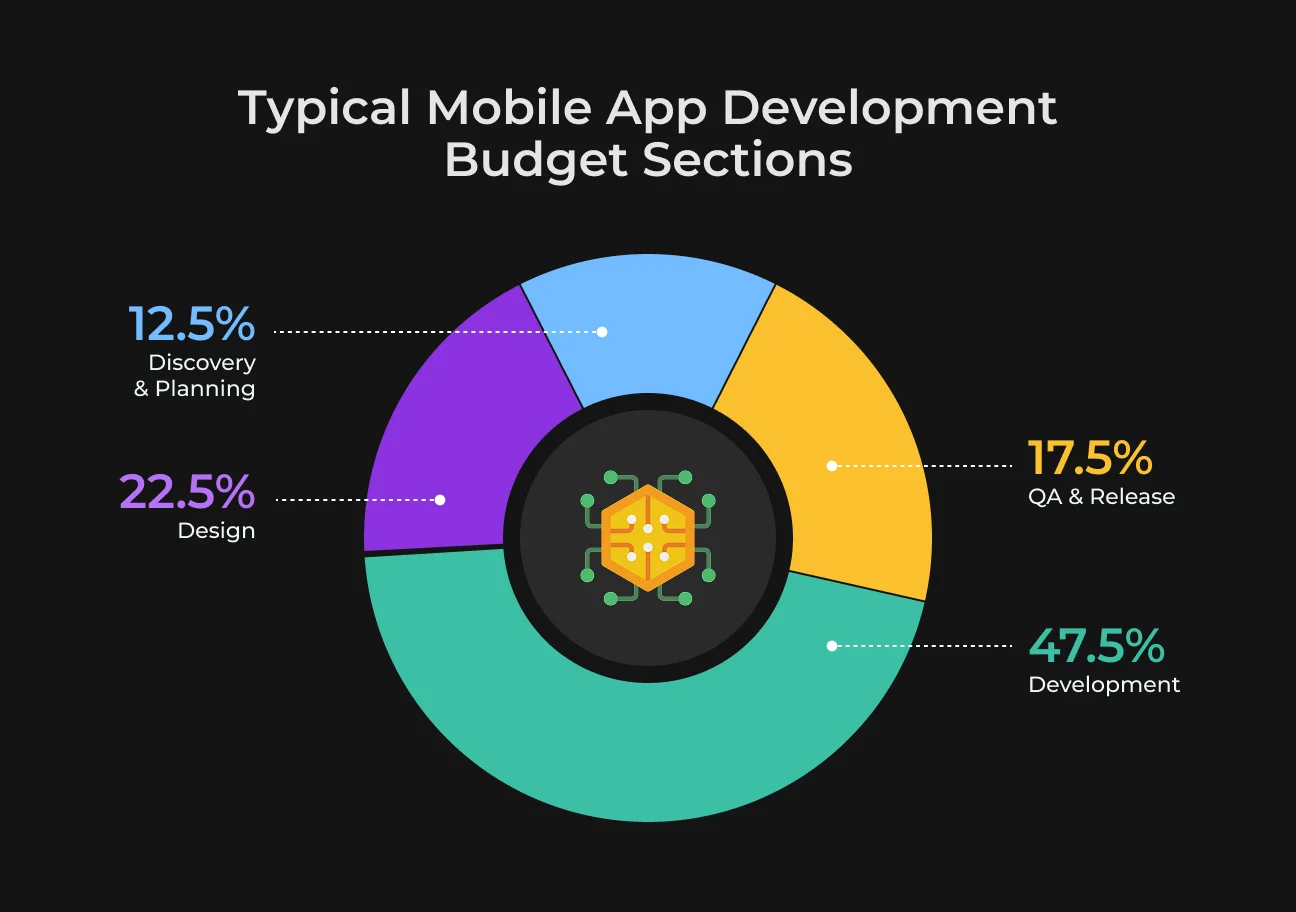
A mobile budget splits into four blocks of work, and each one below explains what it pays for.
1. Product Discovery and Planning
Discovery accounts for 10 to 15% of a typical budget. The team documents requirements and maps user flows, and an architect tests the riskiest technical assumptions before anyone estimates the build.
A quote that skips discovery looks cheaper on paper. Missing requirements can become change requests once development starts, increasing both cost and delivery time.
2. UI/UX and Mobile App Design Cost
Mobile app design cost runs at 20 to 25% of the total.
The design budget typically pays for the following work.
- UX research;
- Wireframes;
- UI design for both platforms;
- A design system;
- Clickable prototypes;
- Accessibility work;
- Custom animations and interactions.
Standard platform transitions require less custom work than a personalized onboarding animation, which needs its own design, development, and testing.
3. Development
Engineering absorbs 40 to 55% of the budget and splits into five pieces of work:
Component | Scope |
| Mobile frontend | Screens and navigation on iOS and Android, plus offline storage and device features. |
| Backend | Business logic and user accounts, along with the databases behind them. |
| Admin panel | The web interface your staff uses to manage users and content. |
| API development | The contract between the app and server, versioned to keep older installs working. |
| Infrastructure | Cloud environments and CI/CD pipelines, including monitoring. |
Founders often budget for the first item alone, yet the other four keep the app running.
4. QA and Release
Testing and release preparation take 15 to 20%.
QA engineers check the app across device models and OS versions, and a regression suite runs ahead of each release. Security testing follows the OWASP Mobile Top 10. Publishing requires Apple's $99 annual developer membership and Google’s $25 one-time registration fee.
Store review also needs time in the schedule. A rejection can delay launch and create additional revision work. SapientPro’s iPad app project for Fine Balance Photography illustrates why submission requirements belong in release planning.
The client highlighted this work in their review:
Their attention to detail was fantastic. We missed a lot of guidelines for submission, but they were always there to reconfirm the requirements.

Gauri Chopra
7 Factors That Change the Mobile App Development Price
Seven variables decide where your app lands inside those budgets.
{{a3}}
1. Number and Complexity of Features
Screen count alone is a weak cost measure. A basic notification flow usually needs less work than a vendor portal with separate roles, order handling, and permissions. Features that add complex server logic, real-time processing, or external dependencies can increase the budget substantially:
- Authentication with SSO and role-based access;
- In-app payments and subscriptions;
- Chat;
- Video calls and media processing;
- Maps and geolocation;
- Real-time synchronization between devices;
- AI features;
- Offline mode with conflict resolution;
- Complex permissions.
One item from that list can outweigh a dozen static screens.
2. Native vs. Cross-Platform Development
Two native apps mean two codebases, Swift for iOS and Kotlin for Android, each requiring its own development and testing. Flutter and React Native share one codebase between platforms, which reduces duplicated work for apps built on standard interface patterns.
Platform-specific integrations and testing still need separate attention.
Native development still earns its cost in apps that rely on heavy graphics or deep hardware access.
3. Backend and Infrastructure Requirements
The backend carries the logic users never see, and its scope usually includes these components:
- API design and versioning;
- Databases and data models;
- Authentication services;
- Cloud infrastructure and environments;
- Capacity planning for traffic growth;
- Data processing pipelines and background jobs;
- Multi-tenancy for B2B products serving several client companies.
An app for 5,000 employees and one for a million consumers can look identical, yet their backends and budgets differ.
4. Third-Party Integrations
Every integration carries two costs, whether it connects payments, maps, a CRM or ERP, an identity provider, or analytics. Engineering time goes into the connection and its failure cases, as our article on integrating a payment gateway in an e-commerce website and app shows.
The vendor’s recurring fee, usually charged per transaction or per API call, grows along with your audience. Include it in the operating budget alongside the initial integration work.
5. Security and Compliance
Fintech and healthcare apps often need additional security and compliance work because of the data and transactions they handle. The scope may include encryption, access controls, audit logs, and penetration testing.
Requirements depend on the product, jurisdiction, and applicable standards.
Both stores add obligations of their own. Apple requires privacy manifests that declare how an app and its SDKs use data, and Google Play asks developers to complete a Data Safety form for every listed app.
6. Development Team Location and Composition
Developer pay shows how far regional prices spread:
- United States, a median wage of $64.44 an hour, according to the Bureau of Labor Statistics;
- Ukraine, a median salary of $3,450 a month after tax, according to DOU’s winter 2026 survey.
These figures use different periods and tax bases, so they are not a direct comparison of agency rates. A project quote also reflects team composition, project management, QA, overhead, and delivery responsibility – all factors that must be considered.
7. Existing Product vs. Building From Scratch
Your starting point changes the bill.
Project Type | Scope and Cost Implications |
| New product | Every component gets built from zero. |
| MVP expansion | Validated flows stay, and new money goes into requested features. |
| Legacy rewrite | Data migration and old business rules add work of their own. |
| Mobile apps on an existing backend | Your APIs already exist, and a first release can cost well under $100,000. |
MasTrack illustrates the scope of a legacy rebuild. SapientPro rebuilt its fleet platform as a real-time GPS tracking system, with the published case study reporting fleet management 10 times faster. That example shows the work a rewrite can involve: it is not a mobile app pricing benchmark.
Seven Factors, One Number for Your App
You now know what moves the price. Tell us which factors apply to your app, and a SapientPro tech lead will show where its budget lands.

How Much Do Different Types of Mobile Apps Cost?
App category helps identify likely cost drivers, but it does not determine the price on its own.
The levels below describe broader products in our project record.
App example | Main cost drivers | Typical budget level |
| Marketplace | Payments, vendor accounts, search, reviews, admin | Mid-six figures |
| Fintech app | Security, transactions, compliance, integrations | High six to seven figures |
| Delivery/logistics app | Maps, tracking, real-time updates | Mid-to-high six figures |
| Social app | Feeds, messaging, media processing, traffic spikes | Mid-six figures |
| AI mobile app | Model/API costs, backend orchestration, data handling | Low to mid six figures, plus model usage fees |
Our guide to building a successful marketplace website explains the marketplace workflows behind the first row. The projects below show why the deliverable scope matters more than the category label when comparing budgets.
AI Language Learning App
For a Dutch language school, SapientPro built an AI-powered language tutor with live avatars.
It is a cross-platform app whose avatars score pronunciation at the phoneme level and correct grammar mid-conversation. Azure AI Services and OpenAI handle its speech and language processing.
The recorded effort for that build was 300 hours, equivalent to roughly $13,500 at our average rate of $45 per hour. This is the engineering effort reported for that engagement, rather than a benchmark for the broader products in the tables above. A like-for-like comparison would also need to establish which design, backend, release, and operating costs each budget includes.
The build took 300 hours, or roughly $13,500 at our average rate. The school kept costs predictable by defining what its avatars needed to do before development began.
Sander Cramer, who runs the school, had previously commissioned an attendance tool from SapientPro; his Clutch review lists that project’s cost at €12,000. Both budgets reflected a clearly defined scope that stayed consistent throughout development, with no discounts involved.
They gave me a good outline of the timeline. It was clear from the beginning what we'd include. Even if something wasn't in the scope, it was easy to make changes without being charged more.

Sander Cramer
Community App for Newcomers
Our newcomer handshake platform connects new arrivals in the Netherlands with local organizations and events in five languages, running on React Native with a React web platform behind it.
Its head of product, Tim Grasmaijer, reports a budget of $200,000 to $999,999 on Clutch.
That range covers the engagement described in the review, including mobile and web development. It should not be presented as the price of the mobile app alone. The platform serves newcomers, municipalities, and volunteers, so the scope extends beyond the phone interface.
SapientPro has developed our mobile and web app using React Native, React.js, and Google Cloud Platform. The system's uptime is almost 100%, and there are hardly any complaints from our users.

Tim Grasmaijer
Mobile App Maintenance Costs After Launch
Mobile app maintenance costs continue after launch: bugs need fixes, dependencies change, and platform requirements evolve. Over several years, maintenance can become a substantial part of total ownership cost. Keep this budget separate from new feature development.
A peer-reviewed study links about 90% of software lifetime cost to the maintenance phase.
Since April 28, 2026, iOS apps uploaded to App Store Connect must use the iOS 26 SDK or later. Since August 31, 2026, new mobile apps and updates submitted to Google Play must target Android 16 (API level 36) or higher. Keeping up with these requirements is part of maintaining the ability to publish updates.
Recurring expense | What it covers | What drives the bill |
| Maintenance | Bug fixes, OS and dependency updates, security patches | $1,000 to $5,000 for fixes; $5,000 to $30,000 for platform updates |
| Infrastructure | Servers, database, storage, CDN, monitoring | $5,000 to $25,000 for servers and backend |
| Third-party services | APIs, payments, analytics | $3,000 to $20,000 |
| Product development | New features and improvements | Scoped as separate work |
Ask for monthly or annual estimates for recurring services and separate quotes for major updates.
Without a billing period and defined scope, maintenance figures cannot be compared meaningfully.
How to Cut App Development Costs and Avoid Technical Debt
Reducing the first-release budget works best when you reduce scope and reuse suitable systems. Cutting testing or leaving architectural problems unresolved can create rework later. These measures help control both initial cost and technical debt.
Recommendation | Practical Approach |
| Start with one core workflow | Build the path that earns money first. |
| Postpone non-critical integrations | A CSV export can stand in for a CRM connection at launch. |
| Consider cross-platform where it fits | Standard business apps rarely need two codebases. |
| Reuse existing backend systems | Your current APIs may already cover part of the server work. |
| Define acceptance criteria before development | A feature with written criteria gets built once. |
| Test risky technical assumptions in the first sprint | A short spike costs less than a rewrite. |
| Separate prototype scope from production requirements | Prototype code only proves an idea. |
Each measure reduces the work itself, and none of it reappears in a later budget.
How SapientPro Builds Mobile Apps for Business
SapientPro has been building software for clients since 2017.
As a mobile app development company, we offer the mobile app development services listed below:
- Consulting and discovery;
- UX/UI design;
- iOS, Android, and cross-platform development;
- Backend, API, and integration work;
- QA and legacy modernization.
Our engineers use AI coding tools within an architecture they design, with human review of code before it reaches your repository. To discuss a project, send us the core workflow, target platforms, and existing systems. The team can then define the scope and estimate the work for your approval.
Six Figures or Seven? Your Scope Decides
Describe the app you have in mind and the systems it has to talk to. Our tech lead will price it stage by stage, maintenance included.
FAQ
How much does it cost to build a mobile app?
A production app with its own backend usually starts at around $100,000. Growth-stage products reach the mid six figures, and regulated enterprise platforms can pass a million.
How much does it cost to maintain a mobile app?
Over a product’s life, upkeep can outweigh the original build. Plan a maintenance budget alongside the launch budget, and keep new features in a separate one.
Is it cheaper to build for iOS or Android?
Neither platform is cheaper by default. Android testing covers more devices, and your audience affects the bill more than the platform itself.
Can I build an app for $10,000?
In most cases, $10,000 covers a clickable prototype or one feature added to an existing product. A production app with its own backend needs a larger budget.
The price of mobile app development depends on decisions made before anyone writes code. Product stage sets the bracket, and the seven factors above move the figure inside it. A tightly scoped core workflow and a reusable backend pull the total down.