All How to Use AI for Customer Segmentation
June 29, 202615 min read


Most segmentation work still runs on spreadsheets refreshed quarterly. That's a problem when a customer can move from casual browser to high-intent buyer within a single mobile session.
AI customer segmentation fixes this by replacing static, rule-bound audience groups with models that update continuously, find patterns humans miss, and predict who's about to churn, buy, or upgrade — before it happens.
This guide covers how customer segmentation using AI works, which models to use, and what to watch out for when building it.
What Is Customer Segmentation?
Customer segmentation is the process of splitting a customer base into discrete groups that share common characteristics, needs, or behaviors. For executives, it's a capital allocation tool: it tells you where to focus sales, marketing, and product investment to get the highest return.
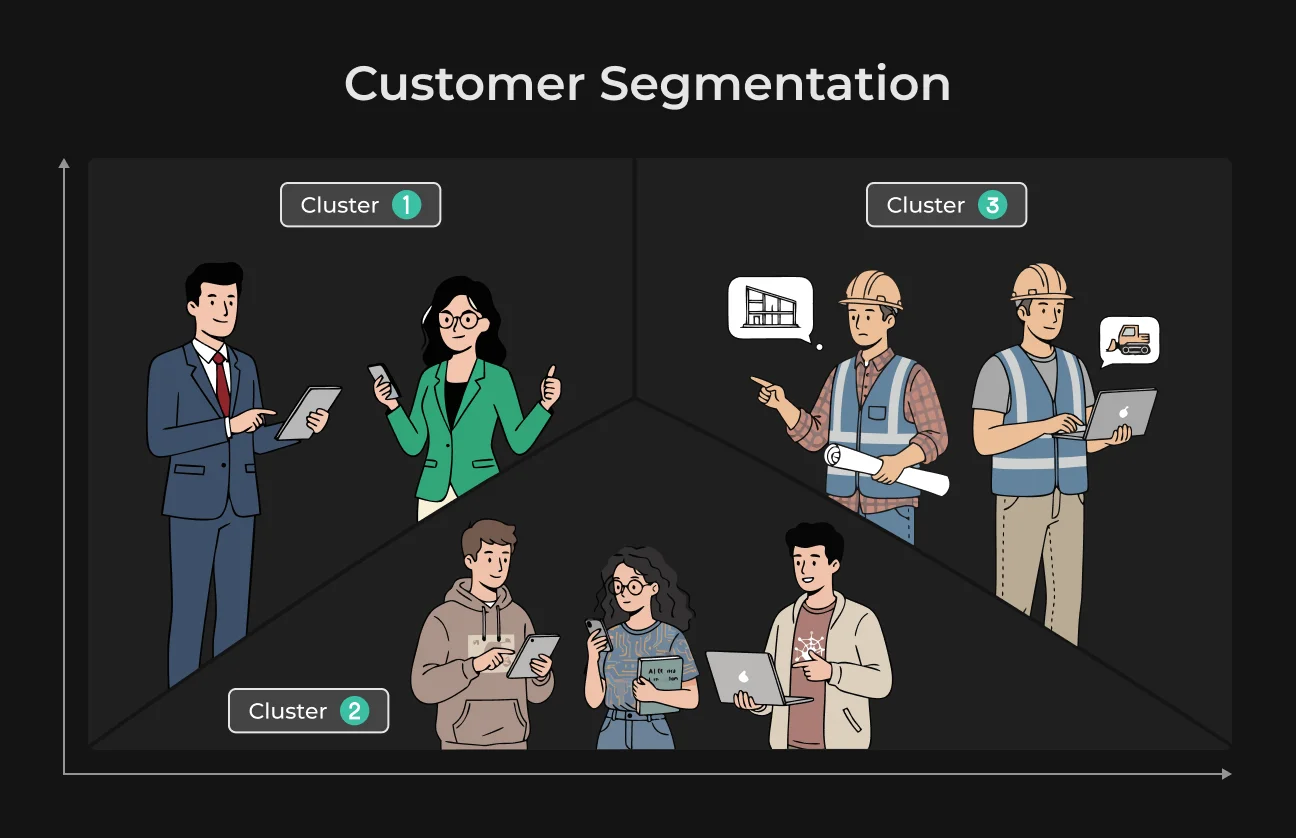
The ultimate goal of customer segmentation is to identify which customers offer the most loyalty, are less price-sensitive, and possess the potential to become A-level clients. In the context of investor relations, segmentation is a tool for maximizing the LTV of the customer base while minimizing the CAC.
Effective segmentation informs the entire business model, influencing:
- Pricing strategies: identifying segments that are value-driven versus those that are price-conscious;
- Product development: prioritizing features that solve the specific pain points of high-value cohorts;
- Service options: designing support tiers that align with the profitability of each segment.
The importance of this process is highlighted by the ROI paradox.
Many organizations are investing heavily in AI. Indeed, only 41% of marketers can confidently point to improved ROI from these efforts. This disconnect often stems from a failure to ground AI initiatives in a strong segmentation framework.
When done correctly, however, the results are transformative. Companies that successfully use personalization (a direct output of effective segmentation) can lower customer acquisition costs by as much as 50% and increase revenue growth by 5% to 15%.
How to Use AI for Customer Segmentation?
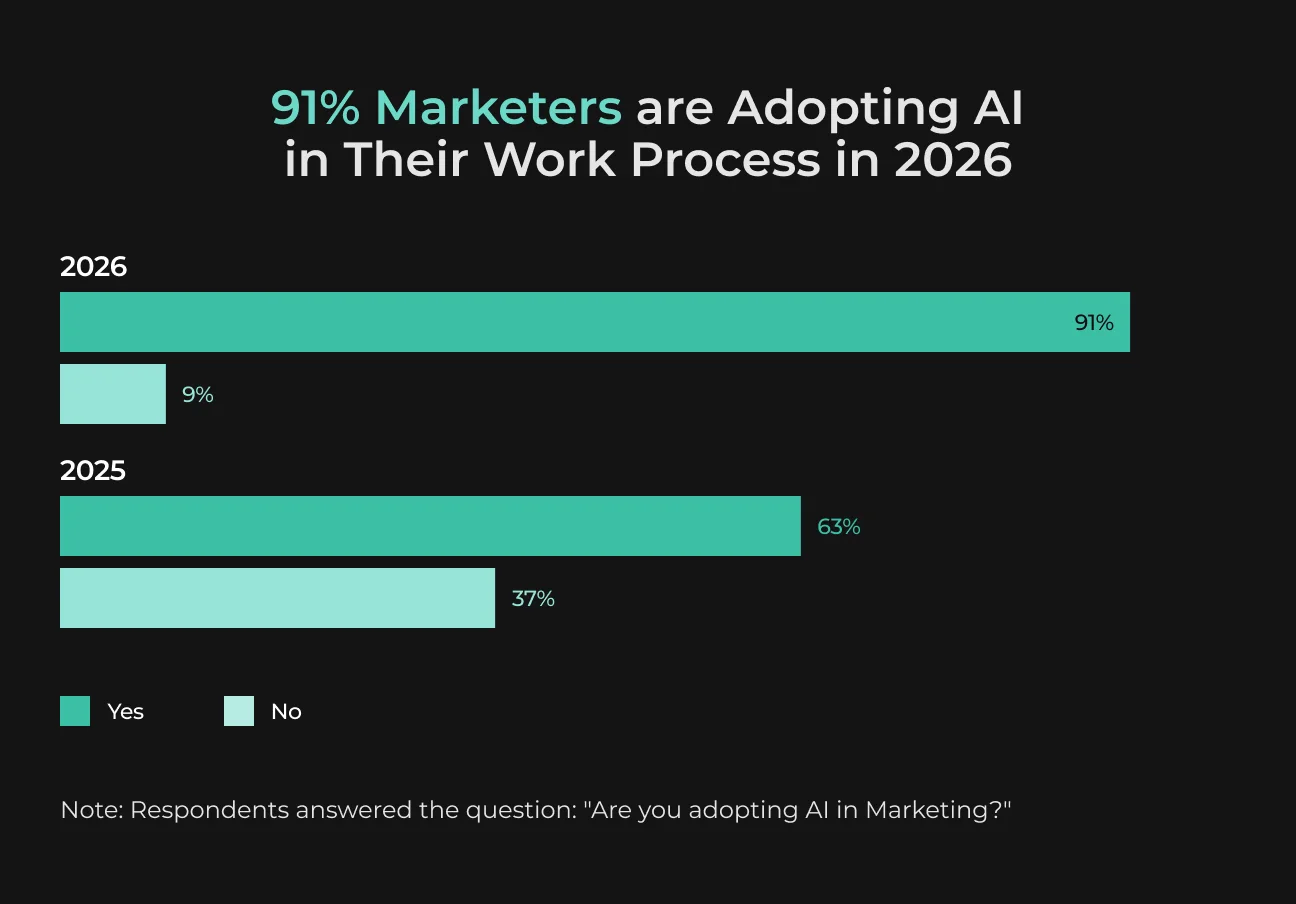
The traditional customer segmentation straategy that relied on quarterly refreshes of static spreadsheets is no longer sufficient to capture the nuances of a buyer who may move from a casual browser to a high-intent purchaser within a single mobile session.
Limitations of Legacy Architecture
The primary issue facing global enterprises is that traditional segmentation is both static and structurally limited. Human analysts typically develop segments based on a handful of pre-selected variables, such as age, location, or past purchase total.
This approach treats every 35-year-old male in a specific zip code as though they possess the same motivations and price sensitivities. However, customer behavior has become increasingly complex, influenced by:
- Real-time social signals;
- Shifting economic conditions;
- Immediate availability of competitors.
Furthermore, legacy systems suffer from domain bias, where the segmentation is constrained by what the business already suspects to be true.
AI-Driven Orchestration of Segmentation
The integration of AI customer segmentation offers a comprehensive solution to these structural failures.
Unlike traditional methods, AI does not require a predefined hypothesis. Instead, unsupervised ML algorithms ingest millions of data points to identify natural groupings that are invisible to the human eye. These data points include:
- Browsing history;
- Sentiment analysis from support transcripts;
- Real-time clickstream data.
This shift is a fundamental change in how CEOs and investors view customer value. By moving to AI-based customer segmentation, the organization can implement a strategy that is predictive rather than retrospective.
Types of Customer Segmentation
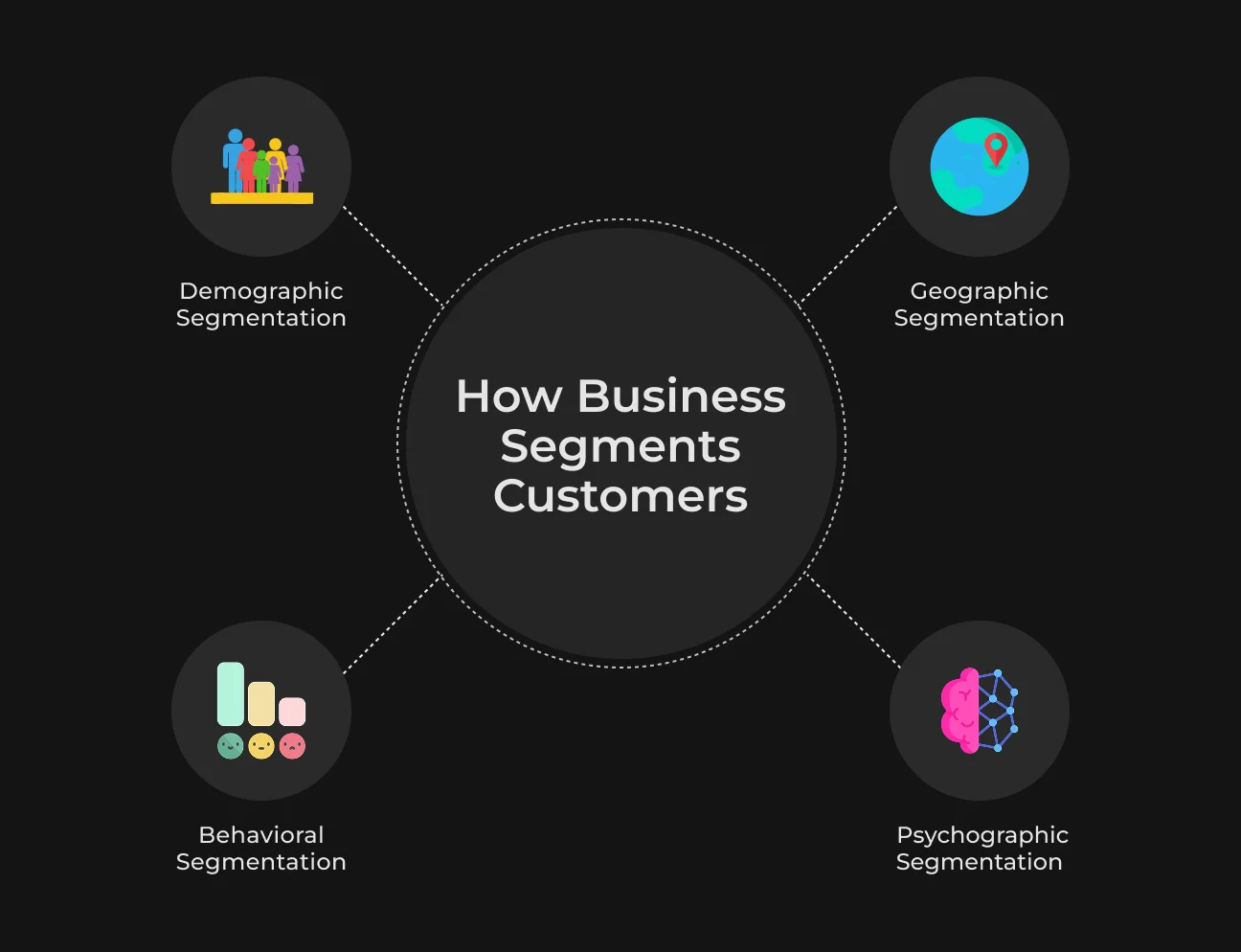
With these 4 types of customer segmentation, you can implement a successful customer segmentation strategy.
| Segmentation Type | Focus | Key Benefit | AI Improvement |
| Demographic | Characteristics | Foundational targeting | Cross-variable subgroup identification |
| Geographic | Location | Logistical efficiency | Real-time, proximity-based offers |
| Behavioral | Interactions | Predictive accuracy | Pattern recognition across touchpoints |
| Psychographic | Motivations | Emotional resonance | Sentiment analysis of unstructured data |
Demographic Segmentation
This remains the baseline for most strategies, focusing on objective traits.
Possible B2C variables:
- Age;
- Gender;
- Income;
- Education level;
- Family size.
Possible B2B variables (firmographics):
- Company size;
- Industry type;
- Revenue;
- Geographic operations.
Traditional demographic lists are often static. AI for customer segmentation allows for cross-referencing these variables with real-time behaviors. You can identify, for example, that high-income Millennials in a specific city are currently exhibiting a sudden interest in sustainable home goods.
Geographic Segmentation
Geographic targeting groups customers based on their physical location. This is critical for logistics, localized marketing, and regional pricing. Possible variables:
- Country;
- Region;
- City size;
- Climate;
- Urbanization (urban vs. rural).
For example, a car dealership might use geographic data to recognize that 45-year-old parents in suburban areas have different vehicle needs (minivans/SUVs) than 21-year-old college students in dense urban centers (compacts/micro-mobility).
Behavioral Segmentation
Behavioral analysis is the most predictive of the four types of customer segmentation. It focuses on the actual interactions between the customer and the brand. Key metrics:
- Purchase frequency;
- Basket size;
- Share of wallet;
- Tenure (loyalty);
- Browsing patterns.
AI can identify micro-behaviors. Suppose, a customer downloads a whitepaper, visits the pricing page twice, and attends a webinar. AI can identify these micro-behavious and place the user into a high-propensity segment that triggers a direct sales reach-out.
Psychographic Segmentation
This is often the most difficult data to collect. However, it is the most valuable for building an emotional connection. Possible variables:
- Beliefs;
- Values;
- Goals;
- Interests;
- Attitudes;
- Lifestyle choices.
AI improves this by using NLP to analyze customer reviews, social media sentiment, and support chat transcripts to infer unspoken motivations.
Limitations of Traditional Customer Segmentation
Now, let’s take a look at why legacy approaches are failing in the 2026.
Static and Rule-Based Segmentation
Manual segments rely on fixed rules: target all users who haven't purchased in 30 days. That snapshot says nothing about why they went quiet. A customer on parental leave, a customer who bought from a competitor, and a customer who's considering an upgrade all look identical under a rule-based system.
Limited Data Processing Capabilities
Early clustering methods like k-means applied to a handful of variables worked when customer data lived in one system. Now customers generate data across dozens of channels.
Spreadsheet-based sorting breaks down before it gets close to the full picture, and historical data doesn't capture what a customer is doing right now.
Domain Bias and the Hypothesis Trap
Manual segmentation encodes whatever the team already believes. If churn analysis only examines credit scores, no one discovers that declining app usage is a stronger predictor. AI identifies correlations that fall outside the original hypothesis entirely — which is exactly where the most valuable signals tend to hide.
Poor Personalization
Broad segments treat large groups as a single unit. 76% of consumers say they find this frustrating. And as an audience scales from hundreds to millions, rule-based systems can't keep up without adding headcount proportionally. AI handles scale automatically.
How AI Improves Customer Segmentation
To build customer segmentation using machine learning, you must implement the following tech stack:
- ML. Algorithms that improve their accuracy over time by learning from the results of previous interactions.
- Clustering algorithms. Unsupervised learning techniques (like k-means or hierarchical clustering) group data points based on mathematical proximity.
- Data pipelines. The infrastructure that connects disparate data sources (CRM, website, social media) to the AI engine, ensuring that the model has a clean and timely stream of information to process.
AI fundamentally changes the segmentation. By automating the discovery and maintenance of audiences, AI customer segmentation allows for a degree of precision and speed that was previously reserved for small-scale experiments.
Dynamic Clustering and Fluidity
Unlike the frozen lists of the past, AI enables dynamic clustering. This means that segments are constantly updated as new data flows into the system. A high-intent user who makes a purchase is immediately moved out of the prospect segment and into the onboarding or new customer segment without human intervention.
Predictive Analytics and Anticipatory Growth
The most transformative aspect of customer segmentation using AI is its predictive nature. ML models do not just group people based on who they were. They group them based on who they are likely to become. Customer segmentation solutions can detect:
- Purchase intent: identifying in-market shoppers before they search for a competitor;
- Churn risk: detecting subtle declines in engagement signals that precede a cancellation by weeks;
- Expansion potential: pinpointing which long-tail small customers have the behavioral markers of an enterprise-level account.
Pattern Detection in High-Dimensional Data
AI can process thousands of signals simultaneously—something humans cannot do.
It might be discovered that a customer's likelihood to buy increases significantly if they visit the "About Us" page on a mobile device on a Tuesday morning after receiving a specific push notification.
These non-obvious patterns allow for the creation of hyper-specific micro-segments, which are the key to maximizing ROI in crowded markets.
Benefits of AI for Customer Segmentation
The move to AI-based customer segmentation is driven by measurable improvements in operational efficiency and financial performance.
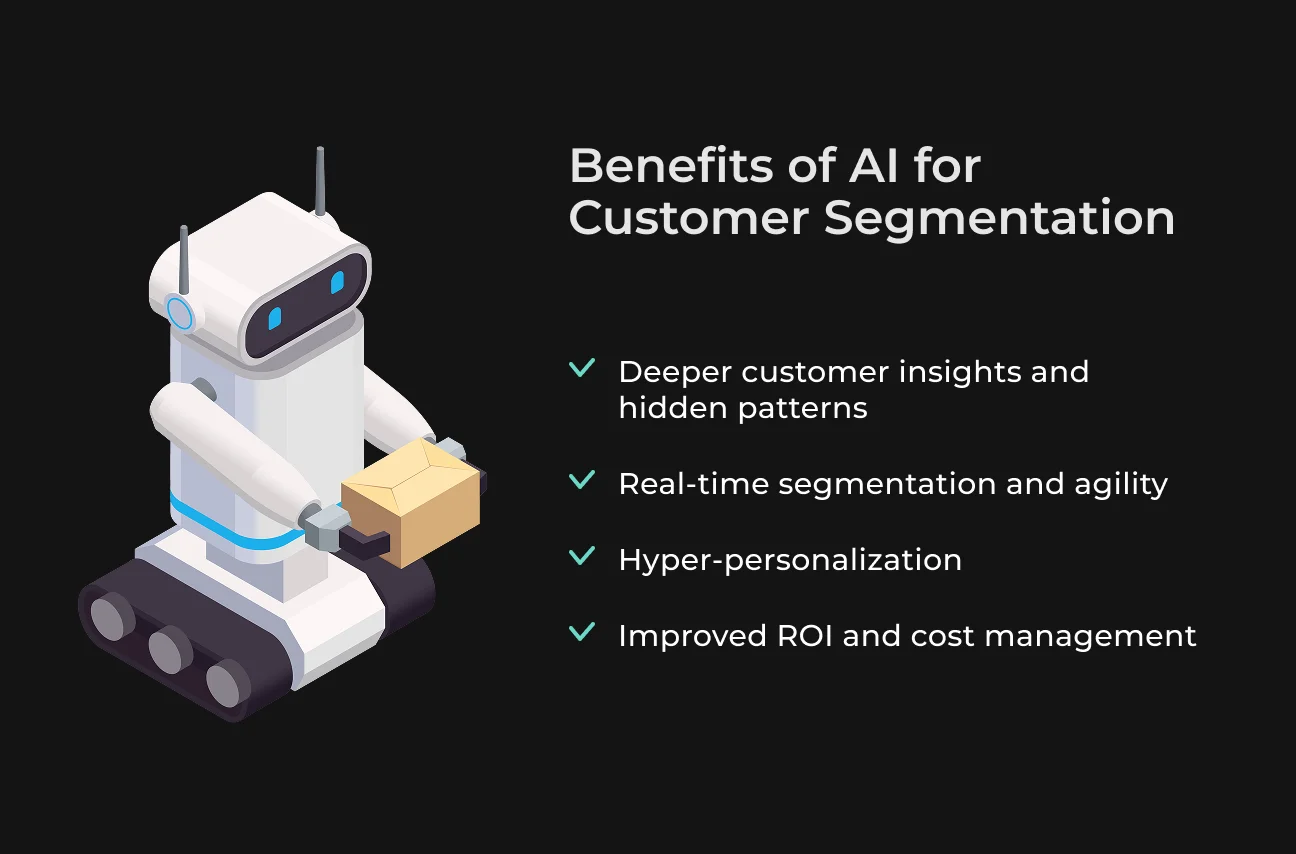
Benefits of AI for customer segmentation:
- Deeper customer insights and hidden patterns.
AI can uncover unspoken intent. For example, in the insurance industry, an AI model might detect that a policyholder is becoming dissatisfied not because they said so, but because their browsing behavior on the coverage eligibility page has changed.
These hidden patterns allow firms to intercede with personalized offers that increase CLV. One Fortune 500 insurance client generated an additional $3 million in annual sales by adopting such a model.
- Real-time segmentation and agility.
Customer segmentation using machine learning allows you to react to fresh signals like browsing spikes or cart abandonment. This agility allows for in-session personalization.
- Hyper-personalization.
Whether a business has 430 or 4,300,000 customers, the AI can deliver tailored content and recommendations to each individual. This is critical. Why? Because 46% of customers will buy more when offered a personalized experience.
- Improved ROI and cost management.
Marketing ROI typically increases by 10% to 30%. Customer acquisition costs can drop by up to 50%.
These are the main reasons why businesses invest in customer segmentation using machine learning.
| Benefit | Traditional Metric | AI-Driven Outcome |
| Personalization | Group-level (Broad) | Segment-of-One (Individual) |
| Response Time | Days/Weeks (Batch) | Seconds (Real-time) |
| ROI | Moderate (Wasted spend) | High (Targeted efficiency) |
| Scalability | Linear (More people = More cost) | Exponential (Automated growth) |
AI Customer Segmentation Models & Techniques
Successfully implementing AI customer segmentation requires selecting the appropriate model.
Clustering Algorithms
These are the primary customer segmentation models for finding natural groupings in unlabelled data:
- K-means clustering. This is the most popular partitioning algorithm. It divides data into non-overlapping clusters by minimizing the within-cluster variance. It is highly efficient for large datasets. Still, it requires the user to specify the number of clusters beforehand.
- Hierarchical clustering. This builds a tree-like structure (dendrogram). It can be agglomerative (bottom-up) or divisive (top-down). It is ideal for smaller datasets where you want to visualize the relationships between groups and don't yet know the optimal number of segments.
Predictive Models
These customer segmentation models focus on what will happen next:
- Churn prediction. Classification models identify high-risk customers by analyzing declining engagement signals (e.g., fewer app opens).
- LTV modeling. Regression or ranking models predict which customers will generate the most revenue over time. They allow for the prioritization of champion cohorts.
Deep Learning & Advanced Models
Here, you have 2 options:
- Neural networks. These are used for processing high-dimensional data like voice, images, or transactional streams in e-commerce.
- Generative AI approaches. GenAI is being used to create synthetic personas and dynamically generate personalized content that responds to a user's inferred segment.
However, remember about noise. It is very important to handle noisy data in machine learning to get accurate results.
RFM Analysis with AI
AI has revitalized the traditional Recency, Frequency, Monetary (RFM) model. By using an AI segmentation model, you can automate the scoring of customers based on their purchase history. RFM model means:
- Recency (R): days since last purchase;
- Frequency (F): number of purchases in a set period;
- Monetary (M): total spend.
AI-powered RFM can process millions of transactions in real-time. It can instantly identify when a previously loyal customer is moving into the at-risk category.
How AI Customer Segmentation Works: Step-by-Step Guide
For the CTO and COO looking to implement AI for customer segmentation, this quick guide will help.
Step | Stage | Description |
| 1 | Assess and Define Objectives | Identify the business problem (e.g., reduce churn by 10%) and set clear, measurable goals. |
| 2 | Gather and Clean Data | Collect data from CRM, social media, and web interactions. Ensure data quality to avoid inaccurate outputs (“garbage in, garbage out”). |
| 3 | Check Data Readiness | Standardize data formats across systems (e.g., align date formats in CRM and ERP). |
| 4 | Train the AI Model | Input clean data into appropriate machine learning algorithms (e.g., k-means for large-scale e-commerce, hierarchical clustering for small B2B datasets). |
| 5 | Identify Predictive Patterns | Analyze model outputs to uncover trends (e.g., behaviors indicating high purchase intent). |
| 6 | Embed into Workflows | Integrate insights into operations—e.g., show segments in CRM, trigger personalized emails, guide sales calls. |
| 7 | Establish a Feedback Loop | Continuously feed campaign results back into the model to improve predictions and segmentation accuracy. |
Stop Guessing Which Customers Are Worth It
We build AI models that tell you before you ask.
AI Customer Segmentation Tools & Software
Choosing the right customer segmentation software depends on your organization's size, technical maturity, and specific needs.
Enterprise Tools and Ecosystems
These AI customer segmentation tools are designed for large organizations that need omnichannel capabilities:
- Salesforce Marketing Cloud. It uses Einstein AI to provide predictive metrics and automated journey mapping.
- Adobe Experience Platform. It uses ML for real-time customer profile enrichment and automated segmentation.
Cloud-Native AI Platforms
For CTOs building custom solutions, these platforms provide the engine for customer segmentation solutions:
- AWS Bedrock and Google Vertex AI. These offer the infrastructure and models (LLMs, clustering engines) to build and scale proprietary segmentation workflows.
- Snowflake. It provides a data cloud environment that allows for high-performance processing of the massive datasets required for AI.
Specialized and All-in-One Tools
Here, we want to highlight 2 options:
- Twilio Segment. It is a real-time CDP that unifies data and uses ML to identify predictive audiences and resolve identities across channels.
- HubSpot Marketing Hub. It is an intuitive platform for mid-market companies, featuring AI-powered email and tight CRM integration for lead nurturing.
Custom AI Solutions
For highly regulated industries (like banking or healthcare), custom AI customer segmentation software may be required. These solutions offer:
- Full data sovereignty. Data never leaves the enterprise boundary.
- Proprietary differentiation. Models are trained on the company’s unique historical data. This creates a competitive advantage that cannot be replicated by off-the-shelf tools.
If you have a SaaS project, we recommend you use specialized SaaS analytics tools.
Real-World Use Cases
The application of AI audience segmentation varies significantly across different business models.
E-commerce personalization
Retailers like Walmart and Disney use AI to analyze browsing history and purchase frequency.
By segmenting customers based on purchase stage (e.g., ready-to-buy vs just researching), they can personalize product recommendations in real-time. This can result in a 15-25% increase in retention and sales.
Banking & FinTech segmentation
In FinTech, AI-based customer segmentation is used for credit scoring and risk management.
By analyzing non-traditional data (like social signals or app engagement), firms can more accurately predict creditworthiness. Additionally, wealth management platforms use AI to flag portfolios at risk of market shifts. They send real-time alerts to specific customer segments.
SaaS customer segmentation
SaaS companies use AI to manage their long-tail portfolios. By identifying behavioral clusters of expansion-ready accounts, they can move from reactive servicing to proactive growth management.
Marketing campaign optimization
In digital marketing, AI-powered audience creation allows project managers to translate complex briefs into actionable segments in seconds. This reduces manual errors and ensures that ad budgets are focused on the most likely converts, resulting in a 30% increase in lead conversion.
Challenges of AI-Based Customer Segmentation
The transition to customer segmentation solutions driven by AI involves several critical hurdles that must be managed by the C-suite.
Data quality and "Garbage In, Garbage Out"
The accuracy of an AI segmentation model is entirely dependent on the quality of the training data. Issues like label noise, missing values, and inconsistent formats across departments can lead to biased or incorrect results.
Mitigation. Implement robust data governance frameworks and use AI-powered monitoring tools to flag anomalies in data streams in real-time.
Privacy, ethics, and compliance
Using sensitive data to train AI models carries legal risks (GDPR, HIPAA) and ethical concerns regarding bias.
Mitigation. Invest in privacy-centric AI that uses anonymized data and ensures transparency in how decisions are made.
Model complexity and "Black Box" Risks
Some advanced models are difficult to interpret. This leads to a lack of trust among business leaders. If a model places a customer in a high churn segment but cannot explain why, it is difficult to take strategic action.
Mitigation. Choose Explainable AI (XAI) models that provide feature importance logs, showing exactly which behaviors drove the segment assignment.
Integration and scalability challenges
Connecting AI models to legacy CRM and ERP systems can be technically daunting. Point solutions often fail to scale when data volumes skyrocket.
Mitigation. Adopt a platform-based architecture rather than a collection of isolated tools, ensuring that AI is integrated into the core orchestration layer of the business.
Best Practices for Customer Segmentation Using AI
To ensure a successful customer segmentation strategy, you should follow these industry-proven practices:
- Establish data discipline. Ensure your historical data is clean and integrated before training models. Data readiness is non-negotiable.
- Combine multiple data dimensions. Don't rely solely on one type of data. The best results come from crossing demographic, behavioral, and psychographic signals.
- Continuously monitor and update. Data drift is real. As market conditions change, your models must be retrained to reflect new customer behaviors.
- Ensure human-in-the-loop. Use AI to augment, not replace, human discernment. Marketers should set the strategy and logic while the AI handles the pattern-finding at scale.
- Prioritize performance at the segment level. Inspect KPIs (ROI, CAC, Churn) at the segment level rather than looking at aggregate revenue. This reveals which cohorts are truly driving growth.
If you are planning to build SaaS projects, you can investigate the best practices for SaaS software development.
Future of AI Customer Segmentation
The next frontier of AI audience segmentation is defined by the rise of agentic commerce and hyper-personalization.
Real-Time "Segment of One" Adaptation
By 2030, the market for AI in customer service is projected to hit $47.82 billion.
We are moving away from fixed groups and toward contextual AI that adapts to a user's intent in real-time. This means the website or app content will change for every individual visitor based on their immediate emotional responses and past history.
AI Agents and Horizontal Ecosystems
In 2026, AI agents (autonomous systems that can research, compare, and purchase) are becoming part of the target audience. Marketers will need to segment between human traffic and agentic traffic, optimizing web experiences for both.
Generative AI and Predictive Content
The widespread investment in GenAI (92% of businesses plan to invest by 2028) will lead to the automated creation of personalized multi-channel sequences. Content will not just be targeted to a segment. It will be dynamically generated to match the psychographic profile of a single person at a single moment.
Case Study: How SapientPro Built a Data Analytics Platform
A prime example of a customer segmentation software is the Big Data Chef project developed by SapientPro. The goal was to centralize and visualize fragmented business data from CRMs, ERPs, and e-commerce platforms. Key challenges and solutions were:
- Data blending. The platform structures and combines data from multiple departments to create unified reports.
- Power BI integration. SapientPro successfully embedded custom Microsoft Power BI widgets using Single Sign-On (SSO) through Azure AD. We ensured both security and high-resolution analytics.
- Responsive rendering. The team developed a layout capable of hosting complex data visualizations across all devices. This ensured that the CTO and COO can access real-time segmentation data whether they are in the office or on the go.
SapientPro developed an advanced frontend that makes the black box of AI-driven segmentation visible and actionable for stakeholders.
Why Choose SapientPro for AI Implementation
SapientPro builds AI customer segmentation systems that go beyond demographic filtering — incorporating behavioral logic and industry-specific constraints into models that run on scalable AWS and GCP infrastructure. What we build:
- Intelligent process automation. We convert unstructured customer feedback and support tickets into structured databases that feed cleaner data into segmentation models.
- Predictive analytics and lead scoring. We build systems that cluster users in real time and surface high-value leads inside your existing CRM — so sales teams know who to call before a competitor gets there.
- Computer vision and document processing. We build high-precision models for retail heatmapping and document verification that feed directly into how you categorize and serve different customer groups.
We integrate AI segmentation engines with Salesforce, HubSpot, and Microsoft Graph. Talk to us about what your current architecture looks like and let’s find the best solution.
Ready to Move Beyond Static Segments?
Talk to SapientPro about what an AI-driven model looks like for your stack.