All Why Most Dynamic Discounting Strategies Keep Failing
May 27, 202610 min read


Static payment terms used to be good enough. But they are not so anymore. Companies now handle high invoice volumes, cash, and suppliers with different demands. Formalize all your invoices, and you might simply under-earn.
With dynamic discounting, every invoice is a real-time decision: pay early and earn a return or hold the cash if it's more logical to do so. This change is already taking place.
The US AI dynamic discounting market was at $0.46 billion in 2024 and is estimated to grow up to $2.53 billion by 2032. Still, many such programs fall short. And the issue isn’t always tools, but treating dynamic discounting like a one-time policy.
This guide from SapientPro’s experts shows how to build a dynamic discounting strategy that really works in practice.
What Is Dynamic Discounting and Why It Matters
Dynamic discounting means the discount isn’t fixed — it moves. In most cases, it’s tied to timing: the earlier a payment happens, the bigger the discount. The benefit decreases by degree as the due date approaches. Here's an example:
- Pay 31 days early (get 2% off);
- Pay 14 days early (get 1% off);
- Pay on the due date (no discount).
That’s the basic idea. More advanced setups might also take into account cash availability, supplier behavior, or risk levels.
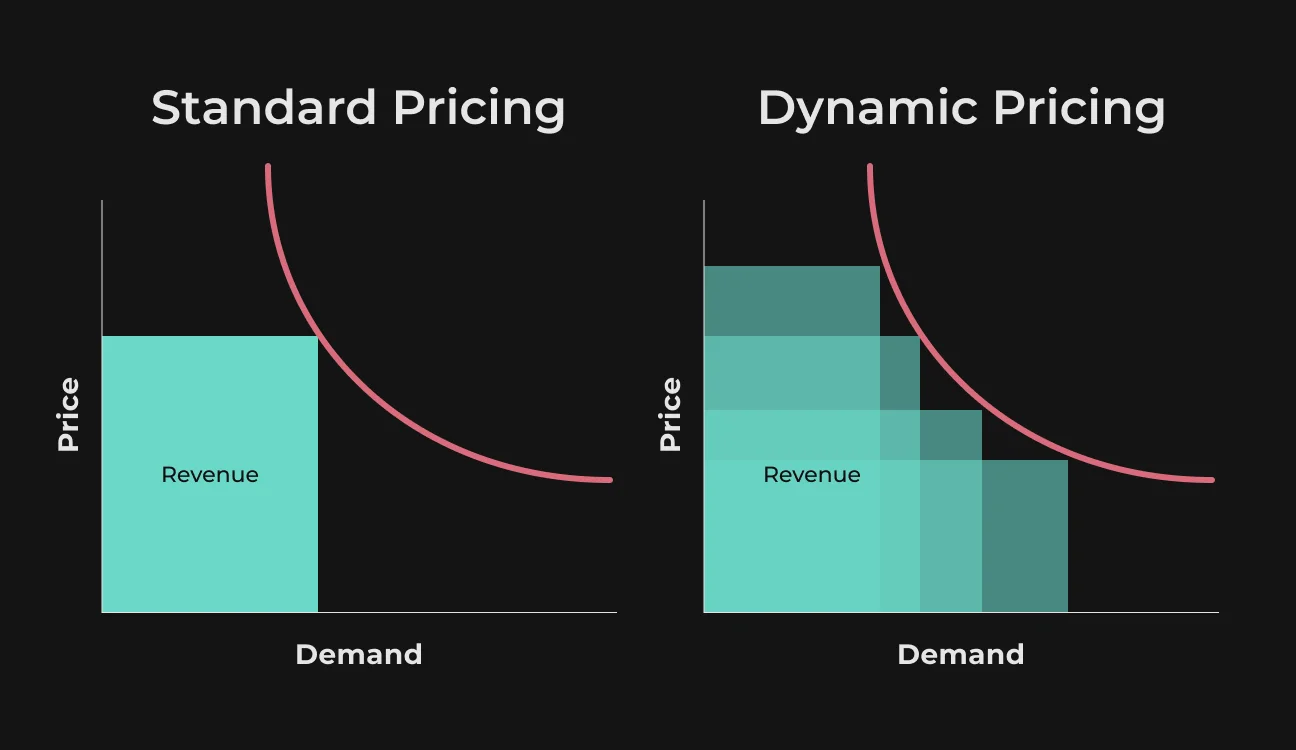
Static discounting is much more rigid. It works like a switch, for example, 2% if paid within 10 days, or the full amount within 30 days. Basically, there’s no flexibility. You either hit that window or you don’t — and most invoices miss it.
That’s why a lot of value never gets captured. Dynamic discounting software fixes this by giving every invoice a flexible price for early payment rather than a single yes-or-no option.
B2B: Invoices and Supplier Cash Flow
Pricing is becoming more flexible. About 45% of manufacturing leaders focus on revenue growth when adjusting prices, and buyers don’t look at price alone anymore. Their decisions are shaped by customer experience (34%), support (32%), and sustainability (30%).
In B2B, this approach is widely used in accounts payable. Buyers offer earlier payment in exchange for a discount that changes over time. Providers that need cash can access it sooner, without turning to external financing.
Buyers, in turn, earn a return on cash that would otherwise sit idle.
B2C: Pricing and Customer Behavior
In B2C, the same logic is in how discounts are offered to customers.
Instead of one fixed coupon for everyone, offers shift based on:
- Browsing and purchase behavior;
- Timing (high and low demand periods);
- Likelihood to convert.
For example, a customer who hasn't purchased in years might receive a bigger discount, or a repeat customer may be offered smaller incentives. This helps increase conversions without unnecessarily giving away margin.
Where Dynamic Discounting Goes Wrong: Main Challenges and Risks
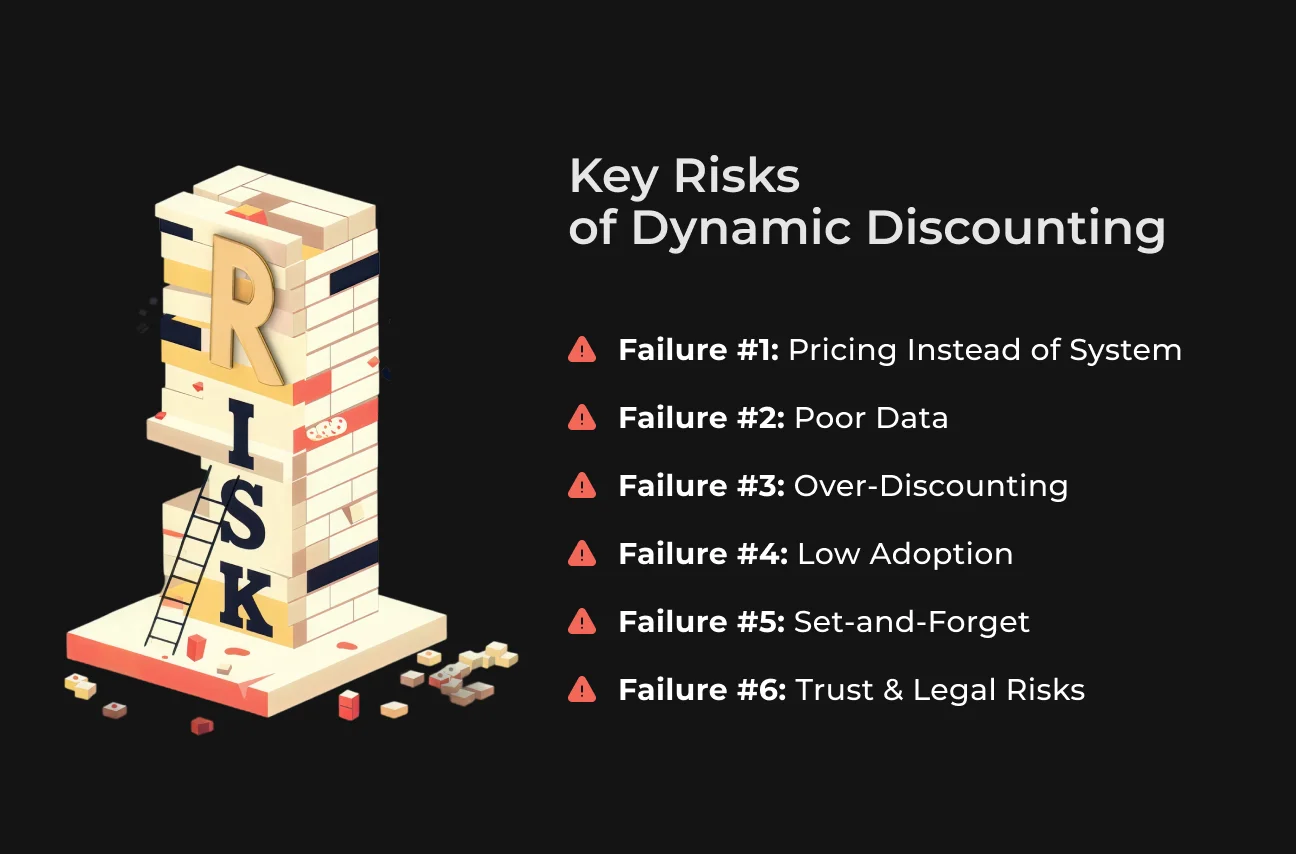
Dynamic discounting rarely fails overnight. It slowly loses value through small mistakes (preventable, though). What starts as a promising initiative may often turn into inconsistent results, low supplier participation, or shrinking margins. And here are the root causes.
Failure #1: Treating It as a Pricing Tactic, Not a System
Many teams approach artificial intelligence dynamic discounting as just gifts. They tweak percentages but ignore how those decisions affect cash flow, supplier behavior, or overall operations.
The bigger issue is fragmentation. Procurement wants happy suppliers, finance their cash, and commercial teams their margin. They are all actually working in parallel. The result could be inconsistent decisions and missed value.
Discounting decisions should be tied to cash strategies. Finance defines when early payments make sense, while procurement and operations add supplier context. Once aligned, decisions become consistent.
Failure #2: Poor Data and Weak Signals
Dynamic discounting depends on timing and accuracy. Decisions quickly get derailed if invoice data is incomplete or cash visibility is low. In many cases, teams automate these decisions without first resolving their data issues — and compound the problem.
Try to start with reliable basics. Clean invoice data, accurate payment timelines, and a clear view of cash position are far more valuable than complex models built on weak inputs.
As data improves, decision logic can become more precise without increasing risk.
Failure #3: Over-Discounting and Margin Erosion
Applying the same discount logic across all suppliers is one of the fastest ways to lose margin. Not every supplier needs early payment, and not every situation justifies a high discount. Without differentiation, companies often give away value unnecessarily or create pressure to keep lowering prices.
The key is selectivity. Suppliers should be grouped based on how they respond to early payment offers or how much they value liquidity. Discount levels can then be adjusted to match those patterns.
Setting clear return thresholds also helps avoid deals that look attractive on the surface but don’t make financial sense.
Failure #4: Low Supplier or Customer Adoption
Even a well-designed discount model won’t work if people don’t use it. In many cases, the experience is simply too complicated. Suppliers have to log into portals, calculate savings manually, or go through multiple steps just to accept an offer. If the benefit isn’t obvious or immediate, they ignore it.
Another common issue is a lack of visibility. If early payment options appear late in the process (or aren’t clearly communicated), they get missed. Without simple, fast actions, adoption stays low.
You need to make that experience effortless. Providers or customers should see available discounts early, with clear numbers and no guesswork. This could be something like one-click acceptance, automated flows, or simple dashboards.
Failure #5: Set-and-Forget Mentality
Some teams launch a discounting program and assume it will run on its own. They set rules, turn on automation, and stop paying attention. Over time, those rules can stop reflecting reality.
Do not consider the system as a static entity that remains unchanged. Analyze performance, experiment with multiple tiers of discounting, and modify based on findings. Even something basic like thresholds or timing can result in better outcomes.
Failure #6: Ignoring Legal and Trust Risks
When discounts feel unclear, suppliers or customers may think they’re being treated unfairly.
There are also legal risks — any model using data has to follow rules like GDPR or CCPA, particularly with personal or behavioral data. If people don’t understand how decisions are made, trust drops fast.
The fix is to keep everything clear. Make it easy to see why a discount is offered and how it’s calculated. Use data responsibly and stay within privacy rules.
Trust is everything here. Without it, even a strong system won’t work.
Architecture Behind a Dynamic Discounting System That Actually Works
Many dynamic discounting programs stop working because the system behind them can’t keep up with real conditions. Delayed data, rigid rules, or poor integration quickly limit results.
The successful setups all share a common base: fast response, learned behavior, and seamless integration within the daily flow.
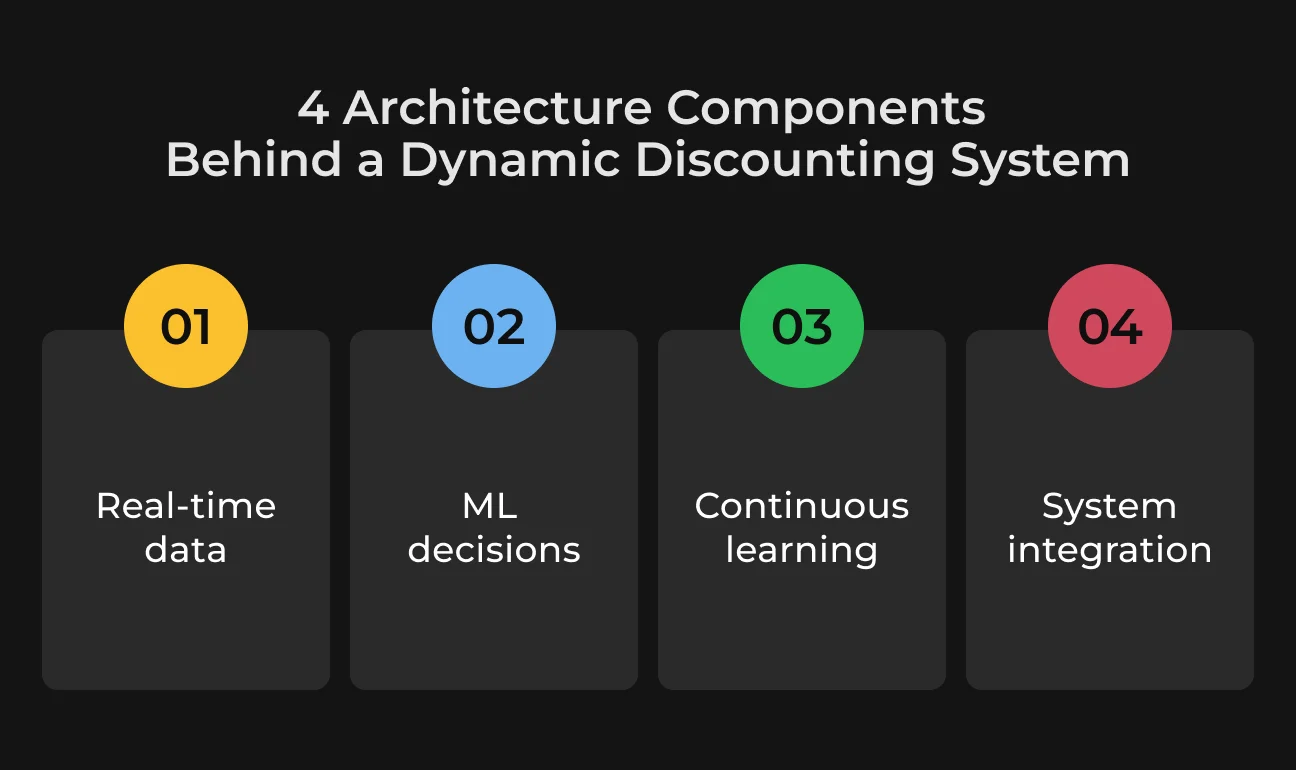
Real-Time Data Infrastructure
Discounts only work if they reflect what’s happening right now — cash position, invoice status, supplier activity, etc..
Event-driven systems make this possible by reacting instantly to changes. Instead of waiting for updates, the system responds as soon as an invoice is approved, cash shifts, or payment status changes. This is where batch logic just can’t keep up.
Machine Learning That Drives Decisions
Using advanced ML dynamic discounting models helps answer key questions:
- How likely is a supplier to accept early payment?
- What discount level actually influences behavior?
- When does timing matter most?
This is where approaches like propensity scoring and elasticity modeling work. They allow the system to move beyond guesswork and base decisions on observed behavior.
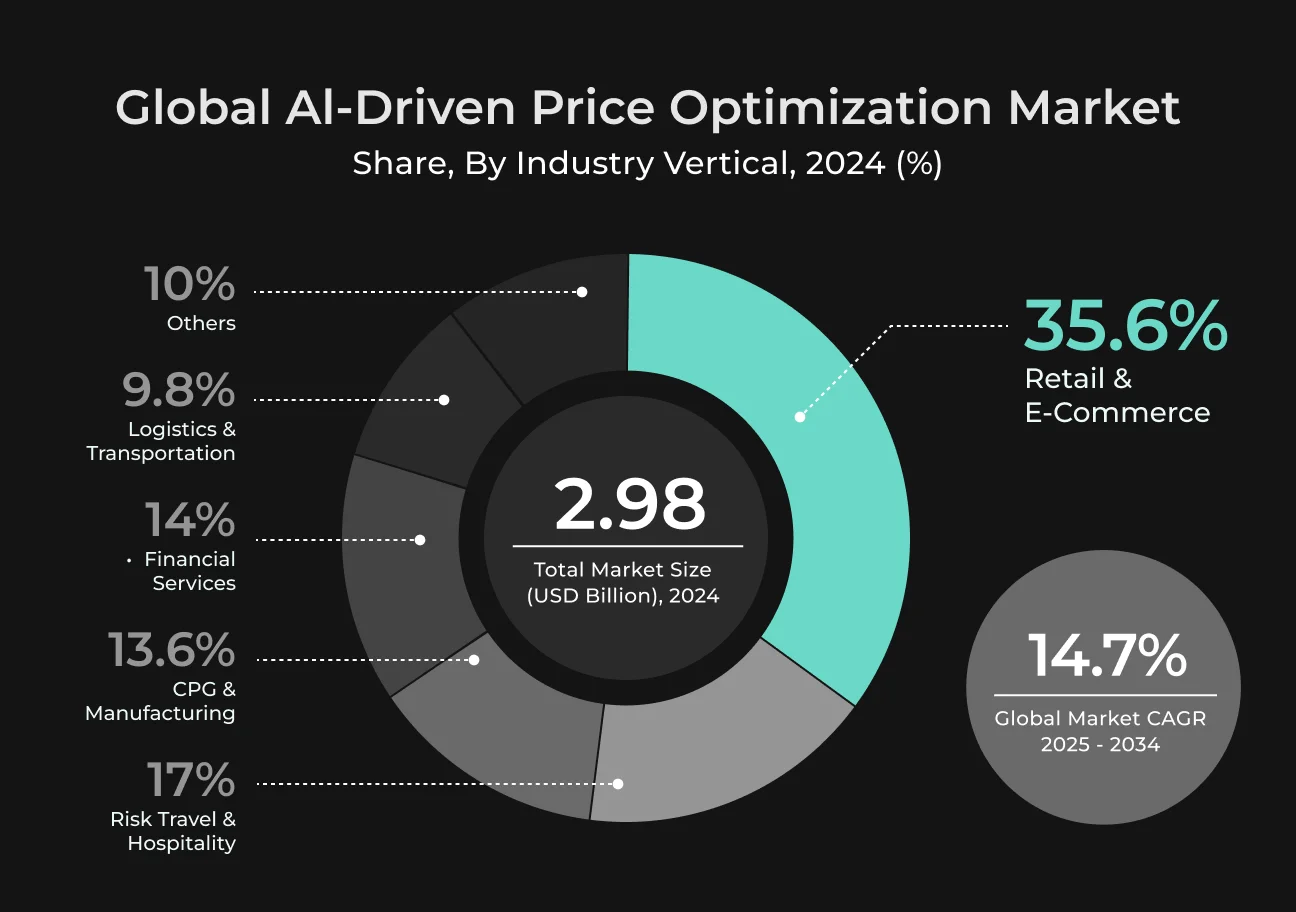
Actually, 78% of organizations now use AI in at least one business function, which makes it easier to adopt pricing analytics. In more mature markets, around 40% of consumers say they switch retailers to find better prices or discounts.
Continuous learning is what really sets the system apart. Every interaction feeds new data back in, improving future decisions.
Integration Into Core Systems
Even strong logic won’t deliver results if it sits outside daily workflows. Discounting needs to be part of how teams already operate.
That means embedding it into:
- ERP systems where you manage invoices;
- Payment platforms where transactions happen;
- Approval or checkout flows where you make decisions.
An API-first setup keeps everything connected without complex integrations. Data exchange becomes easier between systems. Microservices are flexible — you can change one part of the system without disrupting the whole system.
Inside Steam Bot Integration
See how SapientPro made e-commerce bots handle inventory, pricing, and item transfers.

Dynamic Discounting Benefits and Key Features
A dynamic discounting solution only delivers value if it’s built around how decisions actually happen. Like how fast, context-driven, and easy they are to act on.
The features below determine whether the system actually drives results.
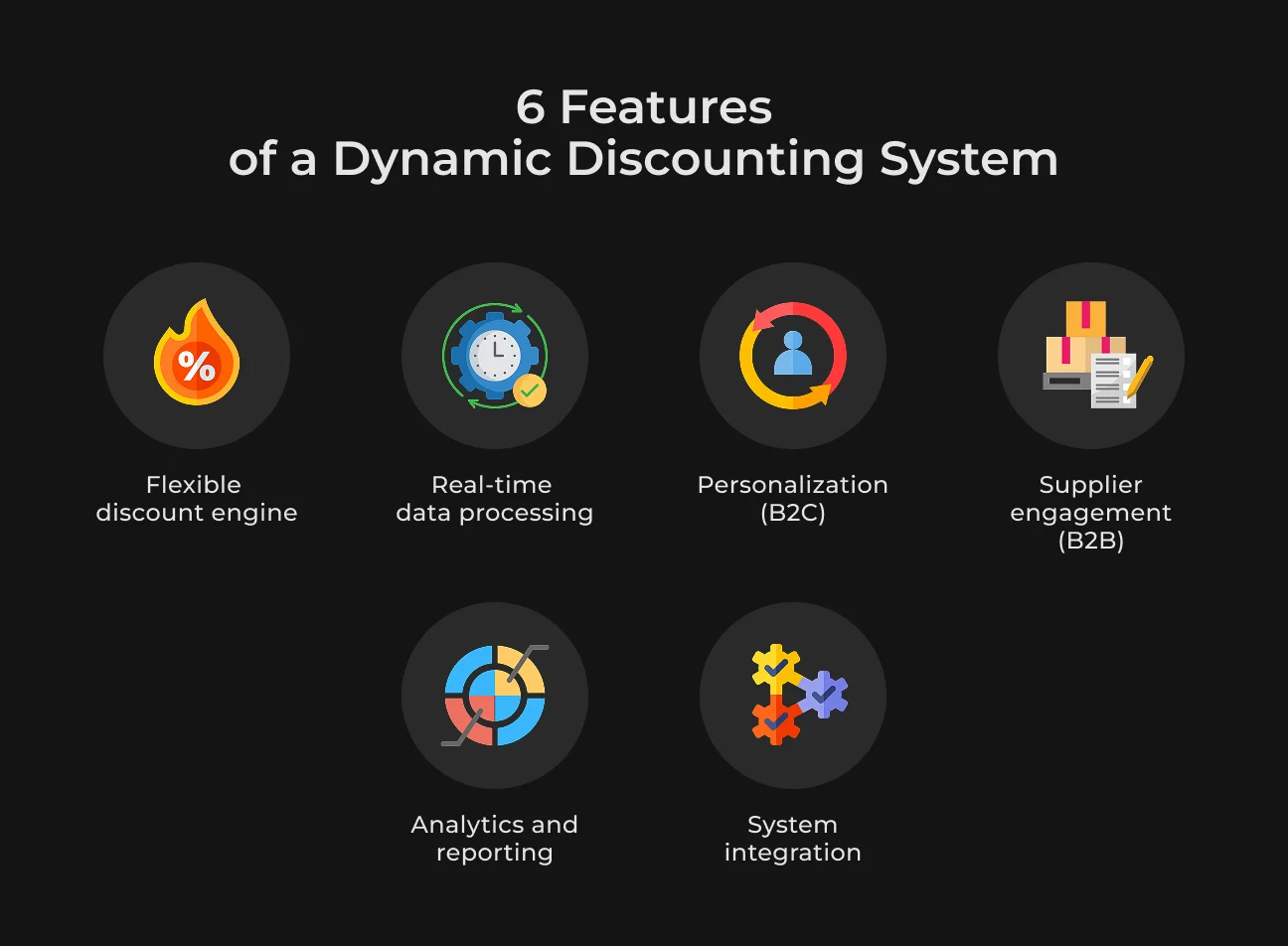
Flexible Discount Engine
A useful discount engine responds to behavior. After a short period, patterns become obvious: some suppliers accept almost any early payment, others need a stronger push, and some won’t react at all unless timing is right.
A static approach treats them all the same. While a really working system does the opposite. It gradually reduces discounts for those who already accept early payments, while increasing incentives only where needed to trigger action.
Timing also plays a role — some suppliers respond better closer to their cash pressure point, not earlier. So, you'll stop overpaying for easy wins and focus on incentives where they actually change behavior.
Real-Time Data Processing
Most systems fail in very practical ways: the data is already outdated by the time a decision is made.
For example, the system may offer early payments in the morning based on last night’s cash balance, but large payouts have already gone out. Or it may miss a window when extra cash is available simply because the data hasn’t refreshed yet.
Real-time processing solves this, responding immediately to real events like an approved invoice or changes to cash. Calculating offers at the point of use is frequently the difference between a meaningful discount and wasted spend.
Personalization Layer (B2C)
There’s a clear gap between intention and reality: 85% of companies say they personalize, but only 60% of customers actually feel it. One of the main reasons is misused discounts — too many go to people who were already ready to buy.
A more effective approach focuses on intent. It looks at behavior in the moment, like browsing patterns, hesitation, repeat visits, and adjusts offers accordingly.
In practice, this leads to a simple shift:
- High-intent users get little or no discount;
- Price-sensitive users receive targeted offers at the moment they’re about to drop off.
The aim is to start using automatic discounts only where they influence the result.
Supplier Engagement Tools (B2B)
Suppliers often ignore early payment offers simply because it’s inconvenient. If they have to log in, check terms, and confirm manually every time, adoption drops fast.
What works is simplicity. For example, sending a clear offer directly via an email with a one-click Accept option. No extra steps and calculations.
Some suppliers can even automate decisions. They can set rules, for example, to accept any offer if the discount is over X% or if the time window is between a certain period.
Analytics and Reporting
Most dashboards show basic metrics like the number of offers or acceptance rates. That doesn’t show if you’re actually making money. A useful setup answers simple, practical questions:
- Where do we pay higher discounts than needed?
- Which suppliers only respond at certain levels or at certain times?
- Do we use cash in a way that brings better returns?
It should also support quick testing (like lowering discounts for certain suppliers or moving offers earlier) and show the expected impact before you apply the change.
Integration Capabilities
In working systems, basically, the choice appears right where the action happens.
For example, when a user approves an invoice, it could show an offer: Pay today with 1.2% discount or Pay on due date. Invoice data, cash status, and discount logic must be updated frequently so that the offer reflects correctly.
APIs can run the connection, and a modular setup allows for changes without breaking everything.
Best Practices for Implementation
Most teams lose money because they simply make repeated decisions that are actually wrong. Generative AI dynamic discounting runs across many invoices, so even tiny inefficiencies add up fast. The same applies to improvements. Small fixes made consistently drive real results.
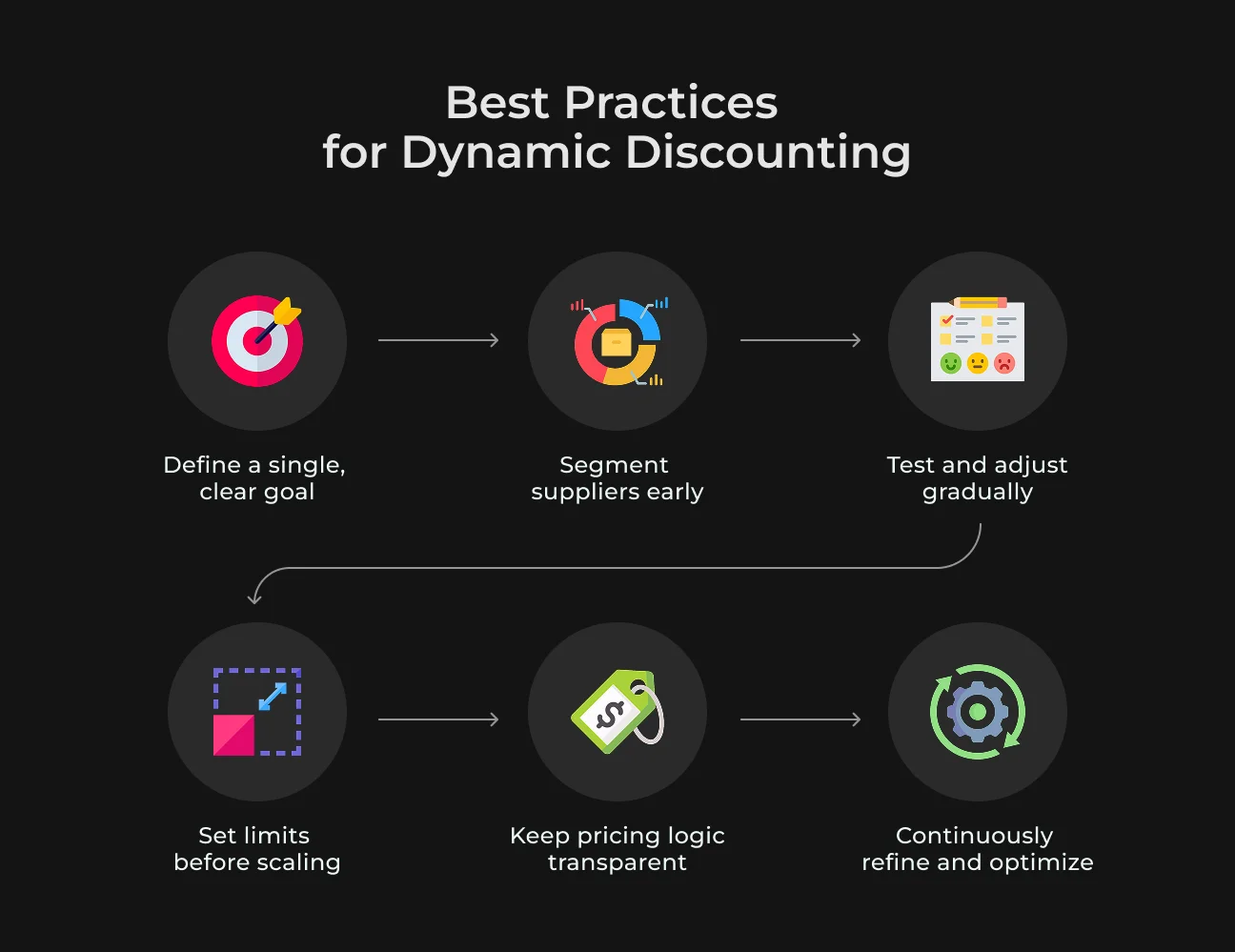
Check out these best practices to know exactly what direction to head in.
#1 Start With One Clear Objective
Dynamic discounting can result in great returns, but only if you know your optimization goal. In practice, mixing goals leads to confusion. If you’re targeting cash profit, you should reject low-return deals. If you’re focused on supplier stability, you might accept them anyway.
Teams that don’t define this upfront end up changing logic mid-cycle, which leads to inconsistent decisions.
#2 Segment Early
The biggest hidden loss is overpaying providers who would accept anyway.
In real data, you’ll quickly see patterns like:
- A group that accepts early payment even at low discounts;
- A group that needs a specific threshold;
- A group that rarely engages.
If you treat those groups the same, you either waste margin or miss volume. Even basic segmentation can reduce unnecessary discounts immediately.
#3 Test Small Changes
The system learns through incremental and specific changes. For example, after one or two weeks of tracking, you will notice that some suppliers accept early payments almost always, even if the discount is smaller than that of others.
You can reduce it a little bit and see if the behavior changes. In many cases, it doesn’t.
Even minor adjustments in the presentation of offers — like making them visible sooner or simplifying the language — can improve acceptance.
#4 Set Limits Before Scaling
Without clear limits, the system slowly starts giving away too much margin. It doesn’t break but becomes less profitable.
For example, discounts may stay high even when suppliers would accept less, or large payments go through without checking if the return makes sense.
Simple controls fix this: set minimum return thresholds, cap discounts where needed, and require approval for larger deals. This keeps your decisions focused on actual financial goals.
#5 Make the Logic Visible
If suppliers or users don’t understand the offer, they can hesitate or distrust it. There should be a simple and precise message like Get paid 14 days early with 2% discount. This works better than abstract percentages or hidden calculations.
#6 Keep Adjusting — Behavior Changes Fast
The teams that get consistent results treat performance reviews as an ongoing process. They do it regularly, look for small gaps, and adjust things like discount levels, timing, or segmentation.
Key areas for regular review are:
- Focus on discounts. Optimize your deals, but never harm your brand and reputation;
- Timed plan. Work with the time that your customers are active and responsive to your outreach plan;
- Precise segmentation. Update your audiences so that your messaging is still relatable and timely.
What This Looks Like in Practice from SapientPro’s Experience
If you want to see how these dynamic pricing ideas work in practice, take a look at how SapientPro applied AI-driven pricing and discounting in real products.
AI-Driven Discount Personalization
SapientPro built an AI shopping assistant that adjusts discounts in real time based on user behavior, purchase intent, and product preferences.
Instead of showing the same promotion to every customer, the system applies discounts only when they are likely to influence a buying decision. This helps businesses avoid unnecessary margin loss while still giving users a more relevant shopping experience.
Key features included:
- Real-time discount adjustment based on user behavior;
- Personalized offers matched to purchase intent;
- AI-powered product search using keyword and semantic search;
- Direct integration with the store’s product database;
- LLM-based request processing to choose the best search and pricing logic;
- More accurate product recommendations for users.
As a result, the pricing logic becomes more adaptive to real shopping behavior while keeping discounts focused on users who are more likely to convert.
Dynamic Pricing in a Digital Marketplace
SapientPro also worked on a Steam-based marketplace where one of the main challenges was real-time inventory access. Since Steam does not provide an open API for this use case, the platform needed a custom technical solution.
SapientPro built a trading system that retrieves item data directly from user inventories. Dedicated bots help keep communication stable, accurate, and up to date.
Key features included:
- Custom trading system for direct inventory data retrieval;
- Dedicated bots for stable communication with user inventories;
- Real-time item availability updates;
- Smart contract integration for secure crypto transactions;
- USDT-based trading support;
- More flexible pricing logic based on inventory, demand, and marketplace activity.
This setup helped the marketplace improve liquidity, speed up item sales, and move beyond static pricing rules.
Future Trends: Toward Autonomous E-Commerce
See what’s coming next in autonomous e-commerce and what trends are emerging right now.
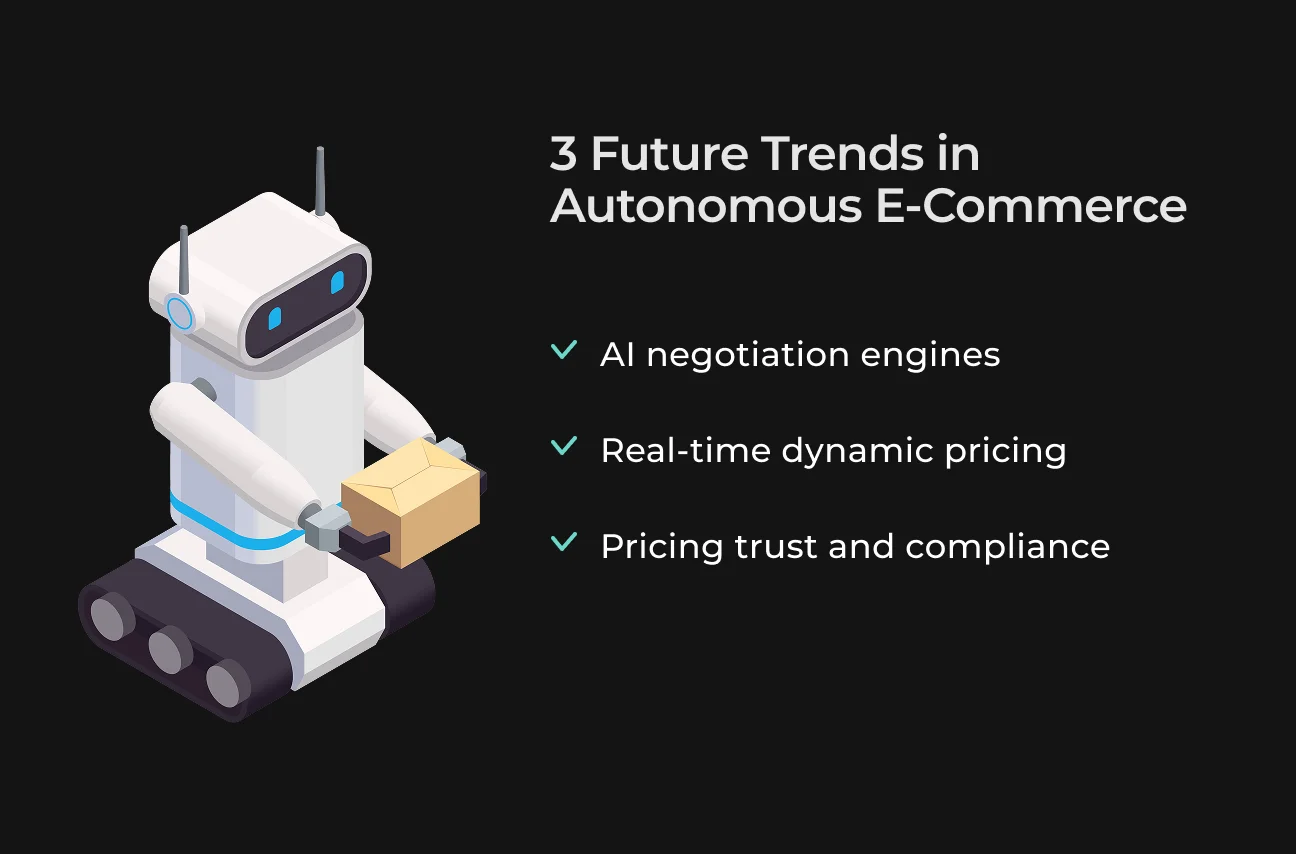
1. AI-Driven Negotiation Software
AI is moving beyond simple price optimization toward fully automatic deal-making between agents.
Agentic AI alone is predicted to create $450 billion in economic value from 2028 onwards. And by 2030, agent-driven commerce could drive up to $1 trillion of US retail sales ($3–5 trillion globally).
Gen AI can act on both sides of a deal (the buyer and the provider). They are each led by specific targets, like staying on budget, hitting margin goals, or meeting delivery deadlines.
This results in a negotiation process that behaves decidedly human-like but is much faster and continuous with the data-driven decision-making.
2. Real-Time Pricing Ecosystem
Companies do not update their pricing once a day or even once a week anymore. Systems can modify pricing in real time based on demand, user actions, behavior, or competitor activity.
A December 2025 analysis showed how far this tendency has already gone. Nearly 75% of identical grocery items on Instacart were displayed at different prices depending on the user.
Prices ranged by around 13% on average, with some differences reaching 23%. Somtetimes, shoppers were presented with as many as five different prices for the same product.
So price becomes something flexible — it shifts in real time depending on what’s happening in the market and who is looking at the product.
3. Regulation and Trust in Algorithmic Pricing
Using AI to set personalized prices for every shopper is a real privacy and fairness issue.
In one survey of 2000 individuals, 62% stated they are concerned with this type of personalized pricing. Only 10% said they have no worries at all, again demonstrating how sensitive this issue is for the vast majority of consumers.
Companies may soon be required to clearly tell users when AI is setting prices, make those systems understandable, and stay responsible for the results.
Many are already limiting how much prices can change and are more careful with personalization.
Why Choose SapientPro for E-Commerce Development
SapientPro builds e-commerce solutions for web, mobile, and SaaS products that need more than a standard storefront. Our team combines development, UI/UX design, and technical consulting to turn business requirements into stable, production-ready platforms.
With SapientPro, you can build or improve:
- Custom e-commerce websites and marketplaces;
- Mobile commerce apps for iOS and Android;
- SaaS-based e-commerce platforms;
- AI-powered product search and recommendations;
- Dynamic pricing and personalized discount systems;
- Payment gateway and crypto payment integrations;
- Inventory, order, and warehouse management systems;
- Third-party integrations with CRMs, ERPs, analytics tools, and marketing platforms;
- Performance optimization for faster product discovery and checkout;
- Ongoing platform support, monitoring, and maintenance.
After deployment, you get SLAs, constant monitoring, tested backups, periodic updates, and continuous maintenance. That means most notifications you see are new orders, not system issues. Looking to build or scale an e-commerce product?
Let’s collaborate and create a solution that delivers real value for your business and customers.
Build Dynamic Pricing Tools
Create smarter systems for real-time discount decisions with SapientPro's engineers.