
All Is Solana the Best Blockchain for DeFi Development?
Updated:April 30, 2026


Decentralized finance is making a powerful comeback. The total value locked surged 211% in 2024, hitting $214 billion — almost back to its record highs from 2021.
Among the winners of this revival, Solana stands out. Solana’s DeFi ecosystem exploded by 2,000% in TLV after a challenging 2023, propelling it to the #2 spot globally after Ethereum. By the end of 2024, Solana’s TVL climbed to $8.6 billion, overtaking Tron and solidifying its position as a top-tier DeFi chain.
Usage is booming as well: the Solana network saw about 2 million daily active users in 2024, attracted by its speed and ultra-low fees. That’s why more startups and companies are looking forward to integrating this blockchain technology into their products.
Let’s find out whether Solana is the best blockchain for DeFi development this year.
What is the Solana Blockchain?
Solana is an open-source Layer-1 blockchain launched in 2020 by Solana Labs. It was founded by Anatoly Yakovenko and Raj Gokal. Solana uses a new hybrid consensus protocol: combination of Proof of Stake and Proof of History (PoH).
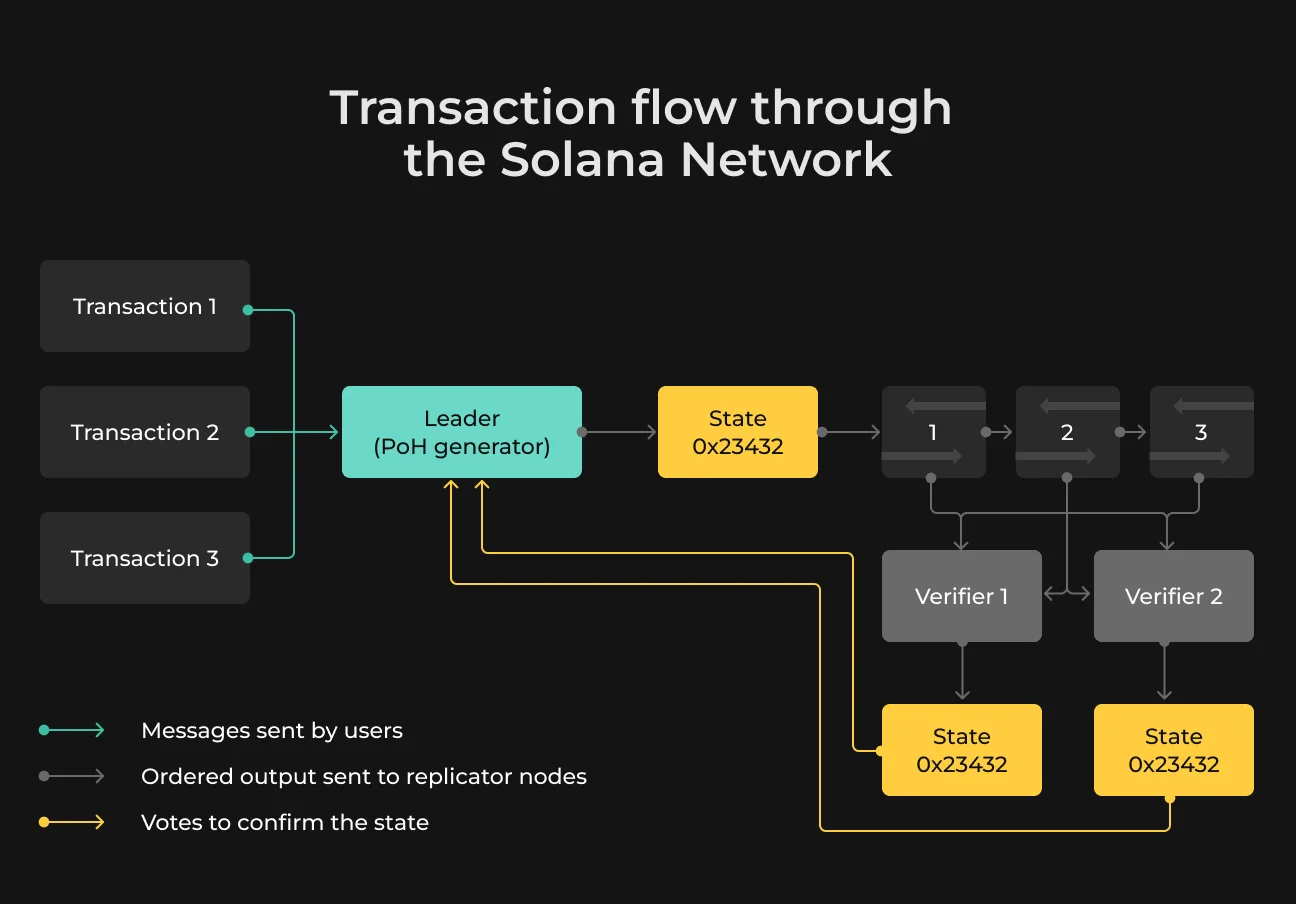
Solana's monolithic architecture (single world state) allows it to process all transactions on-chain without the need for sharding. The result is extremely fast settlement of transactions (400–600 ms block times) and the capability to process up to 65,000 TPS under ideal conditions.
What is DeFi?
Decentralized Finance (DeFi) is a blockchain-based financial system that lets users borrow, lend, trade, and earn without banks or intermediaries. It runs on smart contracts, giving users full control of their assets and enabling transparent, permissionless transactions.
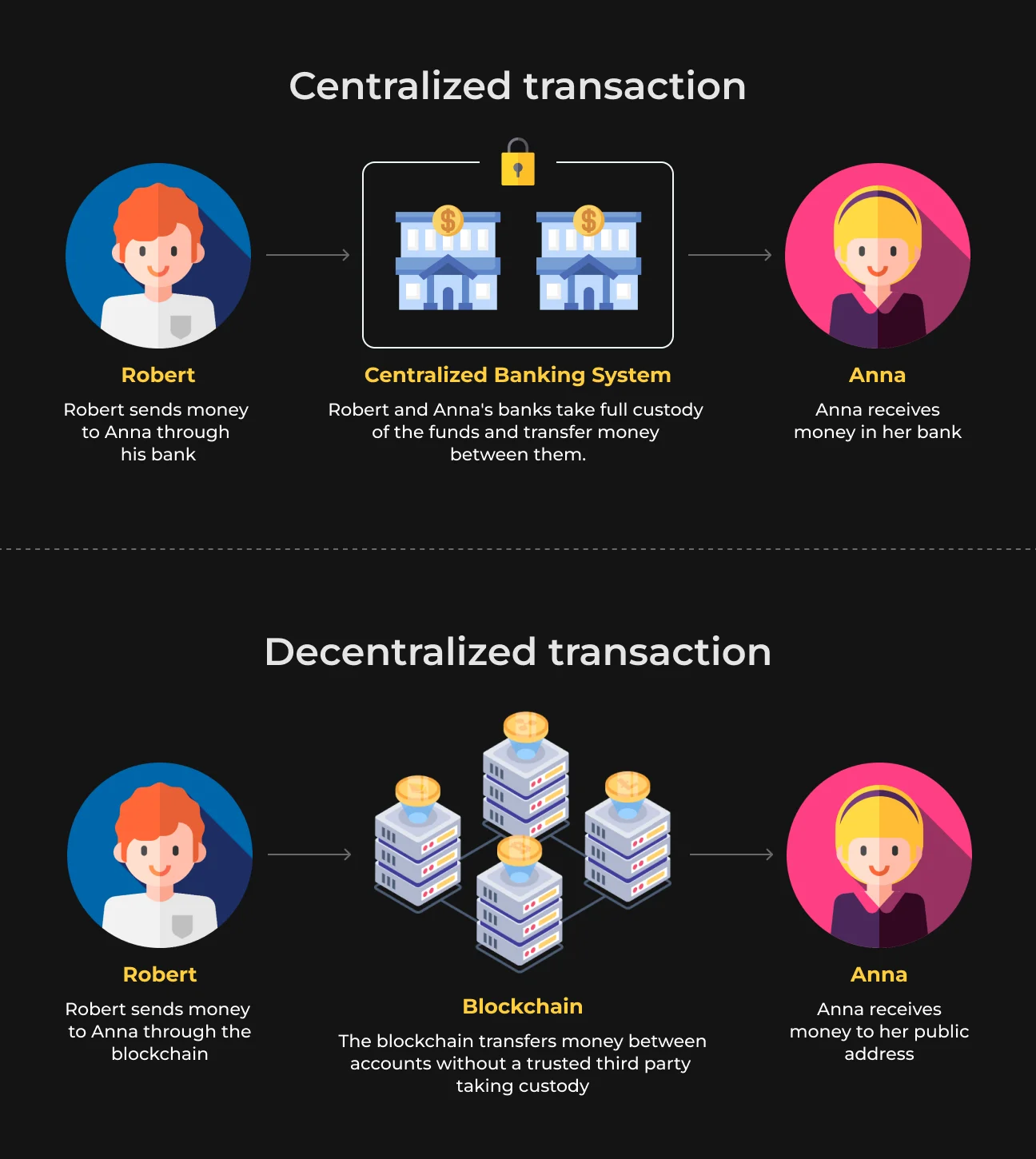
Instead of going through a traditional bank, a user can borrow USD stablecoins by locking up crypto as collateral directly through a DeFi protocol. This shift toward decentralized lending and borrowing is expanding beyond Ethereum — the Bitcoin DeFi ecosystem is now gaining strong momentum, opening new opportunities for on-chain financial innovation.
Benefits of Using Solana for DeFi Development
Wondering what are the benefits of Solana DeFi development compared to any other blockchain? As an experienced Solana DeFi app development company, we’ll share the pros we’ve seen so far.
1. High Throughput and Speed
Solana accommodates tens of thousands of TPS, far greater than Ethereum's current 15 TPS. Blocks are confirming in under a second (350–450 ms). High throughput enables DeFi on Solana to grow to millions of users and execute trades or liquidations in real-time.
It is an important requirement for decentralized exchanges (DEXs) and other latency-sensitive protocols.
2. Proof of History
A core innovation is Solana's PoH timestamping. PoH is a cryptographic timestamp that orders events before consensus, reducing validators' workload significantly. All block producers must compute a PoH hash, providing an open-to-auditing timeline of time.
Through “pre-ordering” transactions, Solana's network achieves quick consensus on orders without having to wait for timestamps. For developers, PoH means that your DeFi on Solana gets low confirmation times and consistent ordering, even at high loads.
3. Low Fees
On Solana, transaction fees are practically zero – around $0.00025 per transaction on average. Even under heavy network use, Solana fees are pennies because of its efficient runtime and fee markets.
This is different from Ethereum, whose base-layer gas fees consistently jump $1–$10+ under congestion. Microtransactions and high-volume trading are enabled by low fees.
4. Scalability & Decentralization
Solana's architecture is geared towards scaling via hardware improvements like using GPUs and multi-core processors. As hardware gets faster, Solana throughput can be scaled up, providing a future-proof scaling solution. Most importantly, it does so without sharding, so all DeFi apps are contained in one global state (with composability between protocols assured).
Solana's network is secured by over 1,000 validators worldwide, closing the gap to Ethereum in terms of decentralization. Initiatives such as the Solana Foundation delegation program and developing a second validator client like Firedancer further decentralize the blockchain.
5. Developer-Friendly Ecosystem
Smart contracts on Solana are primarily written in Rust, a language known for its high performance, memory safety, and security. This makes it ideal for building reliable decentralized applications. To simplify the development process, frameworks like Anchor offer Ethereum-like ergonomics with declarative APIs and automatic IDL generation. This enables faster and more efficient DeFi development.
The Solana developer ecosystem is well-supported and rapidly evolving. Engineers benefit from extensive documentation, tutorials, and frequent hackathons that attract thousands of participants worldwide, often giving rise to new DeFi startups. The tooling has matured significantly, featuring great CLI tools, local cluster emulators, and production-ready libraries such as Solana Web3.js and Solana Pay SDK.
6. Strong Community and Support
The Solana Foundation provides grants and runs accelerator programs to support Solana DeFi projects. In 2024, the Solana ecosystem had 400+ dApps in DeFi, NFTs, and Web3 social, indicative of active community participation.
Developer DAOs like Solana Collective or LamportDAO and meetups are actively welcoming new entrants.
7. Growing Partnerships
In 2023, Visa began using Solana to settle transactions in USD Coin (USDC), taking advantage of Solana’s high throughput to significantly speed up cross-border payments.
Around the same time, Shopify integrated Solana Pay, enabling hundreds of millions of merchants to accept USDC payments directly over Solana’s network.
These are not isolated moves. Circle launched native USDC support on Solana, and Stripe added USDC payouts on the network — strong signals of institutional confidence in Solana’s reliability and performance.
For developers and businesses, this growing institutional adoption means higher liquidity, more active users, and a trusted ecosystem for launching new DeFi apps.
With deep integration across major wallets like Phantom, Solflare, and MetaMask, as well as broad fiat on-ramp support, Solana has become a firmly established player in the global payments and DeFi market.
8. Energy Efficiency
Solana is a proof-of-stake chain, thus much more energy-efficient than proof-of-work chains. In fact, one Solana transaction consumes about the same energy as a Google search of solana.com. The network is highly low-carbon, and the Solana Foundation releases energy reports regularly, even purchasing carbon offsets. For green projects or companies with ESG goals, building on Solana is a good fit.
9. Interoperability
Solana’s interoperability is a key advantage for DeFi developers. Cross-chain bridges like Wormhole make it possible to transfer all assets including Bitcoin (BTC), Ethereum (ETH), and various stablecoins between Solana and other blockchains. This allows Solana DeFi protocols to tap into deep liquidity pools from ecosystems like BNB Chain and Ethereum.
Beyond bridges, Solana supports Inter-Blockchain Communication (IBC) and other emerging interoperability standards, expanding its connectivity across the wider Web3 ecosystem.
For developers, there’s also Neon EVM – a compatibility layer that enables Solidity smart contracts to run directly on Solana. This opens the door for Ethereum-native projects to easily deploy in Solana’s high-performance environment. Additionally, Pyth Network demonstrates how Solana-based data can be pushed to multiple chains, enhancing cross-chain functionality.
In practice, this interoperability means developers can build a multi-chain project: for example, letting users collateralize Ethereum assets in a Solana lending protocol or route trades through Solana’s fast DEX infrastructure even if they originate on another chain. This connectivity makes Solana a powerful backbone for next-generation DeFi applications.
Build Your Solana Project with SapientPro
Why Are Solana’s Transaction Costs Lower than Ethereum's?
Solana's consistently low transaction fees boil down to fundamental design differences with Ethereum.
Efficient Consensus & Execution
Solana's combined PoH + PoS consensus is extremely light on computational overhead. Validators can confirm transaction order via PoH's cryptographic timestamps instead of performing heavy proof-of-work or complex leader elections on each block. This efficiency means validators perform less work per transaction, which translates to lower costs that they pass on in the form of lower fees.
Ethereum (before the recent Merge to PoS) was founded on PoW and even today uses a more computation-intensive approach to ordering (with proposers and attestors over 12s slots). Solana's minimalistic approach simply costs less to run.
High Throughput = Amortized Costs
Solana's architecture is built for high throughput (as much as 65k TPS), so it can process many transactions in parallel. That enormous capacity allows fixed costs of running the network (node hardware, bandwidth, etc.) to be spread across thousands more transactions per second than Ethereum.
Cost per transaction is still microscopic because the network is capable of supporting volume without congestion. Ethereum's lower throughput means there is perpetual congestion, with users bidding up gas prices and raising fees. Solana's high TPS design avoids those bidding wars by accommodating more load.
Low Resource Requirements per TX
One of Solana’s key strengths lies in its efficient transaction design. Transactions on Solana are compact and have low state storage requirements, thanks to its account-based model and lean runtime. As a result, validators consume significantly less memory per transaction, which in turn lowers their operational costs.
Because of this efficiency, a single Solana validator can handle an order of magnitude more transactions on the same hardware than an Ethereum validator. By burning less CPU and RAM per transaction, validators can keep network fees low while remaining profitable.
On top of that, Solana’s inflation rewards and fee burn mechanism help stabilize transaction costs over time. In contrast, Ethereum’s higher per-transaction resource usage and greater state growth contribute to higher network fees, making Solana a more cost-efficient and scalable option for high-throughput DeFi applications.
Optimised Validator Scheduling
Solana’s transaction processing architecture is designed for maximum efficiency. Its Pipeline and Gulf Stream protocols push transactions to the next block producer ahead of time, while Turbine breaks data into tiny chunks for rapid propagation. Together, these innovations reduce mempool congestion and minimize orphaned blocks, allowing validators to spend less time and energy on redundant tasks.
By contrast, Ethereum uses a more decentralized but competition-heavy block production model. Multiple nodes propagate identical transactions, and under its historical proof-of-work system, miners often duplicated effort, which contributed to higher operational costs and higher fees.
Solana’s coordinated block production minimizes redundant work, helping to keep transaction fees low and predictable. The network burns 50% of each transaction fee and follows a stable fee schedule, avoiding extreme price swings. Meanwhile, Ethereum’s EIP-1559 mechanism also burns base fees but remains more exposed to fee spikes during high network demand.
Comparison Between Solana, SUI, and ETH
When evaluating blockchain platforms, it’s helpful to compare Solana with other major smart contract networks. Looking at Sui, a newer high-performance chain, and Ethereum, the established leader in DeFi, provides valuable insight into their performance, design choices, and ecosystem maturity.
Solana vs SUI
Both Solana and Sui aim for high throughput and scalability, but they take different approaches.
Consensus mechanism
- Solana: uses Proof of Stake + Proof of History with Tower BFT. PoH provides a global time source, enabling rapid transaction sequencing and fast finality (≈0.4 s) with many validators.
- Sui: operates on Delegated PoS with Narwhal–Tusk (Bullshark) DAG-based BFT. Narwhal handles mempool ordering, while Tusk ensures consensus and parallel execution. Finality is around 1–2 s.
Programming language
- Solana: uses Rust and C/C++ with the Solana Runtime (SVM). Rust offers performance and safety but has a steep learning curve. Frameworks like Anchor make development easier.
- Sui: uses Move, adapted from Diem. Move’s design prioritizes security (e.g., preventing reentrancy attacks). Sui’s object-oriented model offers fine-grained asset control, simplifying certain dApp logic such as NFTs and gaming.
Throughput (TPS)
- Solana: theoretical 65,000 TPS, with thousands in production. Achieves this through parallel processing (multi-core, SIMD) and rapid block times. Well-suited for order-book DEXs and real-time applications.
- Sui: theoretical 297,000 TPS in ideal parallel conditions. Its architecture supports massive concurrency, especially for independent transactions like in gaming. Both chains far exceed typical L1 speeds.
Transaction fees
- Solana: ultra-low average fees of about $0.0002 per transaction. Fees are fixed in lamports and remain stable even during congestion, enabling microtransactions and high-frequency trading.
- Sui: low and predictable fees around $0.002 per transaction on average. Uses a gas and storage fee model designed to keep costs flat for end users.
Developer ecosystem and tools
- Solana: mature ecosystem with 1,000+ active developers since 2020. Strong DeFi, wallet, DAO, and NFT infrastructure. Key tools include Anchor, Solana CLI, Phantom Wallet, and Solscan Explorer. Extensive community and documentation.
- Sui: emerging ecosystem since mainnet launch in 2023. Smaller but rapidly growing developer base. Offers Move Studio IDE and SDK. Fewer third-party libraries but strong support from the Sui Foundation and ex-Diem developers.
Ecosystem use cases
- Solana: strong presence in DeFi (e.g., Serum, Raydium, Solend), NFT marketplaces (e.g., Magic Eden), payments (USDC settlements), and mobile (Saga phone). High composability supports complex DeFi platforms.
- Sui: focused on gaming and metaverse applications. Move’s object model makes in-game asset logic simpler. Early NFT and DeFi protocols are growing. Sui’s TVL is still about 11× smaller than Solana’s but aims to attract consumer-facing apps.
Solana vs ETH
Ethereum is the incumbent leader in smart contracts and DeFi, while Solana is often seen as a high-speed challenger. Here’s how they compare.
Consensus
- Solana: uses Proof of Stake combined with Proof of History. Validator leaders are chosen based on stake, while PoH provides cryptographic timestamps. This enables block times of about 0.4 seconds and finality in less than one second. The design emphasizes high speed and efficiency, though it requires more powerful validator hardware.
- Ethereum: uses Proof of Stake since the 2022 transition from proof of work to the Beacon Chain. Blocks are produced every 12 seconds with finalization in six to twelve minutes. The network relies on large validator committees and prioritizes broad decentralization with more than 500,000 validators.
Programming
- Solana: primarily uses Rust and C/C++. Programs are compiled to BPF, and Rust provides memory safety and high performance. Developers commonly rely on the Anchor framework to speed up development.
- Ethereum: uses Solidity and Vyper. Smart contracts run on the Ethereum Virtual Machine. Solidity’s syntax is simple for many developers, and the ecosystem offers mature tooling such as Truffle, Hardhat, and Remix. The EVM runs single-threaded, which limits parallel execution.
Throughput and speed
- Solana: achieves high throughput and low latency. The mainnet consistently handles over two to three thousand transactions per second and can burst significantly higher. Block production is under one second. This performance enables complex on-chain use cases such as real-time trading and order book DEX operations.
- Ethereum: handles lower throughput and has higher latency. Ethereum Layer 1 currently processes between 15 and 30 transactions per second. The network often runs close to capacity, leading to delays and a reliance on Layer 2 solutions for scaling. Twelve-second block times make real-time interactions less practical.
Fees
- Solana: transaction costs are very low, typically between 0.0001 and 0.001 US dollars per transaction. The fee market remains stable, and users rarely need to bid higher to be included in blocks. This structure makes smaller DeFi transactions cost-effective.
- Ethereum: gas fees fluctuate with network demand. After the London upgrade, fees can still range from a few dollars to over one hundred dollars during congestion. A single swap on a decentralized exchange can cost between five and twenty dollars in gas. High fees have pushed many users toward Layer 2 solutions for cheaper transactions.
Ecosystem and liquidity
- Solana: has the second-largest DeFi total value locked, with around eight to ten billion US dollars as of 2025. It is home to established protocols such as Serum, Raydium, Orca, Solend, and Marinade. Liquidity is strong in specific areas like decentralized exchanges and liquid staking, although it remains smaller overall compared to Ethereum.
- Ethereum: hosts the majority of DeFi liquidity and applications, including Maker, Aave, Uniswap, and Curve, with more than fifty billion US dollars locked. It has the largest developer community and user base. Most major DeFi innovations began on Ethereum, and its liquidity depth and network effects remain unmatched, even as activity expands to Layer 2 networks such as Arbitrum and Optimism.
Decentralization and security
- Solana: secured by around 1,500 validators that require high-performance hardware. Its Nakamoto coefficient is strong, but critics note its reliance on a smaller set of super validators and external funding. The codebase is open source, and the network has endured significant stress tests. Past outages are being addressed with upgrades aimed at improving reliability.
- Ethereum: widely regarded as the most decentralized programmable blockchain. Anyone can operate a validator with 32 ETH or participate as a light client. The network includes thousands of full nodes and has maintained exceptional uptime. Its security record is strong, protecting billions in assets aside from occasional contract-level vulnerabilities. The high level of decentralization does, however, make scaling more dependent on external solutions.
Popular Solana DeFi Projects in 2025
The DeFi industry is still relatively young. Consequently, it is easy to occupy empty micro niches and build your own Solana DeFi ecosystem. Let's check out 3 popular Solana DeFi projects in 2025.
Raydium
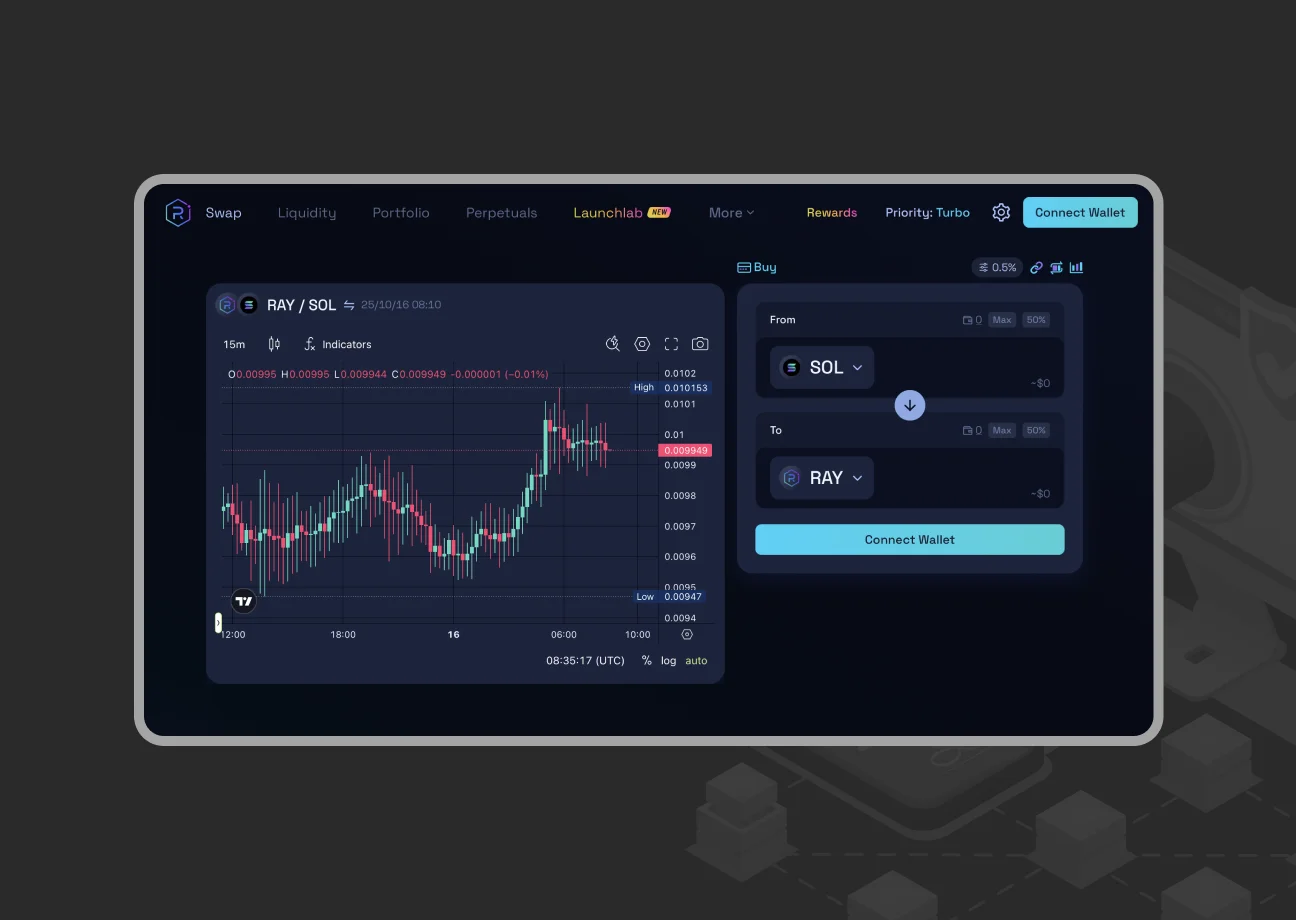
Raydium is a famous DEX with the AMM model built on Solana and liquidity pools, yield farming, and token swaps. Raydium has expanded its ecosystem by introducing initial DEX offerings (IDOs) through its AcceleRaytor platform, providing a launchpad for new Solana DeFi projects.
Kamino Finance
Kamino Finance unifies lending, liquidity provision, and leverage into a single, secure product suite. At its core, Kamino allows users to borrow and lend crypto assets, leverage their SOL staking yield, provide leveraged liquidity to DEXs, and earn AMM yields.
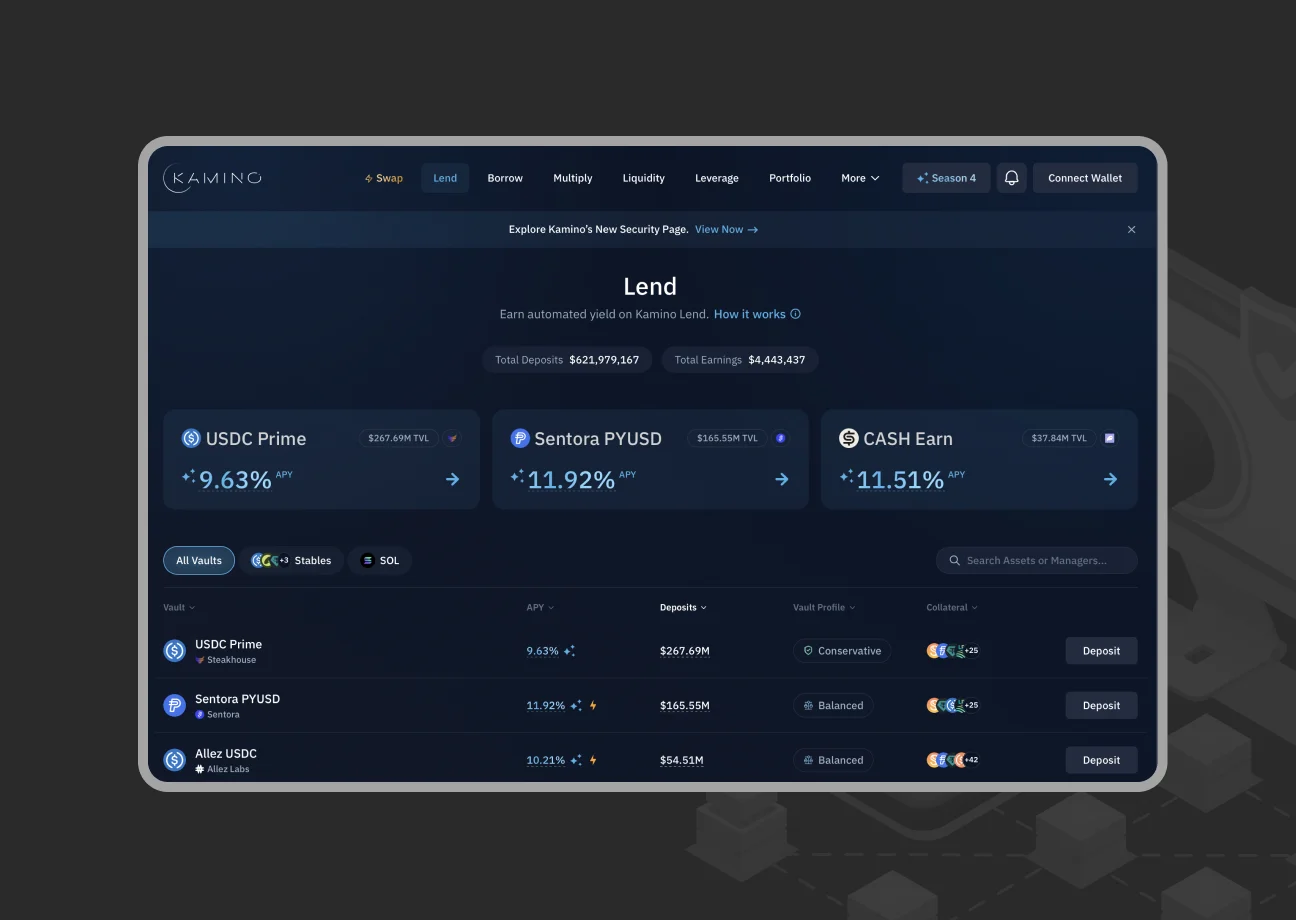
The release of Kamino 2.0 introduced K-Lend, a fully integrated application. This upgrade introduced a unified liquidity market, K-Tokens (yield-bearing tokens), advanced risk management mechanisms, etc.
Drift Protocol
Drift Protocol is a pioneering DEX built on the Solana blockchain that specializes in perpetual futures trading and spot markets. It provides a permissionless and non-custodial trading environment, allowing users to trade with leverage of up to 10 times (10x) on various crypto assets.
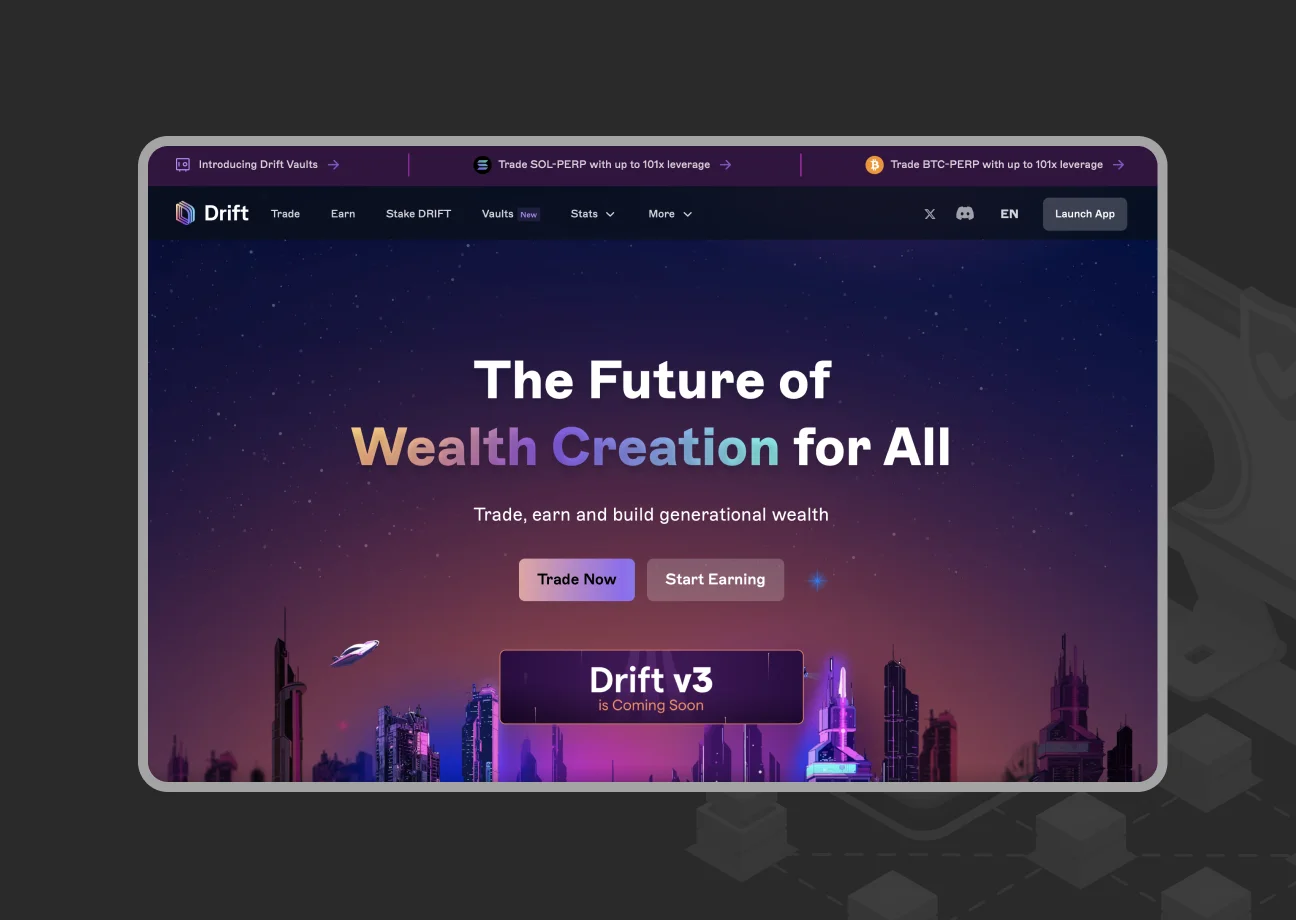
The platform utilizes a cross-margin trading system, which improves capital efficiency and allows for more sophisticated trading strategies. Drift has also introduced innovative concepts like virtual AMMs to improve liquidity and reduce the impact of market manipulation.
Partner with SapientPro to Build Your Solana DeFi Project
SapientPro is a professional blockchain development team with rich expertise in DeFi and Solana projects. We’ve helped multiple companies leverage Web3 technologies to build market-winning solutions:
- Decentralized Domain Management with ENS & Web3;
- Web3 Digital Collectibles Platform, yielding $1.5M from a token drop.
You’ll get all the industry’s best practices and our team’s expertise to create a powerful Solana project that brings all your ideas to life. Partner with SapientPro and get a free consultation to launch development!
Start Building Your Solana Project Today
FAQ
1. Is Solana the Best Blockchain for DeFi Development?
Solana is one of the strongest contenders for DeFi projects thanks to its exceptional speed and very low transaction fees. It’s particularly well suited for applications that require high throughput or real-time interactivity, such as trading platforms, DEXs, or payment systems.
While Ethereum still leads in overall liquidity and user base, the best platform depends on your priorities. Many teams combine the strengths of both networks, using Solana for performance and Ethereum for reach. For many modern DeFi applications, Solana’s technical advantages make it a top choice for development.
2. Where to Hire Solana DeFi Developers?
SapientPro’s team has experienced Solana developers on board, including engineers with a PhD degree that helps them build innovative solutions. You’ll find talented developers and creative minds here.
3. When to Choose Solana for Development?
Solana is the right fit when your application demands high performance, low fees, and a smooth user experience. It’s ideal for:
- High-frequency trading platforms;
- On-chain order books and games;
- Real-time payment applications.
If your goal is to keep all users on a single layer 1, avoid liquidity fragmentation, and engage an active user base, Solana is a smart option. In short, if speed, scalability, and cost efficiency are your priorities, Solana stands out as a strong choice for 2026 development.
RELATED ARTICLES

10 min
Five Lessons from AI Failures in Production
95% of enterprise AI pilots never make it to production. We asked the founders who've seen it firsthand — here's what they said.