All How to Make an AI Trading Bot for Crypto and Forex in 2026
January 3, 202615 min read


Algorithmic and AI-based trading is rapidly transforming crypto and forex markets. Already in 2015, 70–80% of market transactions were made by automated trading systems. The major financial hubs like NYSEand Nasdaq already employ high-speed bots to take advantage of tiny price fluctuations, while in Asia, algorithmic trades totaled nearly half the total volume by the year 2023.
Meanwhile, industry forecasts see runaway growth: e.g., the global algorithmic trading market is expected to grow from about $21.1B in 2024 to over $61.5B by 2030, and the more broadly defined AI-in-finance sector from $20.15B (2022) to $246B (2031).
To investors and CTOs, having a good AI trading bot means they have access to such trends. In this article, we share how to build a trading bot, how much does a trading bot cost, and the step-by-step process of making an AI-trading software.
Key Takeaways
- Rules for AI trading bots range from trend-following and high-frequency arbitrage to machine-learning and statistical models;
- AI can read news releases (e.g. Fed minutes) in seconds to generate trading signals;
- Python is popular for AI trading bot development because it has libraries like NumPy, Pandas, TensorFlow, and PyTorch;
- Concerns involve data bias and quality, model overfitting or failure in new regimes, and explainability/compliance for "black-box" AI;
- Already 70–80% of total trades are algorithmic;
- The share of AI-related content in algorithmic trading patents jumped from ~19% in 2017 to over 50% annually since 2020.
How Do Automated Trading Systems Work?
An Automated Trading System (ATS) uses computer code to execute buy and sell orders based on a pre-defined set of rules. By monitoring market data such as price, volume, and technical indicators, the system acts as a "trading bot" that operates without manual intervention.
Every automated strategy is built on three core rules:
- Entry: specifically when to open a position (e.g., "go long" or "go short").
- Exit: exactly when to close a position to take a profit or cut a loss.
- Position sizing: determining the specific amount of capital to risk on a single trade.
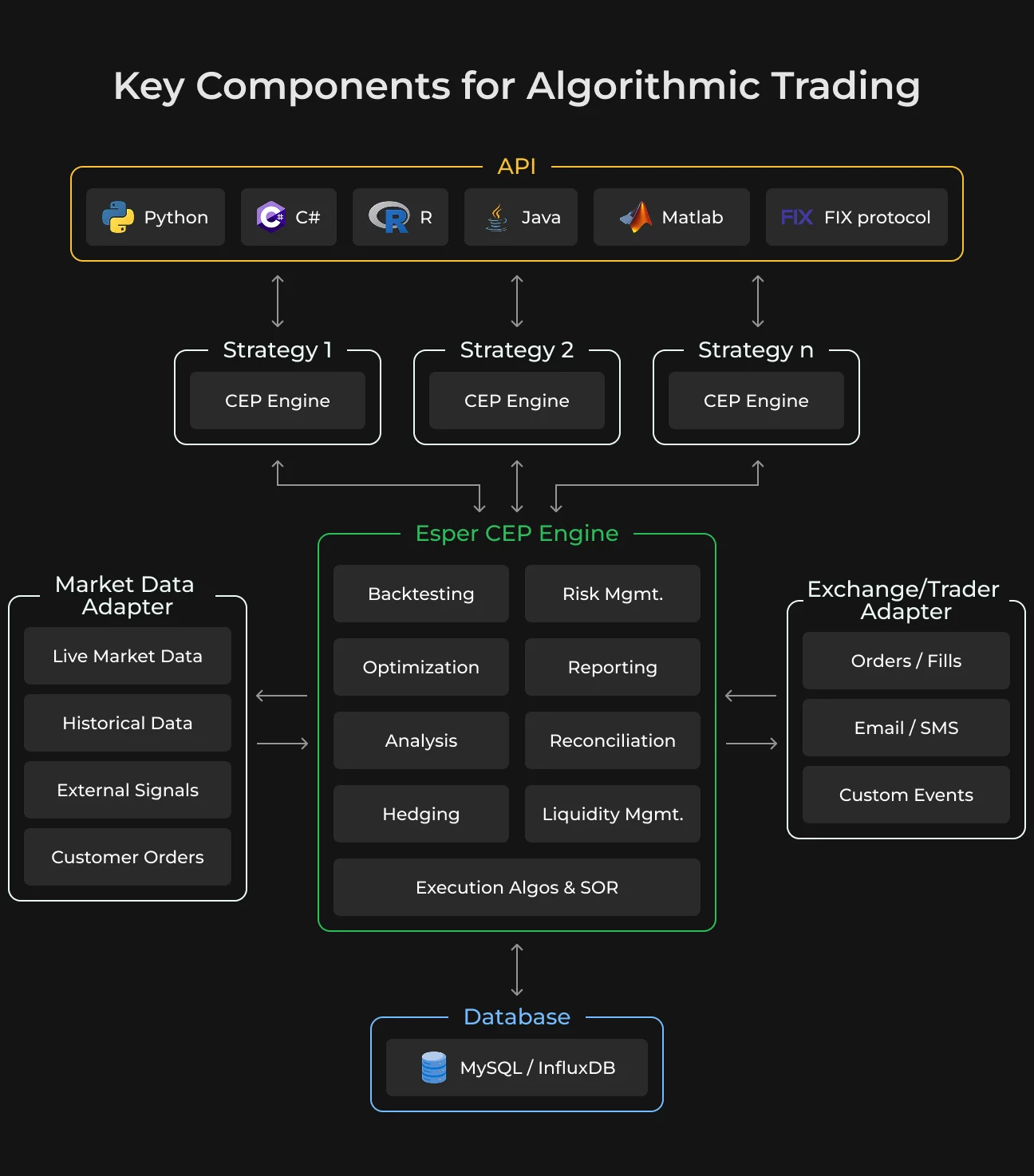
Automated bots can execute various strategies ranging from simple math to complex artificial intelligence:
Strategy | How it Works | Example |
| Trend-Following | Tracks the momentum of the market. | Buying when a short-term moving average crosses above a long-term one. |
| Statistical Arbitrage | Exploits price inefficiencies between correlated assets. | If two similar stocks drift apart, the bot shorts the high one and buys the low one. |
| High-Frequency (HFT) | Executes thousands of trades per second. | Market-making or "latency arbitrage" to capture tiny price gaps. |
| Mean Reversion | Assumes prices eventually return to their historical average. | Selling when a stock is "overbought" or buying after an extreme sharp fall. |
| Machine Learning | Uses AI to find non-linear patterns in data. | Predicting future volatility based on complex historical data clusters. |
These systems are integrated directly into financial markets through exchange APIs, allowing them to scan spot, margin, or derivative markets 24/7. Automated systems are great due to:
- Speed: orders are entered in milliseconds, far outpacing human reaction times.
- Discipline: bots eliminate human emotions like fear and greed, sticking strictly to the plan.
- Backtesting: you can run your strategy against historical data to see how it would have performed before risking real capital.
- Consistency: the system can monitor dozens of markets simultaneously without getting tired or distracted.
How Does Artificial Intelligence Help Trading
AI advances standard algorithmic trading by introducing adaptability and data-driven intelligence that static rules cannot provide. By learning from historical and real-time data, AI can predict price movements, identify shifting market regimes, and process vast amounts of unstructured information.
Key capabilities of AI in trading include:
- Big data analytics: AI platforms track massive datasets, including news feeds, social media, and economic reports, to find market opportunities.
- Natural language processing (NLP): models can parse central-bank language (such as Fed minutes) or social media sentiment, translating text into trading signals in seconds.
- Real-time reactivity: because AI can scan thorough reports far faster than humans, it allows for near real-time market reactions to global news.
- 24/7 automation: according to Nasdaq, AI software enables traders to maintain accurate, automated strategies around the clock.
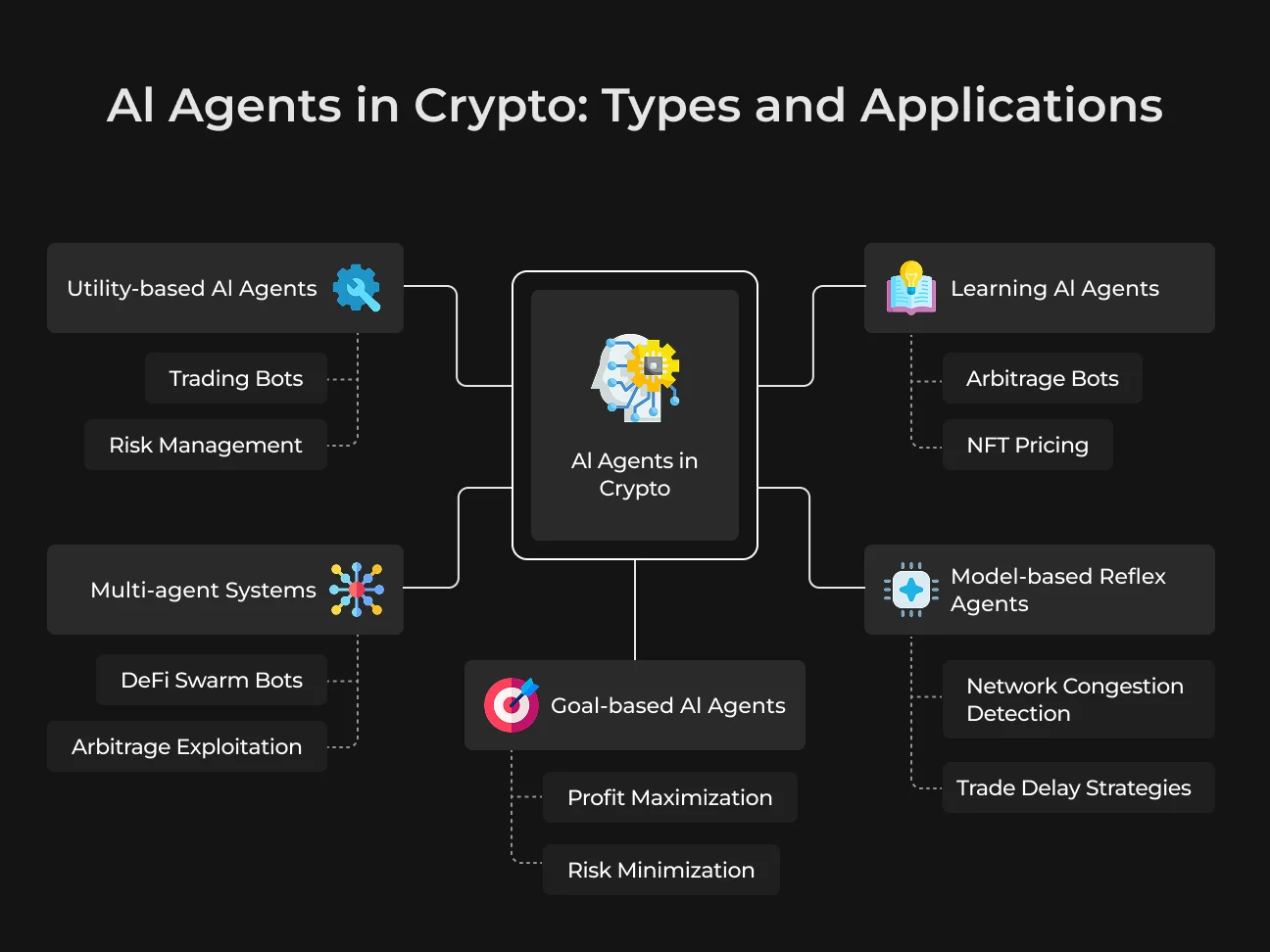
Common machine learning techniques include the following:
Technique | Function | Application Example |
| Predictive Modeling | Uses regression or neural-net models trained on historical data. | Forecasting tomorrow's price based on trends from previous months. |
| Sentiment Analysis | Employs NLP to read news or social media to assess market "mood". | Initiating buy signals for a cryptocurrency following a rush of positive news. |
| Reinforcement Learning | AI agents learn optimal actions through trial and error. | Dynamically adjusting strategies to handle changing market circumstances. |
| Anomaly Detection | Monitors hundreds of features and cross-market info simultaneously. | Detecting possible arbitrage or anomalous behavior at a scale humans cannot match. |
While AI helps optimize timing, risk management, and asset selection, most experts do not recommend replacing human oversight entirely. Instead, a collaborative approach is preferred:
- Human role: traders define the high-level strategy and set specific risk tolerances.
- AI role: data-science tools (such as TensorFlow, PyTorch, and scikit-learn) optimize signals and execution continually.
This combination "supercharges" traditional algorithmic trading by balancing human intuition with machine precision and speed.
Step-by-Step Guide to Building Your Artificial Intelligence Trading Software
To build high-performance AI trading software, you must bridge the gap between financial theory and software engineering. This task begins with a clear vision of your market interaction, as every technical choice flows from your underlying financial logic.
1. Define Objectives and Strategy
The foundation of any bot is its core mission. You must decide whether to target forex, crypto, or stocks and determine the specific methodology that will drive your profits.
For example, a high-frequency arbitrage strategy requires a system built for speed and low-margin efficiency, whereas a market-making strategy focuses on capturing the bid-ask spread.
During this phase, you must also establish strict success metrics and risk parameters, such as your maximum allowable drawdown, which will serve as the guardrails for your development process.
2. Choose Your Tech Stack
While "no-code" platforms offer a shortcut, they lack the flexibility required for professional-grade AI models. A custom stack is essential for scaling. Python is the industry standard due to its extensive library ecosystem, including Pandas for data manipulation and PyTorch or TensorFlow for machine learning.
However, for the components where every millisecond counts, you might integrate C++ or Java. Your stack should also include reliable API connectors, such as CCXT for cryptocurrency or the Interactive Brokers API for traditional equities, hosted on low-latency cloud environments like AWS or Google Cloud.
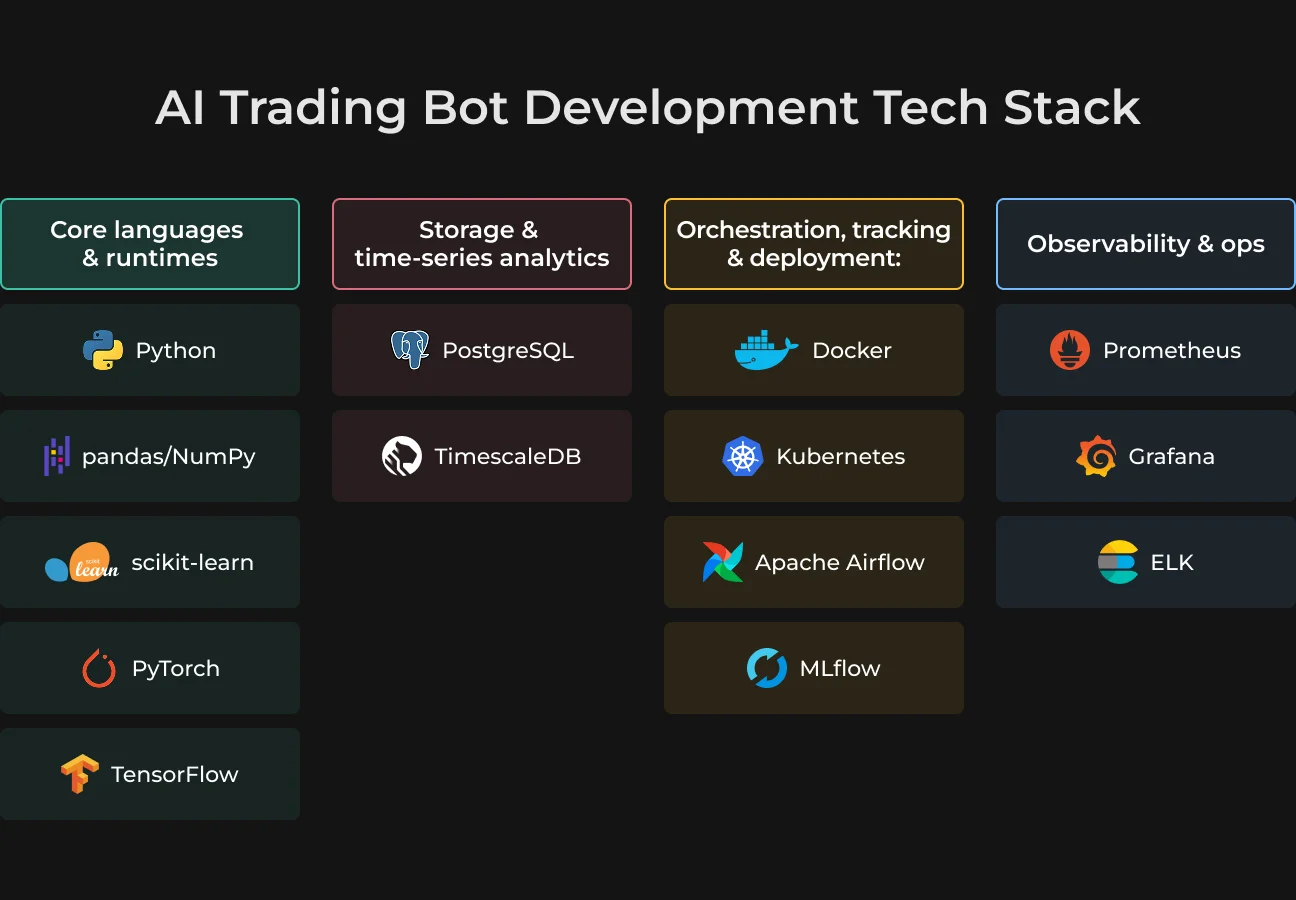
Tip: while "no-code" AI trading software exist, they sacrifice flexibility and likely won't handle more complex or custom models stably. For a professional high-scale solution, your must write custom code.
3. Gather and Prepare Data
The intelligence of your software is entirely dependent on the quality of its inputs. You must build reliable pipelines to collect historical tick data and real-time order book feeds. This data is rarely ready for use; it requires cleaning to handle outliers and normalization to ensure consistency across different assets.
Beyond raw price action, you will need to engineer features like technical indicators and sentiment scores that provide the AI with the context it needs to make informed decisions.
4. Build AI/ML Models
Implement the primary AI models.
In most cases, your choices are:
- Supervised learning models. Train regression or classification models to predict future price movements or trade signals. E.g. use LSTM neural networks to predict price trends from historical series.
- Reinforcement learning agents. Use RL libraries (e.g. OpenAI Gym, Ray RLlib) to enable an agent to learn trading strategies in simulated environments.
- Ensemble methods. Blend multiple models (e.g. decision trees, gradient boosting, neural nets) to improve reliability.
Design model architecture based on strategy complexity. You must have proper training pipelines and use GPUs if necessary for deep learning. We recommend you start with simplicity (linear models or very small neural nets) and then proceed to add complexity. Model performance must always be tested on validation data to prevent overfitting.
5. Backtest and Validate
Before going live, the system must be validated through backtesting. This involves simulating your bot’s performance against historical data it hasn't seen before to calculate the Sharpe Ratio and other risk-adjusted returns.
A successful backtest should include walk-forward analysis and stress-testing under various market regimes, such as high-volatility crashes or stagnant sideways markets. This phase is critical for spotting over-optimistic logic that only works in "perfect" historical conditions.
6. Deploy Infrastructure
Transitioning to live trading requires a production-grade environment. Your architecture should be modular, separating the data pipelines from the AI logic and the execution engine. You’ll need the following elements:
- Hosting. Use stable servers (cloud VM, AWS/GCP, or dedicated hardware) with low-latency network access to exchanges.
- Broker/exchange integration. Set up stable API connections to chosen exchanges (crypto APIs or FIX endpoints). Use SDKs or libraries for Binance, Kraken, etc. We integrated Binance, ByBit, and Kraken via unified SDKs in one of our case studies.
- Trade execution engine. Build the module that takes signals and places orders. Include risk controls (stop-loss, position limits) applied in the engine.
- Data pipelines. Ensure real-time market data and account data flow smoothly to the AI models and dashboard.
- Monitoring & logging. Log every trade and artificial intelligence trading software event. Use dashboards for monitoring performance and health. This also aids in regulatory compliance and debugging.
All these substeps are critical to create the best AI trading software. Don’t forget to pay special attention to everything related to machine learning for algorithmic trading.
7. Monitor, Maintain, and Iterate
Markets are dynamic, meaning an AI trading bot is never truly "finished." Once live, you must continuously monitor for "alpha decay," where a strategy becomes less effective over time as other market participants adapt.
This requires a cycle of periodic retraining with new data and constant system health checks. Finally, always include a manual "kill switch"—an emergency override that allows you to pause all activity instantly if market conditions turn unpredictable or technical anomalies occur.
Challenges in Using AI Trading Software
Embracing AI in trading comes with tremendous benefits but also with challenges. The key challenges include the following.
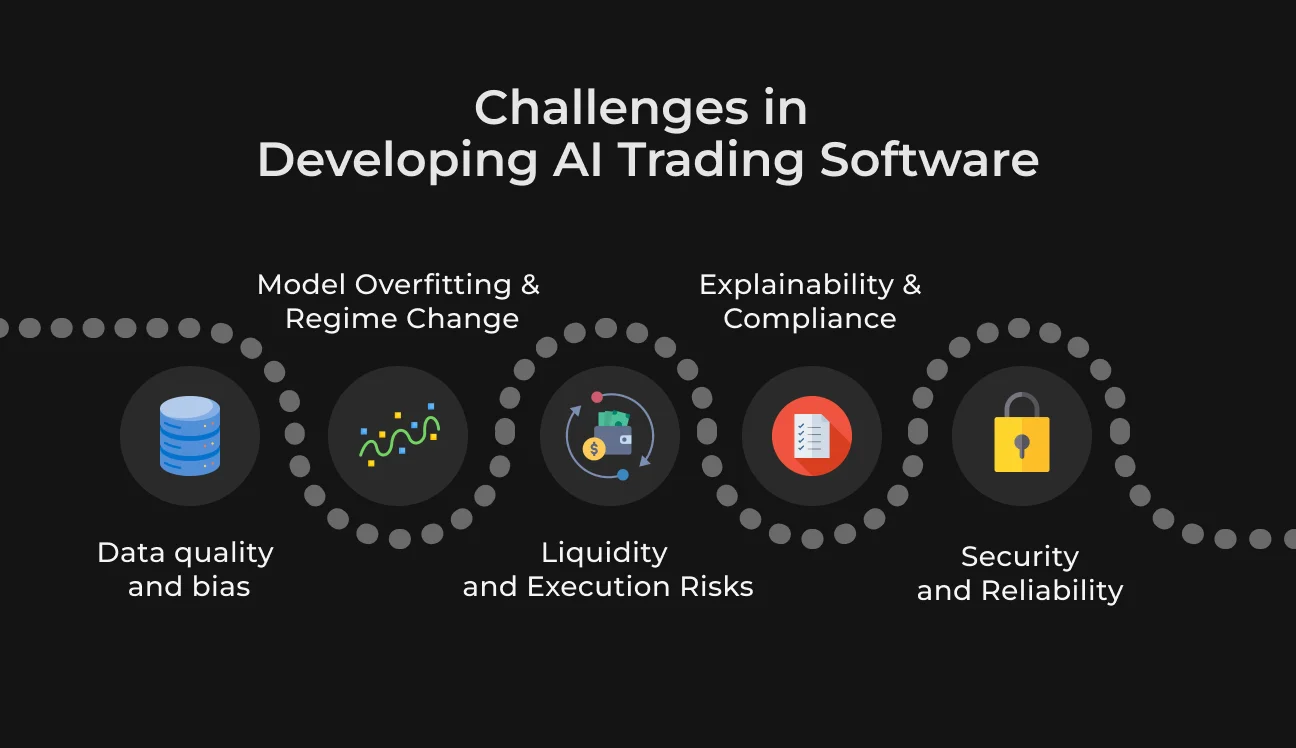
Data quality and bias
An AI model is only as effective as the information it consumes. Because these systems are trained on historical data, any inherent flaws or biases in that data will inevitably lead to erroneous or even catastrophic trading decisions.
A common pitfall is survivorship bias, where the model is trained only on currently successful assets while ignoring those that were delisted or failed, leading to over-optimistic performance projections.
Furthermore, training data anomalies such as "flash crashes" or periods of extreme volatility can skew a bot's logic, causing it to misinterpret normal market behavior.
Solution. To mitigate these risks, you must source data from broad, reputable providers and implement a strict cleaning and normalization pipeline. This involves stripping out outliers that do not represent true market conditions and ensuring the dataset is diverse enough to cover various economic cycles.
Beyond the initial build, it is important to periodically refresh your datasets and consistently validate model outputs against fresh, "out-of-sample" market conditions.
By maintaining this constant feedback loop, you ensure the bot evolves alongside the market rather than remaining anchored to outdated or biased historical patterns.
Model Overfitting & Regime Change
The most significant risk in AI development is overfitting, where a model learns to "memorize" historical noise rather than identifying genuine, repeatable patterns. Such a strategy may show spectacular results during backtesting but fail immediately in live markets because it lacks the ability to generalize.
This vulnerability is compounded by regime change—the tendency of markets to shift abruptly between distinct states, such as moving from a low-volatility "bull" market to a high-volatility "bear" crash.
Because an AI is inherently a product of its training environment, it may struggle to adapt when the underlying rules of the market evolve.
Solution. To build a resilient system, you must employ advanced validation techniques like k-fold cross-validation and walk-forward testing, which evaluate the model on data it has never seen before.
Stress-testing the model against diverse historical scenarios like simulating everything from liquidity crises to "black swan" events is essential to determine its breaking point.
Architecturally, you can mitigate regime risk by using ensemble methods, which blend multiple models to smooth out individual errors.
However, no amount of math can replace a robust safety net. It is vital to implement conservative risk constraints—such as hard stop-losses and position limits—and maintain a human overseer with the authority to halt or adjust the bot if the market shifts in a way the AI was never designed to handle.
Liquidity and Execution Risks
The transition from a theoretical model to a live market introduces the harsh reality of execution risk. In environments with low liquidity or "thin" markets, even a modest order can trigger significant price slippage, causing the bot to enter positions at far worse prices than its AI signals intended.
This risk is amplified during flash crashes or periods of extreme volatility, where the bid-ask spread widens and order books empty out. Without proper regulation, high-frequency strategies can inadvertently enter a feedback loop, acting erratically and contributing to further market instability.
Solution. Protecting your capital requires a multi-layered defense system that sits between the AI’s "signal" and the actual exchange. You should enforce strict maximum order sizes to ensure the bot does not attempt to trade more volume than the current market liquidity can absorb.
Furthermore, the system must include automated circuit breakers and trading halts that trigger during abnormal price movements or "black swan" events.
By integrating these financial safeguards directly into your software, you create a "sanity check" for the AI. Even if the machine learning model identifies a high-confidence opportunity, the execution engine should have the final authority to reject or downsize the trade if the current market liquidity is insufficient or if volatility has exceeded pre-defined safety thresholds.
Explainability & Compliance
The more advanced an AI becomes, the more it tends toward becoming an "inscrutable black box." Deep learning models and complex ensemble methods are exceptionally powerful at finding non-linear patterns, but they rarely offer a clear explanation for why a specific trade was triggered.
This lack of transparency poses a significant challenge for regulatory compliance, as financial authorities often require firms to demonstrate a clear rationale for their market actions to prevent manipulation and ensure stability.
Without a way to audit the decision-making process, a bot could inadvertently engage in predatory behavior or take on systemic risks that go unnoticed until it is too late.
Solution. Balancing performance with transparency requires a "Glass Box" approach to development. Whenever possible, you should utilize interpretable models or hybrid systems where complex neural networks are supplemented by decision trees or rule-based logic that a human can easily follow.
A robust compliance framework must also include a high-fidelity logging system that captures not just the trade itself, but the "state" of the model at the moment the decision was made—including the specific input features and confidence scores.
By maintaining a human-in-the-loop architecture, you empower risk officers and senior traders to oversee the AI’s behavior in real-time. This ensures that a human can interpret the bot's logic and, if necessary, override an action that appears to violate internal risk policies or external regulatory standards.
Security and Reliability
In automated finance, security is the bedrock of the entire operation. Because a trading bot has direct access to exchange accounts and capital, it is a high-value target for hacking, API key theft, and data manipulation.
Additionally, the risk is not just external. Internal failures such as software bugs, "infinite loops" in order logic, or server downtime can lead to unintended trades that liquidate an account in minutes.
A minor coding error that fails to handle a "null" response from an exchange can result in the bot losing track of its positions, leading to catastrophic financial loss.
Solution. Protecting an automated system requires a "Defense-in-Depth" strategy that secures every layer of the stack. At the code level, you must implement strict QA testing and automated unit tests to catch logic errors before they reach production.
For sensitive data, never hard-code credentials; instead, use encrypted vault services to manage API keys and implement IP whitelisting so the exchange only accepts orders from your specific secure servers.
Reliability is further ensured through infrastructure redundancy. By deploying backup servers in different geographic regions, you can ensure the bot remains online even if a primary data center fails.
Finally, full-scale monitoring systems should be configured to detect anomalies, such as a sudden spike in order frequency or a disconnect from the market feed, triggering an immediate system pause to protect the remaining capital.
SapientPro mitigated all these challenges and created a CS2 trading integrated with Steam Marketplace. Make sure to check it out.
Every risk is manageable through thoughtful design. In SapientPro's SaaS trading platform project, we neutralized connectivity and load issues by standardizing API abstractions and leveraging cloud auto-scaling. The vital lesson for any developer: always combine cutting-edge technology with integrated risk controls to ensure long-term stability in volatile markets.

Max Tatarchenko
How SapientPro Built a SaaS Trading Platform
SapientPro recently partnered with a Canadian fintech firm to develop a web-based quantitative trading platform. The goal was to provide a professional environment where users could design, backtest, and deploy automated strategies across the forex and crypto markets.
Phase 1: Proof-of-Concept and Tech Selection
Our team began by building a rigorous proof-of-concept. Using historical datasets and the Binance Testnet, we verified that user-defined strategies could execute reliably in a simulated environment. We selected Python as the primary backend language, leveraging its specialized libraries to handle the intense performance requirements of financial modeling.
Phase 2: Overcoming Integration and Scaling Challenges
The project presented two primary technical hurdles: managing the fragmented nature of exchange APIs and ensuring the system could handle thousands of concurrent users.
- Standardized API layer: to solve the fragmentation issue, we engineered a custom abstraction layer. This allowed the platform to communicate with Binance, ByBit, and Kraken through a single, uniform interface, making it easy to add new exchanges in the future.
- Elastic cloud architecture: to manage heavy loads, we deployed a cloud-based architecture that dynamically scales computing resources. This ensures that even during periods of high market volatility, user strategies execute without latency.
Phase 3: Optimizing the Backtesting Engine
Speed is critical when analyzing years of market history. We optimized our data pipelines by implementing advanced indexing and compression techniques. This allowed our "trading strategy core" to scan massive datasets and deliver backtesting results in seconds rather than minutes.
Phase 4: User-Centric Design and Control
We developed a React dashboard to provide users with full transparency and control over their algorithms.
- Visualization: users can view live buy/sell signals on interactive charts and manage strategy parameters.
- Manual override: while the platform is built for automation, we integrated manual trading features to ensure users always retain final control.
- Operations: we rounded out the SaaS experience with secure subscription billing, usage tracking, and enterprise-grade security layers.
Result
Over 2,000 engineering hours, a dedicated team of five SapientPro developers delivered a modular trading solution. The project implements three critical pillars of modern fintech development: robust API integration, high-speed data pipelines, and intuitive UX design.
Future of AI in Trading
Looking ahead, the future of artificial intelligence in finance points toward an increasingly automated and high-velocity global market. The following trends highlight the rapid expansion and evolution of this sector:
- Massive market growth: The global algorithmic trading market is projected to reach $61.5 billion by 2030, nearly tripling its 2024 value. This mirrors a broader surge in financial AI investment, which is forecasted to climb from $20.15 billion in 2022 to over $246 billion by 2031.
- Dominance of automated volume: Algorithmic trading already accounts for 70% to 80% of total trades. In 2024, over 72% of major US equity volume was automated, while emerging markets in Asia reached 45% in 2023. These figures are expected to rise as AI-based strategies become the standard.
- Surge in innovation: Intellectual property in this space is shifting rapidly toward machine learning. The share of AI-related content in algorithmic trading patents rose from 19% in 2017 to over 50% annually starting in 2020.
- Accelerated market reactions: AI has drastically shortened the window for price discovery. Stock price reactions to major economic announcements, such as Federal Reserve statements, now align with final outcomes within 15 seconds. Previously, this same level of market digestion required 15 minutes.
- Higher strategy turnover: Specialist products like AI ETFs feature significantly higher turnover rates than traditional funds. While these products often rebalance monthly rather than annually, they provide greater market liquidity but also introduce the risk of coordinated selling during periods of high stress.
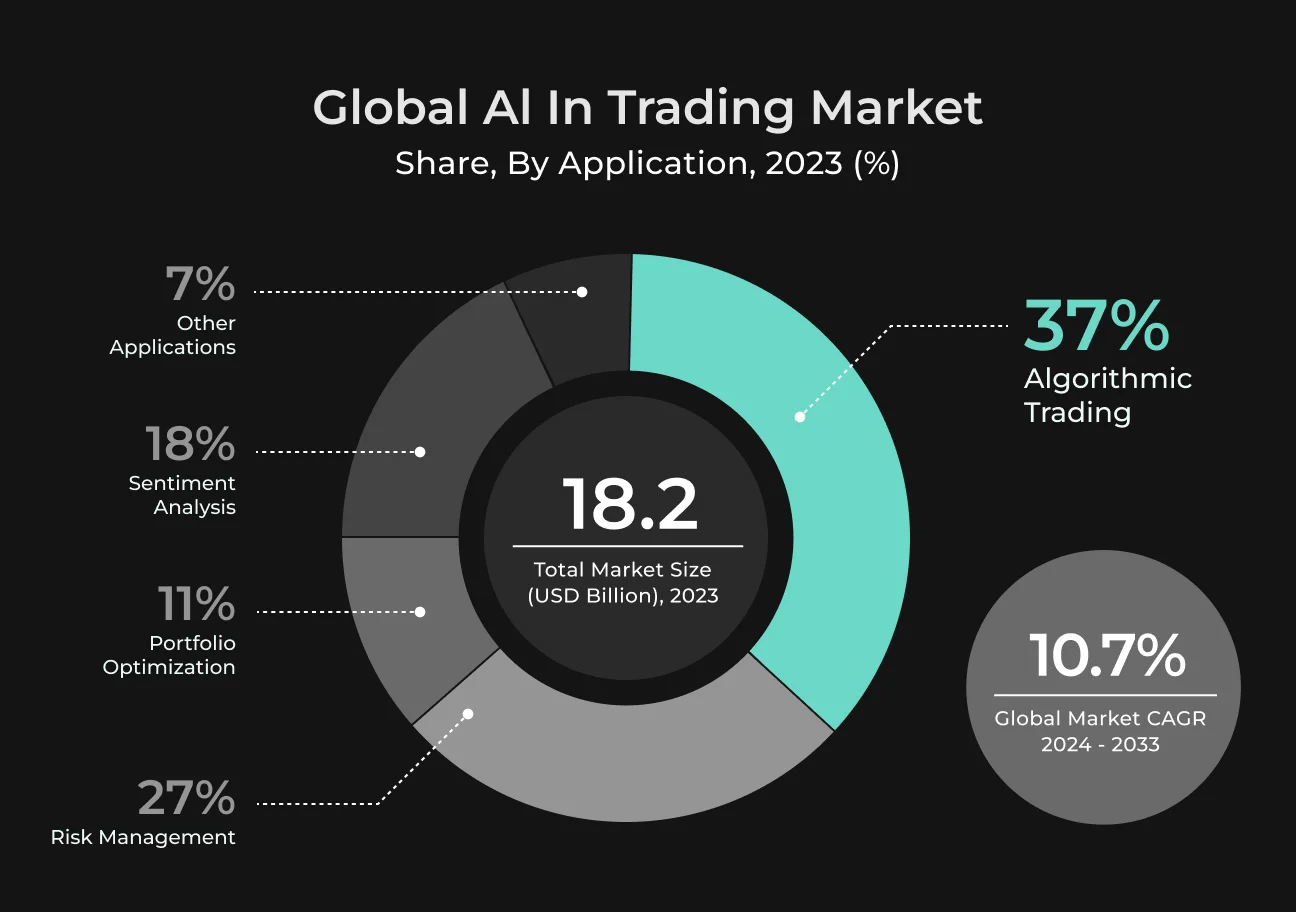
In summary, the integration of AI is set to fundamentally enhance market depth and sophistication. As data-sensitive, high-frequency trading becomes the dominant force in global finance, the industry will shift toward a market defined by speed and predictive accuracy.
This evolution will prompt regulators to intensify their focus on AI-specific risks, particularly concerning market stability and algorithmic transparency. Both technologists and investors now view AI as an indispensable tool for managing risk within increasingly automated and complex markets.
Partner with SapientPro to Build Your AI Trading Bot
SapientPro’s engineers have 9+ years of experience in building and integrating AI-powered solutions into financial workflows. Our team created both complex and simple projects for multiple niches using:
- Artificial intelligence and machine learning;
- Natural language processing, LLMs, and related technologies;
- Big data and scraping solutions, and more.
Partnering with us means getting a team of experienced developers who know how to bring your idea to life. You’ll get quality, performance, and reliability within a single vendor. Interested?
Contact SapientPro today to get a detailed estimate.
Build Your AI Trading Software With SapientPro