All How to Build a Web3 Wallet: Architecture, Standards, and Key Decisions
July 30, 202615 min read


A Web3 crypto wallet is an identity layer, a transaction signer, a gateway to decentralized applications (dApps), and the primary UI for any blockchain-based product. For modern builders, deciding how to configure this component is both a technical and business decision. Selecting the wrong setup ruins onboarding or locks users into rigid networks.
70% of potential customers abandon sign-ups during the onboarding sequence. The drop-off comes from complex setup flows and poorly explained technical terms, which is why wallet architecture deserves treatment as a foundational product decision from day one.
What is a Web3 wallet?
A Web3 wallet is client software that lets users manage blockchain accounts, sign cryptographic transactions, connect to dApps, and interact with digital assets. The software coordinates access without exposing sensitive keys to external parties.
Wallet Action | Cryptographic Mechanism | Business Utility |
| Address Generation | Derives public keys from seed entropy via path standards. | Provides unique deposit coordinates for assets on multiple networks. |
| Key Management | Secures private credentials on-device or via distributed storage. | Prevents unauthorized asset transfers and controls data access. |
| Transaction Signing | Signs payloads using standard cryptographic proofs. | Authorizes on-chain state changes without sending keys to nodes. |
| Balance Tracking | Queries network RPC nodes and parses database state. | Displays updated token balances and digital collectible assets. |
| Ecosystem Linking | Connects browser or mobile environments to smart contracts. | Enables direct interaction with decentralized lending and trading protocols. |
| Identity Representation | Resolves addresses to naming registries and verified profiles. | Establishes portable user logins across independent web3 networks. |
Investors often ask what a Web3 wallet for crypto actually does. Beyond letting users hold and move crypto assets, its broader role is as an access portal to dApps and blockchain-based services. It functions like a passport for DeFi and verified networks, replacing standard passwords with cryptographic proof.
Comparing Web3 Wallet vs Cold Wallet Mechanics
Infrastructure choices split along one line: a Web3 wallet vs cold wallet comparison reveals two distinct security models:
- A cold wallet stores private keys entirely offline on physical hardware, minimizing exposure to remote network intrusions. This is ideal for long-term storage of large reserves.
- A Web3 wallet maintains active connections to browser or mobile software environments to sign live transactions and connect with dApps instantly.
Many organizations use a tiered model. They keep operational funds in a Web3 crypto wallet and transfer surplus assets to offline cold storage. This balances daily liquidity needs with rigorous institutional protection.
Web3 Wallet Types: Which Model Should You Build?
Before starting Web3 crypto wallet development, you must choose a custody and signing model. This choice dictates your engineering timeline, regulatory exposure, and user onboarding friction.
Wallet Model | Key Ownership | Regulatory Risk | User Experience Onboarding |
| Non-Custodial | User-controlled | Low | High friction |
| Custodial | Third-party host | High | Low friction |
| Smart Contract | Programmable code | Medium | Flexible, modern |
| Embedded | Hidden MPC shares | Low to Medium | Seamless, Web2-style |
Non-Custodial Wallet
In a non-custodial Web3 decentralized wallet, the user maintains exclusive control over private keys.
This design matches projects built for self-custody products, DeFi, NFT markets, gaming, and DAO voting networks. It's widely considered the standard for a Web3 safe wallet because it removes the service provider as a target for hackers.
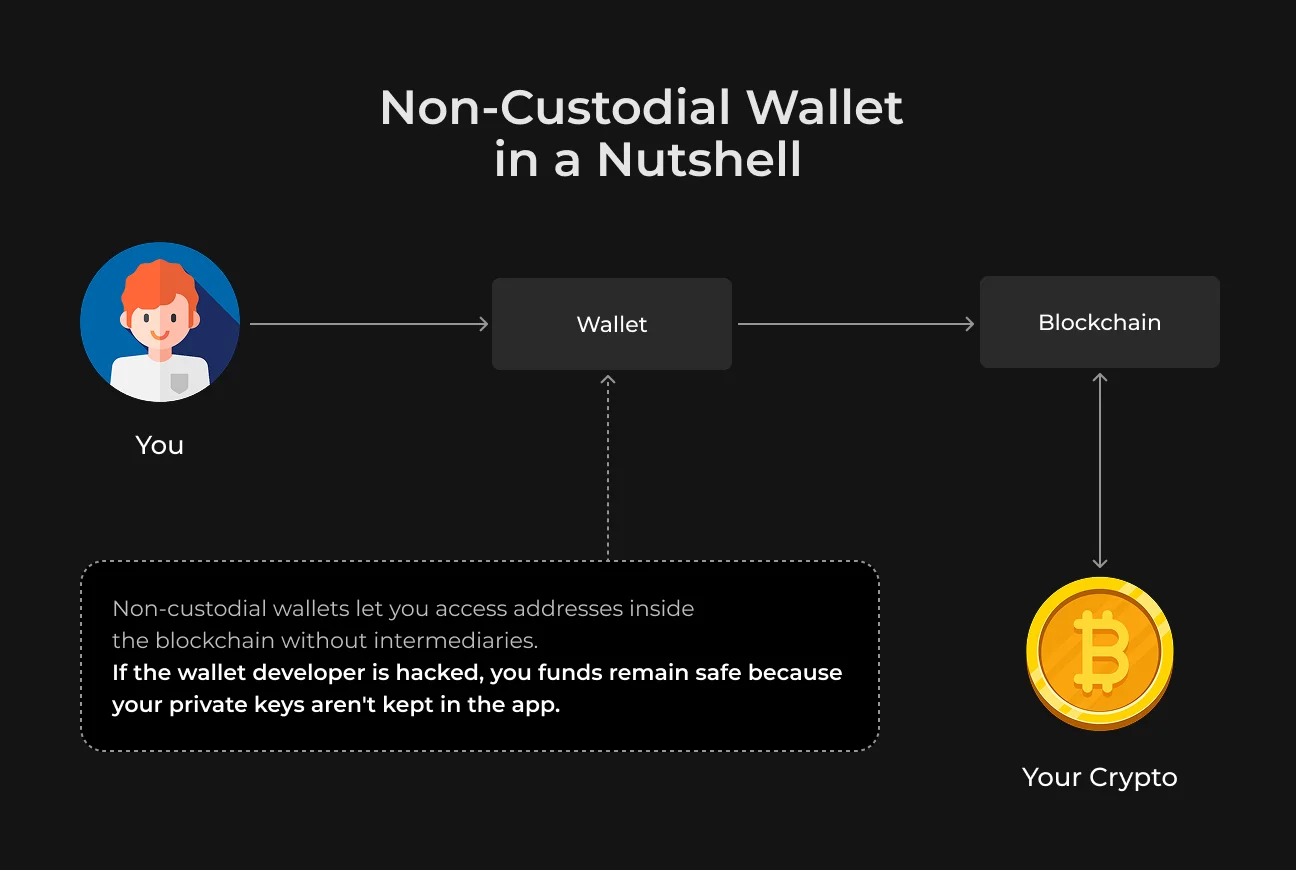
User asset ownership remains absolute here, which lowers regulatory custody liabilities for the operating business and aligns with the trustless principles decentralized networks are built on.
Yet account recovery is exceptionally difficult. The user interface is often intimidating, requiring prior blockchain familiarity. If a user loses their mnemonic recovery phrase, they lose access to their funds forever.
Custodial Wallet
A custodial Web3 crypto wallet relies on the enterprise or a third-party security provider to manage private keys. This Web3 crypto wallet fits FinTech platforms, centralized exchanges, marketplaces, and corporate administrative portals.
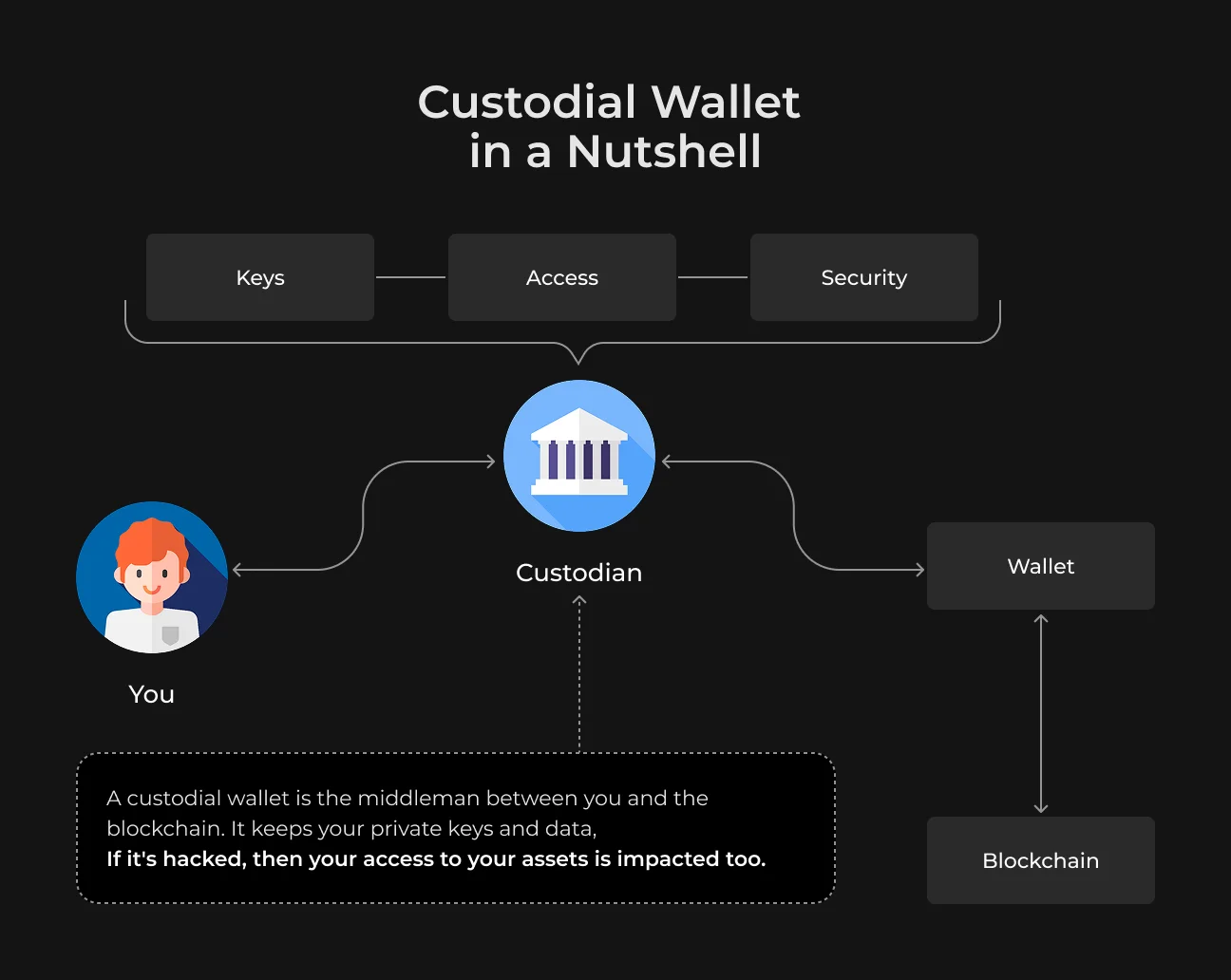
It allows for familiar onboarding: quick sign-ups and Web2-style recovery mechanisms like email password resets. Customer support representatives can directly assist users who run into account access issues.
Despite these advantages, the custodial model introduces significant corporate risks.
The operating company faces high security and compliance burdens. It requires a massive protection infrastructure to prevent data breaches. It also demands strict adherence to regional licensing laws, such as money transmitter rules, depending on where the business operates.
Smart Contract Wallet
A smart contract wallet is a programmable account governed by smart contracts on the blockchain rather than a private key. Corporate structures can set multi-signature parameters directly on-chain.
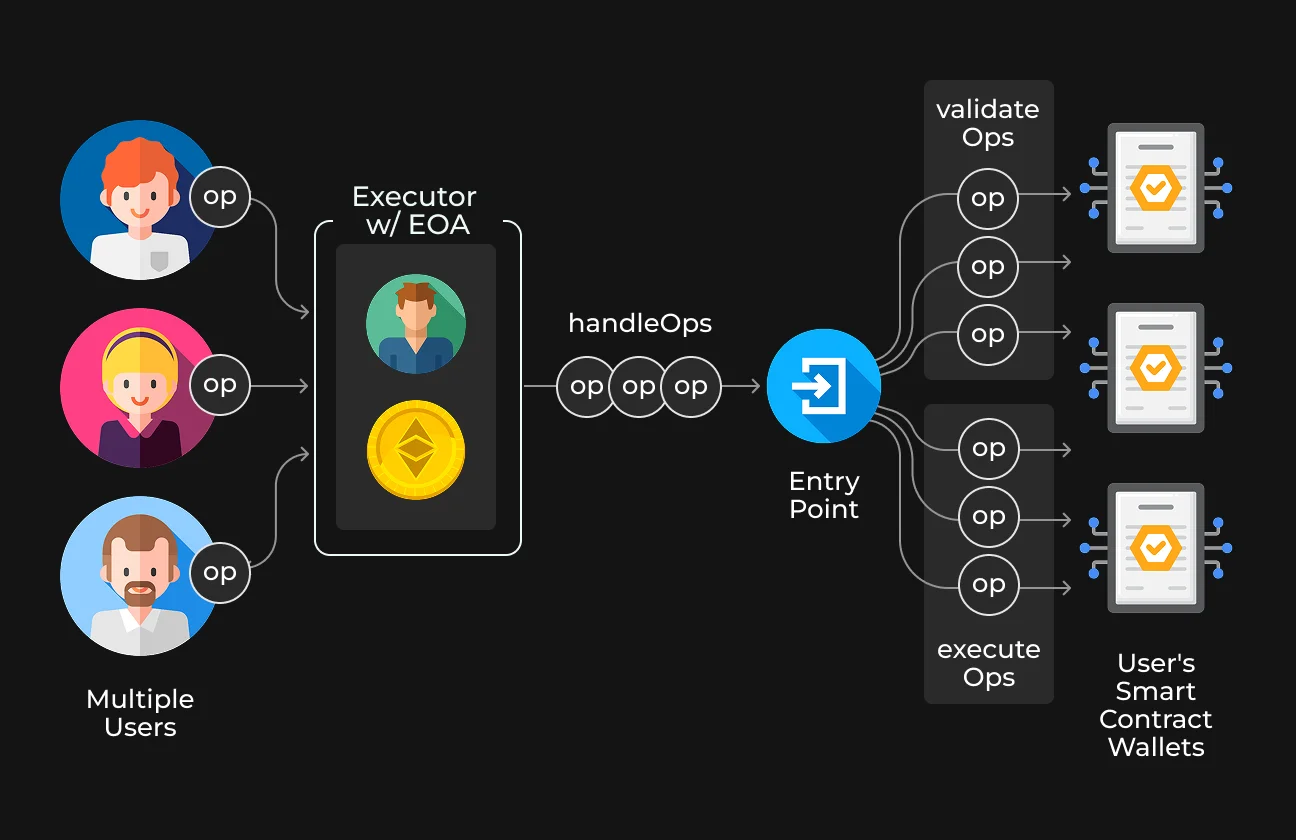
The smart contract wallet uses account abstraction, specifically ERC-4337, to separate the account from the signer. This setup enables advanced capabilities, including:
- Spending limits;
- Social recovery networks;
- Gas fee sponsorship;
- Batching;
- Passkey logins.
Still, transaction fees are higher because executing smart contract logic consumes more network gas. The system requires continuous audits to prevent vulnerabilities in the contract code. Launching smart accounts across multiple chains also introduces significant developer overhead.
Embedded Wallet
An embedded wallet is built directly into an application's user interface, generating keys behind the scenes. It uses social logins or biometric passkeys to insulate users from technical blockchain jargon. It removes onboarding drop-offs, allowing users to interact with a product before dealing with asset security.
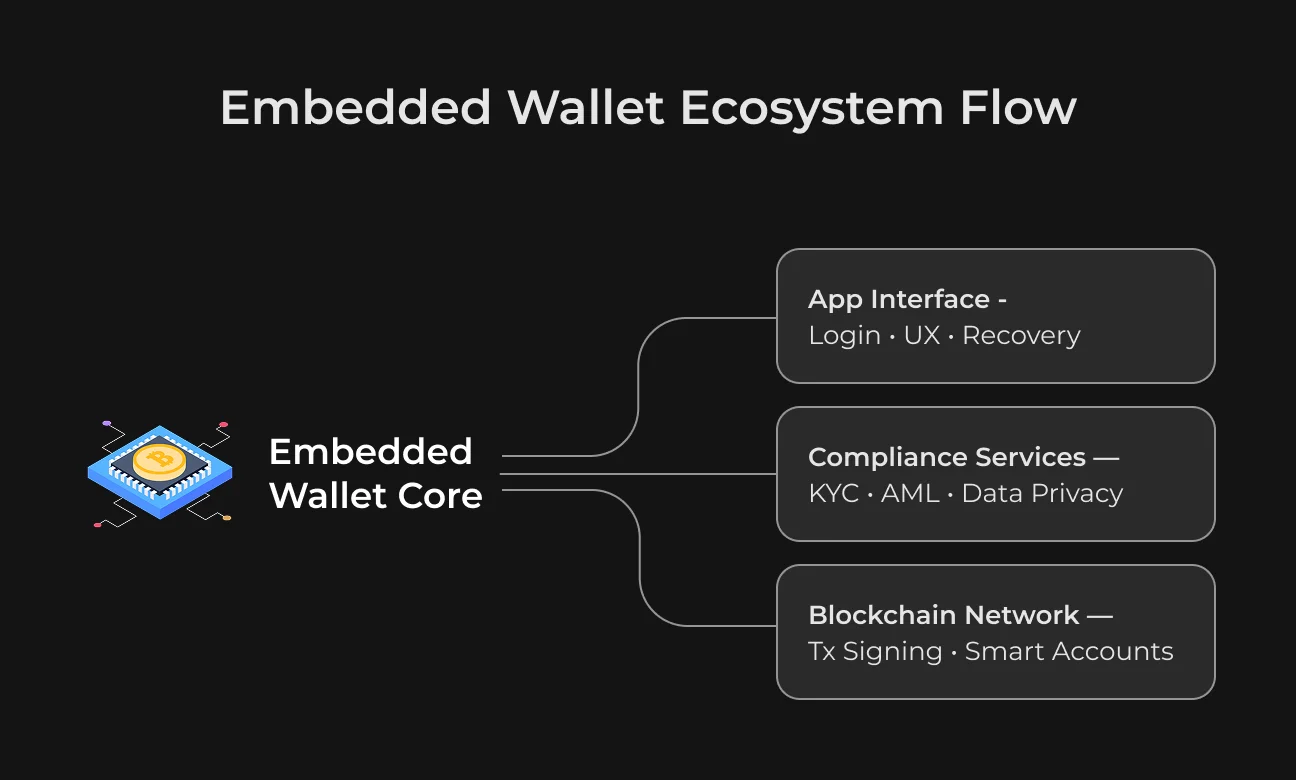
However, this model relies heavily on third-party key infrastructure providers. Key portability is restricted unless users undergo a manual export sequence. Over time, licensing costs from SaaS key providers can scale rapidly as the user base grows.
For consumer-facing apps looking for a practical Web3 wallet example, an embedded Web3 wallet development solution is usually the right path.
Core Web3 Wallet Architecture
Building a production-grade Web3 blockchain wallet requires a modular architecture. Each layer must remain isolated to prevent private key leaks and coordinate block queries.
Layer Component | Architectural Duties | Standard Tech Stack |
| Client Application | Onboarding, address displays, confirmation panels, recovery flows. | React Native, Swift, Kotlin, Flutter, Tauri. |
| Key Management | Private seed generation, secure enclave storage, MPC share splits. | BIP-39 mnemonic systems, Shamir secret algorithms. |
| Blockchain Connection | Node communications, balance fetching, broadcasting, gas estimations. | Alchemy, Infura, QuickNode, The Graph. |
| Backend Services | Push alerts, database indexing, real-time transaction screening. | Node.js, NestJS, Go, PostgreSQL, Redis. |
| Connection Layer | Secure handshakes with dApps, session tracking, remote routing. | WalletConnect SDKs, Web3 provider APIs. |
Client Application
The client application is the user-facing interface, appearing as a:
- Mobile app;
- Browser extension;
- Embedded web interface.
The client application manages onboarding, wallet creation or importing, transaction confirmation screens, and asset displays. It displays token balances and handles dApp connection approvals. To maintain user trust, the interface must present clear transaction previews and secure recovery flows.
Key Management Layer
This layer is the most sensitive portion of Web3 crypto wallet development. It manages:
- Private key generation;
- Seed phrase or mnemonic handling;
- Secure device storage;
- Hardware-backed storage where available;
- MPC or threshold signatures for advanced products;
- Passkeys or biometric unlock;
- Backup and recovery design.
You can develop something like a Web3 Safe wallet only with deep expertise in this layer.
Blockchain Interaction Layer
The blockchain interaction layer links the client application to decentralized networks. This layer is important for:
- RPC providers;
- Node infrastructure;
- Chain indexing;
- Token balance fetching;
- Transaction broadcasting;
- Gas estimation;
- Transaction status tracking.
Because querying blockchains directly is slow, indexing pipelines are used to translate raw block data into clean feeds.
Backend Services
While a simple wallet can run client-side, production apps require supporting backend services. These handle:
- User settings;
- Push notifications;
- Transaction history indexing;
- Token metadata;
- Risk checks;
- Analytics;
- Feature flags;
- Support tools;
- Compliance-related control.
These services are core to Web3 wallet development, not an afterthought.
dApp Connection Layer
Web3 crypto wallets require a secure way to connect with dApps, approve sessions, and sign requests. This layer coordinates handshakes and session states. Here, developers rely on standardized protocols to bridge communication between the browser sandbox and the wallet's signing environment.
Build a Secure Web3 Wallet With SapientPro
Our engineers handle key management, multi-chain support, and protocol compliance from architecture through launch.

Web3 Wallet Standards and Protocols to Consider
To ensure broad compatibility of the Web3 blockchain wallet, your development team must strictly adhere to industry standards. This prevents the lock-in of user assets.
EIP-1193 for the Ethereum Provider API
This standard dictates how a browser extension or mobile web view communicates directly with an active wallet application. In simple terms, the wallet injects a JavaScript object, typically called window.ethereum, into the webpage's context. This object is the API provider.
It makes Web3 wallet integration straightforward because any compliant dApp can interact with the wallet using standard calls. The API itself is lean. Instead of complex multi-method callbacks, EIP-1193 mandates a single asynchronous entry point: request(args).
WalletConnect for Wallet-to-dApp Connectivity
When a user visits a dApp on a desktop screen but stores their keys on a mobile device, standard browser injection fails. WalletConnect solves this. It establishes an encrypted WebSocket channel between the two devices.
The protocol follows the CAIP-25 (Chain Agnostic Improvement Proposal) standard. This agnostic design allows it to work across any blockchain network with a designated namespace, including EVM, Solana, Cosmos, or Bitcoin.
The connection handshake relies on namespaces:
- Proposal Namespaces. The dApp sends a list of mandatory and optional blockchains, methods (like personal_sign), and events it needs.
- Session Namespaces. The mobile wallet inspects these requirements. It can grant the requested permissions or provide access to extra networks if needed. Once approved, a secure cryptographic pairing session starts.
All transaction signing requests are sent as encrypted payloads through a distributed relay server network. The private key never travels over the air, keeping your user's assets protected.
BIP-39 for Mnemonic Phrases
A Web3 crypto wallet builds a secure account starting from raw mathematical entropy. BIP-39 governs how wallets turn that entropy into readable mnemonic recovery sequences.
First, the client software generates a random binary sequence of 128 to 256 bits. It appends a short SHA-256 checksum to this binary string. Next, the system splits this modified string into groups of 11 bits. Each 11-bit group corresponds to an index between 0 and 2047, which maps directly to a word in the standard 2048-word BIP-39 dictionary. This creates the familiar 12 to 24-word seed phrase.
To get the actual cryptographic keys, the wallet feeds the word sequence into a password derivation function. The key derivation follows the formula PBKDF2 (Mnemonic, Salt, 2048, HMAC-SHA512), where 2048 represents the round count.
The software also appends an optional user-provided passcode to act as a salt. This process outputs a 512-bit seed. From this master seed, the client derives an infinite tree of public and private keys using BIP-32 and BIP-44 path standards.
Token Standards
To read and write digital asset states, your Web3 blockchain wallet needs to decode specific smart contract templates. These standard interfaces are defined by Ethereum Request for Comments (ERCs):
- ERC-20. This template represents fungible tokens. It uses standard methods like totalSupply(), balanceOf(address), and transfer(to, value).
- ERC-721. This structure defines unique collectibles or NFTs. Each token has an individual tokenId mapped directly to its owner address.
- ERC-1155. This is a multi-token standard. It allows a single contract to represent fungible assets and non-fungible collections simultaneously. This reduces transaction fees because users can batch multiple token transfers in one execution.
- ERC-4337 (Account Abstraction). This standard turns user accounts from simple cryptographic keys into smart contracts. Instead of signing transactions directly, the user signs a data structure called a UserOperation. Alternative network workers, called Bundlers, pack these operations into standard blocks. Special contracts called Paymasters can sponsor the gas fees, enabling a completely frictionless user onboarding setup.
Proper decoding of these payloads is required to prevent users from signing malicious transfers.
Common Mistakes in Web3 Wallet Development
A single error during the planning phase can compromise user capital and expose your Web3 blockchain wallet to severe liabilities.
Vulnerable Local Storage of Key Material
Storing private keys or mnemonic words in unencrypted browser local storage or simple files is a major security flaw. Malicious scripts can easily extract unencrypted data via:
- Cross-site scripting (XSS);
- Browser malware.
Your security engineers must encrypt key material with strong derivation algorithms like PBKDF2 and rely on hardware-backed storage.
Obscure Transaction Signing Screens
Displaying raw hexadecimal bytecode on approval screens confuses users and invites phishing scams. When transaction details are illegible, users cannot distinguish between a routine login and a malicious token approval. You must design clear transaction screens that explain the action, network fees, and expected outcome.
Rigid Single-Network Client Interfaces
Restricting a Web3 crypto wallet to one blockchain network limits its utility. As users migrate to high-speed Layer-2 networks or alternative chains to avoid high gas fees, single-chain wallets quickly become obsolete. Building a multi-chain address structure from the start prevents expensive downstream rewrites.
Partner with SapientPro for Web3 Wallet Development
SapientPro is a trusted technology partner that designs and builds:
- Custom Web3 solutions;
- Secure smart contract systems;
- Decentralized identity platforms.
We design architectures that let users securely save authenticated data, manage credentials, and share access based solely on explicit consent.
For example, SapientPro built a Web3 social identity platform with strong authentication layers. Our team builds custom identity platforms to minimize data exposure and lower systemic security risks.
We also built a decentralized domain naming system: an ENS-based platform that lets users register Web3 domains, link them to multiple crypto wallets, and manage digital identities.
Our engineers resolved major mid-process protocol changes when ENS updated its smart contracts, delivering a responsive registration flow with clear UI layouts. If your business needs Web3 wallet integration or a custom Web3 wallet development solution, SapientPro can help.
Ready to Start Web3 Wallet Development?
Talk to our team about custody models, standards, and architecture decisions before you write a single line of code.