All Data Lake Architecture: How to Design Scalable Storage for Raw Business Data
September 25, 202610 min read


How can you store growing volumes of raw business data without making it expensive to query or difficult to secure? Logs, operational events, and other raw records can strain traditional databases. Putting them in cloud storage without catalogs, access rules, or quality checks can create a data swamp.
A data lake stores raw data in its original format and separates storage from the compute used to process it. This gives teams room to scale storage and query capacity independently. Current data lake architecture trends include open table formats, automated metadata cataloging, and stronger data governance.
Data lake best practices start with clear storage zones, dataset ownership, access permissions, and security controls. These choices make raw data easier to find and prepare for analytics as volumes grow.
This guide explains the architecture, compares lakes with warehouses, and sets out the steps for data lake implementation.
What is Data Lake Architecture?
A data lake is a centralized repository for structured, semi-structured, and unstructured business data, often stored in its native format. Unlike systems that require a fixed analytical schema before ingestion, a data lake can retain raw records and apply a schema when they are processed or queried.
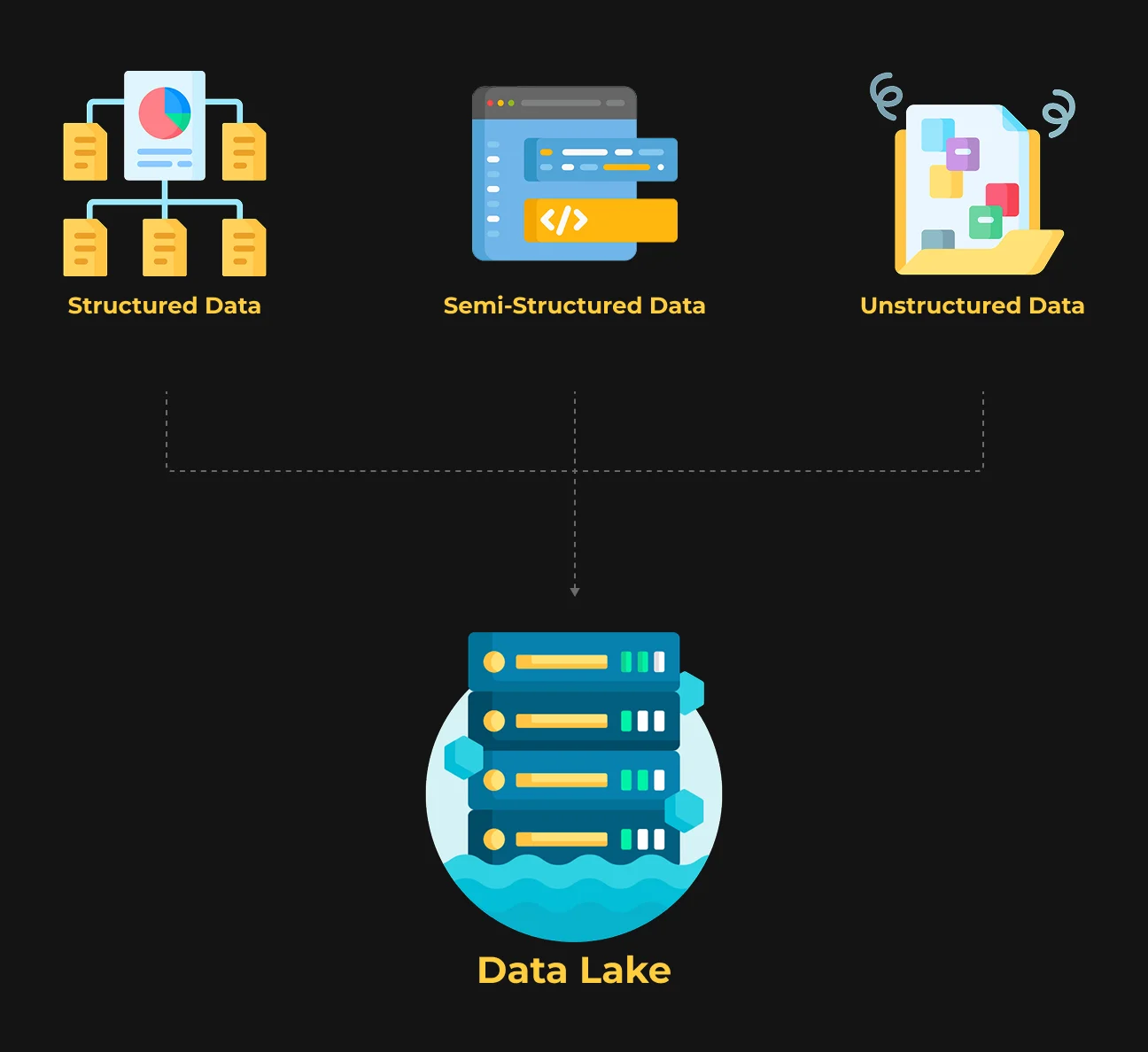
So, what is data lake architecture? The lake is the storage repository; the architecture is the set of systems and controls that move data into it, describe it, process it, protect it, and make it available to users. Its components include:
- Ingestion pipelines;
- Metadata catalogs;
- Processing engines;
- Data lake governance systems;
- Security frameworks;
- Consumption endpoints.
What is a data lake used for? Common applications include:
- Consolidating records from separate operational databases;
- Analyzing several years of operational data;
- Preparing training datasets for machine learning and artificial intelligence;
- Collecting application logs, clickstreams, and IoT sensor streams in real time;
- Joining sales records with web activity to build customer 360 views;
- Staging raw feeds for downstream data warehouses;
- Retaining raw records that may support future analysis.
Managing big data and data lake environments means balancing storage capacity with query performance. At petabyte scale, the design must keep storage costs under control while giving teams practical access to SQL analytics.
Data Lake vs Data Warehouse: Key Differences
The data lake vs data warehouse comparison starts with how each system stores and prepares data.
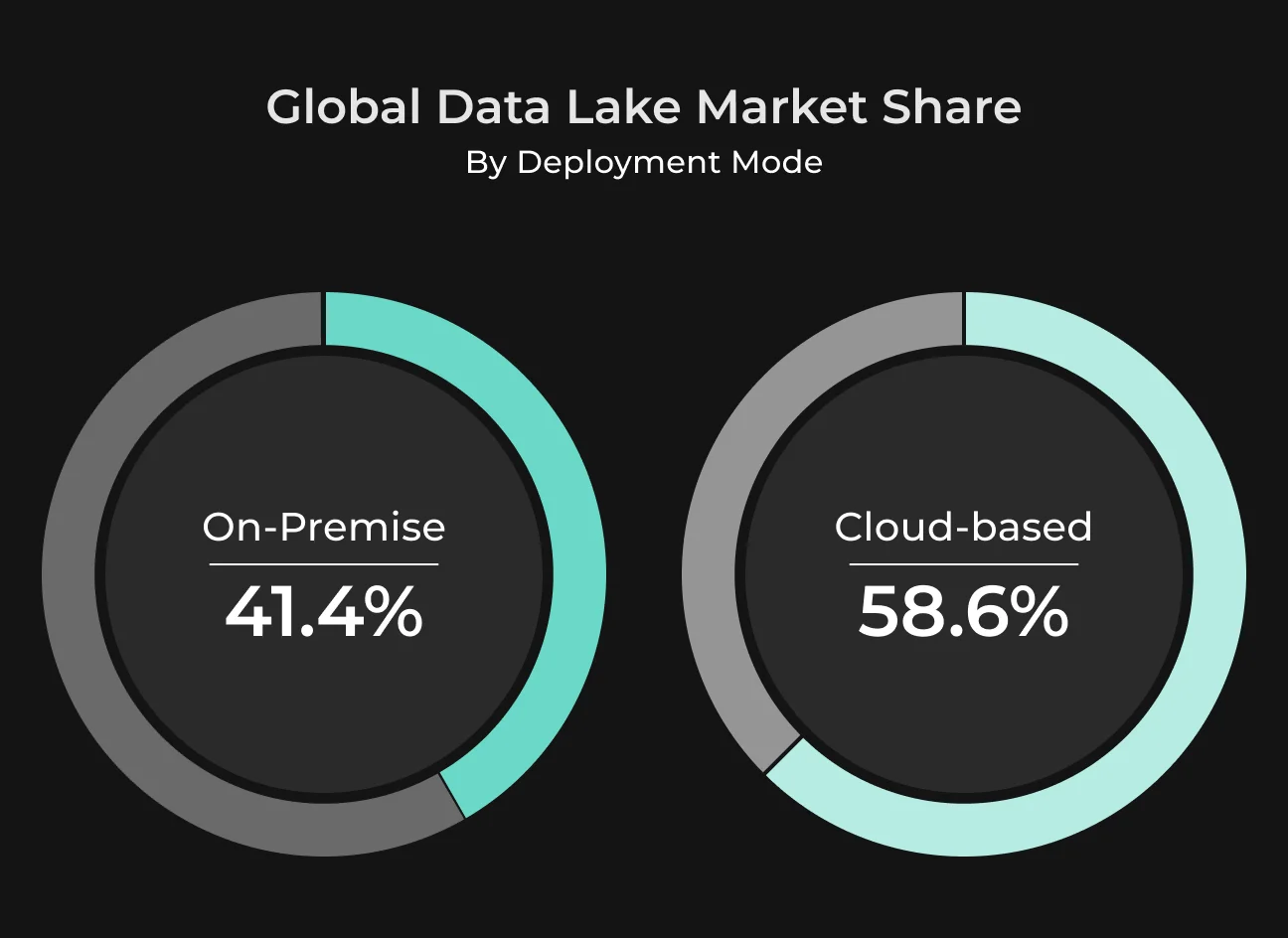
A lake accepts multiple raw formats for later processing; a warehouse stores modeled data for repeatable reporting. The global data lake market stood at $16.6 billion in 2026 and is projected to reach $59.9 billion by 2030. The data warehousing market is projected to reach $99.2 billion by 2034.
The difference between data lake and data warehouse architecture is often described through schema timing:
- Data warehouse: schema-on-write applies a defined structure before data enters warehouse tables. This supports standardized SQL reporting but requires modeling and transformation during ingestion.
- Data lake: schema-on-read lets teams store raw files first and define how to interpret them when they process or query the data.
Google Cloud's Architectural Guidance on Storage Systems provides further technical detail.
Technical Parameter | Data Lake | Data Warehouse |
| Supported Data Types | Raw, structured, semi-structured, unstructured (CSV, JSON, Parquet, video, logs) | Cleaned, transformed, strictly structured relational tables |
| Schema Enforcement | Schema-on-Read (applied during query execution) | Schema-on-Write (applied before storage) |
| Storage Cost Profile | Low cost per gigabyte using cloud object storage | Higher cost per gigabyte due to tightly coupled compute resources |
| Ingestion Pattern | Extract, Load, Transform (ELT) | Extract, Transform, Load (ETL) |
| Primary Users | Data scientists, machine learning engineers, data engineers | Business analysts, BI developers, operational leadership |
| Analytical Agility | High flexibility for exploratory data science and AI training | High speed for standardized SQL reporting and executive dashboards |
A combined data lake data warehouse architecture can use a lakehouse to support both raw storage and managed analytical tables. Hybrid data lake architecture frameworks use open table formats such as Apache Iceberg or Delta Lake on object storage to add ACID transactions without moving all data into a conventional warehouse.
Components of Scalable Data Lake Architecture
Data lake business benefits depend on how the ingestion, storage, catalog, processing, and access layers work together. Separating storage from compute lets teams increase capacity in one layer without scaling the other at the same rate.
Data sources and ingestion
The ingestion data lake layer accepts records from multiple sources and transport protocols, including:
- Transactional databases;
- SaaS API endpoints;
- Mobile application logs;
- Binary documents;
- Web clickstreams;
- Real-time IoT event streams.
Data lake integration typically uses three ingestion patterns:
- Batch Ingestion. Scheduled extracts move files from databases or legacy drop zones.
- Streaming Ingestion. Event platforms such as Apache Kafka or AWS Event Hubs capture continuous operational events with low latency.
- Change Data Capture (CDC). Pipelines read database transaction logs to keep stored records in sync with source systems without repeatedly scanning production tables.
Decoupled ingestion pipelines make it easier to handle source schema changes before they affect storage and downstream jobs. SapientPro's ETL development services can help design and build ingestion pipelines for your source systems.
Scalable data lake storage and data zones
Cloud object storage underpins modern data lake storage. Options include AWS S3, Azure Data Lake Storage Gen2, Google Cloud Storage, and MinIO for on-premise data lake solutions. Object storage allows storage capacity to grow independently of the compute clusters that process and query files.
Many teams organize storage into three medallion data zones:
- Raw Zone (Bronze).
Stores ingested objects in their original form. Keeping source files supports audits and reprocessing after a schema change. Some pipelines store fields as strings or binary values to tolerate schema drift.
- Cleansed Zone (Silver).
Contains validated, deduplicated, and normalized records. Jobs handle missing values and formatting errors and may convert files to columnar formats such as Apache Parquet or ORC. Data scientists can use these datasets for predictive modeling.
- Curated Zone (Gold).
Holds aggregated datasets, star schemas, or specialized data marts for executive dashboards and BI tools.
Microsoft Azure Architecture Center guidance describes the medallion pattern for moving raw files into validated datasets. Converting CSV or JSON files to columnar Parquet in the silver and gold zones can reduce scanned data during analytical queries and reduce storage footprint.
This multi-tiered zone layout is a data lake architecture pattern for 2027.
Metadata, catalog, and data discovery
Without a catalog, analysts cannot reliably locate or interpret files across millions of stored objects. In 2027, data lake software needs a centralized metadata catalog. Examples include AWS Glue Data Catalog, Hive Metastore, and Databricks Unity Catalog.
The catalog and related metadata systems record:
- Schemas and field data types;
- Data provenance, source systems, and processing lineage;
- Dataset owners and team contacts;
- Classifications for sensitive fields, including PII and financial metrics;
- Searchable business definitions.
Automated crawlers inspect storage locations and update schema information as datasets change. Catalog entries also give teams a way to identify files that have not been indexed.
Processing and transformation
Processing jobs turn bronze data into validated silver datasets and curated gold tables. Many deployments use ELT: data lands in object storage before distributed compute engines run transformations.
Typical transformations include:
- Deduplication;
- Missing-field filtering;
- Cross-table joins;
- Record enrichment;
- Business aggregations.
SapientPro's data transformation services can help configure transformation jobs and compute workloads for these pipelines.
Consumption layer
The consumption layer gives business and technical teams access to processed data. Different tools can query the same stored datasets for different workloads:
- SQL Engines. Trino, Presto, and Databricks SQL Warehouses query gold tables.
- Business Intelligence. Power BI and Tableau use gold data marts for dashboards.
- Machine Learning Frameworks. TensorFlow and PyTorch use silver-zone datasets in training pipelines.
- Operational APIs. Internal services use curated records in applications or send metrics to CRM tools.
Creating a data lake in stages makes each layer easier to test before more sources depend on it. When planning how to build a data lake, set data quality checks and run load tests early so that ingestion and query performance can be measured as volume grows.
Turn Raw Data Into Usable Insights
We design data lakes that keep records accessible, secure, and ready for analysis.
How to Build a Data Lake That Can Scale
A data lake strategy should define data sources, expected volumes, query workloads, access policies, and retention rules before large-scale ingestion begins. The phases below show how to build a data lake from those requirements.
Implementation Phase | Action Steps | Primary Deliverables |
| Phase 1: Strategy & Assessment | Audit source systems, estimate data volumes, assess business query patterns. | Implementation roadmap, compliance matrix, vendor platform choices. |
| Phase 2: Storage & Network Setup | Provision object storage, set up IAM boundaries, define Bronze/Silver/Gold directories. | Secure object storage layout, network endpoints, retention rules. |
| Phase 3: Ingestion Engineering | Build CDC streaming pipelines, set up event queues, deploy batch schedules. | Fault-tolerant ingestion pipelines with automated alert triggers. |
| Phase 4: Cataloging & Security | Deploy metadata crawlers, configure fine-grained access policies, enable lineage tracking. | Searchable metadata catalog, column-level security rules. |
| Phase 5: Processing & Lakehouse | Write Spark or SQL transformation jobs, convert raw objects to Iceberg/Delta formats. | Automated ELT pipelines, silver/gold target tables. |
| Phase 6: Consumption & BI | Connect BI applications, expose SQL query endpoints, establish user access roles. | Operational executive dashboards, data science sandboxes. |
Data Lake Security and Governance
Data lake security starts with access rules for stored objects and the systems that query them.
Research shows that 80% of data lakes fail to deliver business value because of weak metadata management. Without metadata, quality checks, or named dataset owners, stored files can become a data swamp. The effects include:
- Slower queries;
- Rising storage costs;
- Less trust in reported figures.
Centralized policy management helps teams apply permissions consistently. AWS Lake Formation, for example, centralizes access rules for data in object storage. Depending on the platform, data lake governance systems can control access at the database, table, column, row, or cell level.
Data Lake Security and Governance Best Practices
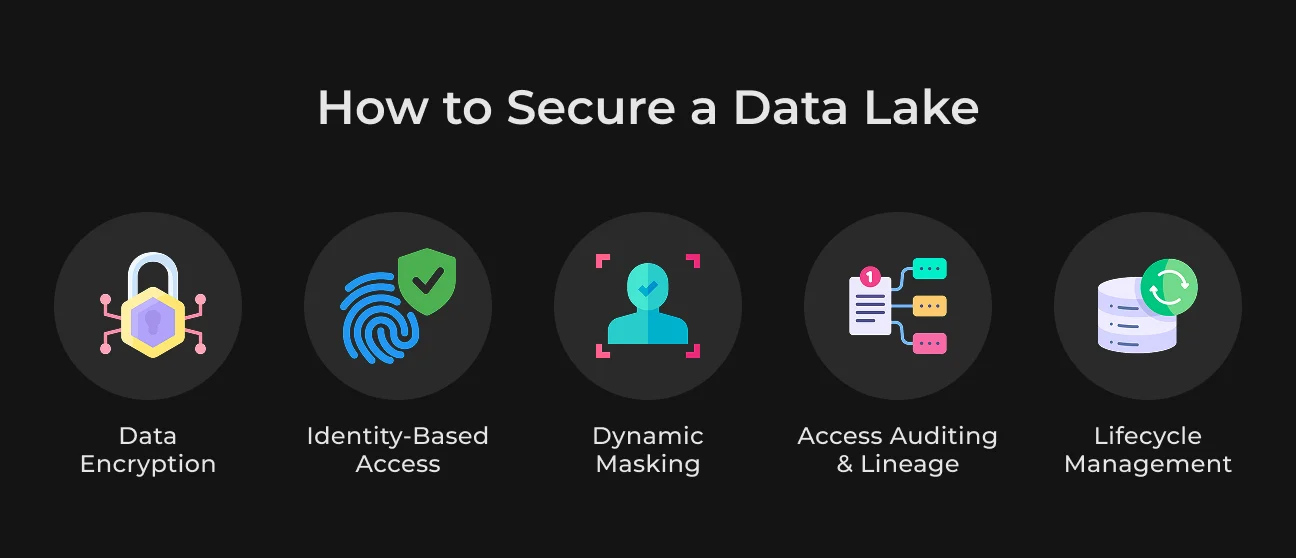
Key controls for data lake solutions include:
- Data Encryption. Encrypt stored data with server-side encryption (AES-256) and data in transit with TLS 1.3.
- Identity-Based Access. Use Role-Based Access Control (RBAC) and Attribute-Based Access Control (ABAC) through identity providers such as Microsoft Entra ID or Okta.
- Dynamic Masking. Hide personally identifiable information (PII), such as social security numbers or credit card details, from roles without access rights.
- Access Auditing & Lineage. Keep immutable logs of queries, file reads, and schema changes to support reviews against applicable privacy requirements.
- Lifecycle Management. Move infrequently accessed raw objects to archival tiers such as S3 Glacier and purge records when their retention periods expire.
Apply these controls when data enters the lake. Catalog entries, ownership, and access rules help authorized teams find and use datasets while restricting sensitive records.
Data Lake Business Benefits and Use Cases
These data lake use cases show what teams can do with raw and processed datasets. The stated business outcomes depend on data quality, the processing pipeline, and how the resulting data is used.
Enterprise Use Case | Technical Capability | Business Outcome |
| Customer 360 Modeling | Joining web clickstreams, support tickets, POS transactions, and CRM records. | Improves customer retention rates and increases cross-sell conversions. |
| Historical BI Reporting | Retaining multi-year transaction data in low-cost Parquet formats. | Delivers long-term trend analysis without expensive warehouse scaling. |
| AI & Machine Learning | Storing uncompressed historical datasets, raw media, and sensor records. | Accelerates training cycles for predictive ML models. |
| Log & Security Analytics | Ingesting real-time application logs, security events, and cloud server metrics. | Lowers Mean Time to Detect (MTTD) cyber threats and platform outages. |
| IoT Telemetry Processing | Collecting continuous time-series streams from field machinery economically. | Powers predictive maintenance systems, reducing unplanned operational downtime. |
| Data Warehouse Staging | Ingesting and landing raw bulk feeds before structured transformation. | Offloads expensive staging compute workloads from relational data warehouses. |
| Generative AI & RAG | Storing unstructured PDF manuals, audio transcripts, and vector embeddings. | Powers enterprise Retrieval-Augmented Generation engines with internal records. |
Common Data Lake Challenges
These data lake challenges have specific technical causes. Address them in the architecture and operating procedures before the number of data sources grows.
Operational Challenge | Technical Cause | Recommended Architectural Response |
| Data Swamp Risk | Absent metadata catalogs, missing dataset owners, missing quality rules. | Deploy automated crawlers, mandate dataset ownership, enforce data contracts. |
| Low-Quality Data | Unvalidated ingestion feeds, unhandled null values, missing schema checks. | Implement Silver-zone validation checks, quarantine corrupt records automatically. |
| Runaway Cloud Expenses | Unoptimized query scans, uncompressed JSON storage, active compute clusters. | Compress objects to Parquet, enforce partition pruning, configure auto-stopping compute clusters. |
| Slow Query Latency | Millions of tiny uncompacted files, missing table partition keys. | Run file compaction jobs, optimize partition layouts, apply vectorised query engines. |
| Duplicate Event Ingestion | Network retries in streaming jobs, non-idempotent ingestion pipelines. | Use Delta/Iceberg primary key merge options, enforce deduplication during Silver staging. |
| Access Control Sprawl | Decentralized bucket permissions, untracked object copies containing PII. | Centralize access policy management via AWS Lake Formation or Unity Catalog. |
| Broken Downstream Tools | Source schema modifications changing column types unexpectedly. | Adopt schema evolution rules in open table formats, enforce Bronze-tier schema validation. |
| Cloud Vendor Lock-In | Proprietary file formats and platform-bound catalog engines. | Adopt open table formats (Apache Iceberg, Delta Lake) and open interfaces. |
Choose data lake software with the controls your operating model requires.
Projects with strict privacy policies may use on premise data lake solutions based on MinIO or private cloud infrastructure. Data lake technology choices should also account for how teams will catalog, secure, process, and query larger volumes over time.
How SapientPro Helps You Build a Data Lake
SapientPro works on storage design, distributed ingestion and processing pipelines, and data lake governance. Our data engineering work covers:
- Assessing existing databases, APIs, files, and analytics infrastructure;
- Designing scalable storage architecture;
- Implementing ETL/ELT and ingestion pipelines;
- Integrating separate systems;
- Cleaning and transforming data;
- Connecting the lake to warehouses, analytics tools, dashboards, or AI applications;
- Modernizing existing data infrastructure.
We can help define the architecture and build the pipelines and controls needed to keep data accessible as storage volumes grow.
Build Secure Foundations for Data Analytics
Set up storage zones, permissions, and pipelines before adding more data sources.