All AI Governance in Financial Services: Risk, Compliance, and Audit Trails
October 13, 202610 min read


AI governance in financial services defines who owns an AI system, where it can be used, how it is tested, and what evidence the firm keeps. These controls help banks and fintech firms investigate errors, explain decisions, and manage changes after deployment.
Consider a loan decision reviewed six months later. The model and customer data may have changed. An auditor needs the version and inputs used at the time, the original output, and any human override. Current model documentation alone cannot answer those questions.
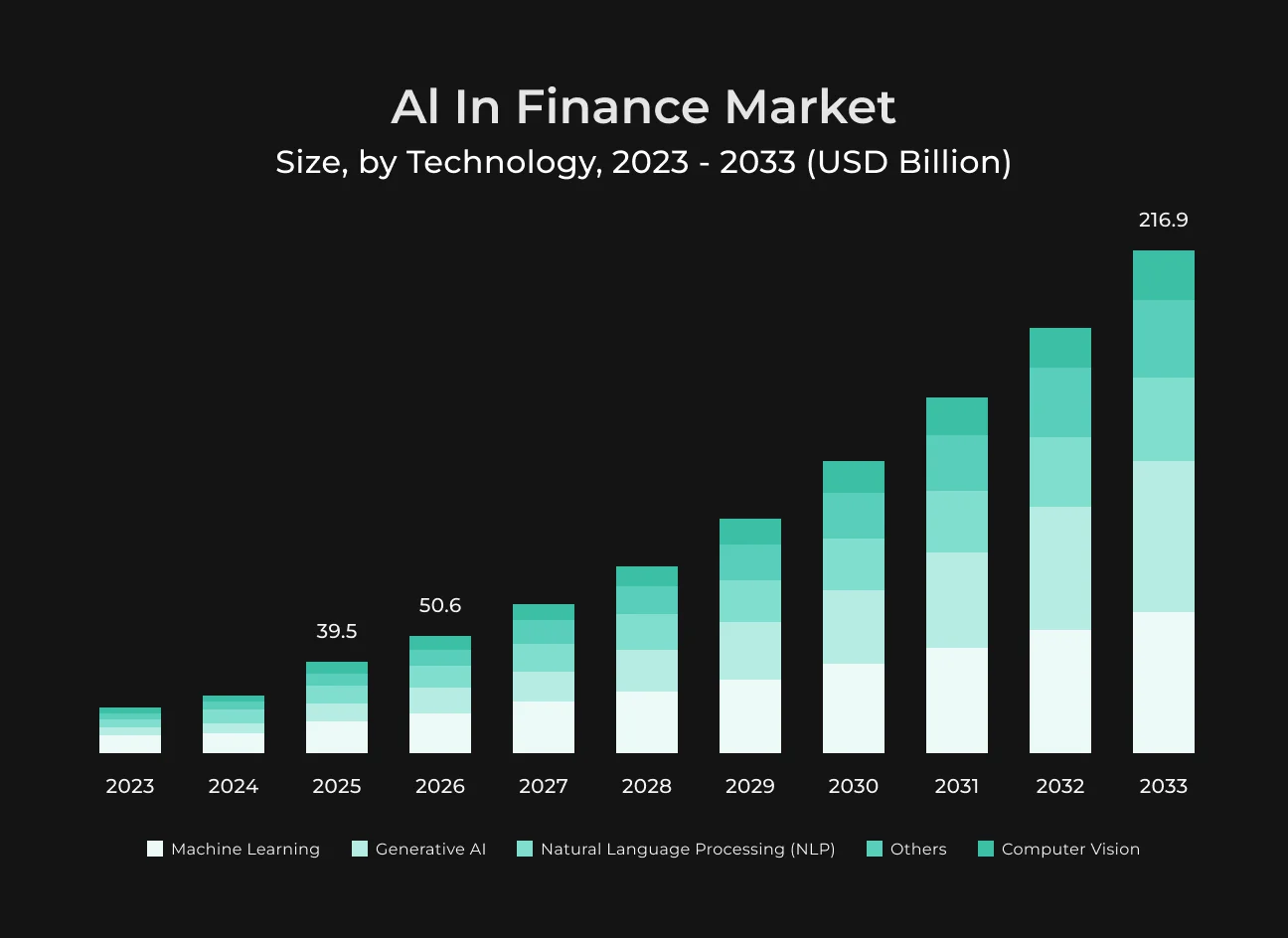
The Cambridge Centre for Alternative Finance’s 2026 global report found that 81% of surveyed financial services firms were adopting AI at some level, with 40% scaling or transforming their operations. Yet an explainability gap remains: 78% of surveyed regulators rated explainability as critical or important, while 50% of industry respondents reported adopting explainable AI methods.
This guide explains how AI risk management finance practices can improve control and make AI decisions easier to audit.
What AI Governance Means in Financial Services
In a financial firm, AI governance begins with a clear owner for each system.
A model cannot move into production without a person or team responsible for it. The firm also needs a clear record of why the model exists and the limits of its use. Validation checks that the model is ready for production, and data rules govern the information it uses.
After deployment, teams track how the model behaves in real use and control who can access or change the system. When an output affects a customer or a financial decision, the firm needs an explanation it can defend later. Any human override stays in the record. That history helps reconstruct an incident without relying on memory or incomplete notes.
When a model leaves production, the firm records the date and who approved its retirement.
AI governance does not replace cybersecurity or data governance. Model risk and compliance teams continue to handle their own areas. AI governance ties those controls to the same system, so ownership stays clear after deployment.
AI Financial Risk Management: Where New Risks Appear
Financial firms are giving AI risk more attention.
In the Bank of England’s 2026 H1 Systemic Risk Survey, 32% of respondents included AI-related risks among the five with the greatest potential impact on the UK financial system. That figure rose by 11 percentage points from the previous survey.
Traditional software controls do not capture all of these risks.
They can confirm that an application is running correctly or that access is restricted, but neither control shows if the model is still producing reliable outputs. Model behavior can shift after release even when the application itself remains stable.
Model and Decision Risk
Validation only shows how a model behaved under the conditions used for testing.
Those conditions do not stay fixed.
The customer mix shifts and error rates may rise even though the application shows no technical failure. That is where model drift becomes a business risk, because the model can keep producing outputs after the conditions used during validation have changed.
A separate problem appears when teams stretch a model beyond the use case it was approved for. A credit model tested on one borrower population may later support decisions for a group that barely appeared in the validation sample.
In that situation, the old test results say little about the new use. The bank needs fresh validation based on the population and decision context the model now serves.
Data, Bias, and Explainability Risk
Model quality depends heavily on the data used for scoring.
In lending, gaps in repayment history or income data can distort the result before the model reaches a decision. Historical records may also reflect approval patterns that a firm would not accept today. Removing a protected characteristic does not eliminate bias when another field serves as a proxy.
Explainability becomes important when a customer or reviewer challenges the outcome. The firm needs enough evidence to show how the model arrived at that specific result. Because that review may involve sensitive customer records, access to the supporting evidence needs tight control.
Generative AI and Third-Party Model Risk
Generative AI brings risks that look quite different from errors in a conventional predictive model. A support assistant may invent a policy detail and present it with complete confidence. Prompt injection can steer the model through instructions hidden inside uploaded files or external content.
Control becomes harder when the institution depends on an external foundation model provider.
The model or API may change even when the bank has made no update to its own application, and the same prompt can start producing a different output. That makes fresh testing necessary after provider-side updates.
Customer data in prompts needs extra care when an external provider processes it.
NIST’s Generative AI Profile notes that GenAI can introduce new risks and make existing ones more severe. It recommends managing them throughout the AI lifecycle.
AI Governance Requirements for Financial Services
AI governance for banking varies across markets. In the EU, the AI Act classifies some financial uses as high risk. Creditworthiness assessments fall into this category, along with certain life and health insurance applications. The main Annex III requirements start on December 2, 2027.
In the U.S., firms still rely on existing lending rules and banking guidance for AI.
Under Regulation B, lenders need to explain why they denied credit even when an algorithm helped reach the decision. Federal banking agencies also updated their model-risk guidance in April 2026. It covers traditional quantitative models and non-generative AI, excluding generative and agentic AI.
Canadian banks already work under existing privacy and risk rules. From May 1, 2027, Guideline E-23 will explicitly include AI and machine-learning models in OSFI’s model-risk rules.
Maintain an AI and Model Inventory
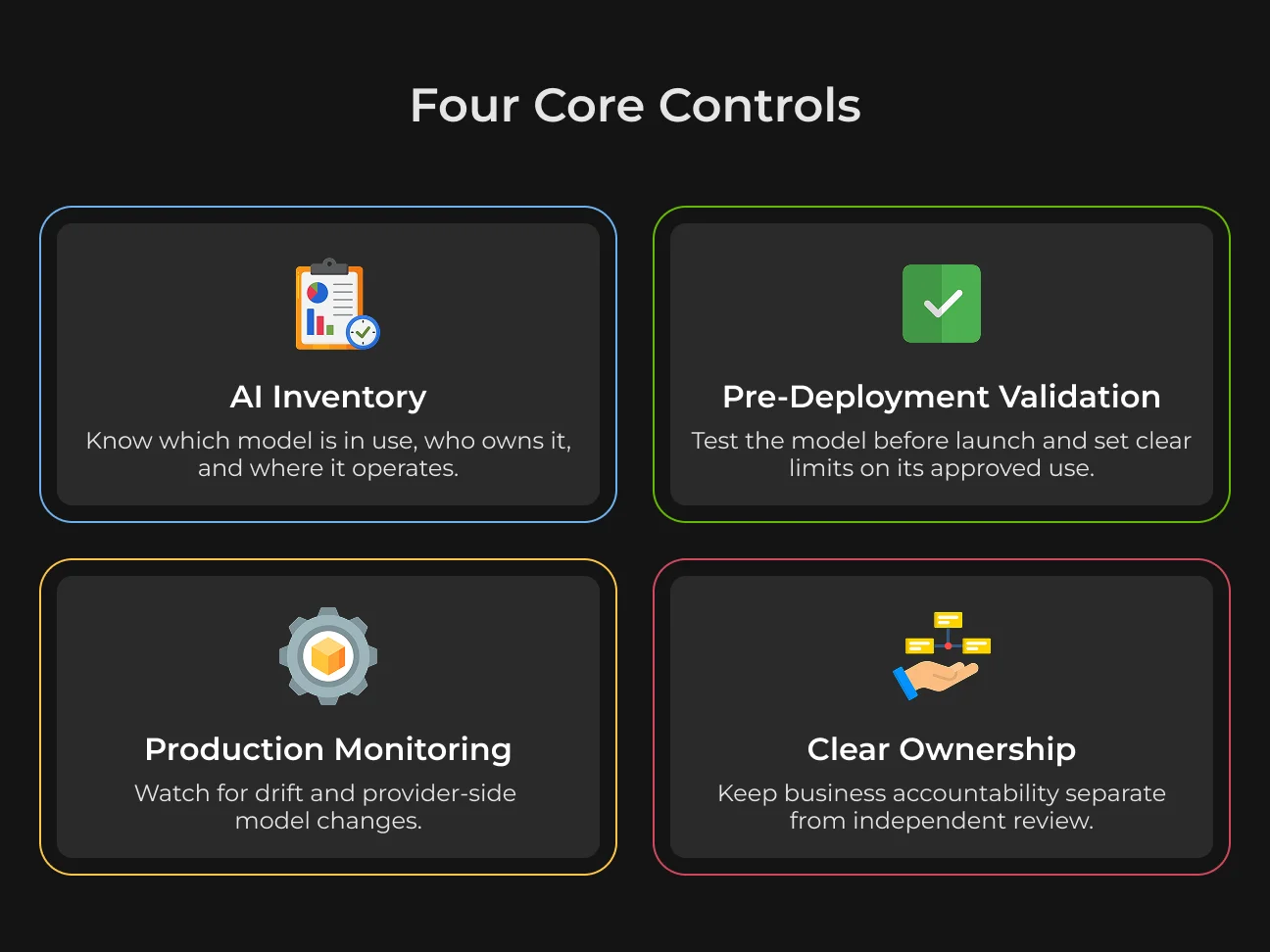
An AI inventory shows which system was in use when a particular decision was made.
Each entry names the owner and purpose, then identifies the exact model version in use.
For a third-party system, the provider goes in the same record. The inventory also links the model to the business process and source data. Its risk rating sets the level of oversight, and the deployment status shows where the system currently stands.
Current U.S. banking guidance describes a comprehensive model inventory as common industry practice. Canada’s E-23 goes further and requires firms to update the record when a model’s use or performance changes.
Assign Clear Ownership and Approval
Compliance cannot be left to a generic AI team. The business owner is responsible for how the model is used, with engineering handling the technical work. Regulatory or security issues go to the team responsible for that area.
Internal audit stays out of day-to-day approval and checks how the governance process works in practice. U.S. banking guidance expects clear accountability and enough distance between model development and validation. Canada’s E-23 also keeps model ownership separate from independent review, and the owner does not automatically approve the model.
Under the EU AI Act, high-risk systems need active human oversight. The person in that role must have enough authority to question an output and stop the system when a serious issue appears.
Validate Models Before Deployment
Before a model goes live, reviewers need evidence that it is fit for the intended use.
Reviewers compare its results with a suitable benchmark and challenge assumptions made during development. For customer-facing decisions, the review may include checks for unfair outcomes across relevant groups.
Robustness testing checks how the model behaves outside its normal operating range. Reviewers also need enough detail to defend a result later. Clear limits on use prevent teams from applying the model to a new business case without another check.
U.S. banks generally validate models before first use and may use benchmarking or interpretability checks where those methods help. Under Canada’s E-23, major data changes or performance breaches can send a model back for review.
Monitor AI After Deployment
Production data shows when a model moves outside its approved performance range. A rise in overrides or weak outputs in routine cases may reveal a problem before aggregate performance metrics show a decline.
The incident record should point to the model version in use at the time. Canada’s E-23 specifically covers model drift and provider-side version updates. For EU high-risk systems, logs generally need to be kept for at least six months unless another law sets a different period.
NIST’s voluntary AI RMF is built around four functions — Govern, Map, Measure, and Manage.
What an AI Audit Trail Should Record in FinTech
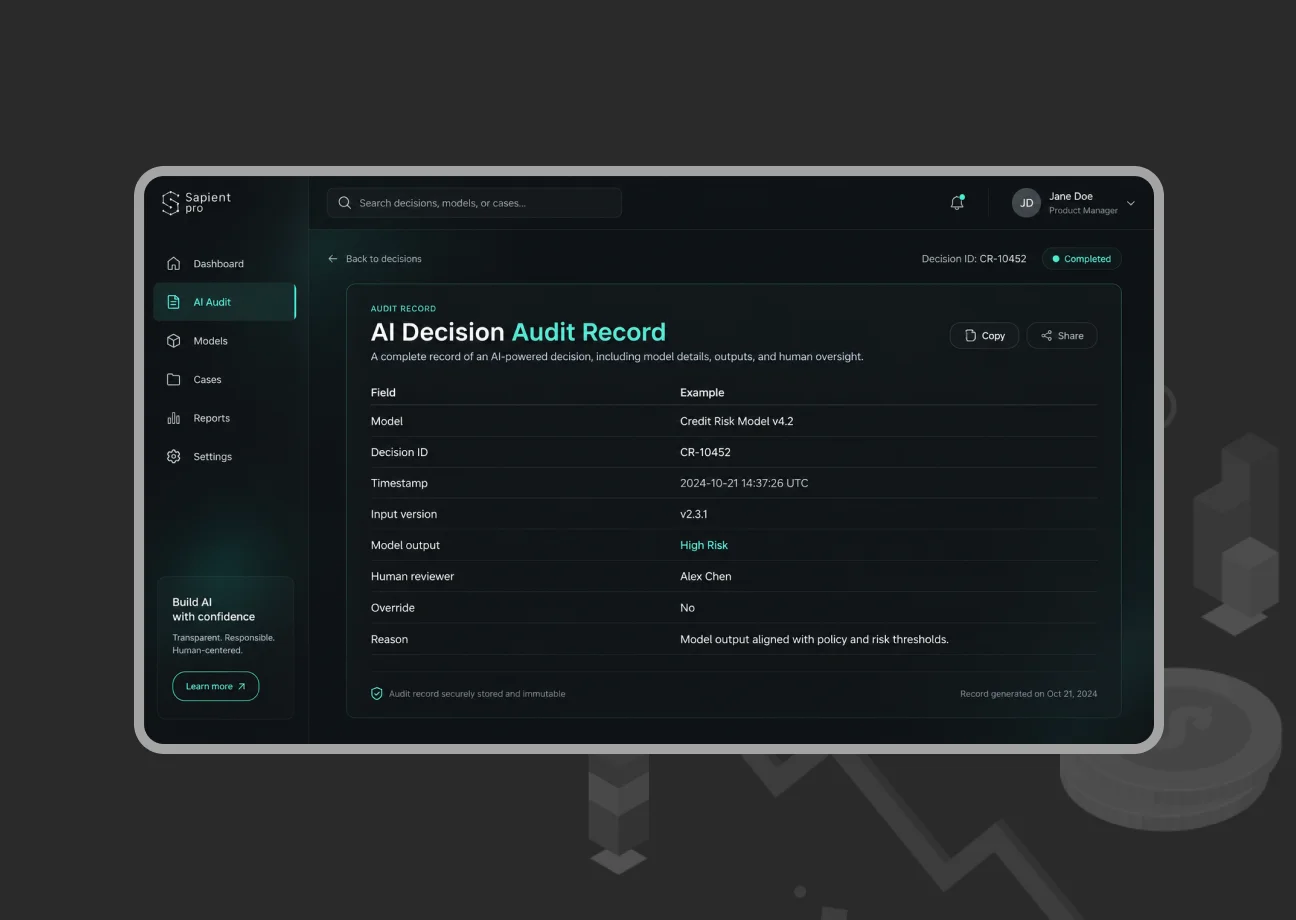
An audit trail needs to recreate the conditions around a past AI decision, even after the system has changed. A score or generated answer by itself gives an auditor very little context. The record should identify the system that produced the result and show any human change made later.
Model and Configuration Records
For every decision, the audit trail needs the exact model version that was running at the time. Configuration also needs to be captured, because the same model can behave differently after a parameter or system-setting change. In LLM workflows, the record may also include the system prompt or other instructions that shaped the response.
The deployment date shows which release was active. The same record also states the business purpose approved for that version.
Input and Output Records
Audit logs do not need a second copy of every customer record. A reference ID can point back to the original source, which limits unnecessary duplication of sensitive data.
The output needs to stay tied to the time it was produced. For scoring models, that means preserving the score used in the case. In a RAG workflow, reviewers also need to know which documents or context fed the response.
Human Decisions and Overrides
The audit trail records each point where human judgment changed the model’s result. It records the reviewer and the action taken, so the final outcome does not look like it came from the model alone.
For an override, the log captures the reason and any escalation that followed. Auditors can then trace the case from the original model output to the final human decision.
Model Changes
The change log needs to show which model version was active before and after an update. It should also keep the validation result used to approve the new release.
Rollout and rollback dates help tie later decisions to the right version. The approval record shows who authorized the change.
For EU high-risk systems, the AI Act generally requires automatically generated logs to be kept for at least six months, unless another law sets a different period. Financial institutions can keep those logs with the regulatory records they already maintain.
How to Ensure AI Compliance in Financial Services
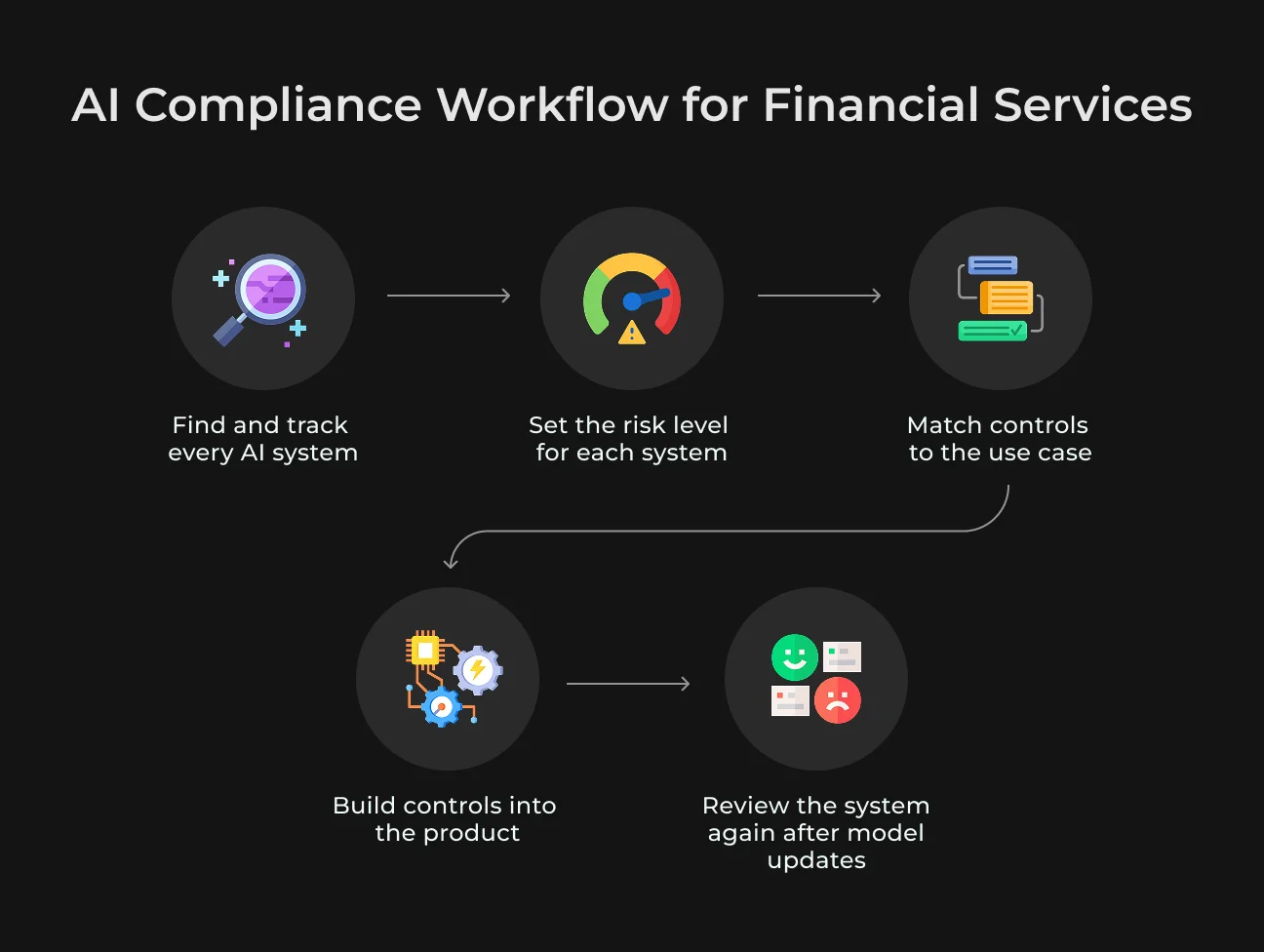
AI in financial compliance becomes easier to manage when every system is visible and tied to a defined set of controls. The product and its workflows need to enforce those controls in practice.
Step 1: Inventory Every AI System
The inventory should capture every workflow that uses AI. In-house models are usually easy to identify. SaaS products may already contain AI features that teams use every day, and external generative AI APIs need separate records.
Shadow AI is less visible because employees may bring in tools without formal approval. Procurement records and access reviews can reveal some of that use. Browser or SaaS telemetry can uncover additional tools if the firm already collects that data.
Step 2: Classify Systems by Risk
The risk level depends on what the AI system can affect. A credit model that influences eligibility needs tighter control than an internal writing tool.
The rating goes up when employees have little room to intervene or the system handles sensitive customer data. Financial exposure and regulatory impact can raise it further. Human review only reduces risk when the reviewer has real authority to change the outcome.
Step 3: Map Each System to Applicable Controls
Each use case needs its own control set. A lending model may require formal validation and explainability before it reaches a credit workflow. A customer-facing GenAI assistant often needs tighter permissions and clear AI audit trails for compliance.
The data the system uses also affects which controls apply. Human review becomes more important when an AI output can affect a customer outcome or financial decision.
See more
See how AI bookkeeping software is built and which features support real financial workflows.
Learn moreStep 4: Add Controls to the Software Architecture
The application needs to enforce access and accountability directly. Permissions control who can change a model or approve its use, and version records tie each decision to the release active at the time.
Each approval should be recorded with the reviewer’s identity and timestamp. Higher-risk cases can pause for human review before the action goes through. Data lineage helps trace the source records used in that decision.
See more
Explore the technical side of DeFi protocol integration and how it fits into a Web3 application.
Read nowStep 5: Review and Revalidate Continuously
A new model version can change how the system behaves. A major shift in training data may affect performance, and an external provider can update the model without touching the firm’s code.
A clear drop in performance or a serious incident may send the model back for review. Regulatory changes can also require the team to revisit an earlier approval and check that the current use still fits the rules.
AI Governance Framework for Financial Institutions
The table below gives teams a practical checkpoint for reviewing an AI system before launch and during production.
Area | What the team needs | What to keep on record |
| Ownership | Named business and model owners | Who can approve model use and changes |
| Inventory | A current list of AI systems and versions | Model ID, provider, status, approved use |
| Data | Clear data sources and access rules | Lineage records and quality checks |
| Validation | Testing before the model goes live | Results, known limits, and issues found |
| Explainability | A way to explain important model decisions | Reason codes or supporting evidence |
| Human oversight | A clear review and override path | Who reviewed the case and why |
| Monitoring | Regular checks on live model behavior | Drift signals, overrides, incidents |
| Auditability | Enough history to reconstruct a past decision | Model version, input reference, output, timestamp |
| Change management | A controlled process for model updates | What changed and who approved it |
| Third-party models | Oversight of external models and APIs | Provider details and model changes |
| Incident response | A clear path for investigating AI failures | What happened and how the team responded |
| Retirement | A defined process for removing old models | Retirement date and replacement system |
Implement AI into Finance with SapientPro
Financial AI works better when governance controls are built directly into the product architecture. SapientPro can help financial teams design new AI systems or improve existing ones, with access rules, version control, auditability, and review flows handled inside the application.
SapientPro can review the current setup and define the technical controls the use case requires for deployment and future audits. The team can also integrate those controls with the systems the business already uses.
Contact SapientPro to discuss your financial AI project and its technical requirements.
Build Financial AI You Can Audit
Book a call with SapientPro to plan access controls, approvals, and decision logs.