All How to Make a Rust Smart Contract Audit
July 27, 202615 min read


Crypto projects lost more than $1.3 billion to hacks and exploits in the first half of 2026, according to CertiK’s Hack3D report. Losses on this scale make one point clear: a smart contract security audit is no longer optional.
Solidity has traditionally been the default language for Ethereum-based dApps. However, a growing number of Layer 1 and Layer 2 ecosystems rely on Rust, including Solana, Polkadot, NEAR, and Cosmos SDK-based chains that support CosmWasm.
Rust’s security features do not automatically make these projects safe.
Its compiler enforces strict rules for memory safety, ownership, and borrowing, but these checks only address a specific category of programming errors. They cannot detect flawed business logic, excessive administrative privileges, insecure transaction validation, or broken economic assumptions.
As a result, code written in safe Rust can compile successfully and still contain vulnerabilities that lead to serious financial losses.
Auditing these systems also requires more than experience with Solidity. Rust-based virtual machines use different approaches to storage, validation, account management, and transaction execution than the Ethereum Virtual Machine.
A reliable assessment therefore requires Web3 smart contract security audit services with experts who understand the architecture and attack surface of the specific blockchain environment. SapientPro’s team prepared a guide that explains what to consider in this case.
What a Rust Smart Contract Audit Covers
Every rigorous blockchain smart contract audit checks the same core boundaries in the code (structural, mathematical, and logical) regardless of which language it's written in.
The categories of risk stay consistent industry-wide, but how each one shows up in the code differs a lot between Solidity and Rust.
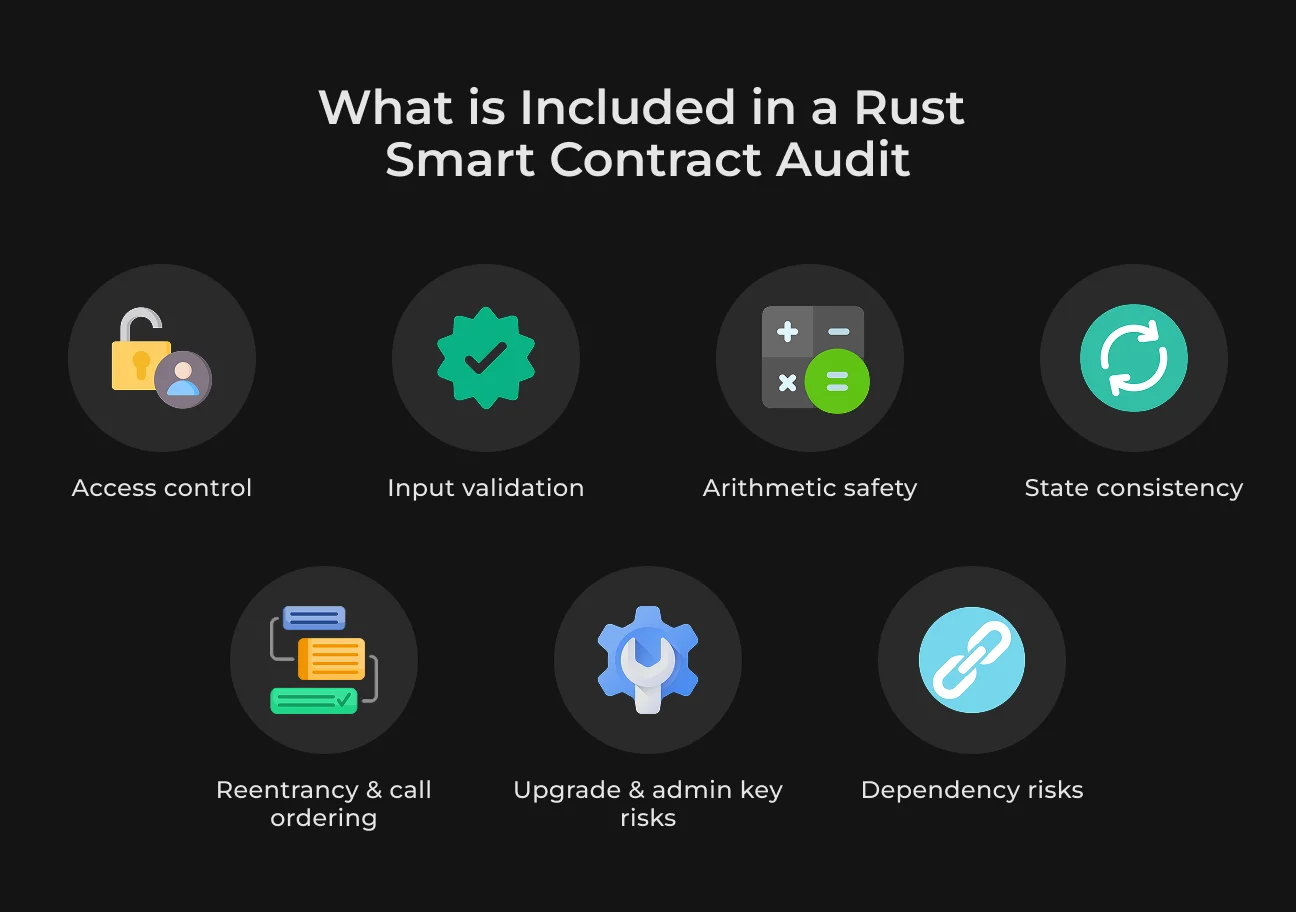
Access Control
Restricts execution of administrative functions to authorized accounts, under whatever conditions the protocol specifies. Auditors verify administrative signature validation, role permissions, and ownership assertions.
Input Validation
Every external input has to be verified and sanitized before it touches contract logic. That means checking account types, verifying caller-supplied data, and confirming account ownership.
Arithmetic Safety
Financial calculations can't be allowed to overflow, underflow, or lose precision. Auditors check that the math holds up under edge-case scaling, not just typical inputs.
State Consistency
No transaction should be able to force the system into an invalid or corrupted state. This is where storage slots, state boundaries, and data synchronization get scrutinized, especially during parallel execution.
Reentrancy and Call Ordering
Malicious actors shouldn't be able to hijack control flow and trigger unexpected recursive calls. Auditors trace external contract messages, CosmWasm replies, and Solana cross-program invocations to close off that path.
Upgrade and Admin Key Risks
Centralization vectors and single points of failure in administrative pathways get identified here, through review of multisig structures, upgrade authorities, initialization logic, and proxy storage layouts.
Dependency and Library Risks
External code, frameworks, and packages need their integrity and security verified independently. That involves scanning cargo lockfiles, evaluating third-party crates, and flagging supply-chain vulnerabilities.
While these high-level security categories apply to both Rust and Solidity audits, the underlying vulnerabilities manifest differently in each language. This difference is why selecting an auditor with specialized language expertise is important.
When Do You Need a Rust Smart Contract Audit?
Implementing a continuous testing strategy helps you prepare for launch while optimizing smart contract audit costs.
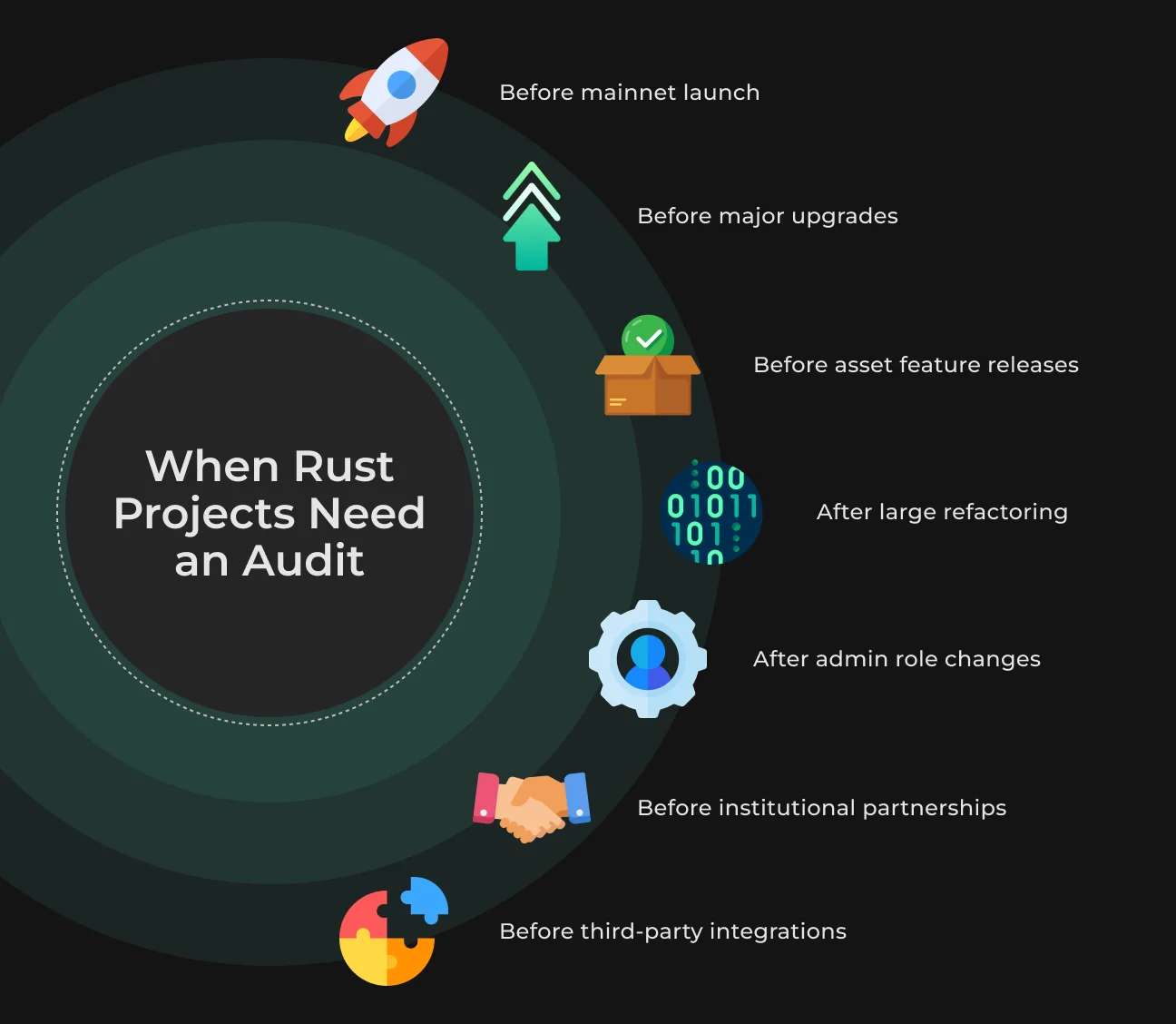
Mainnet Launch
Code changes on a live blockchain are permanent and immediately targetable, so this is the point where uncovered logical bugs, structural vulnerabilities, and contract exploits do the most damage. A clean audit here establishes protocol trust, protects initial user capital, and satisfies investor due diligence.
Major Protocol Upgrades
Modifications to logic or state migrations can introduce regression errors: broken internal variables, authorization oversights, and data layout mismatches. Catching these preserves existing security baselines and keeps active users from experiencing service disruptions.
Financial & Asset Feature Releases
Adding custom token mechanics, DeFi pooling, NFT distributions, or bridge infrastructure opens the door to collateral arbitrage, cross-chain transfer exploits, and logic bugs. An audit at this stage protects treasury assets and keeps the token launch compliant.
Large-Scale Refactoring
Changing structural parameters or logic paths can alter compile-time execution assumptions in ways that are easy to miss, producing compilation anomalies, performance regressions, and logical mismatches. Testing at this stage keeps system performance intact and makes sure code updates land safely.
Administrative or Role Updates
Modifying multi-signature thresholds, administrative keys, or contract migration routes carries real risk: unauthorized role transitions, administrative lockout, credential takeover. Getting this right secures the decentralization process and closes off insider threat vectors.
Institutional Partnerships
Partnering with enterprises or raising institutional capital brings regulatory non-compliance and unaddressed code liabilities into focus. An audit satisfies legal risk assessments and builds long-term investor trust.
Third-Party Integrations
Connecting external oracles, liquidity bridges, cross-chain relays, or hardware wallets introduces price-feed manipulation, outdated oracles, and integration failures as live risks. Auditing these connections secures external trust boundaries and reduces systemic dependency risk.
How to Audit a Rust Smart Contract: Full Process
A professional Web3 security audit combines deep manual analysis with automated tools. A Solidity audit follows a similar process, but the two aren't identical.
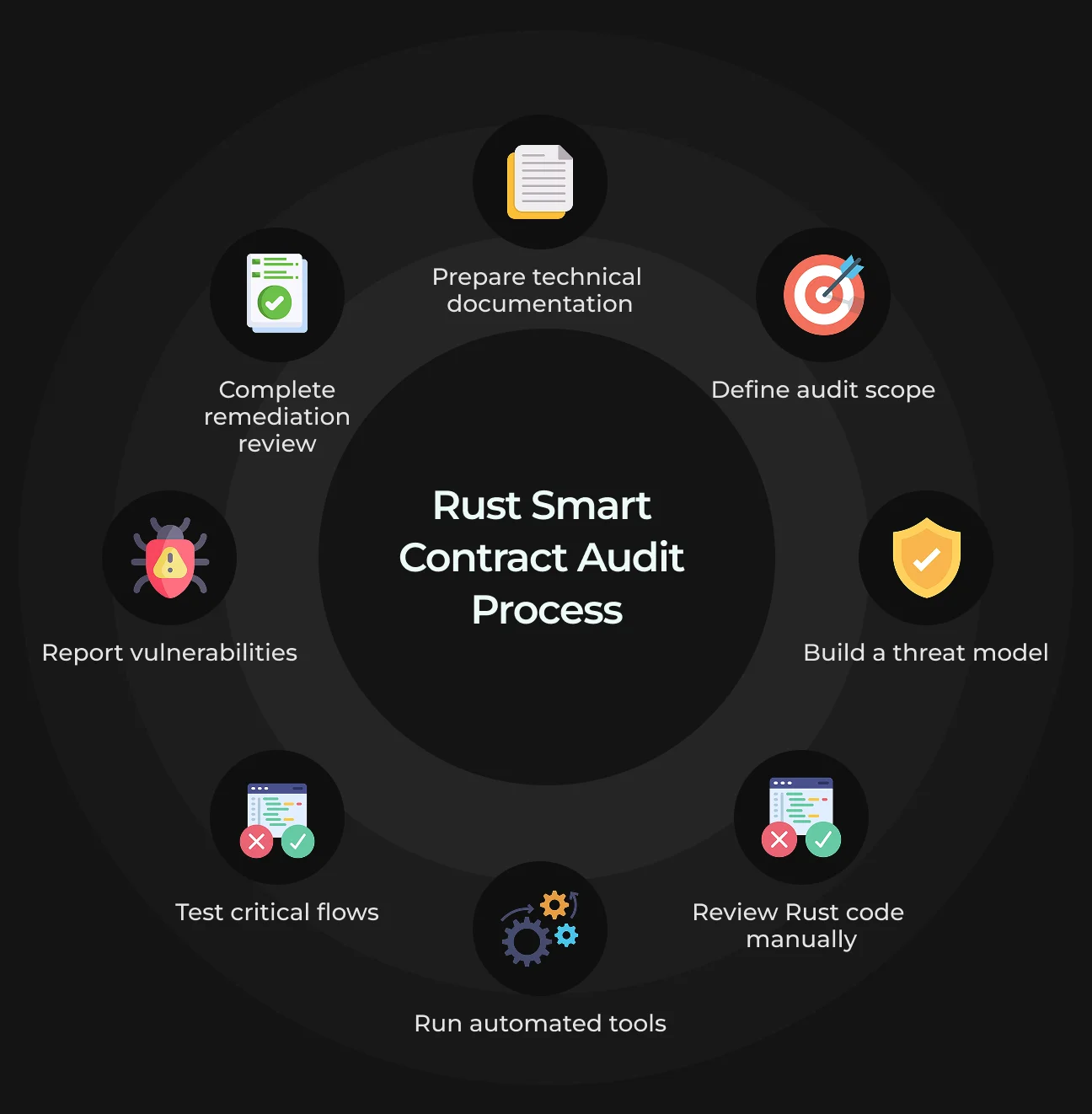
1. Define the Audit Scope
The engagement begins by defining the exact boundaries of the codebase. The Rust smart contract audit should include:
- Repository and commit hash. The target repository state must be frozen at a specific Git commit hash, pausing active refactoring during the review.
- In-scope code elements. The audit explicitly identifies the programs, smart contracts, libraries, custom helper modules, or crates scheduled for analysis.
- Out-of-scope components. Web interfaces, database systems, deployment helper scripts, and third-party platform infrastructure are flagged as out-of-scope.
- Target blockchain and execution runtime. The project specifies its target blockchain (e.g., Solana, Near, Cosmos) and framework versions (e.g., Anchor, CosmWasm, Substrate FRAME).
- Deployment context. The current deployment status is defined, noting whether the code is offline, on a private devnet, or running on a public testnet.
- Known system risks and critical flows. The core architectural paths handling value, calculations, or administrative rules are mapped to prioritize analysis.
This scoping work keeps the security review focused on what matters most, and it's also what auditors use to calculate the smart contract audit cost.
2. Prepare Technical Documentation
Manual code review is more effective when backed by technical documentation. This technical package details the business-logic design of the codebase:
- Product Overview. A clear explanation of what the application does, its target workflows, and its underlying tokenomics models.
- System Architecture Diagram. A visual schematic of the system mapping interactions between contracts, external modules, and the global blockchain state.
- Contract Responsibilities. Clear definitions of what each program or contract is authorized to perform.
- State and Account Model. A detailed map of on-chain storage, detailing custom accounts, data schemas, and key-value indexes.
- Permission and Role Structure. Documentation detailing user tiers, multisig signers, and administrative capabilities.
- Upgrade and Migration Mechanics. The process used to execute contract logic updates and handle state migrations.
- External Integrations. A list of all external dependencies, including oracle systems, bridges, liquidity hubs, or indexing tools.
- Expected Critical Behaviors. Step-by-step technical descriptions of key flows, detailing expected system state inputs and outputs.
3. Build a Threat Model
Auditors build a threat model to trace every possible attack vector against the system, mapping the logical paths a malicious actor could exploit. This includes:
- Identifying who can execute each instruction, endpoint, or message;
- Mapping all inputs, parameters, and storage references that a caller provides;
- Explicitly documenting which external contracts, oracles, or platform modules are assumed to be safe;
- Analyzing how administrative functions can alter system rules or override normal user limits;
- Tracking where protocol value (native tokens, liquidity pool reserves) is stored and identifying the instructions that can authorize withdrawals;
- Evaluating system behavior if a trusted oracle goes offline, a bridge pauses, or a linked program is exploited;
- Simulating how sudden price changes, frontrunning, or flash loans could affect the contract's financial logic.
These threat paths, once mapped, become the checklist auditors work through in manual review.
4. Review Rust Code Manually
Specialized auditors read the codebase line by line to find logical flaws and design oversights that automated scanners miss. They examine:
- Business logic validation;
- Authorization verification;
- State transition correctness;
- Serialization safety;
- Error and panic handling;
- Arithmetic precision;
- Unsafe code blocks;
- Framework abstractions.
Manual code analysis remains the core of a professional smart contract security audit.
5. Run Automated Smart Contract Audit Tools
To complement manual code reviews, auditors run automated smart contract audit tools to identify known vulnerability patterns and verify code quality.
Tool Class | Core Functionality | Representative Tools | Ecosystem Support |
| Static Analyzers | Scans code patterns for known vulnerabilities and bad practices. | Semgrep, AuditBase, SCPF, L3X. | EVM, Rust (SVM, CosmWasm), Move. |
| Fuzzing Frameworks | Executes property-based testing with randomized inputs to discover edge-case panics. | Echidna, Medusa, Trident. | EVM (Echidna, Medusa), Solana (Trident). |
| Dependency Scanners | Checks cargo trees and dependencies for outdated or vulnerable library crates. | cargo-audit, cargo-geiger. | Generic Rust ecosystems. |
| Linters & Formatters | Identifies style errors, structural anomalies, and syntax violations. | Solhint, Ethlint, Clippy, Rustfmt. | EVM (Solhint), Generic Rust (Clippy). |
| Symbolic Execution | Explores contract logic paths mathematically to identify unreachable states and bugs. | Mythril, Manticore. | EVM bytecode. |
6. Test Critical Flows
Auditors design custom test paths to verify how the codebase behaves under complex and adversarial conditions:
- Unit tests;
- Integration tests;
- Negative tests;
- Permission tests;
- Edge cases;
- Localnet or testnet scenarios;
- Upgrade and migration tests;
- Adversarial behavior tests.
Every one of these tests traces back to something the threat model or manual review flagged.
7. Report Vulnerabilities and Severity
Once the analysis is complete, the auditing firm provides a detailed report containing all identified security findings. Each vulnerability is categorized by severity:
- Critical-risk findings. Exploits that allow immediate theft of funds, administrative takeover, or complete protocol freeze.
- High-risk findings. Vulnerabilities that allow unauthorized withdrawals, bypass permissions, or corrupt global state under specific conditions.
- Medium-risk findings. Logic errors, math inaccuracies, or rounding issues that can disrupt normal protocol operations.
- Low-risk findings. Minor implementation issues, missing validations, or edge-case oversights with limited exploit impact.
- Informational notes. Code style suggestions, gas/compute optimizations, and general best practices.
Every finding in the report includes a detailed description of the risk, its technical and business impact, clear reproduction steps, and specific remediation advice.
8. Fix issues and Complete the Remediation Review
The final phase of the Rust smart contract audit ensures that identified vulnerabilities are safely and permanently resolved:
- The project’s engineers analyze the report and implement code fixes in a dedicated remediation branch;
- Auditors evaluate the updated code to verify that the fixes resolve the issues without introducing new vulnerabilities;
- Findings are updated in the final report as Resolved, Partially Resolved, Acknowledged (if the team accepts the risk), or Unresolved;
- The finished smart contract security audit document is prepared for publication, providing a transparent security record for users, partners, and investors.
With the final report in hand, the CTO and CEO decide whether to deploy the protocol to mainnet.
What Makes Rust Smart Contract Security Different?
Rust's compile-time safety checks are powerful, but its execution and storage model creates security risks that don't exist in Solidity.
Rust Improves Memory Safety, but Not Protocol Safety
Rust's compiler catches traditional memory bugs before code ever runs. Strict ownership and borrowing rules, enforced at compile time, guarantee that programs are free of:
- Buffer overflows;
- Use-after-free vulnerabilities;
- Double-free anomalies;
- Multi-threaded data races.
However, this compiler-enforced safety does not extend to the business logic of smart contracts. A Rust program can compile cleanly without warnings but still contain severe logical errors:
- If an instruction fails to check that a transaction was initiated by an administrator, the code compiles perfectly but remains highly vulnerable to unauthorized access;
- If an interest calculation rounding error allows users to withdraw slightly more collateral than they deposited, this mathematical drift will compile cleanly.
Rust ensures that your program runs exactly as written. It does not ensure that what you wrote is logically secure.
Runtime-Specific Validation Matters
In Solidity, the EVM couples code logic and state storage within a single smart contract address. When a user calls a contract, the EVM automatically handles state routing and transaction contexts.
In contrast, Rust-based blockchains separate code logic from data storage, a setup known as the stateless account model. In this model, programs contain only immutable execution logic, while data is stored in separate account buffers passed as inputs with each transaction.
Because the caller provides these storage accounts, the program must validate them on every execution to verify they are legitimate and owned by the expected program.
As for specific blockchains:
- Solana Programs (SVM).
On Solana, every account passed into an instruction is an untrusted input.
The program must manually check that the signer flagged as authorized is a valid transaction signer, confirm that state account owners match the program's ID, and verify Program Derived Address (PDA) derivations. This helps prevent malicious account substitution.
- CosmWasm Contracts (Cosmos SDK).
On Cosmos-based networks, contracts communicate via message-passing.
The program must validate message structures, state transition logic, migration entry points, and reply handlers. These ensure cross-contract calls are secure and cannot be spoofed by malicious modules or chains.
The stateless architecture enables massive parallel transaction processing. Still, it places the responsibility for validation entirely on the developer, making smart contract security audits important.
Framework Abstractions Can Hide Risk
Writing raw Rust code for complex blockchains means a lot of repetitive boilerplate for manual verification. To cut down on that work, teams use frameworks like Anchor for Solana or standard CW modules for CosmWasm. These frameworks lean on Rust macros and custom metadata to validate incoming accounts and parse data structures.
While frameworks cut boilerplate and prevent common validation mistakes, they can also obscure critical execution paths. A developer who doesn't fully understand how a macro resolves account derivations or how state constraints get evaluated can introduce silent security vulnerabilities without realizing it.
The frameworks themselves aren't immune either: bugs or incorrect compiler rules inside them can compromise contract execution just as easily. That's why an experienced Rust auditor reviews both the custom logic and the underlying framework configuration.
Secure Your Rust Contract Before Mainnet
Get a full audit covering account validation, PDA checks, and CPI risk before you deploy.

Common Vulnerabilities in Rust Smart Contracts
Let’s take a look at the key vulnerabilities in Rust smart contracts and their mitigation strategies.
Missing Signer Checks
No verification of the is_signer flag means an instruction never confirms that the account claiming authority actually signed the transaction. Anyone who knows the right account address can trigger admin actions or withdrawals meant to be gated.
Mitigation: check is_signer explicitly on every account expected to authorize an action. In Anchor, use the Signer<'info> type instead of raw AccountInfo, since it enforces this check at the framework level rather than leaving it to manual code.
Missing Account Ownership Validation
If the program never confirms who owns an account before trusting its data, an attacker can hand it a fake account shaped just like the real one. That's enough to bypass permissions or inflate balances.
Mitigation: verify account.owner == program_id before deserializing anything, or use Anchor's Account<'info, T> type, which validates both ownership and the account discriminator automatically.
Incorrect PDA Validation
When PDA seeds or the bump aren't checked against what the program expects, or the caller supplies the bump directly, attackers get room to spoof vaults or admin accounts under the program's own address space.
Mitigation: re-derive the PDA from its seeds and canonical bump inside the program, then compare the result against the account key passed in. Never trust a bump value the caller supplies.
Arbitrary Account Substitution
Input accounts that go unvalidated for type, owner, or role open the door to substitution attacks: an attacker swaps in a malicious oracle or treasury account, and the program has no way to tell.
Mitigation: constrain every account with explicit type, owner, and relationship checks. Anchor's #[account(constraint = ...)] attributes exist for exactly this.
Unsafe Cross-Program Invocations (CPI)
A program_id that isn't verified before invocation is a blank check. Privileges and value get forwarded to whatever program the attacker points the call at, trusted or not.
Mitigation: hardcode or explicitly whitelist the program IDs your contract is allowed to CPI into, and check the target ID against that list before every invocation.
Incorrect Access Control
Admin roles and permission checks that are incomplete, or enforced inconsistently across instructions, leave gaps. Unauthorized users end up able to modify protocol settings, mint tokens, or change parameters they shouldn't touch.
Mitigation: centralize role checks in one shared function or constraint rather than reimplementing them per instruction, and write a test for every privileged path, not just the common ones.
Broken State Transitions
State changes that happen in the wrong order create windows for reinitialization, race conditions, or replay of setup logic that was only supposed to run once.
Mitigation: guard one-time operations with an explicit initialized flag checked before any mutation, and follow a strict checks-effects-interactions pattern so state updates can't be reordered around a check.
Arithmetic Overflow, Underflow, Precision Loss
Interest calculations, exchange rates, and reward math are the usual places where unchecked overflow, underflow, or rounding drift creep in. Left alone, they inflate balances or drain a protocol one small exploit at a time.
Mitigation: use checked arithmetic (checked_add, checked_sub, checked_mul in Rust) instead of raw operators, and round in the protocol's favor rather than the user's.
Unsafe Serialization / Deserialization
Parsing account data without validating its discriminator, or rolling custom (de)serialization logic, invites type confusion. Malformed data gets treated as valid, and from there it's a straight line to logic bypasses and corrupted state.
Mitigation: use a well-tested serialization framework, Anchor's Borsh integration being the standard choice, rather than hand-rolled parsing. Validate the account discriminator first, before touching anything else.
Poor Error Handling
Errors from sub-calls or checks that get silently ignored or dropped mean a failed operation can look like a successful one from the outside.
Mitigation: propagate every fallible result explicitly with Rust's ? operator and custom error enums, and write tests that assert failure paths actually fail rather than just testing the happy path.
Replay Risks
Signed transactions without a nonce or expiration can be submitted again. And again. Each resubmission executes the action as if it were new.
Mitigation: include a nonce or sequence number in every signed message and reject anything at or below the last-seen value, or attach an expiration timestamp to the signature itself.
Migration Bugs
An upgrade that changes account storage layout without a compatible migration path leaves existing accounts unreadable or, worse, misinterpreted as something they're not.
Mitigation: version every account struct explicitly, and write and test a migration function for each layout change before the upgrade ever touches mainnet.
Upgrade Authority Risks
Whoever holds the upgrade key controls the protocol's future, so a poorly protected key or an authority held by too few parties is a standing risk. A compromised authority can push code that drains the treasury on the next update.
Mitigation: move upgrade authority to a multisig or timelock, or renounce it entirely once the protocol has stabilized. A mandatory delay between proposing and executing an upgrade gives users time to notice something's wrong.
Dependency Vulnerabilities
Third-party crates carrying known vulnerabilities, or crates that have simply stopped being maintained, turn the dependency tree into a supply-chain risk the core team didn't write and may not have reviewed.
Mitigation: run cargo audit and cargo-geiger as part of CI, pin dependency versions, and review any crate containing unsafe code blocks before adopting it.
Incomplete Test Coverage
Test suites that only cover the happy path miss exactly the conditions attackers look for. Bugs that surface under unusual or hostile inputs make it to production because nobody tried to break the code on purpose.
Mitigation: add negative tests and adversarial simulations alongside standard unit tests, and bring in fuzzing tools like Trident for Solana or Echidna and Medusa for EVM chains.
Incorrect Assumptions About External Programs
Trusting an oracle, bridge, or other external program without validating its responses means their failure becomes the protocol's failure. Oracle manipulation or a bridge outage propagates straight into the contract's logic.
Mitigation: validate external data against sanity bounds or multiple independent sources, and design the contract to degrade gracefully, not catastrophically, if an external dependency misbehaves or goes offline.
Partner with SapientPro for Smart Contract Audit Services
SapientPro provides development, testing, and security audit services across both Solidity and Rust ecosystems. Our technical teams have built and secured NFT platforms, DeFi tools, and custom blockchain infrastructure, and we validate on-chain applications thoroughly before mainnet deployment.
Our smart contract solutions cover:
- Architecture design: secure state machines and access control from day one;
- Secure development: modular, gas-efficient contracts built on proven patterns;
- Security auditing: manual review paired with static analysis and property testing;
- Testing and verification: adversarial simulation and full code coverage;
- Version optimization: compute tuning and upgrade authority management as the protocol evolves.
Get your security review scheduled early to prevent vulnerabilities before your mainnet launch.
Catch Vulnerabilities Before Attackers Do
Our auditors review signer checks, account ownership, and arithmetic safety line by line.