All How Much Does It Cost to Build a Custom ERP System?
October 20, 202610 min read


A custom ERP is the one system a company buys that changes how every department does its work, and its price follows from that. Our engineers write the software. A second budget pays for moving the company onto it; work your own people do alongside ours.
In our estimates, custom ERP development begins near $10,000 for a focused operational system – enough to get a ready product that keeps your business running.
Complex systems for large-scale enterprises, multiple integrations, legal entities, regulations, and other features may go over $35,000. However, a big part of these costs can be saved because SapientPro already has pre-built solutions that can be easily adapted for your business.
For you, this means two things:
- You get tested capabilities fully adapted to your needs;
- You get them cheaper and faster while maintaining top-tier quality.
Let’s take a look at the budgets to expect based on SapientPro’s expertise since 2017.
Custom ERP Budget Has Three Parts
Three budgets make up the total. Most proposals usually quote the first one.
Budget | What it pays for | When it arrives |
| ERP development | Architecture, modules, workflows, database, UI, APIs | Once, across the build |
| ERP implementation | Migration, integrations, testing, configuration, training, rollout | Once, mostly at the end |
| Ongoing ownership | Infrastructure, support, security, improvements | Every month afterwards |
We price this work in engineering hours, and an hour with SapientPro’s team averages $45. The development values below are what those counts come to once rounded. Approach them as planning ranges, because a real scope often mixes two of them.
Scope | Typical engineering | Approximate development cost |
| Operational ERP | 200 to 1000 hours | $9,000–$45,000 |
| Multi-department ERP | 1000 to 3000 hours | $45,000–$135,000 |
| Enterprise or multi-entity ERP | 3000 hours and above | $135,000+ |
Implementation stays outside those numbers. Oracle’s NetSuite, writing about its own platform, puts a full implementation anywhere between the low five figures for a small company and several million for a large one, with a rule of thumb of 1% of annual operating budget.
What Influences Custom ERP Development Cost?
Four parts of an ERP take the most engineering, and they are rarely the parts a demo spends time on.
Core Business Modules
Most ERP briefs name the same seven candidates.
- Finance and accounting;
- Inventory;
- Procurement;
- Sales and order management;
- Warehouse;
- Manufacturing;
- HR.
Module count is a weak proxy for price, because modules share data to each other.
One transaction travels a long way:
Sales order → Inventory → Procurement → Warehouse → Invoice → Accounting
Change a pricing rule at one end of that chain, and behavior shifts at the other. Most of the engineering goes into the traffic between modules. Estimates usually get the modules right and the traffic wrong.
Business-Specific Workflows
Custom ERPs get commissioned over this heading more than any other.
- Custom approval chains;
- Production planning;
- Pricing rules;
- Supplier workflows;
- Multi-stage fulfillment;
- Company-specific financial processes.
Krcmar Surveying runs job flows with no packaged product anticipated. Our engineers have been extending their system with workflow virtualization so a user can reshape a flow or skip a step that does not apply without waiting for a release. Rules of that kind are the reason the system exists at all.
SapientPro's work has been phenomenal. They’ve learned Gyroscope, our business needs, and a very complex paradigm on how to automate our processes, allowing them to implement new features to our CRM.

Jamie Krcmar
Integrations and Data Architecture
An ERP rarely operates alone, and the list of neighbors grows with the company.
- CRM and e-commerce;
- Warehouse management;
- Payment systems and EDI;
- BI platforms and accounting;
- Supplier APIs;
- Production and IoT systems.
SapientPro built a CRM-connected portal for Origami.ms, bringing together more than a dozen systems, APIs, and data sources. Each integration added engineering work beyond the initial connection: authentication, data mapping, and recovery when an external service stopped responding.
That recovery logic is a substantial part of the integration budget.
Permissions, Reporting, and Auditability
Access rules follow the org chart. User count has little to do with what they cost.
- Department and entity-based access;
- Approval limits;
- Audit logs;
- Financial and operational reporting.
For a listed company, the audit trail is a legal obligation. The SEC requires management to assess internal control over financial reporting in each annual report, and an ERP that cannot show who approved a payment makes that assessment an expensive exercise.
ERP Implementation Cost Breakdown
This budget pays for work inside the company, which is what makes it resist a flat quote.
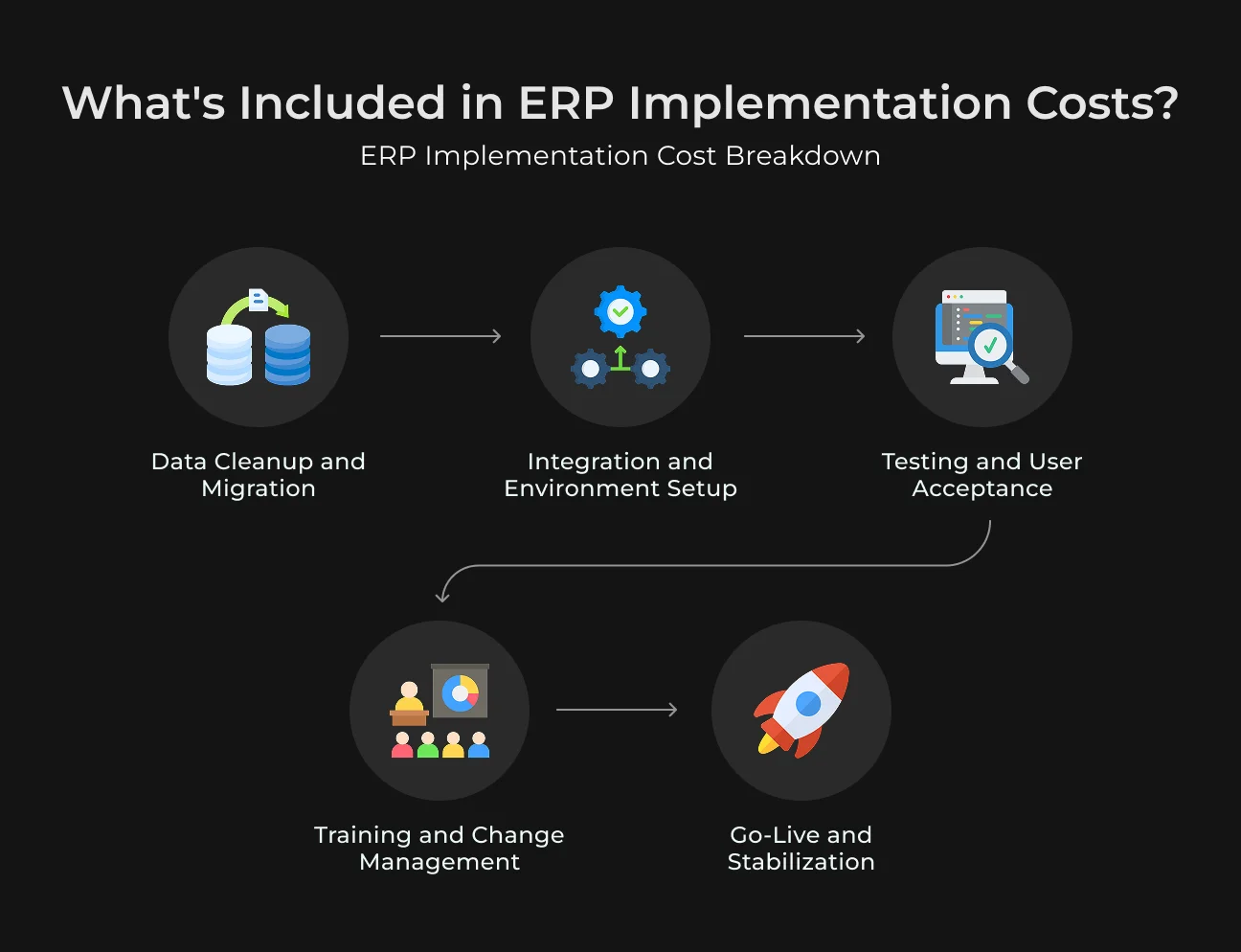
Data Cleanup and Migration
Everything below has to reach the new system in a state the business can work with.
- Customer and supplier records;
- Inventory and SKUs;
- Accounting history;
- Bills of materials;
- Employee data.
A database that has been running for years accumulates duplicates and competing versions of the same record, and somebody has to decide which of the three addresses held for one customer is the current one. Gartner puts the average annual cost of poor data quality at $12.9 million.
A migration line pays for those decisions. Copying the rows is the quick part.
Integration and Environment Setup
Developing an integration and putting it into production are separate pieces of work with separate price tags. The second one involves live credentials, a data mapping that survives real volumes, and an environment that behaves like production.
Testing and User Acceptance
ERP testing follows a workflow all the way through, across every module it touches:
- Purchase request → Approval → PO → Receipt → Inventory → Invoice → Accounting
A script of that length needs people from several departments at the table, and their hours belong in the budget too.
Training and Change Management
A technically sound ERP still has to earn its place against the spreadsheets people have relied on for years.
- Role-specific training;
- Documentation;
- Process changes;
- Internal ERP owners.
NetSuite counts the same thing as a real cost: the hours internal teams spend on an implementation instead of their day jobs. The return shows up on the other side of it. Our attendance monitoring tool for edtech ran to 800 hours, and it brought a school group’s administrative work down to five hours from 165.
Go-Live and Stabilization
Cutover happens once, and its date rarely moves. The Norwegian Refugee Council requested SapientPro to connect an EspoCRM instance to KoBoCollect for its education program in Sudan, where stabilization had to hold up under field conditions.
What Does a Custom ERP Cost at Three Different Scopes?
ERP requests tend to come in three shapes. What separates them is how far the system reaches across departments.
Operational ERP
Inventory and orders form the center of this scope, with procurement and a couple of financial workflows around them, and one or two integrations underneath.
One consulting firm knew exactly which slice of its ERP to build first, a web-based database tracking competitor products and stock availability across a premium design market. Phase one stays this modest when it has a single job to do.
Multi-Department ERP
Accounting, the warehouse, and CRM order flows join the first group. Permissions become a design problem of their own, and legacy data has to move. Most mid-sized companies mean this scope when they say ERP.
Enterprise or Multi-Entity ERP
This scope adds several legal entities and the workflows of manufacturing or supply chain, usually with localization and custom analytics alongside.
Examples of ERP Projects and What They Cost
Prices read better next to the work they bought.
Client | What our engineers built | Project budget |
| Consulting firm in a premium design market | ERP database MVP tracking competitor products and stock availability | \€20,000 |
| Krcmar Surveying | CRM extended with workflow virtualization for custom job flows | $50,000+ |
| Origami.ms | Portal around the client’s own CRM, connected to more than a dozen systems | $50,000+ |
We have an MVP that works accurately, which is astonishing. Every problem that occurs is solved the same day.

Anonymous
The first row bought one department a working tool. The other two paid for systems that several departments lean on every day.
Where ERP Budgets Usually Expand
ERP overruns repeat themselves with some regularity. McKinsey’s study of large IT projects put the average budget overrun at 45%, with delivered value falling short of the business case, and the five situations below produce most of what we run into.
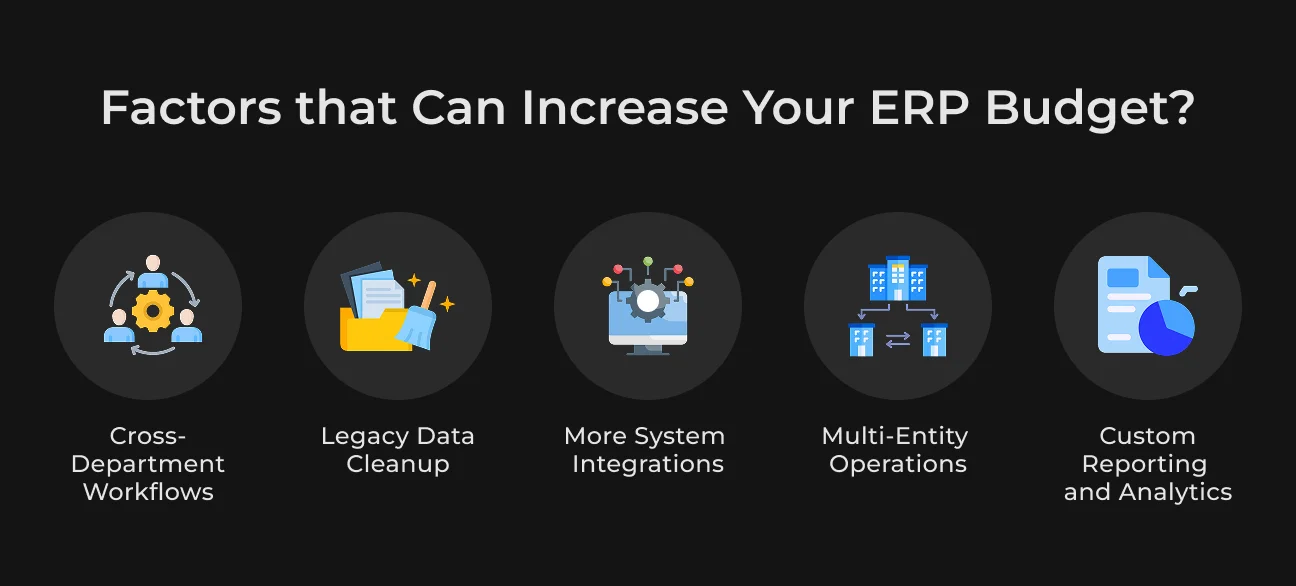
One Department Becomes a Shared Workflow
Accounting, the warehouse, and procurement start influencing the same transaction. More departments mean more dependencies, and dependencies cost more than users.
Legacy Data Is Worse Than Expected
Migration becomes a cleanup project, and the analyst and validation hours behind it were priced as a transfer.
One Integration Turns Into a System Network
A planned CRM connection acquires e-commerce, the warehouse, payments, and a supplier portal. Each of those keeps its own release schedule, and your ERP survives all of them or none.
One Company Becomes Multi-Entity
Currencies and tax rules multiply, warehouses separate, and two charts of accounts stop matching each other. Consolidated reporting follows all of it. European sellers also have a date in the diary, since digital reporting for cross-border B2B transactions begins on 1 July 2030 under VAT in the Digital Age.
Reporting Becomes Its Own Data Product
Standard dashboards come with the build. Historical analysis and executive reporting often need a warehouse of their own. Our AI-powered data analytics platform gathers figures from ERP, accounting, and e-commerce systems into embedded Power BI reports.
The frontend work took 350 hours, which is about $15,750.
What Does ERP Cost After Go-Live?
Ownership costs settle into four headings.
- Infrastructure and monitoring. Compute, databases, backups, and recovery, priced by how much the business transacts.
- Maintenance and security. Dependencies age, access rules follow people between roles, and security patches land regardless of the release plan.
- Business change. A new warehouse, a new entity, or a new compliance rule each becomes development work.
- Data growth. Longer history raises infrastructure costs without anyone deciding to spend more, and BI workloads outpace transactional ones.
Packaged systems carry an ownership bill of their own. Microsoft lists Dynamics 365 Business Central at $80 per user a month for Essentials and $110 for Premium on annual billing, so 120 people on Premium commit around $158,000 a year before a partner writes a line of configuration.
What Information Do You Need for an ERP Cost Estimate?
These ten answers are what any vendor needs before quoting a firm number.
- Which departments will use the ERP?
- Which workflows must move into it?
- Which modules are required at launch?
- How many locations and legal entities are involved?
- Which systems must connect to it?
- What legacy data has to be migrated?
- Which reports are business-critical?
- Which user roles and approvals exist?
- Are there industry or regulatory requirements?
- Which functions can wait for phase two?
We ask for these answers before quoting, and the ones a company cannot give yet usually point at the part of the ERP that needs a discovery phase of its own.
Why SapientPro is the Best ERP Development Company
SapientPro has built operational software since 2017, including CRM platforms with custom job flows and reporting layers over several source systems and data engines, keeping records current across markets. As an ERP development company, we cover the work below through our ERP development services:
- Custom ERP development;
- Finance, HR, supply chain, and CRM modules;
- Legacy migration and data cleanup;
- Integration with external systems;
- Mobile access for field and warehouse staff;
- Permissions, compliance, and support after go-live.
Business rules are the part our engineers write by hand and review line by line, since an approval limit behaving oddly costs more than it ever saves. You see the scope and the price in writing before development opens.
Send a description of how your company works today through our contact page.
Two Budgets, One Clear Estimate
Tell us which departments and systems are involved. You will get the build figure and the implementation figure separately, with the hours behind each.
FAQ
How much does it cost to develop a custom ERP system?
SapientPro’s planning ranges start at $10,000–$50,000 for a focused operational ERP, rise to $50,000–$150,000 for a multi-department system, and reach $150,000+ for enterprise or multi-entity platforms. These development estimates use a $45 hourly rate. The final budget depends on workflows, integrations, and how much existing functionality can be adapted.
How much does ERP implementation cost?
ERP implementation requires a separate estimate covering data cleanup, migration, environment setup, user acceptance testing, training, and rollout. Its cost depends on the condition of existing data, the systems involved, and the rollout plan. Budget for both the delivery team’s work and the time your employees spend preparing and testing.
Why is ERP implementation so expensive?
ERP implementation involves moving live business processes and records into a new system. Teams must reconcile data, test transactions across departments, verify permissions, and train employees. Complex integrations, inconsistent records, and phased rollouts add work. Defining these requirements early makes the budget more predictable and reduces rework before launch.
Is custom ERP more expensive than ready-made ERP?
Custom ERP can require a higher initial investment, although adapting existing components can reduce development work. Ready-made ERP adds licensing, configuration, integration, and support costs. Custom systems also need hosting, maintenance, and potentially third-party licenses. Compare both options over five years using the same users, workflows, integrations, and support requirements.