All 10 Generative AI Challenges and Ways to Mitigate Them
June 12, 202610 min read


Generative AI is powerful, but putting it into production is rarely an easy task. Without a multi-layered risk management framework, organizations can face challenges that slow adoption, increase costs, and expose the business to avoidable risks.
Current generative AI challenges include regulatory uncertainty, a significant shortage of specialized technical talent, difficulty demonstrating ROI amid rising infrastructure costs, and the ongoing risk of reputational damage caused by model errors.
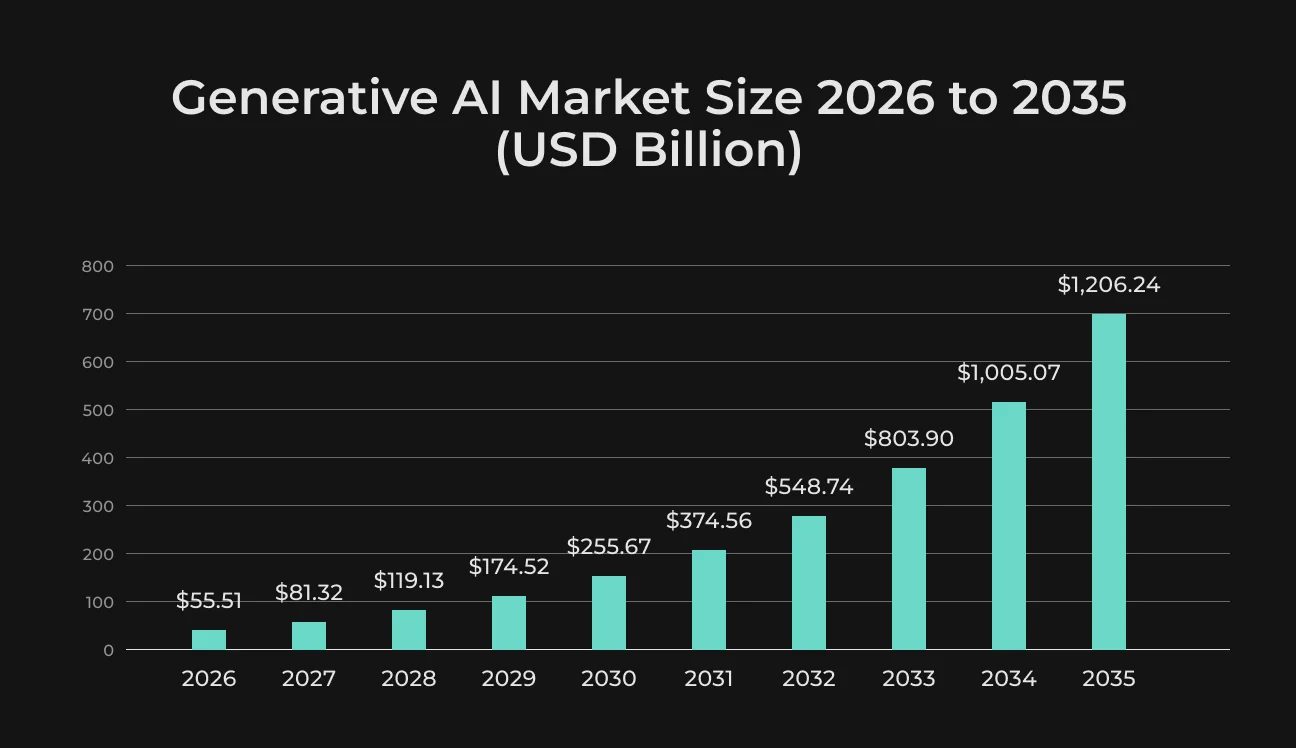
According to Deloitte, these barriers remain among the key factors limiting deployment. To address them, businesses need to manage generative AI risks across four distinct domains: technical, security, ethical, and business-operational. Read on to learn more about the current challenges and how SapientPro’s team mitigates them.
What Are the Challenges of Generative AI?
The dangers of generative AI are often silent.
Unlike traditional software, where logic is deterministic and errors are usually binary (the system works or it crashes), generative systems operate on statistical likelihoods. That introduces a gray area where a model can produce syntactically perfect but factually disastrous content.
So, what are some of the challenges of generative AI?
We have classified them into 4 categories.
Risk Category | Primary Manifestations | Concern |
| Technical Risks | Hallucination, lack of grounding, reasoning failures, model drift | Output reliability and decision integrity |
| Security Risks | Prompt injection, data poisoning, model theft, sensitive data exposure | Intellectual property loss and system exploitation |
| Ethical Risks | Algorithmic bias, lack of representativeness, toxic content generation | Legal discrimination and reputational ruin |
| Business/Operational | High inference costs, integration complexity, automation bias, skill gaps | ROI erosion and operational disruption |
Challenge #1: Hallucinations in Generative AI
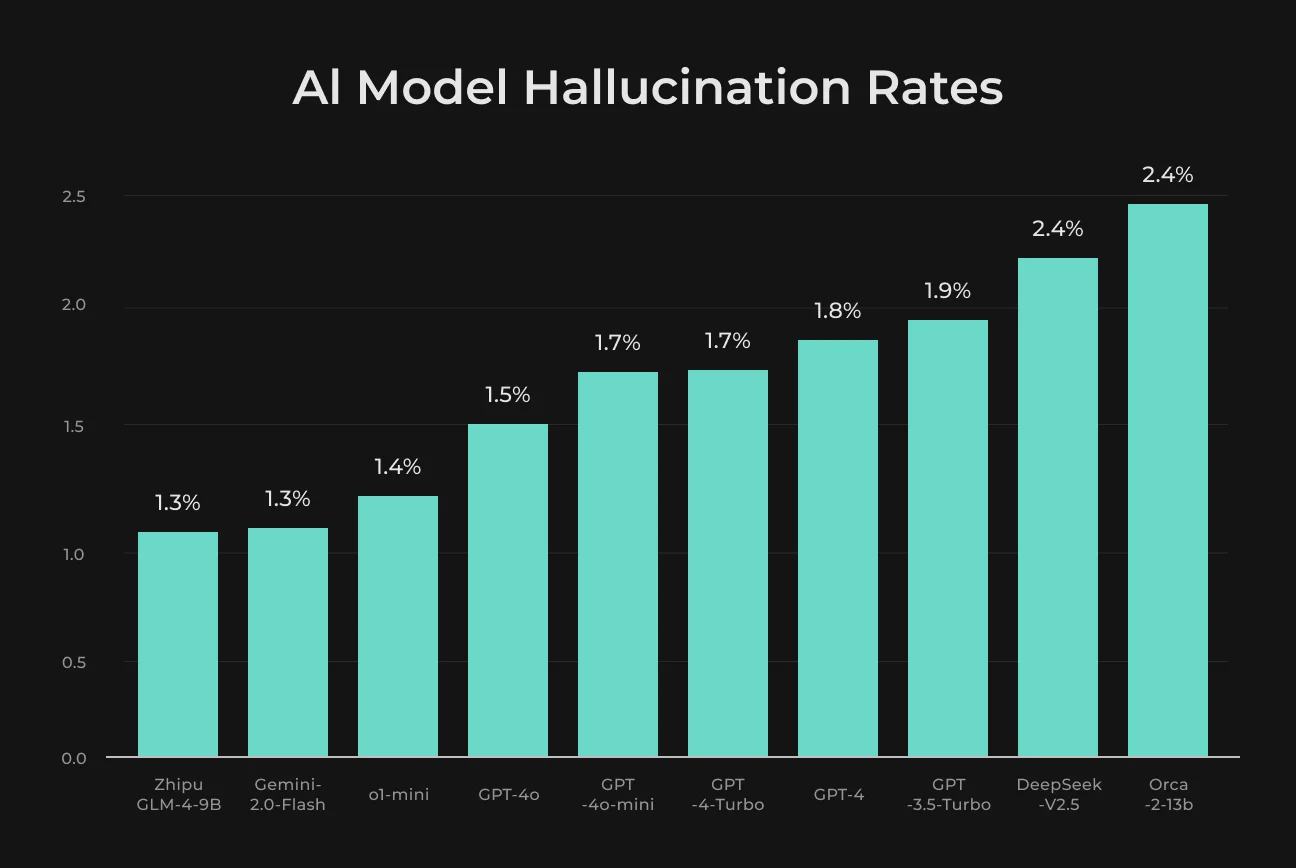
LLMs produce hallucinations: outputs that are coherent, fluent, and confidently delivered, but entirely false, fabricated, or misleading. To understand what is hallucination in generative AI, you need to understand that these models do not reference a real-time database of facts unless specifically built to do so. They are next-token predictors that fit a sequence based on patterns learned during training.
Why hallucinations happen
Hallucinations come from the gap between linguistic fluency and factual grounding.
A model might cite a fake legal precedent or a nonexistent scientific study simply because the shape of the citation fits the generated text. Studies from 2024 and 2025 found that hallucination rates vary widely across models, with some producing fabricated references in over 90% of complex academic queries.
Business impact
The business impact of hallucination generative AI is severe. In legal, lawyers have faced sanctions for submitting briefs containing AI-invented case law. In healthcare, a model might misidentify a benign symptom as malignant or recommend an imaginary treatment protocol. That directly endangers patients.
One high-profile example: Derek Mobley, a Black job seeker over age 40 with a disability, filed a lawsuit in February 2023 alleging that Workday's AI-based screening system discriminated against him and potentially hundreds of thousands of others based on age, race, and disability.
How to mitigate hallucinations
Four techniques address the hallucination generative AI problem:
Mitigation Technique | Description | Role in Accuracy |
| RAG | Connects LLM to verified internal data stores | Reduces reliance on internal model "memory" |
| Human-in-the-Loop | Experts review and validate high-stakes outputs | Final backstop against nonsensical errors |
| Confidence Scoring | Model flags responses with low probabilistic certainty | Alerts users to potential fabrications |
| Output Filtering | Rule-based systems scan for known forbidden patterns | Prevents the release of inappropriate content |
Challenge #2: Bias in Generative AI
The potential for bias in generative AI represents a significant ethical risk for modern enterprises. Because generative models are trained on scraped datasets from the internet, they inevitably absorb and amplify the human prejudices present in that data. These can be racism, sexism, ageism, etc.

The potential for bias in generative AI represents a significant ethical risk for enterprises. Because generative models are trained on scraped data from the internet, they absorb and amplify the human prejudices in that data: racism, sexism, ageism, and others.
Sources of bias
The origins of bias are typically found in:
- Training data;
- Model design;
- Human-mediated evaluation process.
A major Stanford University study found that LLMs like ChatGPT carry deep-seated biases against older women in the workplace. A separate report in BMC Medical Informatics and Decision Making identified gender-related bias in AI-generated clinical summaries. And that’s just the tip of the iceberg.
Risks
Type of Bias | Definition | Business Impact |
| Implicit Bias | Subconscious stereotypes embedded in training data | Unfair treatment of specific user groups |
| Systemic Bias | Broader institutional practices reflected in data | Propagation of societal inequities |
| Confirmation Bias | Developers favoring data that aligns with existing beliefs | Skewed models that ignore contradictory facts |
| Sampling Bias | Under-representation of specific groups (e.g., skin tones) | Diagnostic errors in medical AI |
Mitigation strategies
Mitigating bias in generative AI requires:
- Continuous bias audits;
- Implementation of fairness metrics, such as demographic parity and equalized odds;
- Active curation of diverse datasets.
Teams that skip this step face serious legal penalties and the loss of customer trust.
Challenge #3: Generative AI Security Risks
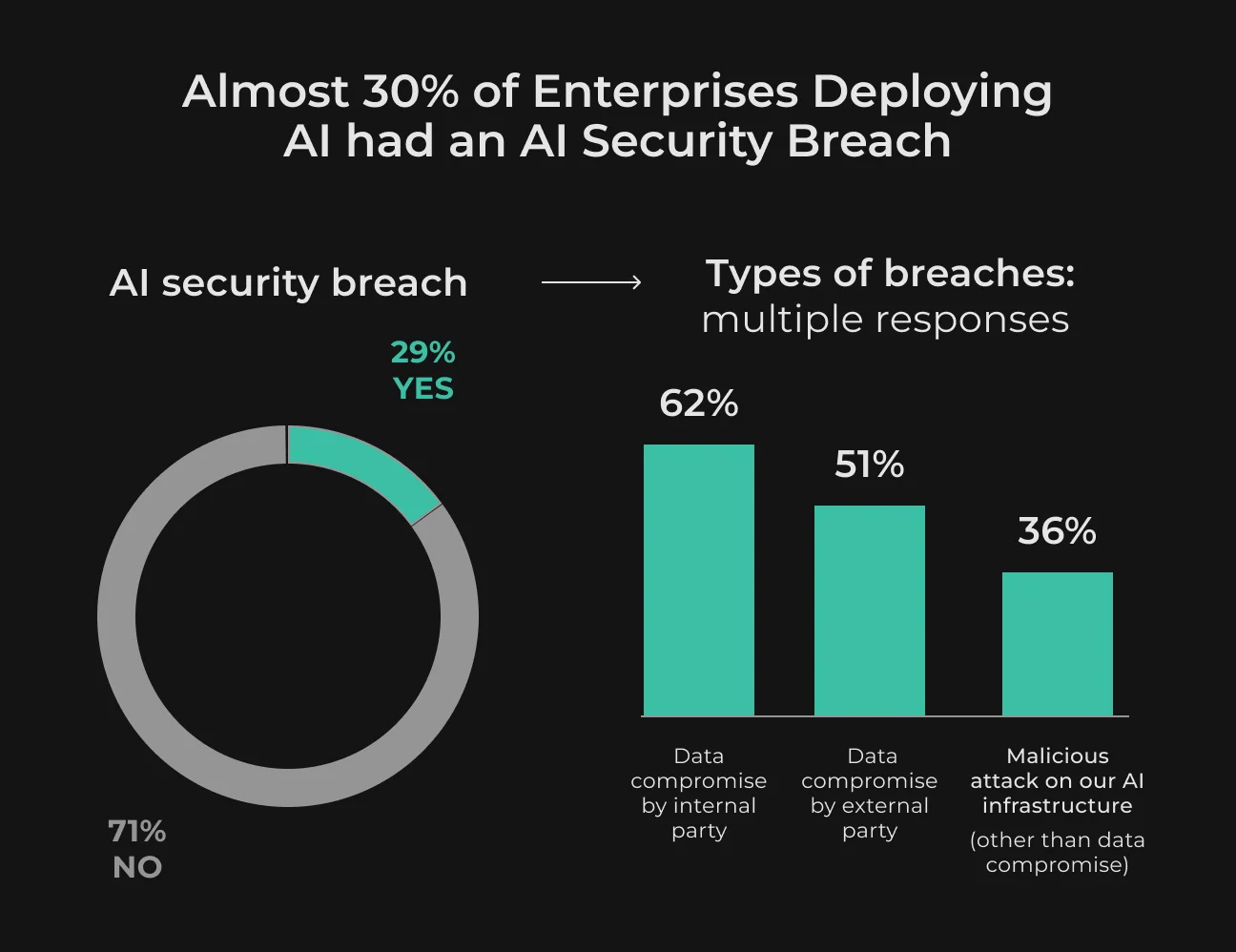
As enterprises integrate AI into their application stacks, they face a new class of generative AI security risks. These are not traditional software vulnerabilities. They are semantic exploits that target the model's reasoning capabilities and its access to internal data.
Types of security threats
Threat Type | What It Is | Example | Risk Level | Mitigation Strategies |
| Prompt Injection | Malicious instructions embedded in input to override system behavior | User forces model to ignore safety rules and reveal hidden data | High | Input sanitization, prompt isolation, strict instruction hierarchy |
| Data Leakage | Exposure of sensitive or confidential data via model outputs | AI reveals internal documents or user data | Critical | Data masking, access controls, output filtering, secure fine-tuning |
| Adversarial Attacks | Crafted inputs designed to manipulate or break model behavior | Slightly altered input causes harmful or incorrect output | High | Adversarial training, anomaly detection, robust evaluation |
| Model Inversion Attacks | Extracting training data by analyzing model responses | Reconstructing personal data from repeated queries | High | Differential privacy, output throttling, query monitoring |
| Membership Inference Attacks | Determining whether specific data was used in training | Attacker confirms if a user’s data is in the training set | Medium | Privacy-preserving training, regular audits, limiting confidence outputs |
| Jailbreaking | Techniques used to bypass built-in AI safety mechanisms | Prompts that trick AI into generating restricted content | High | Continuous red-teaming, guardrails, reinforcement learning updates |
| API Abuse | Exploiting AI APIs through excessive or malicious requests | Automated scripts abuse endpoints for scraping or attacks | High | Rate limiting, authentication, usage monitoring |
| Unauthorized Access | Gaining access to AI systems, models, or infrastructure without permission | Stolen API keys used to query models | Critical | Strong authentication, key rotation, access control policies |
| Supply Chain Attacks | Compromising third-party components (models, datasets, plugins) | Malicious model dependency introduces backdoor | High | Vendor verification, dependency scanning, sandboxing |
| Output Injection | Injecting malicious content into downstream systems via AI outputs | AI-generated code includes hidden exploit payloads | High | Output validation, sandbox execution, content filtering |
| Model Theft | Stealing model weights or replicating model behavior via queries | Competitor recreates proprietary model via API interactions | High | Watermarking, query limits, API monitoring, secure model hosting |
Mitigation strategies
Securing against generative AI security risks requires a Zero-Trust AI architecture. The assumption is that all prompts and model outputs are potentially untrusted, requiring explicit verification at every stage. Four things to put in place:
- Secure APIs. All connectors between AI models and legacy systems need strong authentication and least-privilege access.
- Input/output sanitization. Use AI gateways to filter and redact sensitive data (including PII) before it reaches the model, and scan model outputs for malicious code or exfiltration attempts.
- Shadow AI mitigation. Prevent employees from using unapproved, consumer-grade AI tools that lack enterprise-grade security controls.
Your strategy for managing generative AI cybersecurity risks also needs an incident response plan specifically built for AI-driven threats.
Challenge #4: Data Privacy & Compliance Issues
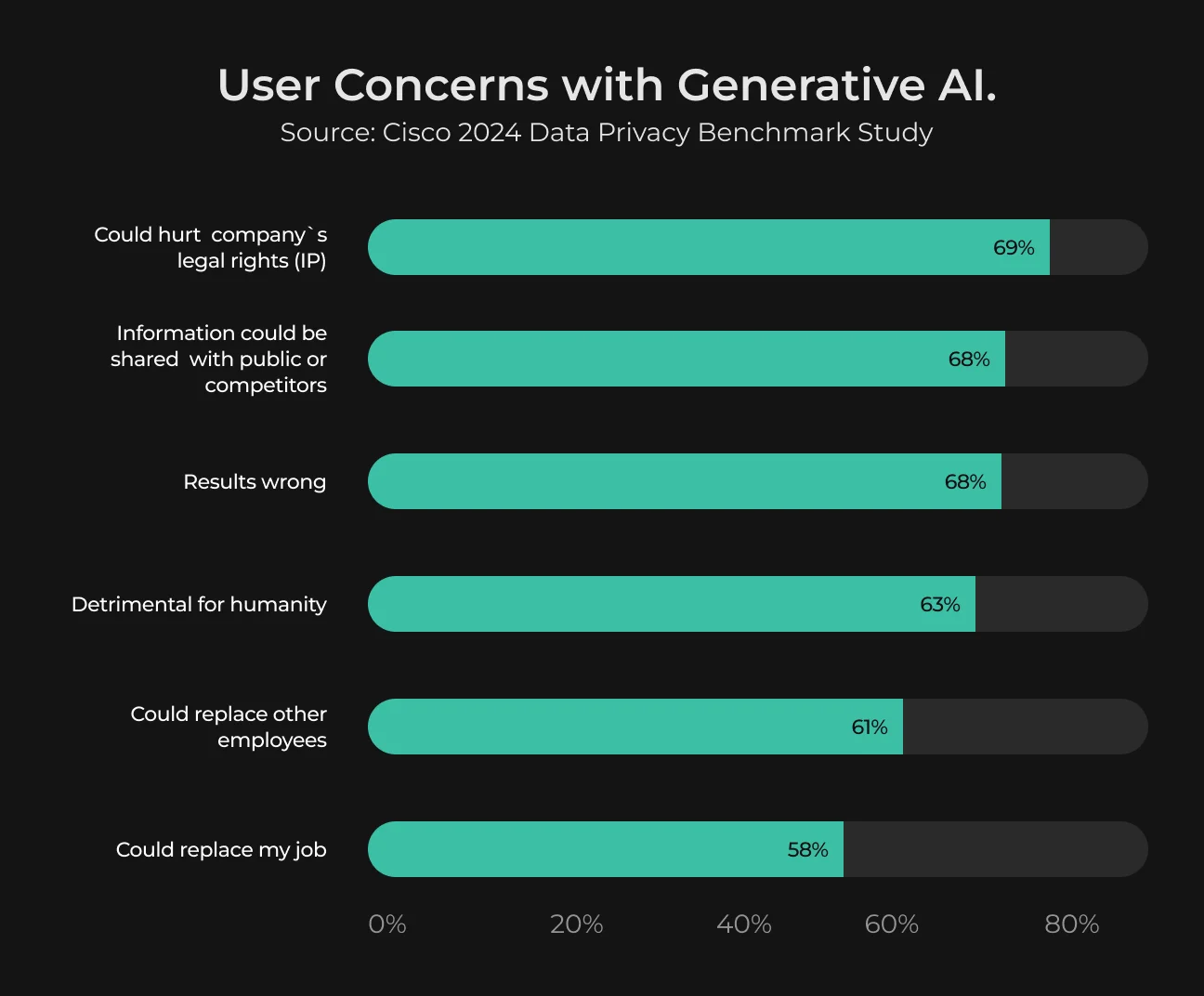
Using public LLMs frequently allows sensitive data to leave the organization's controlled environment, potentially exposing trade secrets or violating regulations like GDPR or HIPAA.
Risks
The most significant generative AI risks in the privacy domain come from training data leakage. Generative models can inadvertently memorize and then regenerate sensitive training data, leading to serious confidentiality breaches.
Cloud-based models introduce additional generative AI security risks around unauthorized data usage. Without explicit enterprise agreements (like a signed BAA for HIPAA), providers often retain user prompts to improve their models.
A single employee pasting internal credentials or proprietary code into a public prompt can effectively leak corporate trade secrets into a competitor's AI training set.
Industries affected
Three industries face particularly severe exposure:
- Healthcare. You must safeguard Protected Health Information (PHI). Exposure of clinical documentation can lead to severe fines under HIPAA and HTI-1. Notably, 98% of healthcare organizations using encrypted AI were able to recover more effectively from ransomware in 2024.
- Finance (BFSI). Strict confidentiality is required for risk scoring, fraud detection, and PII handling. Financial institutions face non-negotiable mandates for regional data residency and internal auditability.
- Legal & government. You risk exposing privileged attorney-client data or classified national security information. These sectors often require air-gapped or on-premise hardware deployments to ensure 100% data sovereignty.
As you can see, highly regulated sectors face the most severe generative AI challenges regarding data residency and sovereignty.
Mitigation
To address these generative AI risks, teams are deploying private or local LLMs. Hosting models within a Virtual Private Cloud (VPC) or on-premise means zero data egress.
Compliance Factor | Public LLM Risk | Private LLM Mitigation |
| Data Residency | Data may cross international borders | Data stays in specific, governed regions |
| Auditability | Limited logs from third-party providers | Full, immutable audit trails of all prompts |
| IP Ownership | Ambiguous ownership of generated content | Complete control and ownership of weights/data |
| PII Exposure | Risk of prompts being used for training | Zero use of prompts for external training |
Challenge #5: Lack of Explainability
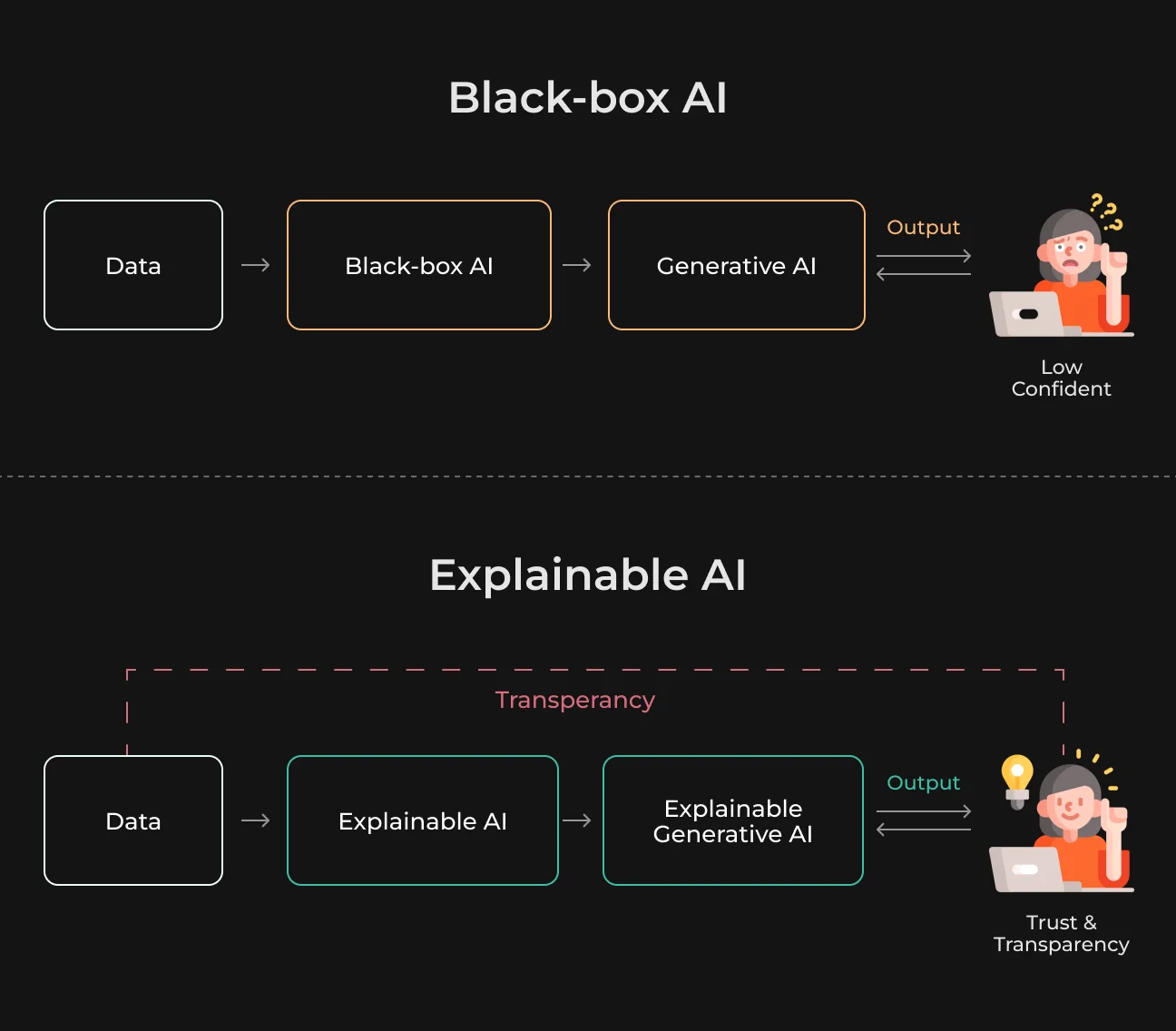
When an AI makes a critical decision, it is often unclear how the model arrived at that conclusion. This lack of transparency leads to regulatory challenges and a general lack of trust among end-users. Examples of such critical decisions are flagging a medical patient for surgery or denying a loan.
Business risks
Here are 3 main risks:
- Erosion of institutional trust.
40% of organizations identified explainability as a key hurdle in adopting GenAI. Engagement drops when the logic behind a high-stakes decision is incomprehensible.
- Regulatory & compliance deadlines.
In Australia, automated decision-making (ADM) transparency becomes mandatory by December 2026.
It requires organizations to provide the decision rationale for outputs significantly affecting individuals. Under the EU AI Act, "high-risk" systems must provide detailed technical documentation and establish human oversight mechanisms (Article 14).
- Legal liability for silent failures.
Organizations remain liable for misleading or deceptive conduct regardless of whether the AI hallucinated. Without explainable AI, companies cannot effectively audit for the dangers of generative AI before they trigger litigation.
So, the black-box nature of LLMs creates a triad of business risks that can derail an enterprise's AI strategy.
Mitigation
Teams are adopting eXplainable AI (XAI) techniques like SHAP (SHapley Additive exPlanations) and LIME (Local Interpretable Model-Agnostic Explanations). These tools let data scientists visualize which specific features or inputs most heavily influenced a model's output.
Technique | Goal | Benefit |
| SHAP | Measures feature contribution | Provides a global view of model behavior |
| LIME | Approximates local predictions | Explains individual outputs for specific users |
| Logging | Detailed traceability of data flows | Essential for audits and regulatory compliance |
Deploy AI Without the Risk
We handle compliance, security, and custom LLM setup.

Challenge #6: High Infrastructure & Operational Costs
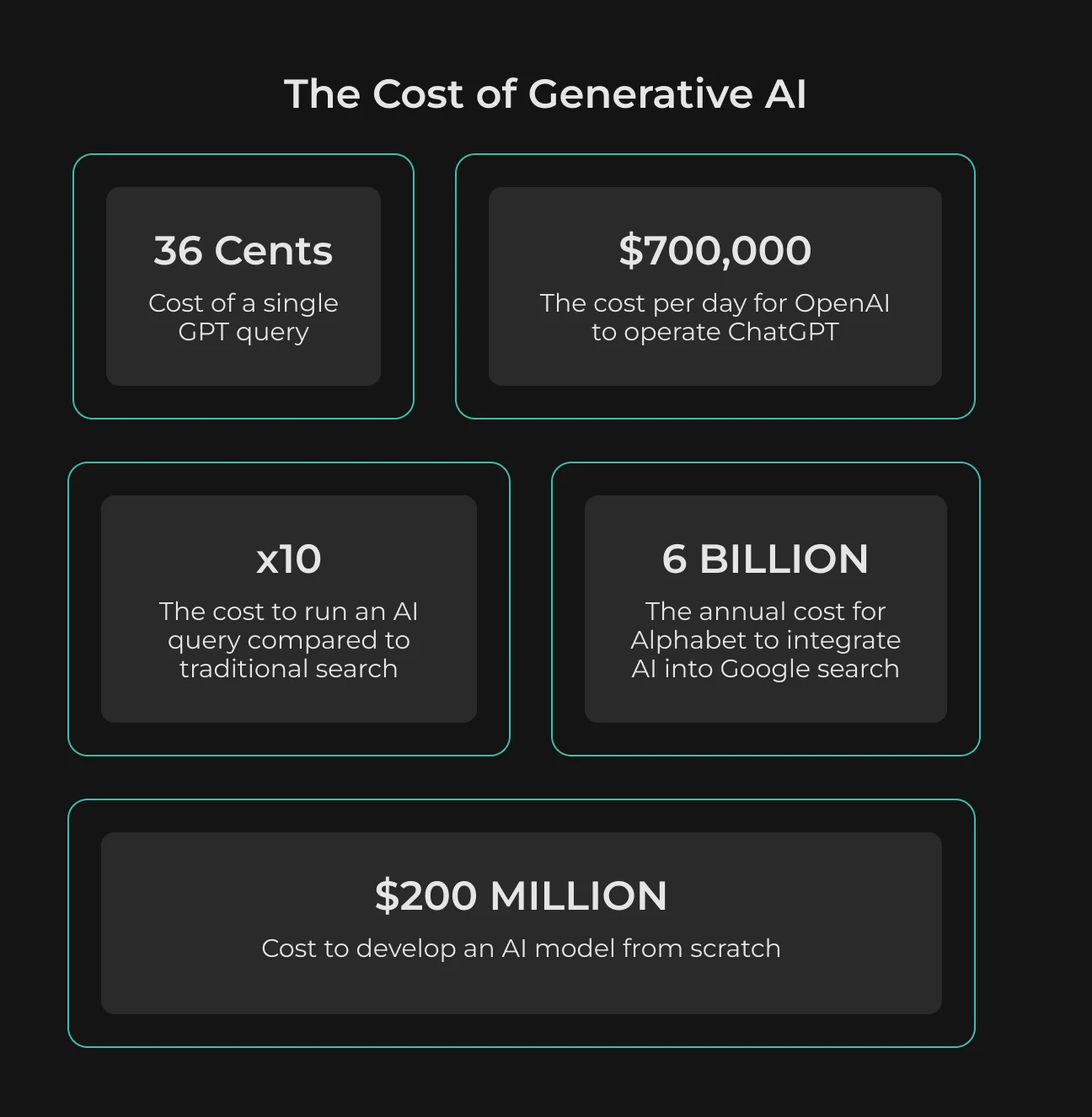
The financial commitment required to scale generative AI is routinely underestimated. Between 2024 and 2028, at least 50% of GenAI projects are projected to overrun their budgets due to poor architectural choices.
Cost drivers
Inference costs (the ongoing expense of running a model) typically represent at least 70% of the total lifetime cost of an AI system. Every request carries a price, and agentic workflows involving multiple model calls can cause costs to expand non-linearly.
Cost Driver | Description | Optimization Strategy |
| Token Volume | Pay-per-token (input + output) | Prompt compression and length limits |
| GPU Capacity | High cost of specialized hardware | Spot instances and auto-scaling |
| Redundancy | Re-processing identical queries | Semantic caching |
| System Prompts | Long instructions sent with every turn | Moving static logic to code |
By implementing semantic caching (storing the results of previous similar queries), teams can reduce inference costs by up to 40%.
Mitigation
To address these high-infrastructure costs, you must adopt a structured FinOps discipline:
- Semantic caching. Caching the outputs of expensive or repetitive calls (FAQ answers, summaries) can reduce inference costs by up to 40% while also improving latency.
- Intelligent model routing. Not every task requires a frontier model. Routing simple queries to cheaper models and premium tasks to advanced models prevents over-provisioning.
- Infrastructure optimization. For self-hosted models, using spot or preemptible instances for non-mission-critical workloads can cut compute costs by up to 60%.
- Prompt and context management. Extracting static instructions into code logic rather than system prompts, and using sliding context windows for chat history, prevents token counts from expanding non-linearly.
- Knowledge distillation. Transferring the expertise of a large model into a smaller, more efficient one can significantly lower the marginal cost of inference.
Just as understanding what is hallucination in generative AI prevents technical errors, FinOps prevents fiscal ones. Without these controls, hallucination generative AI rates can also rise indirectly, as budget-constrained teams opt for lower-quality models that lack proper grounding.
Challenge #7: Integration Complexity
Integrating modern AI into established enterprise architectures is a primary source of project friction. Legacy systems were not built for the high-speed unstructured data flows that generative models require. Identifying what are some of the challenges of generative AI integration early prevents costly mid-project overhauls.
Issues
Integration Issue | Description | Business Risk |
| Fragmented Data Silos | Overlapping, dirty, or siloed data prevents a consistent view of enterprise information | Unreliable reasoning results and failure to scale beyond localized pilots |
| Monolithic Debt | Rigid architectures where changes touch undocumented modules or fragile services | High technology-debt costs and frequent breaks during system modernization |
| Interface Gaps | Legacy platforms lack standardized REST APIs or real-time data pipelines | Connectivity bottlenecks that block the flow of high-velocity data to AI models |
| Manual Logic Mapping | Reliance on senior developers' tribal knowledge instead of structured documentation | Expanded testing cycles and high uncertainty during technology deployment |
Mitigation
The most effective way to modernize without disruption is through an API-first architecture.
Wrapping legacy functions in standardized APIs lets you connect AI models to core transaction systems as a modular service. This reduces technical debt and enables a phased rollout of AI capabilities rather than a high-risk big-bang migration.
Challenge #8: Quality & Reliability Issues
Generative AI often struggles with inconsistent outputs and domain-specific limitations. These are significant generative AI limitations. A model that performs well on general tasks can fail in the specialized environments of manufacturing or legal research. 43.4% of organizations name inaccurate or inconsistent answers as the primary obstacle to scaling AI-powered analytics.
Inconsistent outputs
Inconsistent outputs occur when a model provides different answers to identical or similar queries over time. This is a byproduct of the stochastic nature of LLMs, where the next token is predicted based on probabilistic weights rather than a stable database of facts.
In enterprise settings, logic scattering worsens this problem, producing contradictory results for the same financial or operational KPIs. Models are also susceptible to data drift. Performance degrades silently post-deployment, requiring real-time monitoring to catch anomalies before they affect decision-making.
Domain limitations
General-purpose models like GPT-4 or Gemini 3 Pro demonstrate strong broad reasoning but often lack the depth required for specialized industries like healthcare, law, or finance.
Leading general models can generate "severely harmful clinical recommendations" in up to 22.2% of complex medical cases, primarily through "errors of omission" where they fail to recommend necessary diagnostic tests.
These models also struggle with novelty failure: an over-reliance on memorized training data that causes them to fail on slightly modified logic puzzles or proprietary business scenarios they have not seen before. In regulated environments, using a model that lacks causal understanding (the ability to distinguish correlation from cause-and-effect) can lead to serious strategic errors.
Mitigation
To close this gap, teams need fine-tuning: taking a pre-trained model and adapting it to a specialized dataset. Fine-tuning improves task-specific accuracy and ensures the model adheres to the company's tone of voice and policy requirements.
Domain-specific models trained exclusively on clinical or financial data can achieve 40% higher accuracy than general-purpose foundation models.
Strategy | Technical Implementation | Business Outcome |
| Fine-Tuning | Retraining a base model on high-quality, task-specific datasets | Adapts model "tone of voice" and specific expertise |
| DSLMs | Deploying Domain-Specific Language Models (e.g., Med-PaLM, FinGPT) | Improves accuracy by 25-30% on niche industry tasks |
| Governance-First Semantic Layer | Centralizing business logic in a unified model rather than raw data | Ensures consistent metric calculation across all users |
| Shift-Left QA | Integrating automated evaluation and data validation early in the AI pipeline | Reduces production failure rates and rework cycles |
| Continuous Benchmarking | Using frameworks like RAGAS or TruLens to track faithfulness and context recall | Provides real-time visibility into output quality |
Challenge #9: Ethical & Legal Concerns
As of 2025 and early 2026, the global legal environment remains fragmented. The legal status of AI-generated content is still being worked out. Current rulings in the United States suggest that purely AI-generated work is not eligible for copyright protection.
Copyright issues
Jurisdiction | TDM (Text & Data Mining) Exception | Authorship Policy | Key Legislative / Policy Status (2025–2026) |
| United States | No explicit TDM exception; relies on fair use doctrine (case-by-case, ongoing litigation) | Human authorship required for copyright protection | U.S. Copyright Office maintains human authorship standard; Supreme Court of the United States has declined to hear key AI copyright cases, leaving uncertainty unresolved |
| European Union | Permitted with opt-out under EU Copyright Directive (DSM Directive) | Requires human creative input | EU AI Act (2024) introduces transparency & labeling obligations for AI-generated content; implementation ongoing |
| United Kingdom | No broad commercial TDM exception; existing exception limited to non-commercial research | Human authorship required (with ongoing review of computer-generated works regime) | UK Intellectual Property Office continues policy consultations; prior expansion proposal withdrawn after stakeholder opposition |
| Australia | No explicit TDM exception; governed by general copyright rules | Human authorship required | Ongoing policy consultations on AI and copyright; exploring licensing and remuneration models, no finalized framework yet |
| Japan | Broad TDM exception, including commercial use, for non-expressive purposes | Primarily human authorship, though flexible in practice | Established permissive regime under copyright law; complemented by national AI strategy and regulatory guidance |
| China | No formal TDM exception; training governed by data protection, IP, and platform regulations | State-influenced, consent- and compliance-driven approach | Cyberspace Administration of China enforces generative AI and deep synthesis rules; requires lawful data sourcing and safeguards (including consent in specific cases) |
AI-generated content ownership
The absence of clear ownership creates a defensibility problem.
If a competitor can freely use your AI-generated marketing materials because they are not copyrighted, your competitive advantage disappears. There is also a second exposure: models that have memorized copyrighted song lyrics or news articles during training may inadvertently reproduce them, triggering infringement lawsuits against your organization.
Mitigation
To cope with the generative AI challenges associated with law and intellectual property, you must stick to:
- Legal frameworks.
Anchoring on the EU AI Act as the global highest common denominator effectively covers nearly 80% of requirements found in other jurisdictions. To handle regional variations (U.S., Australia), use the NIST AI RMF Generative AI Profile to map, measure, and manage risks throughout the system's lifecycle.
- Compliance policies.
Enterprises need an AI Workplace Policy that explicitly prohibits the use of generative models for high-stakes decisions (hiring, termination) without human oversight.
So, legal frameworks and rigorous human-in-the-loop documentation are essential to prove that a human exercised sufficient creative judgment to merit copyright protection.
Challenge #10: Over-Reliance on AI Systems
Perhaps the most long-term concern for the COO is the human factor. Automation bias occurs when employees start to blindly trust AI suggestions. Critical thinking declines, and oversight erodes.
Risks
Risk Category | Description of Hazard | Organizational Impact |
| Automation Bias | Blindly following AI suggestions while ignoring contradictory "real-world" clues | Systematic errors in high-stakes environments |
| Stunted Critical Thinking | Over-reliance on AI "shortcuts" prevents staff from developing expert judgment | Long-term erosion of enterprise domain expertise |
| Reduced Oversight | Accepting incorrect outputs without sufficient or "diligent" human review | Reputational damage and legal liability for errors |
| Trust Volatility | High initial trust collapses following an AI error, leading to future under-reliance | Resistance to future beneficial technology adoption |
Mitigation
Strategy | Implementation Action | Benefit |
| Decision Governance | Prohibit AI as the sole determinant in hiring, promotion, or medical decisions | Ensures human accountability and legal compliance |
| AI Literacy Training | Educate staff on failure modes, hallucinations, and the probabilistic nature of models | Empowers teams to maintain professional skepticism |
| HITL Review | Mandate human-in-the-loop validation for all patient-facing or "privileged" operations | Acts as a final safety net against fabricated data |
| XAI Integration | Use SHAP or LIME to explain why a model made a specific suggestion | Facilitates appropriate reliance through transparency |
Teams need to understand that generative AI limitations mean these systems are assistants, not replacements for human judgment.
Generative AI Limitations: What It Still Can’t Do
Despite the hype, the fundamental generative AI limitations matter. These systems are not sentient as they do not possess a true understanding of causality or physical reality.
- Reasoning limitations. LLMs often fail at multi-step logical deductions or simple visual-spatial puzzles that a human child could solve.
- Lack of true understanding. They process statistical patterns, not meaning. When pushed beyond their training boundaries, the result is plausible-sounding nonsense.
- Dependency on training data. If a topic is too new or too niche for the model's training corpus, the probability of hallucination increases sharply.
Recognizing these generative AI limitations is the starting point for deploying the technology where it is actually effective: natural language processing, information retrieval, code assistance, and similar tasks. Complex numerical forecasting or high-stakes autonomous decision-making require far more caution.
How to Mitigate AI Risks: A Strategic Framework
The following checklist helps teams evaluate AI readiness and understand how to mitigate AI risks:
Step | Focus Area | Key Actions | Outcome |
| Step 1 | Risk Assessment | Inventory all GenAI systems (including shadow AI); identify high- vs low-risk use cases; map data lineage (training + RAG) | Clear visibility into AI usage, risk exposure, and data flow |
| Step 2 | Governance & Policies | Appoint Chief AI Officer (CAIO); establish AI ethics/litigation task force; define data usage policies | Strong accountability, compliance readiness, and controlled AI adoption |
| Step 3 | Secure Architecture | Deploy AI gateways (sanitization, PII redaction); implement Zero-Trust (MFA, least privilege); use private/local LLMs | Reduced attack surface, better data protection, and secure infrastructure |
| Step 4 | Continuous Monitoring | Monitor model drift and anomalies; track token costs and apply semantic caching; run bias audits and red-teaming | Early threat detection, cost control, and continuous model reliability |
| Step 5 | Human Oversight | Enforce human-in-the-loop for critical outputs; train teams in AI literacy; apply XAI for explainability | Safer decision-making, reduced risk of errors, and increased trust in AI systems |
Best Practices for Safe Generative AI Implementation
Here are 5 quick best practices to avoid generative AI risks for you:
Use Private or Hybrid Models
Keep sensitive enterprise data inside your own environment to meet GDPR and HIPAA requirements.
The compliance pressure here is real and growing: cumulative GDPR fines reached €5.88 billion by 2026, and most standard public LLM API offerings are not covered by a Business Associate Agreement by default, requiring enterprise agreements or private deployment before PHI can legally touch the infrastructure.
For any team in healthcare, legal, or financial services, private deployment is not a design preference. It is a compliance prerequisite.
Implement Security Layers
Use encryption at rest and in transit. Apply named entity recognition (NER) to redact PII from prompts before they reach the model. The four points where PII enters an LLM pipeline are user input, retrieved context, tool results, and model output itself, and many teams start by guarding only the first one.
That leaves three unguarded. Transformer-based NER lifts recall to 92–96% on free-text identifiers compared to 50–65% for regex alone, though it adds 15–40 ms of latency per request, a tradeoff that is almost always worth making in regulated environments.
Monitor Outputs
Treat all AI-generated content as potentially sensitive until verified by a human or a secondary safety model. 76% of enterprises now include human-in-the-loop processes to catch errors before deployment, reflecting how broadly the industry has accepted that model outputs cannot be trusted at face value.
The other risk is drift: over 70% of enterprises now run AI in production, which means a model that degrades silently post-deployment can affect real business decisions before anyone notices.
Run Regular Audits
Periodically review model performance against fairness metrics and apply security patches. 60% of businesses using AI are not working to develop ethical AI policies, and 74% fail to address potential biases. Those numbers suggest that most organizations treat audits as optional.
They are not, particularly once the EU AI Act's high-risk system provisions become enforceable.
Train Your Teams
Build a professionally skeptical approach to AI outputs.
That is the most direct defense against automation bias. More than half the global workforce (56%) reported receiving no recent training, and 57% lack access to mentorship opportunities, which explains much of the gap between AI adoption and actual productivity impact. Tools without training produce overconfident users, and overconfident users are exactly where automation bias takes hold.
How SapientPro Implemented an AI Assistant in E-Commerce
SapientPro developed a proof-of-concept AI-powered e-commerce assistant to streamline product discovery and replicate the experience of an in-store consultant.

The core challenge was interpreting vague user requests ("green t-shirt") and managing choice overload in a system without strong initial filters.
The solution was a hybrid search engine combining keyword-based and semantic (vector-based) search, with an LLM determining the best method per query. The system integrates price, color, and availability filters in real time, with sub-second response times.
The resulting conversational module guides shoppers to relevant products with human-like feedback and precise matching.
Why Choose SapientPro for AI Development & Implementation
SapientPro brings over five years of AI expertise, with deep specialization in training and deploying custom LLMs. We handle generative AI cybersecurity risks so you get the safest possible solution.
Our private LLM deployments guarantee 100% data sovereignty, providing a secure alternative to public cloud APIs for regulated industries like healthcare and finance.
We can help with:
- Dataset preparation;
- Dataset fine-tuning;
- Infrastructure optimization;
- Compliance audits, and more.
With domain-specific training, SapientPro's solutions achieve higher accuracy on specialized tasks compared to generalist models. We help enterprises scale AI solutions safely, cutting operational costs while maintaining complete infrastructure control and IP protection.
Stop AI Risks Before They Start
Custom LLMs built for your compliance requirements.