All Decentralized Identity Management with Blockchain
August 12, 202615 min read


Global enterprise tech spending passed $2.5 trillion in 2025. Yet identity and access still depend heavily on centralized providers, federated protocols such as OAuth 2.0 and OpenID Connect, and corporate directories that keep sensitive identity data behind a limited number of entry points.
That model is convenient until one of those entry points is compromised.
Decentralized identity changes who controls the identity layer. Instead of asking a company or identity provider to confirm a user’s identity, people and organizations can present cryptographic credentials that can be verified without exposing the underlying personal data or relying on one central database.
For businesses, the appeal is less about blockchain itself and more about the risks tied to the current model:
- Large-scale credential breaches;
- Social engineering attacks built around stolen identities;
- Growing compliance costs under GDPR, CCPA, and similar privacy laws.
Interest is already translating into spending. The decentralized identity market was valued at roughly $2.56–4.89 billion in 2025 and is projected to reach $6.8 billion in 2026.
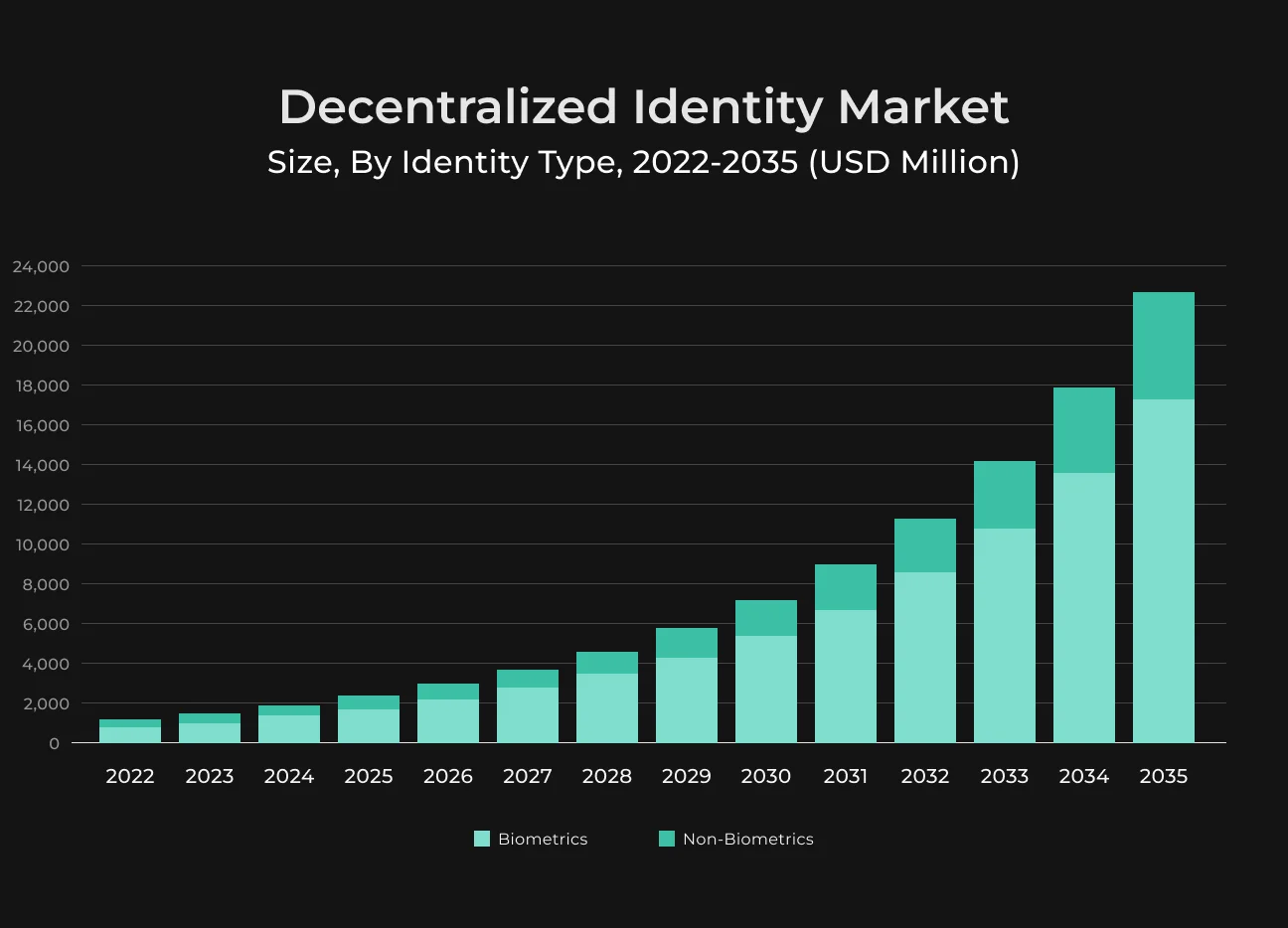
Companies are now testing decentralized identity blockchain systems to reduce the amount of sensitive data they hold, simplify identity verification, and satisfy stricter privacy requirements across markets.
Below, we look at how these systems work, where they fit into enterprise architecture, and how SapientPro’s team approaches their implementation.
What Is Decentralized Identity?
Decentralized identity is an architectural model where digital credentials are created, owned, and controlled directly by individuals or corporate entities, known as identity subjects. Those credentials never sit on third-party centralized servers.
Instead of querying a central directory to validate a user's identity, a decentralized digital identity system relies on:
- Asymmetric public key cryptography;
- Standardized document formats;
- Distributed networks.
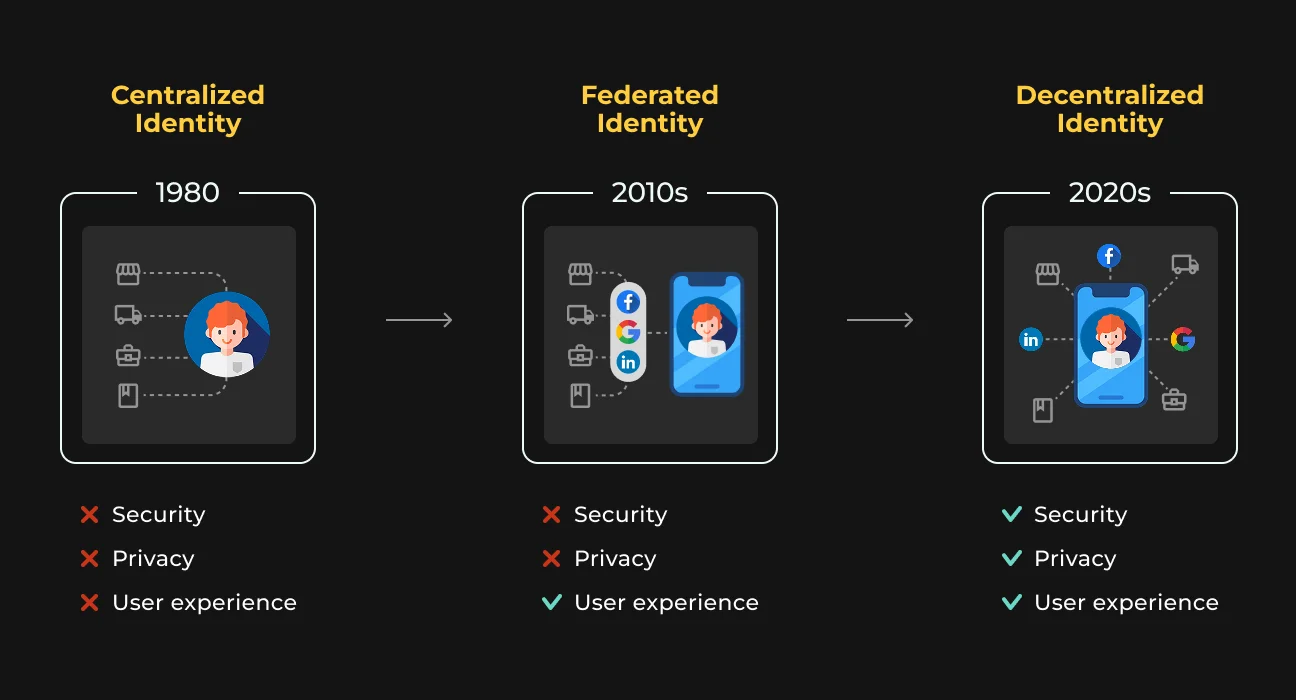
It is important to distinguish between decentralized identity and self-sovereign identity (SSI). While frequently used interchangeably in industry discussions, these terms describe distinct dimensions of modern identity architecture:
Decentralized Identity
This covers the technical layer: open standards such as W3C Decentralized Identifiers (DIDs) and Verifiable Credentials, public-key cryptography, distributed key management, and decentralized networks used to verify identity without relying on a single database or identity provider.
Self-Sovereign Identity (SSI)
This is the ownership model built around that infrastructure. Users hold and manage their credentials themselves, decide what information to share, and can reuse those credentials across compatible services instead of creating a new identity record with every provider.
The difference matters for businesses. In a blockchain decentralized identity setup, the company no longer needs to store every piece of identity data it may need to verify later. It can check cryptographic proofs presented by the user and keep far less sensitive information in its own systems.
That changes the company’s role from identity custodian to verifier — and reduces the amount of personal data exposed if its infrastructure is breached.
How Decentralized Identity Works: Core Components
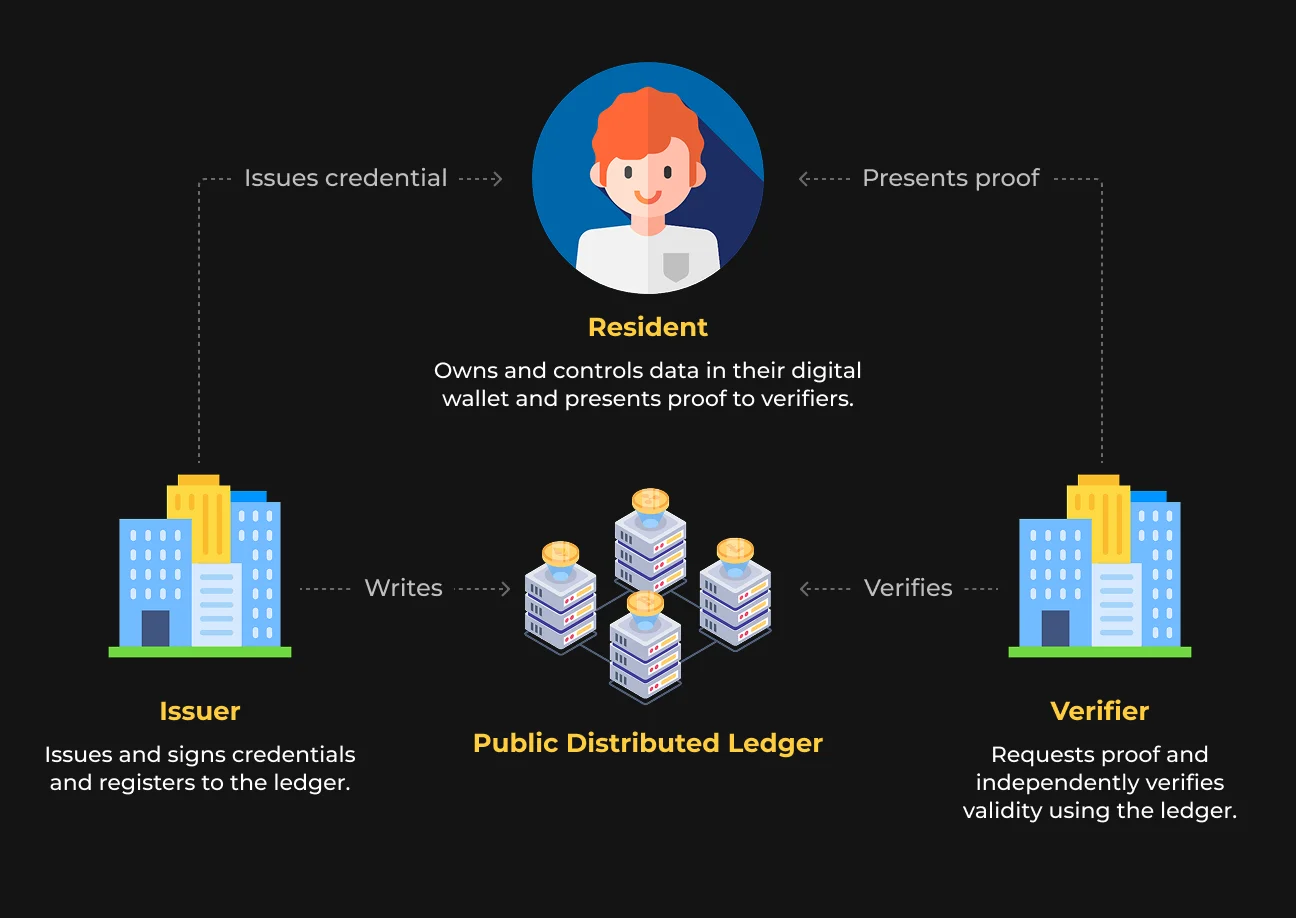
Replacing centralized authentication with decentralized identity management takes an interoperable technical framework built on three components:
- Decentralized identifiers;
- Verifiable credentials stored in edge-based digital wallets;
- Distributed ledger serving as a public trust registry.
Decentralized Identifiers (DIDs)
A decentralized identifier (DID) is a globally unique URI (Uniform Resource Identifier) designed in accordance with World Wide Web Consortium (W3C) standards.
Unlike email addresses, IP addresses, or phone numbers, a DID is created, owned, and managed directly by the identity subject without relying on a central registration authority or domain registrar.
A standard DID follows a structured syntax:
- did:method:method-specific-id (such as did:ion:... or did:ebsi:...).
The identifier resolves to a DID Document, a JSON-LD data structure containing the subject's cryptographic public keys, authentication suites, and service endpoints. DIDs act as cryptographic anchors that enable private, peer-to-peer communication between issuers, holders, and verifiers.
Verifiable Credentials and Digital Wallets
Credentials within a decentralized framework are structured as Verifiable Credentials (VCs). A verifiable credential is a tamper-evident digital document containing:
- Verified claim attributes (such as employment status, legal age, or academic degrees);
- Validity constraints;
- Cryptographic digital signature of the issuing entity.
This architecture works through three parties:
- Issuer. An authoritative entity (such as a government agency, bank, or university) that verifies real-world facts, signs the claims cryptographically, and issues the VC to the holder.
- Holder. The subject who receives the VC and stores it securely within a digital wallet application on a mobile device or hardware security module.
- Verifier. A relying party (such as an enterprise portal, financial institution, or service platform) that requests cryptographic proof of specific attributes to grant system access.
When presenting credentials, modern digital identity blockchain systems use cryptographic techniques like Zero-Knowledge Proofs (ZKPs) and selective disclosure.
Selective disclosure lets a user confirm a specific claim, proving they're over 18, for example, without revealing extra personal details like their exact birth date, home address, or full legal name. That's what enterprise data minimization requirements demand in practice.
The Role of Blockchain
Verifiable credentials can exist off-chain, but blockchain identity solutions use distributed ledger technology as a decentralized Public Key Infrastructure (DPKI) and immutable trust registry.
The ledger carries three architectural responsibilities:
- Public Key Resolution. Storing public keys, DID documents, and smart contract logic required to resolve identity claims universally, without central key management servers.
- Immutability and Resilience. Providing a tamper-proof audit trail for credential schemas and revocation registries, with high availability and no single point of failure.
- Interoperability. Acting as a root-of-trust layer that enables independent organizations across diverse industries and borders to verify cryptographic signatures seamlessly.
Enterprise blockchain identity implementations avoid storing raw or encrypted personally identifiable information directly on-chain.
Writing personal data to an immutable ledger conflicts with privacy mandates like GDPR's “right to be forgotten.” Instead, only cryptographic commitments, issuer public keys, schemas, and non-confidential revocation state vectors get anchored to the blockchain.
Why Businesses Are Switching to Decentralized Authentication
This shift is driven by business imperatives: risk mitigation, lower operational costs, and better user acquisition. Centralized directories increasingly register as financial and regulatory liabilities rather than infrastructure.
Security & Business Dimension | Centralized Authentication (Legacy) | Decentralized Authentication (Modern) |
| Data Storage Architecture | Centralized server databases and cloud directories | Distributed edge storage (wallets) + DPKI trust registry |
| Primary Threat Surface | Target honeypots vulnerable to credential leaks and ATO attacks | Distributed key model; no single database to compromise |
| User Data Control & Consent | Vendor retains administrative ownership over user records | User maintains complete ownership; granular attribute sharing |
| Onboarding & Verification Velocity | Manual document reviews and redundant identity verification flows | Instant verification using reusable, cryptographically signed VCs |
| Regulatory & Audit Exposure | High audit liability across all stored customer PII attributes | Minimal compliance scope via strict selective disclosure proofs |
| System Uptime & Availability | Subject to centralized IdP vendor outages and API downtime | High fault tolerance powered by distributed resolution networks |
Four business drivers are transforming enterprise authentication strategies:
Elimination of Breach Liabilities
Centralized identity databases remain primary targets for credential stuffing, phishing, and ransomware attacks. Decentralized models remove central storage of sensitive attributes, which shrinks the enterprise attack surface.
Compliance Scope Reduction
Modern data protection regulations impose severe financial penalties for improper PII handling. Decentralized identity solutions use data minimization and selective disclosure to cut the volume of stored PII, which shrinks regulatory audit burdens.
Accelerated Customer Onboarding
Manual document checks and repetitive Know Your Customer (KYC) procedures drive high customer drop-off. Reusable, cryptographically verified credentials grant instant access, turning days-long verification into sub-second interactions.
Protection Against Credential Fraud
Password-based systems and federated social logins remain vulnerable to account takeover (ATO) attacks. Asymmetric cryptographic verification neutralizes common credential interception techniques at the protocol level.
Build Secure Decentralized Identity Solutions
Modernize authentication with scalable blockchain identity architecture built for enterprise needs.

Decentralized Identity Use Cases Across Industries
Decentralized identity use cases show how cryptographic identity verification simplifies cross-organizational workflows across major sectors, from finance to supply chains.
Finance and KYC
Financial services institutions face strict AML and KYC regulations. Traditionally, every bank independently performs redundant, costly identity verification checks on the same individual.
Using blockchain identity verification, financial institutions issue “Reusable KYC” credentials directly to customer digital wallets following initial verification.
When opening subsequent accounts across partner networks, clients present these pre-verified credentials. Verifiers validate the issuing bank's cryptographic signature on-chain in seconds. This cuts onboarding costs while preserving AML compliance integrity.
Healthcare
Healthcare networks require cross-institutional data sharing alongside strict compliance with patient privacy laws like HIPAA and GDPR. Decentralized identity architectures allow medical systems to issue verifiable health records, insurance attestations, and provider credentials directly to patients and clinicians.
Patients manage their medical profiles across disparate hospital networks, granting temporary, selective access to specific specialists without centralizing health data.
Modern medical organizations pair decentralized identity protocols with other operational tools to keep clinical environments running smoothly. For example, they implement AI for inventory management to trace pharmaceutical and medical hardware provenance.
E-Commerce and Retail
E-commerce merchants experience checkout abandonment due to registration friction and account creation requirements. Implementing decentralized authentication enables passwordless, one-click checkout flows.
Retailers verify customer delivery details and age eligibility cryptographically without storing credit card numbers or government IDs on retail servers. Privacy-centric loyalty programs also let consumers earn and redeem rewards across retail coalitions without exposing their cross-site browsing behavior.
Merchants modernizing their digital store architectures can integrate wallet presentation flows through our custom e-commerce development services, cutting checkout friction without a full platform rebuild.
Government and Public Services
Governments sit at the root of trust in global identity systems. Public sector entities are issuing digital citizen IDs, driving licenses, and entitlement attestations as verifiable credentials.
The clearest regulatory proof point globally is the European Union's updated eIDAS 2.0 framework (Regulation EU 2024/1183), which entered into force in May 2024. Under eIDAS 2.0, all 27 EU Member States are legally required to provide certified European Digital Identity Wallets (EUDI Wallets) to all 450 million citizens and residents by December 2026.
By December 2027, private-sector relying parties in regulated industries will also be legally required to accept these wallets for user authentication and identity verification.
These private-sector relying parties in regulated industries include:
- Banking;
- Energy;
- Telecommunications;
- Transport;
- Healthcare;
- Very Large Online Platforms (VLOPs).
This legal framework makes blockchain digital identity a regulatory requirement for enterprises serving European markets, not an optional upgrade.
Supply Chain and IoT
Supply chains depend on machine-to-machine trust to verify hardware origins, prevent counterfeiting, and ensure secure data transmission across automated systems. In connected Internet of Things environments, hardware components are assigned unique DIDs during manufacturing. This approach creates an immutable cryptographic identity on a distributed ledger.
When edge sensors transmit telemetry or execute smart contract logic, they authenticate cryptographically without relying on centralized key infrastructure. This prevents device spoofing, verifies component provenance, and secures automated supply chains.
Enterprise engineering teams deploying complex industrial automation pair cryptographic device identities with custom automation solution development to protect industrial control systems from unauthorized network injection.
For example, SapientPro developed an AI-powered solution to manage and automate Safety Data Sheet (SDS) processing across formats and languages. Our team has shipped supply chain and IoT identity projects at this level of complexity before.
Modern Blockchain Identity Solutions
Enterprise blockchain identity implementation relies on two main technical foundations:
Hyperledger Indy and Aries
These are purpose-built open-source frameworks hosted under the Linux Foundation. Hyperledger Indy provides distributed ledger tools built specifically for decentralized identity registries.
Hyperledger Aries provides the peer-to-peer messaging protocols (DIDComm), credential exchange tools, and wallet engines necessary to issue and verify credentials. Active developer participation across Hyperledger Aries and Indy grew by over 180% between 2022 and 2025, demonstrating production readiness.
Global Standards Bodies
The Decentralized Identity Foundation (DIF), W3C Credentials Community Group, and OpenID Foundation define standard transport and presentation specifications. We mean OpenID for Verifiable Credential Issuance (OID4VCI) and Verifiable Presentations (OID4VP). As a result, now we have standardized system interoperability capabilities across vendors.
Mainstream enterprise adoption backs up that technical traction. Platforms like Microsoft Entra Verified ID integrate W3C VC data models, JSON Web Tokens (JWTs), and OpenID Connect protocols alongside the Sidetree/ION DID method anchored to public networks, letting enterprises build verifiable credential workflows directly into existing Azure Active Directory deployments.
IBM and Okta have shipped enterprise-grade platforms too, further evidence that decentralized credential validation is becoming a standard feature of modern Identity and Access Management (IAM) stacks.
Decentralized Identity Implementation Challenges
Transitioning from centralized authentication to decentralized identity solutions raises specific technical, legal, and operational challenges.
Interoperability Across DID Methods
Dozens of active DID methods (for example, did:ion, did:indy, did:web, did:ebsi) compete with different credential presentation formats (JSON-LD, SD-JWT, ISO 18013-5 mDL). Enterprises need flexible abstraction layers to avoid getting locked into a single sub-system.
User Experience and Key Recovery
In non-custodial wallet environments, individuals manage their own private cryptographic keys, and traditional "forgot password" reset workflows don't apply. Designing social recovery options, cloud-encrypted key backups, and edge UX that don't recreate a central point of failure remains a top usability priority.
Regulatory Alignment Outside Europe
While eIDAS 2.0 provides binding legal definitions across the EU, regulatory frameworks in other global jurisdictions remain fragmented. Multinational organizations must navigate varying local legal interpretations regarding digital signature validity and cross-border identity acceptance.
Legacy System Integration Costs
Established enterprises maintain complex IAM and CIAM stacks built around SAML 2.0, OAuth 2.0, and traditional LDAP directories. Integrating decentralized identity verification requires hybrid gateway architectures that convert verifiable credential presentations into standard OIDC session tokens for downstream legacy apps.
None of this rules out decentralized identity. It means implementation takes real engineering: flexible standards, recovery mechanisms people can actually use, and integration paths that work with the enterprise stack already in place.
A self sovereign identity blockchain gives users more control, privacy, and trust than a centralized identity provider ever will, once those pieces are in place.
How SapientPro Approaches Decentralized Identity Projects
SapientPro delivers end-to-end engineering expertise in blockchain development, smart contract auditing, and modern enterprise system integration.
We help companies move from high-risk centralized directories to decentralized identity standards, keeping deployments aligned with regulatory mandates like eIDAS 2.0 without sacrificing user experience.
SapientPro can help you with:
- Decentralized identity architecture design, protocol assessment, and credential schema engineering;
- Custom digital wallet and edge credential agent software development for web, iOS, and Android platforms;
- Enterprise IAM and CIAM bridge development, connecting verifiable credentials to Okta, Microsoft Entra, and custom directory stacks;
- Smart contract development, security auditing, and trust registry deployment across public and permissioned blockchains.
Our delivery framework includes initial scope discovery, technical architecture, parallel delivery sprints, security testing, and post-launch maintenance.
This approach keeps mainnet deployment risk and development costs under control, whether the project involves a global enterprise wallet rollout or a single eIDAS 2.0 compliance integration.
Turn Identity Compliance into Advantage
Prepare for evolving regulations with decentralized identity architecture designed for secure verification.