All AI Governance Maturity Model: Where Your Business Actually Stands
June 22, 202615 min read


AI is already inside the business. It writes first drafts, supports customer teams, helps analysts work faster, screens documents, powers chatbots, and shapes decisions that used to stay fully human.
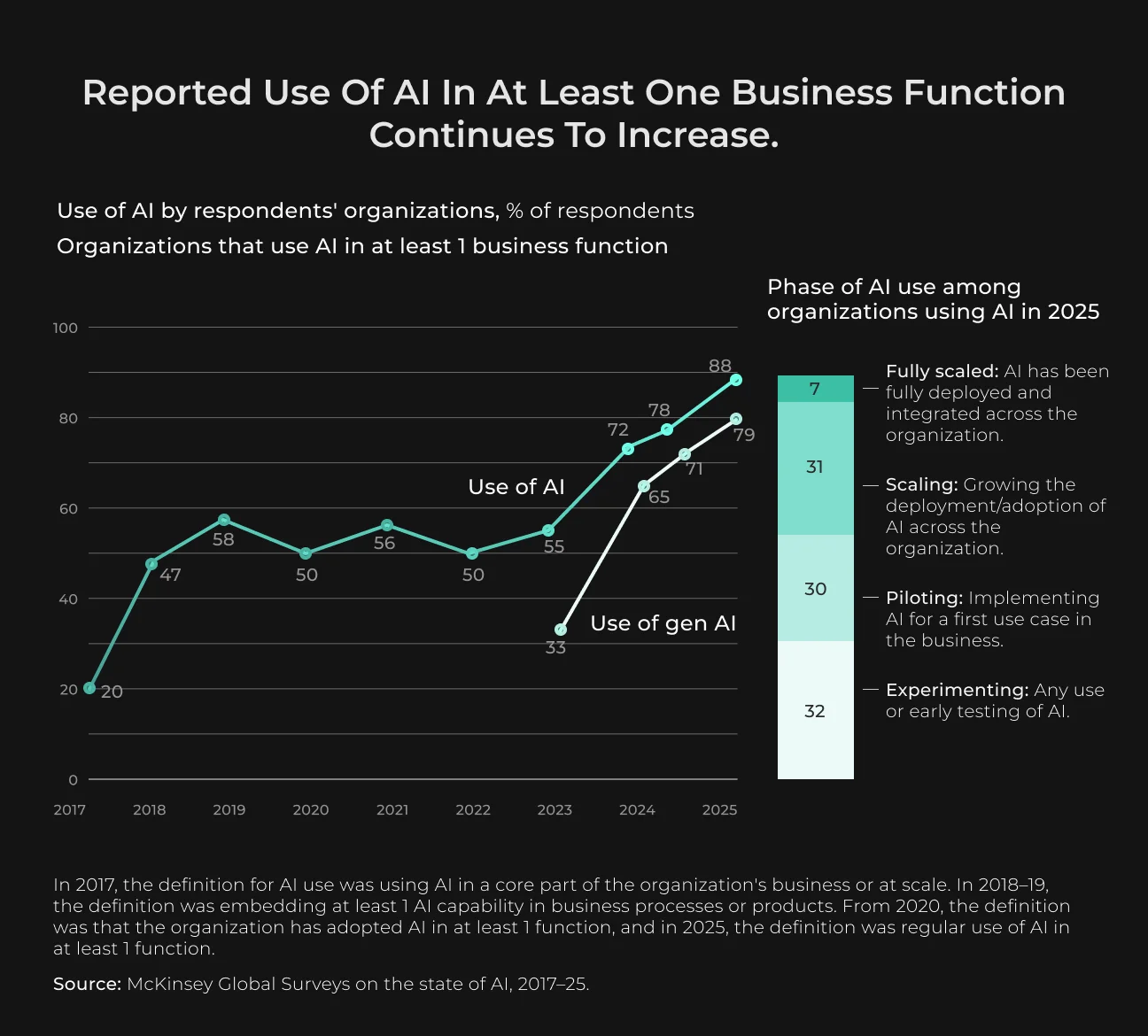
McKinsey’s 2025 global survey shows how far this has gone. It found that 88% of organizations use AI in at least one business function. Only about one-third have scaled it across the enterprise.
The risk is moving just as quickly. McKinsey also states that 51% of organizations using AI have already seen negative outcomes, from wrong answers to privacy and security issues.
That is why AI contextual governance framework cannot stay as a policy file. Leaders need to know where AI is used, who approved it, what data it touches, and what happens after launch.
This article breaks down five maturity levels and helps you understand where your company stands before AI use becomes harder to control.
Why Most Companies Misjudge Their Own AI Maturity
A company can look advanced from the outside and stay immature in practice.
It can have AI tools in several departments, a policy in a shared folder, and a senior leader with AI in the role name. None of that tells you whether people follow a clear process when they launch, approve, or monitor AI.
The real question is much more practical. If someone asked for the AI use cases approved last quarter, could the team find them quickly? Could they show who reviewed the risks, what data was involved, and why the final decision made sense?
This is where many businesses get an unpleasant surprise. They have activity, interest, and leadership attention. What they lack is a working record of decisions. IBM’s 2026 CEO Study shows how fast companies are changing their leadership structures.
In 2026, 76% of surveyed organizations said they had a Chief AI Officer, compared with 26% in 2025. That signals stronger attention from the top. But it does not prove the company already has a living AI register or regular checks after launch.
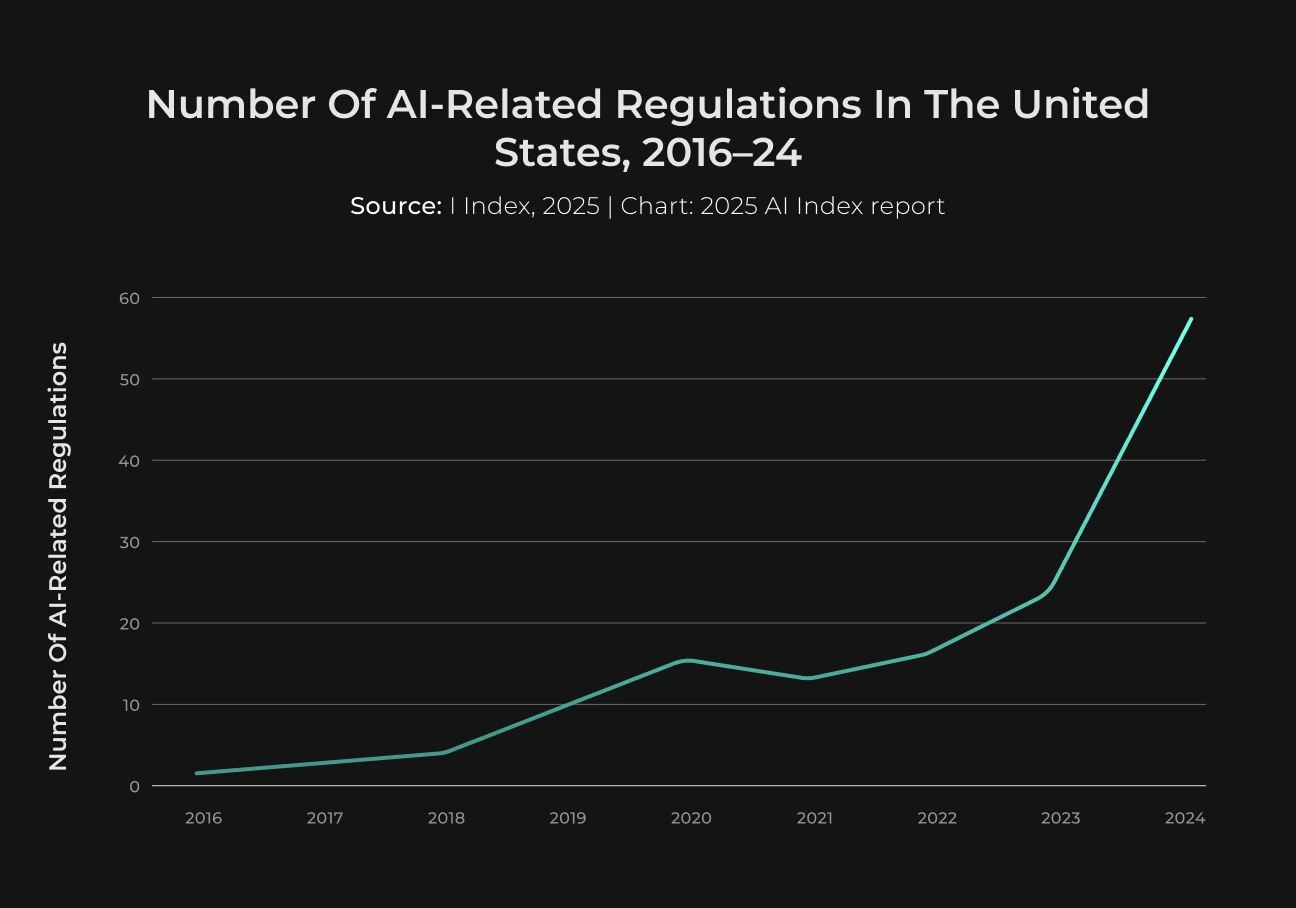
The Stanford AI Index 2025 adds another warning. AI-related incidents continue to rise, and standardized responsible AI evaluations remain uncommon, even among major model developers.
That is why an AI governance maturity model helps. It turns a vague sense of readiness into levels the company can check, discuss, and improve.
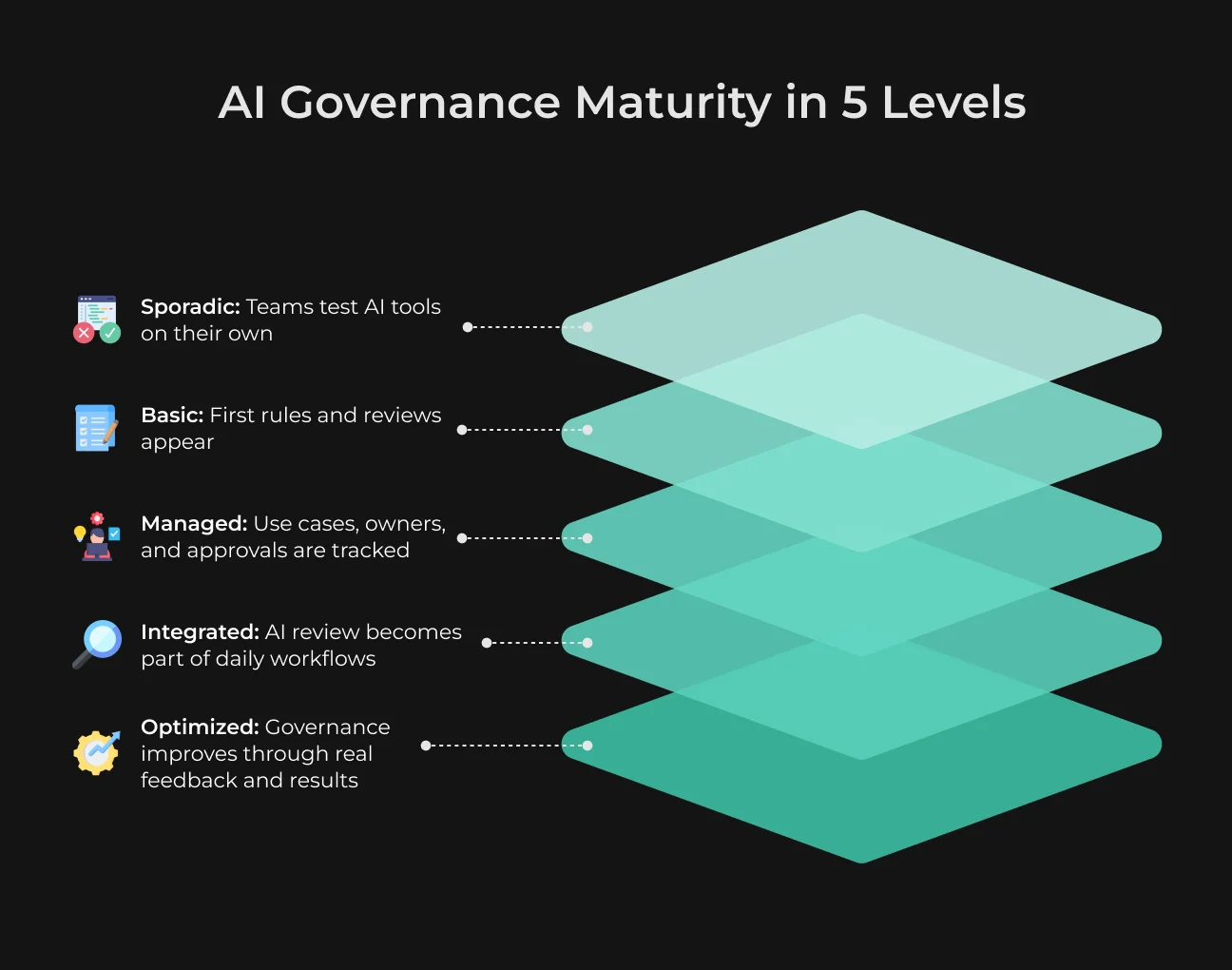
The Five-Level AI Governance Maturity Model
A maturity model is a reality check.
It helps leaders answer a more practical question: do we actually know what teams are doing with AI, or are we finding out only when something goes wrong?
Level 1: Sporadic
At this level, AI usually starts quietly. A few teams test tools because they need faster drafts, quicker reports, or better support workflows. Nobody plans a company-wide AI program yet. People just try what helps them finish work faster.
The problem starts when no one has the full picture.
One team uses a public AI tool for internal notes. Another uploads customer questions into a chatbot. A third adds AI to a report that later goes to management. Each case looks small on its own. Together, they create risks the company cannot see.
A sporadic company needs discovery first. Find the AI tools and use cases already running. Then decide which ones need review before adding more rules.
Level 2: Basic
At the basic level, leadership starts to react. Someone writes an AI policy. Security approves a few tools. Legal gets involved when a project touches customer data or public content. The company begins to understand that AI cannot grow only through personal choice.
The weak spot is daily execution. People know there are rules, yet they do not always know what to do with them. One team asks for approval early. Another sends a request at the last minute. Some employees avoid the process because it feels slow.
This stage needs a simple route. When a team wants to use AI, they need to know where to register the idea, who will review it, and what information matters. If the process takes too much explanation, people will work around it.
Level 3: Managed
AI starts to become part of normal project planning. Teams bring AI use cases into normal project planning. They register them early, name the owner, and keep the main decision details in one place.
The company can now answer basic questions without chasing people across departments. For example, which AI tools are active or which teams use them.
This level also makes discussions easier. Legal, security, product, and business teams work from the same record. A review does not restart from zero every time a new question appears.
Level 4: Integrated
AI governance now sits inside the normal flow of work. Teams do not meet it as a separate review near the end of a project. They account for it when they choose tools, plan features, review vendors, and prepare releases.
A team choosing a new AI vendor knows what to check before the contract moves forward.
Product teams talk about AI risks while the feature is still being planned. That gives leaders time to catch problems before the work goes too far.
Level 5: Optimized
Optimized governance grows through real experience. The work does not end on launch day. A vendor can update the tool, teams can start using it in a new way, or the data behind it can shift.
The company looks at what actually happens at work:
- Long approvals show where the process gets stuck;
- Repeated user complaints point to weak training or unclear review questions;
- Vendor updates trigger a new check before the change creates risk.
The result is a calmer way to grow AI across the business. People understand the process, leaders see the risk clearly, and key decisions stay visible after launch.
How to Run an AI Governance Assessment for Your Business
Start with what is already happening. Ask teams which AI tools they use and whether any approval or review record exists.
Keep the session small. You need people who can answer real questions about systems, data, security, legal risk, operations, and business use. Everyone else can read the summary later.
A team can point to a register, ticket, policy, incident log, or monitoring report. If nobody can show evidence, the score goes down.
Use a 0–4 scale:
- 0 — nothing exists
- 1 — handled case by case
- 2 — used in some projects
- 3 — used across the company
- 4 — tracked and improved
AI Maturity Assessment Scorecard
Area | Weight | What to bring to the review |
| Strategy and policy | 10% | Current AI rules, tool limits, and examples of use cases the company allows or blocks |
| Inventory and ownership | 15% | A list of active AI use cases, with an owner for each one |
| Risk and impact assessment | 20% | Notes showing how the team checked possible harm before launch |
| Data governance | 10% | Proof that teams know which data AI tools can use and which data stays out |
| Lifecycle controls | 15% | Records from launch checks and later reviews after major changes |
| Monitoring and incidents | 15% | A clear way to report AI problems and assign someone to respond |
| Compliance and evidence | 10% | Approval notes, vendor checks, review history, and decision records |
| Training and literacy | 5% | Guidance that helps employees use AI safely in their own role |
For the final score, rate each area from 0 to 4. Then convert it by weight and add the results. For example, a score of 3 in a 20% area gives 15 points.
Score | Level |
| 0–20 | Sporadic |
| 21–40 | Basic |
| 41–60 | Managed |
| 61–80 | Integrated |
| 81–100 | Optimized |
The total score needs two reality checks. If inventory, ownership, or incident response gets less than 2, stop at Basic. Leaders cannot manage AI they cannot locate, assign, or respond to when it fails.
If the business has high-impact AI or EU-scoped use cases, risk assessment and compliance evidence need at least 2 points each. If one falls below 2, stop at Managed. A polished policy cannot cover weak risk review or missing records in sensitive use cases.
Use this score to choose what to fix first, like missing records, weak reviews, or gaps that could create risk in the next AI project.
Your AI Register Shouldn't Live in a Chat Thread
We build the technical foundation that makes governance stick.

Building an AI Governance Strategy That Moves the Company Forward
A real AI governance strategy starts when people stop guessing what to do with a new AI idea. There is one route for the request, one place for the record, and a clear owner for the decision.
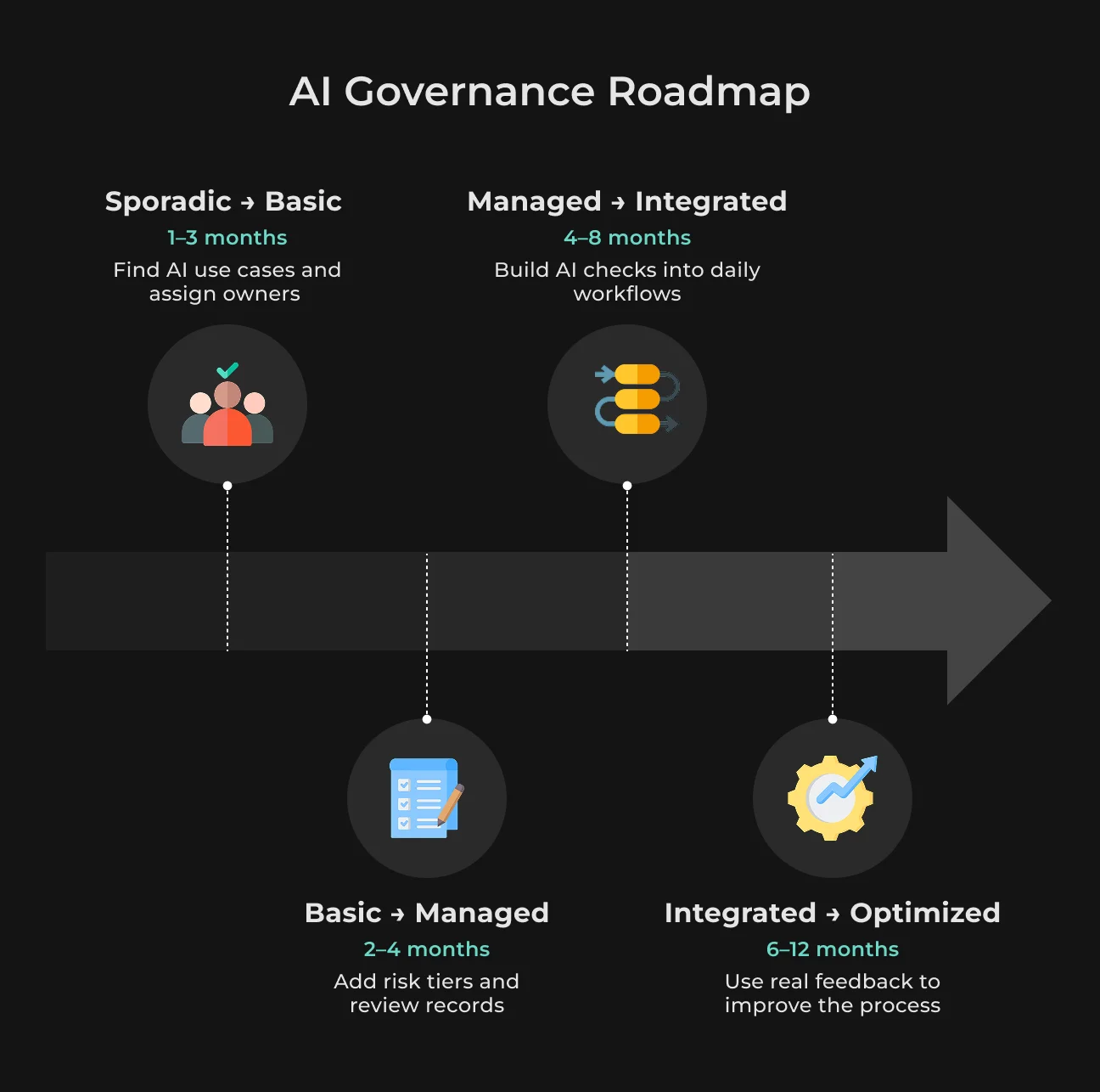
From Sporadic to Basic: 1–3 Months
Start with visibility. Find the AI tools already used across teams, including generative AI apps, agents, external APIs, and AI features inside SaaS products.
The register can stay simple at first. For each use case, record the owner, business purpose, vendor, data used, and current status. That is enough to show where AI already sits in the company.
Then add a short working policy and keep it practical. Name approved tools, blocked use cases, and data that cannot go into public AI systems. Add one executive sponsor, so decisions do not disappear between legal, security, product, and operations.
Vendor checks also need to start here. Before a team buys an AI tool, someone has to ask how the vendor handles data, access, logs, model training, and contract changes.
The company reaches Basic when leaders can answer one plain question: where do we use AI today?
From Basic to Managed: 2–4 Months
At this point, approval needs to become easier to follow. Low-risk internal tools can move quickly. AI that touches customers, personal data, financial logic, or important decisions needs a deeper review.
This is where risk tiers help. They stop teams from treating every AI use case as either harmless or dangerous. The review becomes more balanced.
A serious AI use case needs a short review record before launch. Keep it practical. Write down why the tool is used, what data it touches, what could go wrong, and who checks the output.
Procurement also needs better questions for AI vendors, for example,
- Does the vendor train on customer data?
- Can the company turn that off?
- What logs exist?
- What happens when the vendor changes the tool?
The company moves into Managed when teams stop launching serious AI projects on trust alone and leave a review record before release.
From Managed to Integrated: 4–8 Months
AI governance framework has to stop living in a separate lane. It needs to fit into the processes teams already use.
Procurement checks AI vendors before contracts move forward. Product teams raise AI risk during planning. Security knows which tools manage sensitive data. Privacy and compliance can find records without asking every department one by one.
Reporting also has to become more practical. Leaders need to notice risky AI work and vendor problems before they turn into urgent issues.
If an artificial intelligence tool fails, the team cannot improvise. One person needs the authority to pause it, check what happened, and decide the next move.
The company reaches Integrated when teams include AI review early in planning and use it to make better decisions before release.
From Integrated to Optimized: 6–12 Months
At this final level, the company starts improving their AI governance best practices based on real evidence. Here, the company learns from what happens after launch. A slow approval, vendor update, user complaint, or audit finding can show where the process needs work.
The fixes are usually practical. Remove a useless review question, check vendors earlier, update training, or improve monitoring after the first warning sign.
This is also the right time to prepare for external assurance or ISO/IEC 42001 readiness. The company can check whether its AI management system works in practice.
The company reaches Optimized when AI work feels easier to manage with each new use case. Teams know the route, leaders see the risk early, and the process improves from real experience.
What the EU AI Act Means for Your Current Maturity Level
The EU AI Act focuses less on the technology itself and more on how AI affects people. A tool that helps an employee draft notes is one thing. A system used in hiring, credit, education, public services, safety, or personal rights is a very different one. That difference is what makes the Act relevant to an AI maturity model.
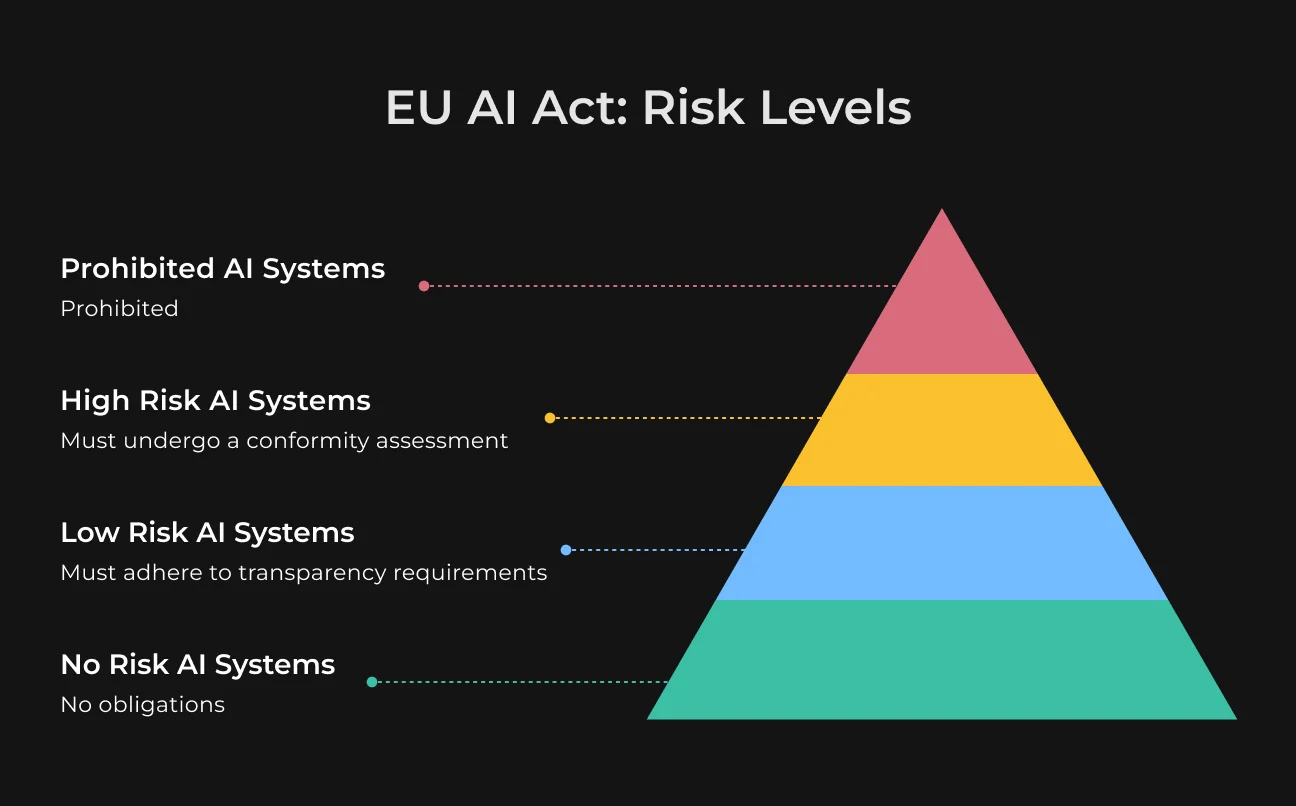
For companies with real EU exposure, the Act already belongs in current planning.
The first rules started applying in February 2025, when the Act banned AI uses with unacceptable risk. This covers social scoring, manipulative AI, harmful use of vulnerable people, some biometric practices, and mass scraping for facial recognition databases.
From August 2025, providers of general-purpose AI models have had to follow GPAI obligations. The most advanced models, where systemic risk can appear, also need notification to the AI Office.
Article 50 starts applying in August 2026 and focuses on transparency. It is worth checking even if your AI system is low-risk. A chatbot, AI-written article, synthetic image, generated video, or AI-made audio can require a clear disclosure to users.
Penalties make weak governance expensive. Breaches of banned AI practices can reach €35 million or 7% of global annual turnover.
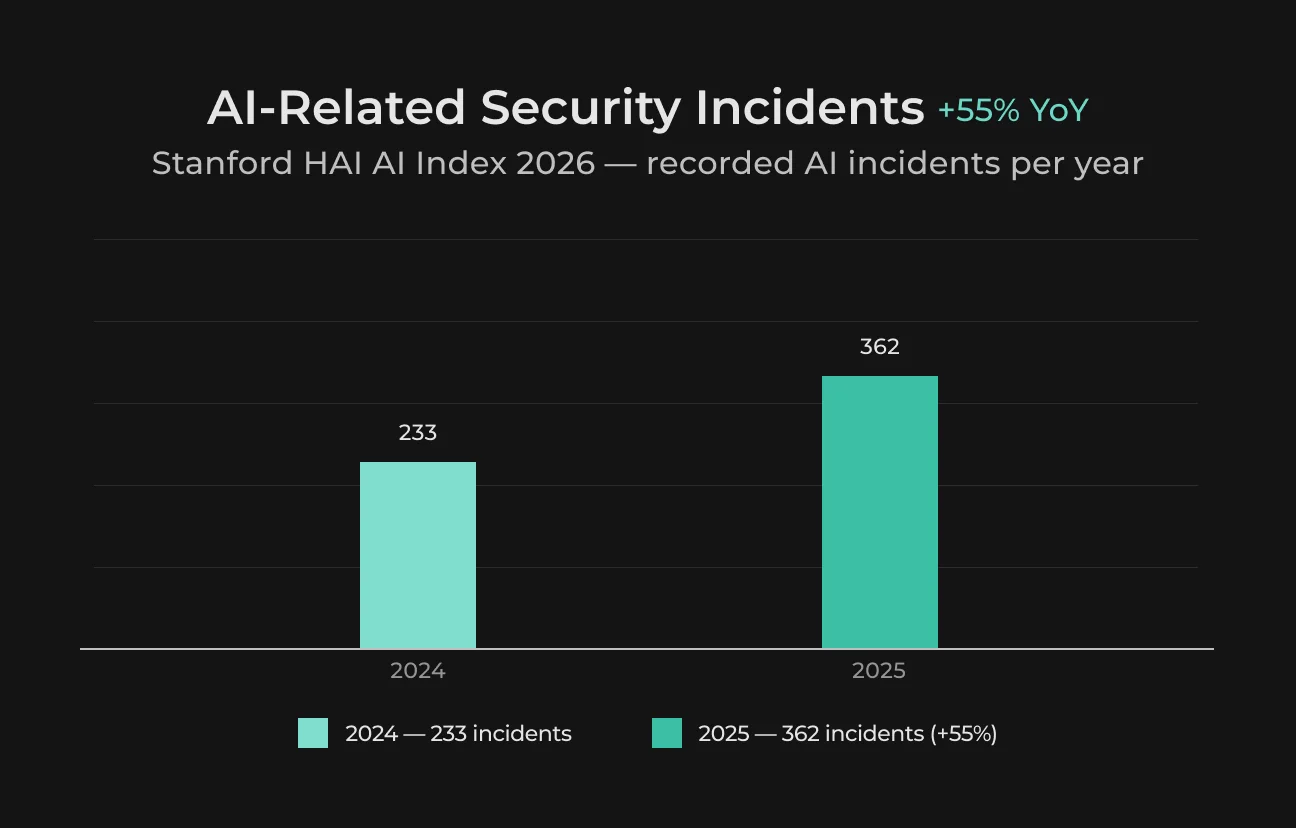
For companies at the Sporadic or Basic level, the hard part is evidence. If approval details sit in private chats or loose files, the company will struggle to explain the decision, the review, and the training behind the system.
High-risk use cases make this problem harder to ignore.
A hiring tool, credit model, biometric system, or product-safety feature needs a clear record from approval to post-launch checks. Managed and Integrated companies have a better starting point because they already track use cases, reviews, and evidence.
The AI Omnibus political agreement also gives more time for high-risk rules, with stand-alone systems moving to December 2027 and product-embedded systems to August 2028. That extra time matters only if the company uses it to build the process now.
This is where the maturity model becomes practical. It shows whether the company can answer the questions the AI Act will bring up anyway. What AI systems are in use? Who owns them? Where is the review record? What proof exists after launch?
If those answers are missing, the next maturity step becomes the first compliance priority.
Why Choose SapientPro as Your Tech Partner
Sound AI governance implementation works when the system is built with control in mind. Our team focuses on the technical details that matter in real work. The architecture has to support secure data use, clear human oversight, and records the business can rely on later.
SapientPro is a good fit when an AI idea already has business value, but the product needs stronger engineering behind it. We help make that product reliable enough for daily use and clear enough for leaders to manage.
Ready to build AI with more control and confidence? Contact SapientPro to discuss your project.
AI Without an Audit Trail Is a Liability
Talk to our team before your next high-risk use case goes live to fix it for compliance.