All How to Build a Marketplace App: Best Niches, Challenges, and Costs
October 25, 202510 min read


Online marketplaces are booming, with giants like Amazon and Pinduoduo dominating global markets. However, multiple niche marketplaces with certain specializations provide significant competition, covering the tech giants’ weak spots.
In this article, SapientPro’s experts share how to build a marketplace app that attracts users and generates income. You’ll learn about the essential features, best niches, core challenges, and costs of developing a custom marketplace. Read now!
Key Takeaways
- Choose the right model (B2B, B2C, C2C) to match how you connect buyers and sellers;
- Follow stages: market validation → defining features → tech architecture → MVP prototyping → testing → launch. Prototypes cut risk;
- Core marketplace features include user accounts, product listings with images, search/filters, carts, payment gateways, reviews, notifications, and admin tools.
Best Marketplace Niches in 2025
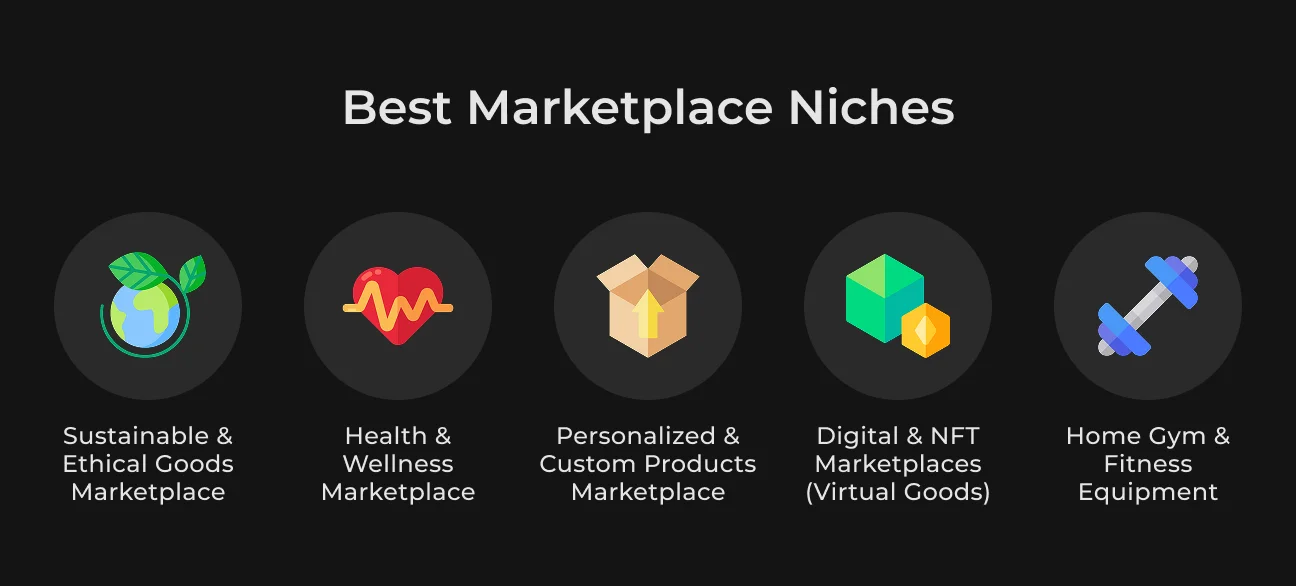
So, how to create a marketplace app? First, you need to decide on the niche to fill the gap. Here are the 5 niches to consider for building a marketplace app.
Sustainable & Ethical Goods Marketplace
Consumers increasingly support brands with green practices. About 66% of global shoppers say they’ll pay more for sustainable products. A marketplace focused on recycled fashion, zero-waste home goods, or fair-trade crafts can tap into this trend.
The global market for sustainable and ethical products, estimated at $7,548.2 million in 2022, is projected to reach a revised size of $17,302 million by 2031.
Health & Wellness Marketplace
The health and wellness industry is experiencing rapid expansion. The $2 trillion global wellness market gets a millennial and Gen Z glow-up. 84% of US consumers say wellness is a “top” or “important” priority (in the United Kingdom, that figure is 79%, while it soars to 94% in China).
According to this study, two big ideas appeared: younger consumers are conceptualizing wellness in new ways, and wellness is showing up in new places. A dedicated platform for vitamins, exercise gear, telemedicine, or wellness treatments (yoga lessons, therapy) meets this demand.
Personalized & Custom Products Marketplace
Personalization is the catchphrase. Customers like things created or established to their specifications – like customized jewelry, custom clothing, or personalized gifts. The personalized gifts market will surpass $38.66 billion by 2027 at a CAGR of 5.83%.
A shopping app that enables buyers to customize products (e.g. monogrammed goods or custom furniture) can command a premium price and maintain loyalty. Add features like custom design tools or product page customization to serve this niche.
Digital & NFT Marketplaces (Virtual Goods)
Virtual property, such as NFTs (non-fungible tokens), virtual property, or virtual items, is a next-generation space. The NFT market is growing: there are already over 11.6 million NFT users across the globe. Its market value is expected to hit $342.54 billion by the end of 2032.
NFT marketplaces enable creators to mint and sell unique digital collectibles (art, music, in-game assets). Even though your main marketplace is physical products, add a digital storefront or NFT drops for limited releases. Statistically, a top NFT marketplace, OpenSea, has recorded over $33 billion in sales.
Home Gym & Fitness Equipment
The pandemic has also changed the way people exercise and work out. As people work from home, they spend money on home gym equipment to keep themselves healthy. The exercise equipment market worldwide generated a revenue of $49.81 billion in 2025. It is projected to experience an annual growth rate of 5.92% (CAGR 2025-2029).
When compared globally, China stands out as the country with the highest revenue, reaching $13.9 billion in 2025. If you are enthusiastic about this niche, now is the time to jump on this bandwagon.
Types of Marketplace Apps
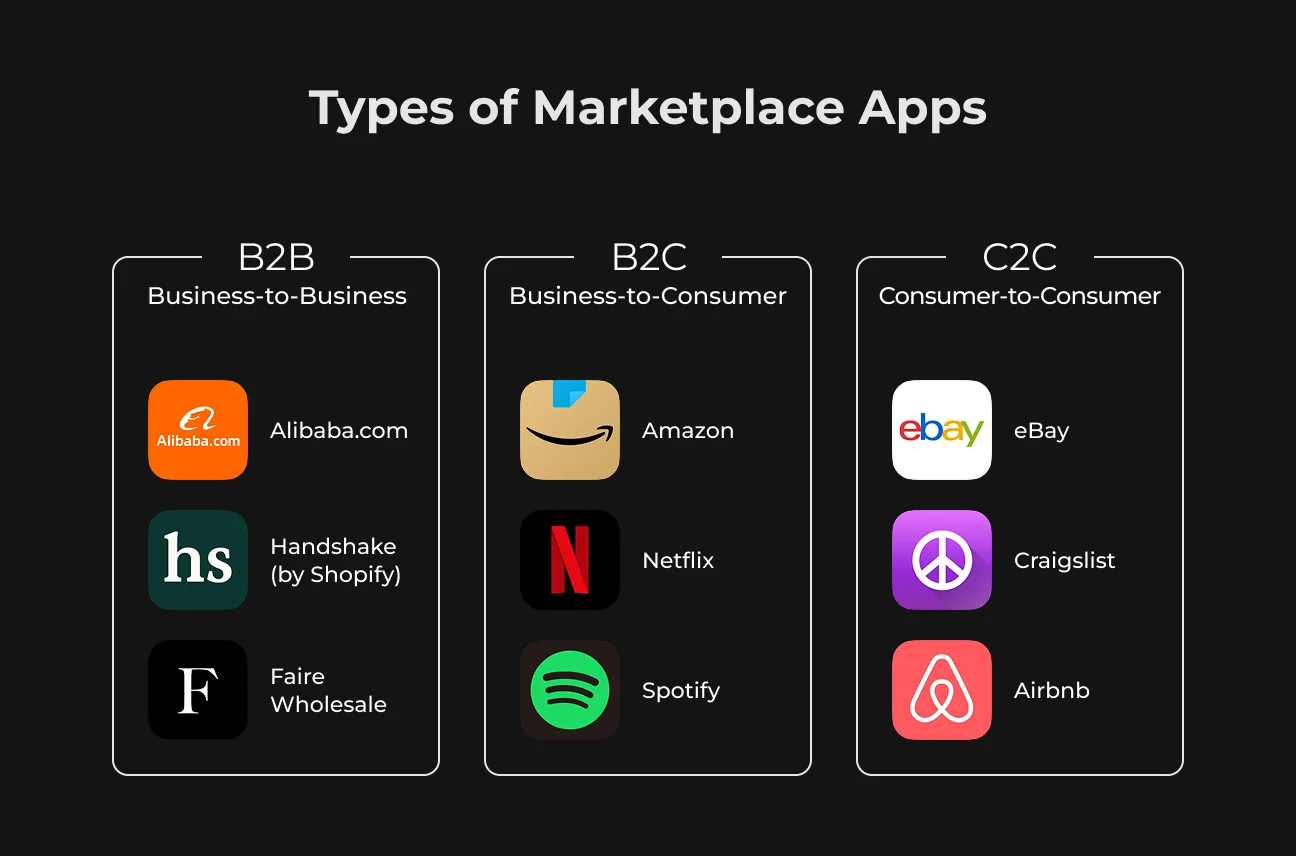
Online marketplace app development difficulty depends on the marketplace type you choose. Why? Each type requires a different approach. Here are the 3 basic types of marketplaces you must pick between.
B2B (Business-to-Business) Marketplaces
These platforms unite businesses with other businesses. A B2B marketplace facilitates transactions between manufacturers and distributors or between enterprises and service providers.
- Characteristics: transactions typically involve bulk orders, high-value purchases, repeat contracts, and often require custom logistics;
- Key features: they focus on professional tools like quote management, invoice processing, detailed user roles (buyer, approver, procurement manager), and integration with ERP systems;
- Complexity note: development is often complex due to the need to integrate with existing corporate supply chains and handle multi-tiered pricing and tax structures.
B2C (Business-to-Consumer) Marketplaces
In this scenario, the platform matches professional retailers or brands directly with individual consumers. Classic examples include Amazon (for retail distribution) or Netflix (for streaming delivery).
- Characteristics: emphasis is placed on a highly simplified, frictionless shopping or booking experience;
- Key features: crucial features include one-click checkout, personalized recommendations, robust search filters, high-quality media displays, and consumer retention tools like loyalty programs or dedicated direct-to-consumer (D2C) brand stores;
- Complexity note: development requires massive scalability and a strong focus on data-driven personalization and logistics integration for fast, reliable delivery.
C2C (Consumer-to-Consumer) Marketplaces
Think of eBay, Craigslist, or Airbnb (which is peer-to-peer for lodging). C2C marketplaces cover the “second-hand” or independent work markets. They require listings for personal items or services and include escrow payments for trust as well.
C2C sites scale when there are low entry barriers. For example, in the first quarter of 2025, U.S.-based e-commerce platform eBay had 134 million active buyers worldwide. To be successful in C2C, prioritize user authentication, rating, and dispute resolution.
- Characteristics: success relies on building a high degree of trust and safety between strangers. These platforms scale quickly when entry barriers for listing are low;
- Key features: essential features include strong user authentication and profile validation, robust rating and review systems, secure escrow payment functionality to protect both parties, and clear dispute resolution mechanisms;
- Complexity note: the primary challenge is managing risk, identity verification, and moderating content and user behavior at scale, rather than just optimizing logistics.
Need an E-Commerce Solution?
Key Stages in Marketplace App Development
How to build a marketplace app that actually works? Let’s take a look at the key stages to go through to succeed with online marketplace app development.
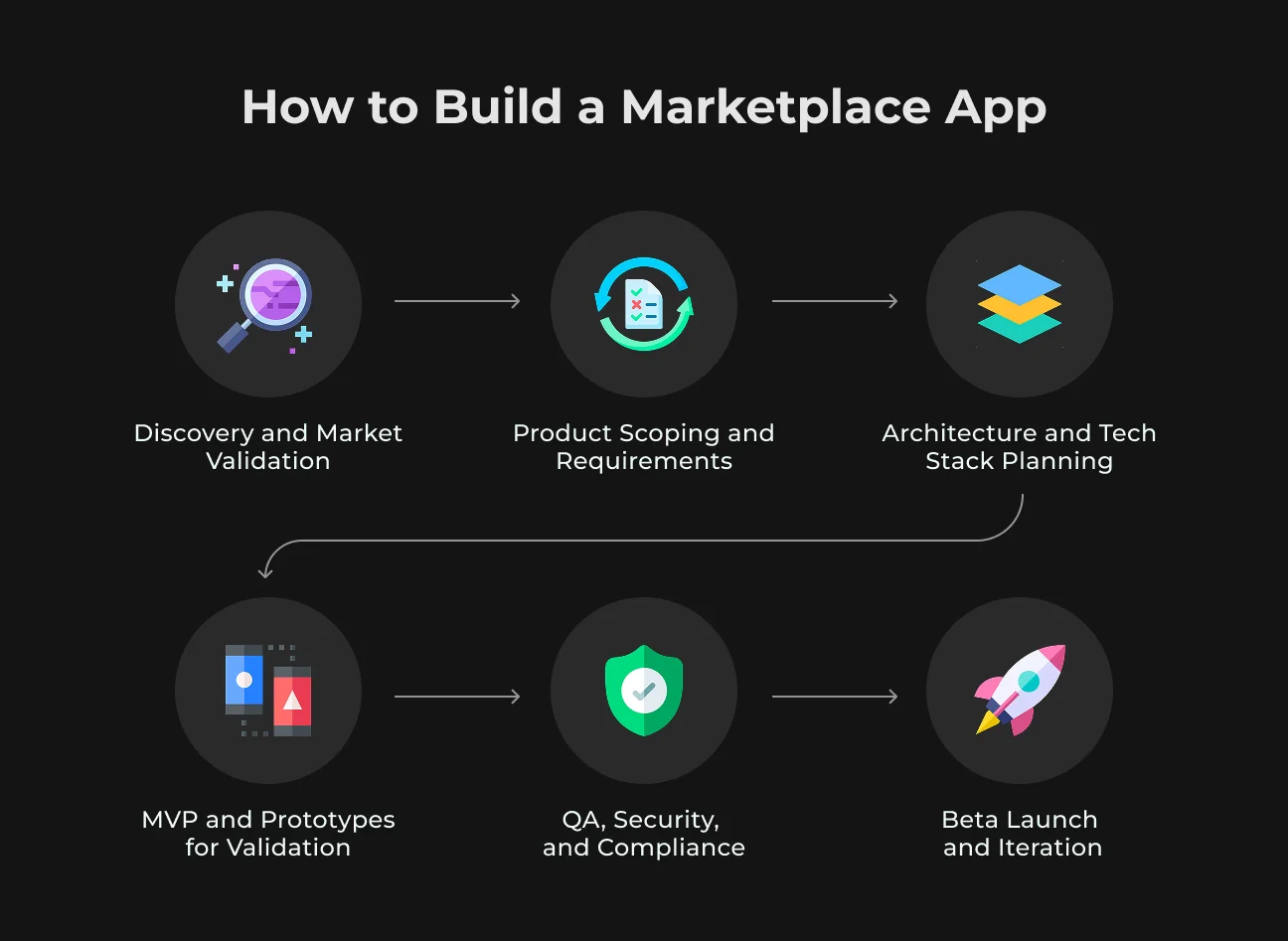
Discovery and Market Validation
Start by conducting thorough market and user research to identify a genuine need or a gap (pain point) that existing solutions do not adequately address. This validation phase is critical to avoiding costly mistakes.
- Conduct surveys with likely buyers and sellers to understand their needs;
- Study the competition to determine unique value propositions.
Experience shows that market research failure is the top reason for app failure. Use cost-effective techniques like customer interviews, small paid advertising campaigns, and surveys to test demand before committing to significant investments.
Product Scoping and Requirements
This stage involves clearly defining the functional and non-functional requirements your application needs to meet. This forms the product specification to guide design and development. Follow these steps:
- Write requirements and user stories for all stakeholders (sellers, buyers, and admins) who will interact with the platform;
- Define core features like search, product catalog, checkout, and user profiles, and categorize them into “must-have” (for the MVP) and “nice-to-have” features;
- Create wireframes or mockups to visually determine the optimal user flow (isting a product, browsing, buying) and overall user experience.
Architecture and Tech Stack Planning
Decide whether to build native mobile apps, a web app, or both. Popular choices are React/React Native or Flutter for cross-platform mobile apps and robust backends like Node.js or Ruby on Rails. Ensure your architecture scales out by using:
- Cloud services (AWS, Azure, GCP);
- Microservices;
- Modular components (search, payments).
Plan data protection (encryption, GDPR) now. The choice of tech stack affects development speed and talent acquisition. Use well-established frameworks with large developer communities so that future maintenance will be easier.
MVP and Prototypes for Validation
Decide on the foundational technology. This choice impacts development speed, ease of future maintenance, and talent acquisition. Follow these steps:
- Determine the application type: native mobile apps, a web app, or both. Popular choices include React/React Native or Flutter for cross-platform mobile development and robust backends like Node.js or Ruby on Rails;
- Ensure your architecture is designed to scale by leveraging:
- Cloud services (AWS, Azure, GCP) for flexible infrastructure;
- Microservices for breaking down the application into independent, manageable services;
- Modular components for core functions like search and payments, enabling easier updates and maintenance.
- Plan for data protection (encryption, GDPR, CCPA, etc.) from the outset.
- Choose well-established frameworks with large developer communities to simplify future support and talent hiring.
SapientPro provides MVP development services that will help you bring your idea to life and validate the idea’s feasibility on the market. It’s the best way to get a team of experts to build a reliable solution that can easily scale when needed.
QA, Security, and Compliance
Thorough testing and security are essential for a successful product. These processes build user trust, ensure legal compliance, and prevent costly breaches.
Implement a comprehensive testing strategy that includes:
- Functional QA: identifying and resolving bugs to ensure features work as specified;
- Performance testing: conducting load tests to confirm the application scales under high traffic;
- Usability testing: evaluating the user interface and experience for intuitive navigation;
- Automated tests: using unit and integration tests to rapidly verify code correctness and component interaction.
Additionally, keep these points in mind:
- Third parties should review critical components like payment flows and authentication;
- Keep all libraries and dependencies patched and updated regularly to defend against known exploits;
- Ensure strict adherence to all relevant laws and regulations, which typically cover tax policy, consumer protection law, and data protection/privacy.
Beta Launch and Iteration
Following successful internal testing, release a beta version to a select group of real users to validate the platform under live conditions.
- Monitor analytics closely to identify user behavior patterns and collect quantitative data;
- Use mechanisms like in-app surveys or chat support to capture qualitative feedback;
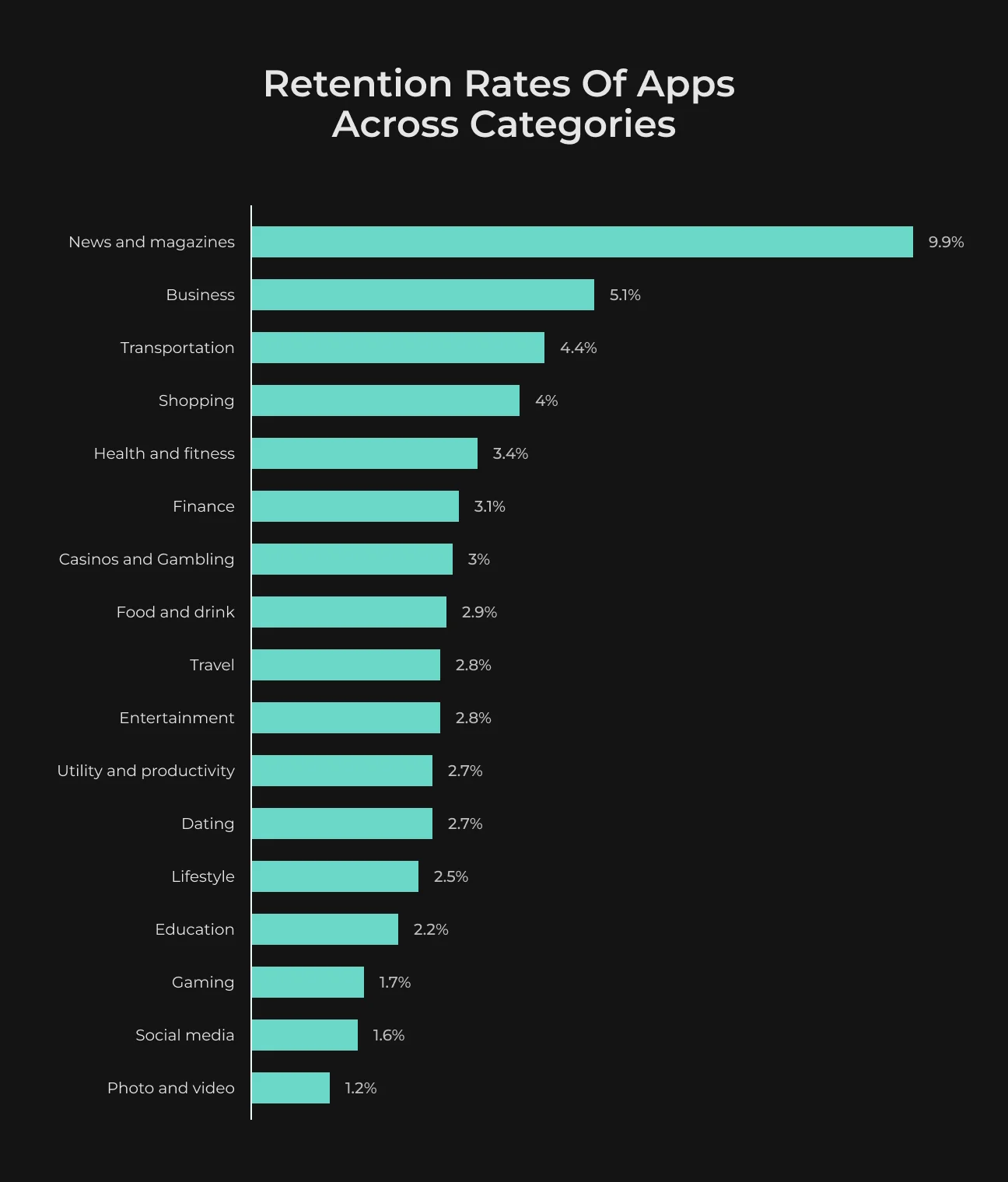
- Track KPIs such as retention and conversion.
The beta phase is crucial for refinement before a wider rollout:
- Fix bugs and refine features based on the collected feedback;
- Roll out updates to resolve usability issues or introduce missing functionality.
A successful beta phase provides the foundation for a complete public launch. When performance and user satisfaction are ideal, proceed with a public launch. Even after launching, continuous iteration is necessary to meet evolving user needs and adapt to market trends.
Main Features of a Marketplace App
Marketplace application development requires a thorough choice of features for your app's successful launch. Let's take a look at the key features.
Feature | Description |
| User Profiles & Accounts | Offer quick registration options such as social media login. Users store preferences and payment information. Implement two-factor authentication for security. |
| Product Listings | Sellers add products with descriptions, images, tags, and prices. Buyers need detailed item pages with multiple photos, specifications, and seller details. 3D views and video improve conversion. |
| Advanced Search & Filters | Allow shoppers to search using keywords and filter by facets like category, price, or rating. A robust search engine with autocomplete is crucial. |
| Shopping Cart & Checkout | An active cart enables accumulating products from multiple sellers. The checkout process must be smooth, supporting one-click checkout and clear order summaries. |
| Payment Gateway Integration | Offer multiple methods including credit cards, digital wallets, and local options. Integrate reliable services like Stripe or PayPal. |
| Ratings & Reviews | Enable buyers to review and rate sellers or products. Use a reputation system with verified badges and star ratings to build community trust. |
| Notifications & Messaging | Use push notifications and email alerts to inform users of orders or account changes. Facilitate direct in-app messaging between the buyer and the seller. |
| Admin Panel & Analytics | A backend dashboard for staff to manage users, listings, and support tickets. Admins moderate content, process refunds, and view sales analytics. |
| POS/Inventory Sync | Integrate a POS system like SapientPro’s solution for Magento 2 for omnichannel markets. This ensures real-time inventory synchronization across online and physical stores. |
| Escrow & Trust Mechanism | Implement a secure system that holds buyer funds until the transaction is complete. This protects both buyers and sellers from fraud. |
| Dispute Resolution Center | Provide a clear and automated workflow for handling and resolving transaction conflicts. This ensures fair and timely resolution of issues. |
All of the features should go smoothly together in harmony. MVP versions should have all the basic features mentioned above before adding advanced ones. Once the core online marketplace app development is done, you can add niceties (AR try-on, AI recommendations, multi-language, etc.) to polish the app. When your marketplace becomes big enough, it will make sense to develop a custom POS solution.
Common Challenges in Marketplace App Development
Building a marketplace app doesn't go easily and smoothly. There are some challenges, and we want to discuss their solutions here.
Balance of Supply and Demand: Chicken-and-Egg Problem
The “chicken-and-egg problem” is the primary initial obstacle for any new marketplace. The platform struggles to attract buyers and sellers simultaneously: sellers refuse to list products if there are no buyers to purchase them, yet buyers have no reason to visit a platform with no inventory.
This obstacle prevents the platform from achieving the critical mass needed for organic growth.
The solution requires a one-sided acquisition strategy to “seed” the platform. Typically, this involves a seller-only seeding effort, incentivizing the supply side with rewards, reduced fees, or promotional benefits before a general launch.
Focus initially on a niche market or a small geographic area to reach critical mass faster. Once the supply side is robust, marketing and partner efforts should then pivot to acquire and build traffic on the buyer side.
Building Trust & Safety
Marketplaces are fundamentally built on user trust. Failures such as fraudulent listings, item misrepresentation, identity theft, or unresolved conflicts can quickly erode the platform's reputation and scare away users. Trust is especially difficult to establish in consumer-to-consumer (C2C) models where transactions occur between strangers.
The solution requires implementing strong protective mechanisms and transparent systems. Strong verification for sellers, such as ID checks, is necessary. The use of secure escrow payment is paramount, holding buyer funds until delivery or service confirmation is received.
Most importantly, an open and transparent rating system and reputation scores must be created to encourage good behavior. Over the long term, a detailed review system provides new users with confidence and helps vet reliable partners.
Scaling Technology & Performance
As the user base grows and transactions multiply, technical limitations can manifest as slow site performance, database bottlenecks, or application crashes. A platform that cannot handle its own success will quickly lose users, particularly during peak traffic periods like holiday sales or major promotions.
The solution is to architect for scalability from the beginning. This involves leveraging cloud hosting with features like auto-scaling to automatically adjust server capacity based on demand. Use Content Delivery Networks (CDNs) to cache and serve content closer to the user, reducing latency.
For heavy data loads, use techniques like database sharding (dividing a large database into smaller, faster parts) and efficient caching. Furthermore, adopting a microservices architecture helps, which involves breaking down the application into separate services like segregating search, user authentication, and payments so that a failure or slowdown in one area does not crash the entire platform.
How Much Does it Cost to Build a Marketplace App
The costs to build a marketplace app depend on many factors:
- Platforms (Android, iOS, web);
- Technologies and architecture;
- Planned scope, and others.
Based on SapientPro’s experience and the market’s average costs, you can expect your project to be within the following cost range.
Project Type | Platforms | Technical & Business Scope | Time | Costs |
MVP | Single Platform (iOS or Android) | Launch-ready core loop. Essential features: listings, user authentication, cart, basic seller admin, single payment gateway. Focus on market validation. | 2–4 months | $10K—$40K |
Standard cross-platform | iOS, Android, and Web | Production-ready, scalable app. Includes advanced search/filters, multiple payment methods, detailed seller/buyer profiles, basic analytics, and operational support tools. | 5–8 months | $40K—$250K |
Enterprise / Advanced | All Platforms + Dedicated Admin | High-scale solution with complex integrations. Features include: microservices architecture, real-time inventory sync, AI-driven personalization, BI dashboards, multi-language support, and enterprise-grade security. | 9–14+ months | $250K—$500K+ |
SapientPro’s engineers will help you get a detailed estimate with all involved costs for your business. Contact our experts today to get a free consultation.
Partner with SapientPro to Build Your Marketplace App
SapientPro’s team has extensive experience in custom marketplace development. Our engineers can help you get a full-scale platform, on-demand service apps, B2B portals, or custom integrations based on your needs. Here are some examples of our previous projects:
- NFT Minting Platform & Marketplace for Digital Assets Launches;
- Custom POS Terminal for Magento 2 Stores;
- Conversational AI Assistant for Easier Online Shopping.
You’ll get expert support and a professional team that’s interested in your success.
Let’s team up now!
Build Your E-Commerce Platform with SapientPro